Saturday, June 30, 2012

Peter and Paul and Jerusalem

Filippino Lippi
St. Paul Visiting St. Peter in Prison
Italian, 1481-1482
Florence, Brancacci Chapel,
S. Maria del Carmine
June 29th is the combined feast of the two patrons of Christian Rome, Saint Peter and Saint Paul. These two men, the outspoken Galilean fisherman and the Jerusalem-educated sailmaker from Tarsus, the apostle who walked with (and denied and loved) Jesus and the persecutor-turned-apostle, both died in the city that was the capital of the Roman Empire within a short space of each other and the sites of their burials are among the earliest of Christian churches.  Peter is particularly honored today as the bedrock of the Roman diocese and, by extension, of the universal Church. The Gospel for today recounts the scene from the Gospel of Matthew, sometimes called “The Giving of the Keys” that includes the statement: 
“I say to you, you are Peter,
and upon this rock I will build my Church,
and the gates of the netherworld shall not prevail against it.
I will give you the keys to the Kingdom of heaven.
Whatever you bind on earth shall be bound in heaven;
and whatever you loose on earth shall be loosed in heaven.” (Matthew 16:18-19)
Excerpt from the Gospel for June 29, 2012

However, today I am going to concentrate on the First Reading for the Mass of today. This reading from the Acts of the Apostles recounts the miraculous liberation of St. Peter from imprisonment in Jerusalem by Herod.
"On the very night before Herod was to bring him to trial,
Peter, secured by double chains,
was sleeping between two soldiers,
while outside the door guards kept watch on the prison.
Suddenly the angel of the Lord stood by him
and a light shone in the cell.
He tapped Peter on the side and awakened him, saying,
"Get up quickly."
The chains fell from his wrists.
The angel said to him, "Put on your belt and your sandals."
He did so.
Then he said to him, "Put on your cloak and follow me."
So he followed him out,
not realizing that what was happening through the angel was real;
he thought he was seeing a vision.
They passed the first guard, then the second,
and came to the iron gate leading out to the city,
which opened for them by itself.
They emerged and made their way down an alley,
and suddenly the angel left him.” (Acts 12:6-10)
Excerpt from First Reading for June 29, 2012

Orations of Gregory Nazianzus
Constantinople, 879-882
Paris, Bibliotheque nationale de France
MS Grec 510, fol. 254v
Lectionarium officii s. petri cluniacensis, Liberation of St. Peter
France (Cluny), 11th-12th Century
Paris, Bibliotheque nationale de France
MS Nouvelle acquisition latine 2246, fol. 113v
Initial N, Liberation of St. Peter
from a Gradual, Sequentiary, Sacramentary
German (Weingarten), 1225-1250
New York, Morgan Library
MS M.711, fo. 25r
The illustrations for this passage from Acts range from barebones representations in the early medieval period to complex works of the late Baroque. At the beginning representations are almost schematic. They feature the bare minimum needed to tell the story: St. Peter, the angel and a suggestion of prison walls.


 Later on, there is a fairytale quality to the representation: St. Peter and the angel appear much larger than the tiny symbolic prison.

Bible historiale of Guiard des Moulins, Liberation of St. Peter
France (St. Omer), 14th Century
Paris, Bibliotheque nationale de France
MS Francais 152, fol. 457v
Claes Brouwer and the Alexander Master
Liberation of St. Peter
from Historiated Bible
Dutch (Utrecht), ca. 1430
The Hague, Koninklijk Bibliothek
MS KB 78 D 3811, fol. 213v
Regensburg Cathedral of St. Peter
Liberation of St. Peter, West Facade Tympanum
German (Regensburg), 1411-1421
German,


Tapestry, Liberation of St. Peter
Flanders (Tournai), 1460
Part of a set commissioned for the
Cathedral of Beauvais
Paris, Cluny Museum


It remained for the Ranaissance to bring the picture into focus, as it were. The prison is now in scale (mostly) with the figures.

Filippino Lippi, Liberation of St. Peter
Italian, 1481-1482
Florence, Brancacci Chapel
S. Maria del Carmine
Raphael and Assistants, Liberation of St. Peter
Italian, 1514
Vatican City, Vatican Museums, Stana d'Eliodoro
But it is Raphael, in his design for the depiction of the scene surrounding one of the doors in the Stanza d’Eliodoro at the Vatican Palace in 1514 that finally “set the scene” firmly in time and space.

Raphael and Assistants, Liberation of St. Peter
Central Section
Raphael and Assistants, Liberation of St. Peter
Right Section
Raphael tells the story in three sections: a scene of the guards outside the prison on the left, the scene of the sleeping Peter being roused by the angel in the center and the scene of the angel leading Peter out of the prison on the right.

Raphael and Assistants, Liberation of St. Peter
Left Section
Leading the way to the future is Raphael’s exploration of the effects of light. We see the effect of moonlight as well as the mysterious light that emanates from the angel.

This is quite different from the flat lighting that was seen in earlier images and leads to the development, which gathered strength during the century after Raphael and leads to the Baroque experiments with light and darkness that sprang from the work of Caravaggio and his followers.


Giovanni Batista Carrociolo, Liberation of St. Peter
Italian, 1615
Naples, Museo Nationale di Capodimonte


We can see this in later representations of the Liberation of Peter by Steenwyck, Carraciolo, and others.
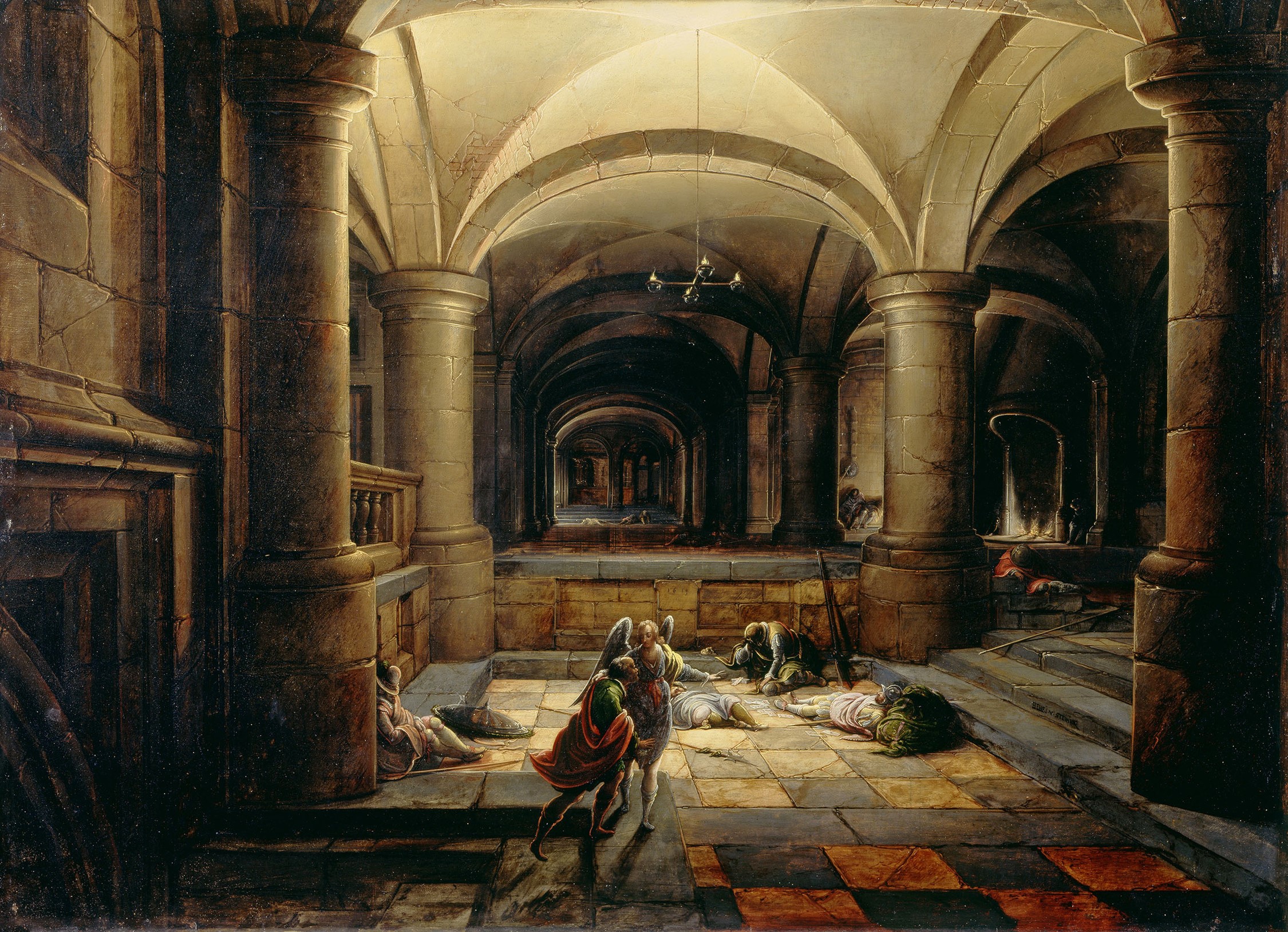

Hendrick van Steenwyck the Younger, Liberation of St. Peter
Dutch, Oil on copper, ca. 1610
Windsor, Royal Collection

Antonio de Pereda, Liberation of St. Peter
Spanish, ca. 1643
Madrid, Museo del Prado


Mattia Preti, Liberation of St. Peter
Italian, 1650-1660
Vienna, Akademie der bildenden Kuenste

Bartolome Murillo, Liberation of St. Peter
Spanish, 1667
St. Petersburg, Hermitage Museum


 And, along with the the movement introduced by the play of light, comes movement in the composition.   The angel no longer approaches sedately, instead he bursts into the picture, full of energy, to arouse Peter from sleep, to extract him from his chains and to lead him out. 
Gerrit van Honthorst, Liberation of St. Peter
/Dutch, 1616-1618
Berlin,Staatliche Museen

Guercino, Liberation of St. Peter
Italian, 1620-1623
Madrid, Prado

Sebastiano Ricci, Liberation of St. Peter
Italian, 1722
Venice, San Stae
Peter was led out of prison in Jerusalem to spread the Gospel and lead the Church in its formative years.  Eventually, he came to Rome where he was again imprisoned and, finally, executed in the circus of Nero at the base of the Vatican hill, across the Tiber from Imperial Rome.  Afterwards he was buried in the cemetery across the road from his place of death and, in the year 319 Constantine began construction of a large basilican church above his grave.  Today, Pope Benedict XVI, the 265th successor of Peter, and Metropolitan Emmanuel Adamakis, leader of the Greek Orthodox in France, representing Patriarch Batholemew I of Constantinople, the successor of Peter's brother, Andrew, prayed together above Peter's tomb, while the combined choirs of the Sistine Chapel and Westminster Abbey (Anglican) sang the moving anthem "Tu es Petrus" ("You are Peter", quoted from the Gospel reading of the day) by Lorenzo Perosi (1872-1956).  It was quite a moment!

©  M. Duffy, 2012

Wednesday, June 20, 2012

Chariots of Fire


Michelangelo, Elijah in the Fiery Chariot
Italian, 1511
Vatican City, Vatican Museum, Sistine Chapel Ceiling
No, this article is not about the 1981 film about the 1924 British Olympic team. It’s about the Biblical event from which the film derived its name – the taking up into Heaven of the prophet Elijah, which is the first reading for today’s Masses.1


“As they walked on conversing,
a flaming chariot and flaming horses came between them,
and Elijah went up to heaven in a whirlwind.
When Elisha saw it happen he cried out,
"My father! my father! Israel's chariots and drivers!"
But when he could no longer see him,
Elisha gripped his own garment and tore it in two.

Then he picked up Elijah's mantle that had fallen from him,
and went back and stood at the bank of the Jordan.”
(2 Kings 2:11-13) Excerpt from the First Reading for June 20, 2012

Giotto, Elijah in the Fiery Chariot
Italian, 1304
Padua, Arena Chapel


The dramatic event of the taking up of Elijah in the fiery chariot has a long history in Western art.

While not necessarily the most popular of images associated with Elijah (other scenes from his life, such as the miracle he performed for the starving widow, received more frequent representation) it is, nonetheless, very frequent.


Nicholas of Verdun, Elijah in the Fiery Chariot
Mosan, 1181
Klosterneuburg Abbey (Austria)


 Like the translation of the patriarch, Enoch, who “walked with God, and he was no longer here, for God took him” (Genesis 5:21-24), it was seen as one of the prefigurations (or types) of the Ascension of Jesus. In the usual tripartite arrangement of “Before the Law, Under Grace and Under the Law" (for example on the 12th century Klosterneuburg Altarpiece by Nicholas of Verdun or in the later medieval Biblia pauperum) the Taking up of Elijah (Under the Law) is presented with the Translation of Enoch (Before the Law) and the Ascension of Jesus (Under Grace).
Master of the Hours of Margaret of Cleves, Biblia pauperum
Translation of Enoch, Ascension of Jesus, Elijah in the Fiery Chariot
Northern Netherlands, ca. 1405
London, British Library, King's 5, fol. 26


It was also a relatively common subject in the illustration of glossed vernacular Bibles, such as that by the 13th century canon, Guiard des Moulins, from Aire-sur-la-Lys in Picardy, whose work became one of the most frequently copied lay volumes in the later middle ages.

Bible historiale of Guiard des Moulins
French (Paris), 14th century
Paris, Bibliotheque nationale de France
MS Francais 155, fol. 87


Bible historiale of Guiard des Moulins
French (Paris), ca. 1415
New York, Morgan Library
MS M.034, fol. 159r
Hours of Anne of France
French (Bourges), ca. 1473
New York, Morgan Library
MS M.677, fol. 311r
It is interesting that here the two prophets
wear the habit of the Carmelite order.
The Carmelites claim a spiritual ancestry
to the Old Testament prophets.


With the advent of the Renaissance the subject became less frequent, replaced by other episodes from the life of Elijah. However, it continued on well into the 20th century, often for the decoration of church ceilings and domes.
Jobst Dorndorf, Elijah in the Fiery Chariot
German, 1544-1546
Pirna, Evangelical parish church of St. Marien


Juan de Valdes Leal, Elijah in the Fiery Chariot
Spanish, ca. 1658
Cordoba, Shod Carmelite monastery
Anonymous, Elijah in the Fiery Chariot
Austrian, 1701-1715
Lambach, Benedictine Abbey


Marc Chagall, Elijah in the Fiery Chariot
Mosaic
Russian, 1970
Nice, Chagall Museum


The image of the chariot ascending to heaven has an even longer history than these medieval images. For, they are based on an earlier prototype, the chariot of the sun god (the Greek Helios or the Roman Apollo). In pagan mythology the sun god drove a fiery chariot with fiery horses through the sky from east to west, accounting for the movement of the sun through the sky.
Red-figure Kalyx-krater, Helios
Greek (Attic), ca. 430 BC
London, British Museum
Helios, Relief from temple of Athena at Troy
Hellenistic, 300-280 BC
Berlin, Pergamon Museum


Clearly the Christian artists had seen remnants of this imagery in originating their own image for Elijah.
________________________________________________
1.It was not the direct Biblical image of the fiery chariot ride of Elijah that inspired the title of the 1981 Olympic film. It was the poem by William Blake, later set to music by Sir Hubert Parry, from which the title came. Blake’s poem, part of the preface to his long poem “Milton a Poem” of 1808-1810, is the actual source. However, the source of Blake’s line “Bring me my chariot of fire” is a reference to the story of Elijah.

© M. Duffy 2012

Friday, June 8, 2012

Is it Art? Reflections on the “Impossible Conversation” now at the Met

Elsa Schaparelli, Jacket
French, Synthetic and Leather, 1937
New York, Metropolitan Museum, Costume Institute
After about two months of difficulties with walking and standing I’ve finally returned to some museum going. But, although I had imagined that my first visit would be to the current Met exhibition “Byzantium and Islam”, it was to something entirely different. The Met is also currently staging an exhibition from its Costume Institute that is framed as a conversation of words and works between the legendary designer Elsa Schiaparelli (died 1973) and the contemporary designer Miuccia Prada. Indeed, the conversation of works is dominated by projected snippets of the conversation in words. This is an actual conversation, staged between the real-life Ms. Prada and an actress (Judy Davis) playing the part of Schiaparelli. The video conversation was directed by the theatrical director, Baz Luhrmann. The walls of the galleries become the screens onto which their discussion is projected. The discussions cover topics that include their life stories (Prada’s early fascination with mime, Schiaparelli’s love life) and their work (Schiaparelli’s collaboration with Dali, Prada’s ideas on how clothing affects self-image).

Schaparelli and Prada, Waist Up/Waist Down
In this gallery the jackets are by Schaparelli and the skirts by Prada
New York, Metropolitan Museum
 Meanwhile, the actual objects on display are the dresses, skirts, jackets, coats and accessories created by the two women. The “conversation” theme applies here too. The clothing is shown in pairings, centered around several themes: “Waist Up/Waist Down”, “Ugly Chic”, “Hard Chic”, “Naif Chic”, “The Exotic Body”, “The Classical Body”. For example, according to the subtext of the “Waist Up/Waist Down” section which opens the show, Schiaparelli, living in the era of “café society”, where women were seen primarily from the waist up, focused her creativity above the waist. Conversely, Prada reserves her highest creativity for the skirt. The items on display include spectacular Schiaparelli evening jackets (any of which I would be happy to wear today) and almost equally spectacular skirts by Prada (although here, actually wearing a couple of them could present some interesting technical problems).

Schaparelli, Zodiac Jacket
French, Summer 1937
Silk, rhinestones, metal, plastic
New York, Brooklyn Museum Costume Collection
at the Metropolitan Museum Costume Institute
Prada, Skirt
Italian, Spring/Summer 2005
Photo © Toby McFarlan Pond


One of the most arresting facets of the projected “conversation” that particularly spoke to me was the contrasting opinions of the two women on the issue of whether art is fashion or not. Schiaparelli states quite directly that “Dress designing…is to me not a profession but an art”, Prada doesn’t think that it is anything of the kind. Her comment is that “Dress designing is creative, but it is not an art. Fashion designers make clothes and they have to sell them. We have less creative freedom than artists. But to be honest, whether fashion is art or whether even art is art doesn’t really interest me. Maybe nothing is art. Who cares!”1   And, interestingly, they are both right –- for their own eras and for their own collections.
Schaparelli, Shoe Hat
Photo from L'Officiel, October 1937
Photo © George Saad
Les Editions Jalou, L'Officiel

Schaparelli, Insect Necklace
French, Autumn 1938
Plastic, metal
New York, Brooklyn Museum Costume Collection
at the Metropolitan Museum Costume Institute


True to her belief in fashion as art, Schiaparelli worked frequently with other artists, particularly with Dali and other Surrealists. Her 1937 and 1938 collections must have been particularly interesting in this regard. In 1937 she collaborated with Dali on producing two of the most whimsical hats that I’ve ever seen: the shoe hat and the lamb chop hat. These hats look like nothing I’ve ever seen before. They look like – well – a shoe and a lamb chop. The lamb chop hat is even adorned with a frilly “panty” just like a real, elegantly served lamb chop. In 1938 a number of her designs, including a very famous necklace, incorporated enameled metal insects. The necklace featured a clear plastic base and, when worn, created the impression of insects crawling over the skin.

Schiaparelli’s creative genius shone most brightly in evening wear, especially in the stunning display of evening capes and jackets on display in the first gallery of the show. The very first item, in fact, is her beautiful evening cape, known as the Apollo of Versailles.

Schaparelli, Apollo of Versailles evening cape
French, Winter 1938-1939
Silk velvet, metallic beads, rhinestones
New York, Metropolitan Museum, Costume Institute
On black velvet, the image of the Apollo from the principal fountain at Versailles is recreated, with his horses, in a tour de force example of bead embroidery, using seed beads, bugle beads and sequins in metallic finishes of silver and gold, along with glittery crystal elements for the eyes of the horse and the interiors of the clouds. The opposing number from Prada featured a skirt of orange silk twill, black felted wool, orange plastic fringe and orange-dyed feathers that reminded me of nothing so much as a punk version of the French maid in Disney’s film of “Beauty and the Beast” who, during the period of enchantment, was portrayed as a feather duster.

Farther into the exhibition are some sensational clothing from both designers reflecting, not surprisingly, their different temperaments and different eras. Schiaparelli’s clothing remained always on the exalted plane of haute couture which, during the era in which she was designing was very haute indeed. Only a few pieces seem to touch the earthy everyday.

Schaparelli and Prada, The Classical Body
In this gallery view the three long dresses are by Schaparelli and the short dresses are by Prada

Prada, Dress
Italian, Spring/Summer 2011
Photo © David Sims
Prada, on the other hand, while definitely able to turn on the glam, also seems more workaday, as well as more problematic. Of course, what is on display is only a fraction of her output, but this predominantly features extreme examples of her aesthetic.

Prada, Lips skirt
Italian, Spring/Summer 2000
Photo © Toby McFarlan Pond

Among these are: her famous lipstick and lips skirts (covered with either lipstick tubes or with big red lips), the latter contrasted with a black suit by Schiaparelli (see above, worn with the shoe hat), with embroidered red lips on the pockets. There is also a Prada pinkish double knit dress covered from neck to hem in synthetic dyed-to-match faux fur and an odd coat with pants, impeccably tailored, but in a fabric so loud and ugly that it puzzles the intellect. However, her work also illustrates the lowered aesthetic level of much of contemporary design. Here I am not speaking about quality or imaginative use of fabric, but merely about the design itself. Contemporary design seems so pared down to essentials that it almost ceases to exist. Often it seems to be merely an upscale version of items available at Old Navy.

Prada, Lipstick skirt
Italian, Spring/Summer 2000
Photo © Toby McFarlan Pond
This observation also seems to reflect their differing statements about fashion as art and Prada’s question about whether art is art. Once such a question would have been both impossible and completely non-sensical. Art seemed obvious, and the definition of art seemed settled. For instance, the Oxford English Dictionary provides this traditional definition of art “The expression or application of creative skill and imagination, typically in a visual form such as painting, drawing, or sculpture, producing works to be appreciated primarily for their beauty or emotional power.” And the dividing line between “high art” and “low art” seemed assured. As defined by the 19th-century critic, John Ruskin, “High art differs from low art in possessing an excess of beauty in addition to its truth, not in possessing excess of beauty inconsistent with truth.”2  
Or, as John Keats would have it
'Beauty is truth, truth beauty,—that is all
Ye know on earth, and all ye need to know.’3

Apparently this is no longer the case. If art cannot be defined, then anything can be art.  And this seems to be the key to much of what we have seen from contemporary art in the last few decades.

1. These quotes from Schiaparelli and Prado are taken from the wall cards of the exhibition. The exhibition runs through August 19.
2. John Ruskin, Modern Painters, Vol. III, p. 33.
3. John Keats, “Ode on a Grecian Urn”, 1819.

© M. Duffy, 2012

Saturday, June 2, 2012

Iconography of the Holy Trinity – Imagining The Unimaginable


Maulbertsch, Trinity,
Budapest, Museum of
Fine Arts, 1785-1786
 Christianity has at its core the belief in one God. But, unlike its fellow monotheistic religions of Judaism and Islam, the one God of Christianity is expressed as belief that the Godhead is composed of the three Persons of Father, Son and Holy Spirit.

This belief appears very, very early in Christianity, as for example in the Second Letter of St. Paul to the Corinthians (2 Corinthians 13:13), generally dated to the year 57. 1  So, from within about 25 years following the death and resurrection of Jesus, His followers already held this belief. Since the Apostles, Jesus’ companions during His life, were Jewish, as was Paul, and, hence, strong believers in one God, this early appearance of the three Persons implies a very profound shift in their thinking. One can only presume that this shift came from the revelation they experienced from the Resurrection and the Descent of the Holy Spirit.

However, while belief in the Trinity has been with the Church from the beginning, trying to describe and understand this revelation in human language has also been difficult and has occupied some of the best minds of the succeeding centuries. One remembers the cautionary tale of St. Augustine of Hippo, one of the most brilliant minds of the fourth or any other century, and the angelic child as it is told in the Golden Legend, a collection of saints lives, mixed with legends, that was compiled during the middle ages and was highly influential during the later middle ages and Renaissance. As the Golden Legend tells us, Augustine was walking by the sea near his North African home, pondering the mystery of the Trinity and trying to come to an understanding of it.

Benozzo Gozzoli, Parable of the Trinity,
San Gemignano, Church of Sant'Agostino,
1464-1465
As the first English edition of the Golden Legend, published by John Caxton in 1483, tells it “he found by the sea-side a little child which had made a little pit in the sand, and in his hand a little spoon. And with the spoon he took out water of the large sea and poured it into the pit. And when St. Augustine beheld him he marvelled, and demanded him what he did. And he answered and said: I will lade out and bring all this water of the sea into this pit. What? said he, it is impossible, how may it be done, since the sea is so great and large, and thy pit and spoon so little? Yes, forsooth, said he, I shall lightlier and sooner draw all the water of the sea and bring it into this pit than thou shalt bring the mystery of the Trinity and his divinity into thy little understanding as to the regard thereof; for the mystery of the Trinity is greater and larger to the comparison of thy wit and brain than is this great sea unto this little pit. And therewith the child vanished away. “2   Augustine understood that he had been rebuked for his presumption.

In spite of this, Christian thinkers and story tellers have continued to try to comprehend the Trinity and its inner life. For example, we have the happy story of St. Patrick’s use of the shamrock (a sort of small three-leafed clover), with its three leaves on a common stem to explain the Trinity to the pagan Irish. And, from the early fourteenth century, we have the truly beautiful image of three circles of different colored light, occupying a single space, that is the crowning vision of Dante’s Paradiso, the last book of his Divine Comedy.            
Within the deep and luminous subsistence
Of the High Light appeared to me three circles,
Of threefold colour and of one dimension,

And by the second seemed the first reflected
As Iris is by Iris, and the third
Seemed fire that equally from both is breathed.
O how all speech is feeble and falls short
Of my conceit, and this to what I saw
Is such, 'tis not enough to call it little. 3
Artists too have tried to imagine the Trinity in the images they have created. Very often this has taken the visual form of a heavenly scene showing the Trinity with an old man as the Father, a recognizable Jesus and a dove for the Holy Spirit. However this is not always the case. Among the visual traditions (types) to do this are the following: