Friday, November 18, 2011

Basilicas of Saints Peter and Paul – November 18

St. Peter's Basilica, Vatican City
During this month of November the Church commemorates the construction and dedication to Christian worship of some of the earliest structures specifically built for that purpose. In her first three centuries Christians had been meeting in whatever location they could find that was suitable for the purpose of performing the developing liturgy. This might be in a private house, in a meeting hall or in buildings such as apartment houses, owned by members and renovated to provide space for the congregation and the priest. (In Rome, these were the tituli, some of which still survive through the churches constructed later on top of them.)  There were also gathering places in association with the graves of the deceased, especially of the highly venerated martyrs, in locations such as the catacombs of Rome or in other, open air cemeteries in Rome and elsewhere. But none of these were on anything like a par with the temples of the Greek, Roman or other religious cults of the time.

It was not until Constantine, the Augustus of the West, and his co-Augustus, Licinius, issued the Edict of Milan in October of 312 that the Christian Church could contemplate creating large, purpose built structures for the liturgy. As we have seen, one of the earliest of these structures, the Church of St. John Lateran, was begun almost immediately after the issue of the Edict, with the active involvement of Constantine himself. Similarly, at about the same time (319-324), another huge basilica was under construction across the Tiber River. In this location there was an open air cemetery on a hill a short distance from the banks of the river. It overlooked a road and a circus (racecourse) built by Caligula, but then known as the Circus of Nero. Nearby was the large circular tomb of the Emperor Hadrian.

Model of the "Trophy of Gaius" over the burial place of St. Peter in the necropolis 
underneath the basilica.
St. Peter's Basilica, Vatican

This cemetery was not very different from our own contemporary American cemeteries. There were numerous mausoleums, owned by rich families, and there were humble graves, set directly into the earth.

One of these simple graves was special to the Christians of Rome and to Christian visitors, as indicated by the inscriptions found all around it. In it was buried Peter, leader of the first Apostles, and first bishop of Rome, who had died in the persecution of Nero.

He had been crucified (upside down according to tradition) in the circus just across the road, and his body had been carried into the cemetery where he was buried. Within a short time after his death a small marble monument, resembling a miniature temple façade, was erected over the grave (see model at right).

As Richard Krautheimer, the great historian of early Christian architecture, points out, it was only the graffiti that surrounded the location that makes this resting place different from hundreds of others in the cemeteries surrounding Rome.1  For, the inscriptions indicate that the man buried in this commonplace grave was Peter, leader of the Apostles and first bishop of Rome, the “Rock” on whom Jesus said that He would build the Church.2


The importance of the grave to Christians can be clearly seen in the way in which Constantine’s architects planned the new building. With Imperial power behind them, they leveled the hill, removing the roofs of the private mausoleums and filling the shells with the dirt and debris of their excavation. Above the grave of Peter they constructed the altar, the focal point of the huge new basilica.

This basilica stood for over a thousand years, until in the late 15th century the decision was made to replace it with a new church. 

While Constantine’s building rose in less than 10 years, it took nearly a century to build the new one, which we see today.

The “new” St. Peter’s was built over the Constantinian basilica and there is one constant point of reference. The altar of today still stands directly over the grave in the Roman cemetery. The “Rock” still lies in the deepest layer. 3

This cross section of St. Peter's shows the three layers we see today:  at the top in brown ink is the current basilica, below that in black ink are the remains of the Constantinian basilica (now called the grottoes and open to the public), at the lowest layer in purple ink is the necropolis, where the tomb of the Apostle lies.  It may be visited by appointment.  Below the cross-section is the plan of the excavated parts of the necropolis.

Another look at the relation of the layers of St. Peter's through a comparison of floor plans.  In red we can see the layout of the necropolis, on top of this is the straight lines of the basilica of Constantine in purple, with radiating chapels built out of it that are shown in green, and finally we can see the huge outline of the current church.

The original St. Peter’s was destroyed in the process of building the current structure, but we can get some idea of how it looked from old drawings. 


Cross section of old St. Peter's


Maerten van Heemskerck, St. Peter's Basilica
Dutch, c.1535
Berlin, Staatliche Museen

In addition we can gain an idea of what it was like by looking at the second building that the Church commemorates today – the Basilica of St. Paul-outside-the –walls.

Basilica of St. Paul-outside-the-walls
Rome
This basilica was constructed about 70 years after St. Peter’s and appears to have been based on it. 4 Built over the resting place of St. Paul, the great missionary to the Gentiles, it stood for 1,500 years before partially succumbing to a fire in 1823.   The nave was badly damaged, but the apse was barely touched.


Engraving of the aftermath of the 1823 fire

It is fortunate that its destruction came so late in time. Had it occurred in an earlier era the building would doubtless have been rebuilt in a contemporary style, just as had happened to the other great early Christian churches of Rome. But, the damage came after a full century of archaeological exploration had placed a high value on the style of past ages. Hence, it was reconstructed to look exactly as it had before the fire and reconsecrated in 1854.

The bones of Saint Paul lie underneath the main altar. In 2006 the sarcophagus containing them was uncovered for the first time in centuries and can be seen through an opening below the altar.5

St. Paul-outside-the-walls, Interior
Rome
In St. Paul’s we can gain a good idea of what the Constantinian churches looked like. These were simple structures with long naves (central part of the church), side aisles and a semi-circular apse at the end opposite the entrance. The interior space is vast and clear, obviously intended to handle large crowds of worshippers. It was also richly decorated. In front of the building there is an open space called the atrium, surrounded by colonnades.

These were significant structures, intended by their Imperial sponsors to make a statement about the importance of Christianity and of the persons buried underneath them. 6
_______________________________________
1. Krautheimer, Richard. Rome, Profile of a City, 312-1308, Princeton, Princeton University Press, 2000, p. 20.

2. Some relevant texts: Matthew 16:18-19, John 20:1-10, Acts 1:15-22, 2:14-40, 3:12-26, 4:8-12, Chapters 10 and 11.

3. It is possible to visit this subterranean world by applying to join a tour group through the Vatican Office of Excavations (the Ufficio di Scavi). Information at http://www.vaticanstate.va/EN/Monuments/Saint_Peters_Basilica/Pre_Constantinian_Necropolis.htm.

4. Krautheimer, op cit., pp. 42-45.

5. http://news.nationalgeographic.com/news/2006/12/061211-saint-paul.html

6. You can participate in virtual visits to these two churches, plus other papal basilicas and chapels at http://www.vatican.va/various/basiliche/index_en.html The speed of the servers seem to vary greatly by location.

© M. Duffy, 2011


Monday, November 14, 2011

Drawings from the Revolution

Jacques-Louis David, Sketch for
Intervention of the Sabine Women in the Fight
Between the Sabines and the Romans
French, 1798-1799
Drawing (graphite, pen and black ink on paper)
Paris, Louvre
Currently, the Morgan Library in New York is offering two special and complementary exhibitions. The largest is an exhibition of 80 drawings on loan from the Louvre Museum in Paris, called David, Delacroix and Revolutionary France: Drawings from the Louvre.* The smaller, Ingres at the Morgan, focuses on 16 drawings taken from the Morgan’s own collection. Both exhibitions are a reminder of a revolutionary time in history, i.e., the years of the French Revolution, and the revolution in art that accompanied it. They focus on the artists who were the witnesses of the former and the actors in the latter.

In these two exhibitions we can chart the threads of artistic expression that carried art in France from the end of the Rococo era, just prior to the French Revolution, through the Neo-Classical phase, which ran concurrently with the Revolution and the First French Empire (Napoleon), and into the Romantic era, with its focus on the exotic, the emotional and the natural world. Indeed, it can be argued that the Neo-Classical style is simply another form of the predominant Romanticism of the period, a different mode of the exotic.

Viewing the drawings from the Louvre is like taking a walk through the history of early 19th century French art. All the important artists, and many of the lesser known, are included: David, Gerard, Gericault, Girodet, Granet, Gros, Ingres. But the most revealing are the many drawings by Delacroix that are included.

Eugene Delacroix, Study for
Liberty Leading the People,
French, 1830
Drawing, Graphite with chalk on paper
Paris, Louvre
Eugene Delacroix is, par excellence, the artist of the Romantic era. His paintings of exotic scenes, based on his travels in North Africa, his portrayal of scenes charged with violence and strong emotions made him the acknowledged leader of the Romantic painters and one of the most influential painters in Europe.

His amazing versatility is strongly apparent in this exhibition. Where the drawings of other artists are mainly finished sketches for compositions or drawings of details, Delacroix’ drawings run through an astonishing range. There are carefully detailed drawings of nearly finished scenes. Others are quick sketches of landscape and architecture. Still others are studies for details of figures.

But the really astonishing drawings are of pure motion, the first such drawings I have ever seen outside of the studies of whirlpools and clouds by Leonardo da Vinci. But, whereas the Leonardo drawings examine natural forces, Delacroix’ are focused on human activity.

Delacroix, Study for The Death of Sardanapalus
French, 1826-1827
Drawing, Pen, brown ink, brown wash on paper
Paris, Louvre
Through these drawings Delacroix appears to be working his way toward the highly active scenes for which he is famous. The variety of moods in his drawings reveals much about how his mind worked and they are fascinating to observe. I gained a whole new outlook on and respect for Delacroix from this exhibition.

If Delacroix was the leader of those Romantic whose mode was centered on the “sublime”, Jean-Auguste-Dominique Ingres was the leader of the other wing, the Neo-Classicists. Characterized by calm, clear-edged lines and compositions, the Neo-Classicists took their subjects from both contemporary life and the distant past. Thus, the accompanying exhibition of Ingres’ drawings, taken from the Morgan’s own collection is an interesting supplement to the main exhibition.
Jean-Dominique Ingres,
Frau Reinhold and Her Daughters
French, 1815
Drawing, Graphite on paper
New York, Morgan Library
In it, one can see fine examples of Ingres work, especially of his works recording contemporary life, i.e., as a portraitist. This exhibition can be viewed online at http://www.themorgan.org/collections/works/ingres/default.asp

The Ingres exhibition will run until November 27th. The exhibition from the Louvre runs throughout the Christmas season, ending on New Year’s Eve. If you’re in the New York area during the season, I urge you to take a break from the shopping or sightseeing and visit them.

* For more information about this exhibition see: http://www.themorgan.org/exhibitions/exhibition.asp?id=49

© M. Duffy, 2011

Tuesday, November 1, 2011

November 1 – Feast of All Saints

Celestial Rose, Illustration to Canto XXXII of
Paradiso, Third Book of the Divine Comedy
by Dante Alighieri
15th-Century Italian
Vatican City State, Vatican Library


On November 1 the Church celebrates the feast of All Saints. On this day we honor all those who through their lives, lived in faith and hope and with charity, have achieved the Beatific Vision of God. Some of them are saints who have been identified and formally recognized by the Church, but most are simply men, women and children who have passed without formal recognition and whose names are now forgotten. They are our ancestors in faith exactly as they are our ancestors in flesh and blood. They enjoy the peace, the glory and the vision of God that we hope eventually to attain.

For obvious reasons it is difficult to represent all the saints in art, but there are some works that come to mind.

The first is the literary image of the Celestial Rose from Canto XXXII of Paradiso, the final book of Dante’s Divine Comedy. Every saint in heaven has his or her seat in the petals of this rose. Representing this in art is impossible, but a 15th-century Italian manuscript now in the Vatican Library gives an idea of what it might look like.


A diagram of how Dante imagined the interior of the rose to accommodate the saints within its petals was prepared in connection with the publication of Dorothy Sayers' English translation of 1962.


The next image that comes to mind is the exquisite altarpiece by the Van Eyck brothers, Hubert and Jan in the cathedral of St. Bavo in Ghent. Known as the Ghent Altarpiece, its lower half represents the Adoration of the Mystic Lamb. Its inspiration comes from the description in the Book of Revelation of the Triumph of the Lamb (Rev. 7:9-10):

“After this I had a vision of a great multitude, which no one could count, from every nation, race, people, and tongue. They stood before the throne and before the Lamb, wearing white robes and holding palm branches in their hands.
They cried out in a loud voice:
“Salvation comes from our God, who is seated on the throne,
and from the Lamb.”
Hubert and Jan Van Eyck, Adoration of the Lamb, Lower Section of Altarpiece Interior
The Ghent Altarpiece
Netherlandish, 1425-1432
Ghent, Cathedral of St. Bavo
In the Van Eycks’ painting, which extends over five panels, the Lamb on the altar (who is Christ, especially Christ in the Sacrament of the Altar, the Eucharist) occupies the central position of the central panel. He is surrounded by angels holding the instruments of the Passion through which He has triumphed over death. Two kneeling angels incense Him. Two groups kneel before Him. To the left are the Old Testament prophets and heroes. To the right are the Apostles, Fathers and other male saints. Advancing from the distance are two other groups; additional male saints from the left and female saints, some of whom carry the martyr’s palm, from the right. In the side panels more saints advance. In the background we can see the New Jerusalem, composed of a combination of actual buildings from several towns and imaginary ones.

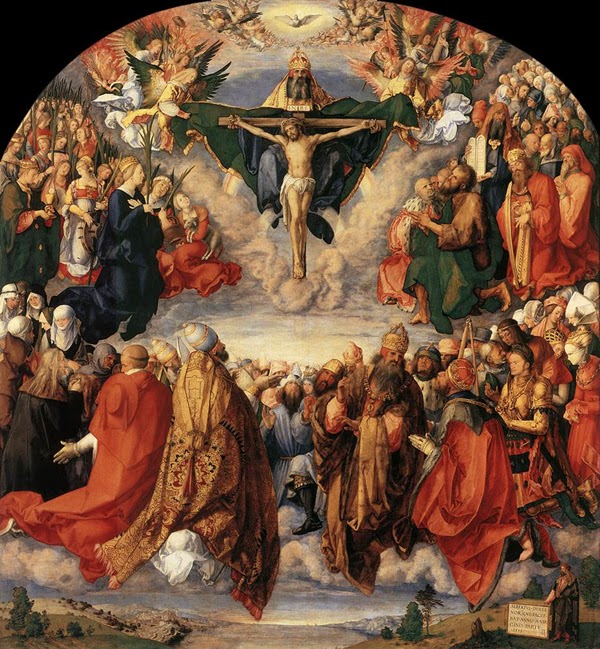
A final image is that of Albrecht Dürer’s Landauer Altarpiece, the Adoration of the Trinity. Clearly deriving from the same inspiration as the Van Eycks’ picture, Dürer interpreted the text less literally. He replaces the Lamb with the image of the Trinity and places the scene in the skies. But, the essentials of the image are the same; God is surrounded by His saints.

Albrecht Durer, Adoration of the Holy Trinity
German, 1511
Vienna, Kunsthistorisches Museum

These are the images of what we celebrate today.

© M. Duffy, 2011

Sunday, October 9, 2011

Paintings As Scientific Documents?


After Frans Hals, Malle Babbe
Dutch, Second quarter of 17th century
New York, Metropolitan Museum of Art
This past week has seen me sick with some viral bug that is making the rounds of New York City. So, this essay is a bit late and for that I apologize. I was going to write a review of the small exhibition of the work of the 17th-century Dutch painter Frans Hals that is currently at the Metropolitan Museum.1

The exhibition is primarily based on the Met’s own collection of his works. I have visited it several times and had been saving writing a review until a period when subject matter might be scarce. 
 
 
Unfortunately, I waited too long. When I checked the exhibition dates today, I discovered that—gasp—it closes on Monday (October 10, one of the Met’s rare holiday Monday openings). So, unless you are in the New York area and can get to the Met by closing time Monday, it will be too late.

Since that is the case I am going to shift this essay from a straightforward review of the Hals exhibition to some musings on an issue that arises from one painting that is included in the show. This is the picture known as “Malle Babbe”. Once considered to be the original it was reassessed some time ago and is now considered to be a copy after Hals. 

A nearly identical portrait of the same person now in the Gemäldegalerie in Berlin has been recognized as the true Hals original (click for high resolution image). The two paintings are extremely closely related, as a side by side comparison between details of the Met’s version and the Berlin version in the final room of the exhibition demonstrates (the Berlin painting is represented only by reproductions of details). If a copy, the Met’s painting is the work of an artist who was able to copy not only Hals’ composition, but his technique as well. It is an intriguing problem for the connoisseur.

Frans Hals, Malle Babbe
Dutch, c. 1631-1633
Berlin, Gemaeldegalerie
 
 
However, what I’ve been reflecting on is not the painting itself, but its subject matter. Malle Babbe was the popular name for a woman who was an inmate in the workhouse in Haarlem, the town where Hals lived. The owl on her shoulder, a symbol of wisdom in classical antiquity, had become by this time the symbol for a fool. 2 The fact that there are several versions or copies of this painting is very suggestive. It accords with other paintings of such human oddities found in the work of other 17th century painters. 
 
Clearly, there was an interest in recording the appearance of unusual people during this century that sets it apart from earlier periods. And this accords with the rise of scientific inquiry in the 17th century. This is the century that begins with the work of Galileo. It also includes the Vatican led reform of the calendar (change from the old Roman Julian calendar to the more scientifically correct Gregorian calendar, named for Pope Gregory XIII) and the development of complex mathematics such as calculus by Leibniz and Newton. It concludes with the publication of Isaac Newton’s Principia (1687).
 
 
In the world of 17th-century Dutch painting, it also includes Vermeer’s experiments with the camera obsura that give his work such immediacy.


Johannes Vermeer, Girl with a Red Hat
Dutch, c. 1665-1666
Washington, D.C., National Gallery of Art


Johannes Vermeer, Woman with a Water Jug
Dutch, c. 1662
New York, Metropolitan Museum of Art


It would appear that part of the burgeoning of science in the 17th century was an interest in human diversity. And this is true not only in the Protestant Netherlands but also in Catholic Italy and Spain. Paintings exist whose subject matter is not just the insane, but dwarfs and other human oddities.

In Spain, Diego Velazquez painted several portraits of the dwarfs who served as members of the Spanish royal household.

Diego Velazquez, Dwarf known as Don Antonio el Ingles,
Spanish, c. 1640-1642
Madrid, Museo Nacional del Prado


Diego Velazquez, Dwarf known as Sebastian de Morra
Spanish, c. 1641-1642
Madrid, Museo Nacional del Prado


In the 17th century many “little people” served in this capacity, as entertainers and as servant “pets” to royal masters.  Today, this may seem undignified and even cruel but, in the world 400 years ago, for a small person unable to find work in occupations that required stature, strength or stamina, this may have been a blessing.


Jusepe Ribera, Boy with a Clubfoot
Spanish, 1642
Paris, Musee du Louvre

In southern Italy for example, the transplanted Spanish painter Jusepe Ribera painted the portrait of a boy with a clubfoot.  His deformity is clearly visible, but so is his engaging, cheeky personality. 


Ribera also painted the portrait of a most unusual family, a bearded woman with her husband and baby.
 
Jusepe Ribera, Magdalena Venturi with Her Husband and Son
Spanish, 1631
Toledo, Museo Fundacion Duque de Lerma

Today these paintings may seem bizarre, but we ourselves are barely removed from the carnival freak show in which people like these would have been on exhibit.

Rather than viewing these pictures with disdain or anger I suspect that we should view them as interesting documents of a burgeoning scientific point of view.


_______________________________________________________________
1. Metropolitan Museum of Art, Frans Hals in the Metropolitan Museum, July 26 – October 10, 2011, http://www.metmuseum.org/exhibitions/listings/2011/frans-hals-in-the-metropolitan-museum

2. Metropolitan Museum of Art, Catalogue Entry, http://www.metmuseum.org/Collections/search-the-collections/110001071?rpp=20&pg=1&ft=malle+babbe&pos=1

© M. Duffy, 2011


Tuesday, October 4, 2011

St. Francis of Assisi

Giotto ?, Sermon to the Birds
Italian, 1297-1300
Assisi, Basilica of St. Francis, Upper Level
A bout of something very much resembling the flu has prevented me from doing the research for the full-length essay on the iconography of St. Francis, which I had planned. But St. Francis is such an important and beloved saint that I can’t let his feast day pass without some acknowledgment. So, I will just point you to the extensive series of frescoes painted, shortly after his death, in the upper church of the basilica in his honor at Assisi.

The story of St. Francis is relatively well known. Perhaps no saint in the history of the Christian Church in the West has been so influential, so beloved, so misunderstood. From his own time to the present he has been made the subject of legends and stories. He has even been the subject of several movies. He is the goofy saint who talks to animals, the holy fool, the proto-hippie, sometimes seen as slightly mad. Yet, in reality his story and his joyful attempt to imitate Christ by a life of poverty, humility and service to the poor, is the spark that has ignited many souls to search for God and spend their own lives in serving the poor.

The Young Francis Receives a Vision While Praying
Italian, 1297-1300
Assisi, Basilica of St. Francis, Upper Level
The outlines of his real life story are fairly well known. Francesco Bernadone was born in the Umbrian town of Assisi in 1182 into a family of merchants. As a youth he had a fairly privileged and sheltered life. During a period of illness in 1205 he underwent the beginnings of a conversion to a more spiritual life and began to try to serve the poor.

Following his understanding of the message he had received in a vision, Francis sold some of his father’s stock of cloth to begin the task of rebuilding a ruined church on the outskirts of their town. His father was, understandably, angry about this and the ensuing battle of wills led Francis to renounce all worldly possessions and attachments, even the clothing he wore.


Francis Renounces Worldly Possessions
Italian, 1297-1300
Assisi, Basilica of St. Francis, Upper Level
 Attired in garments he acquired by begging, Francis began his life of total poverty, begging his clothing, food and the building materials with which he repaired various local churches. He also began to preach the joy of poverty and service in imitation of Christ and to attract other men to follow him.

In 1209 he drew up a simple rule for his “friars” and requested Papal approval. Pope Innocent III eventually agreed and in 1210 the Franciscan Order of Friars Minor was recognized by the Church.

The Rule is Confirmed by Pope Innocent III
Italian, 1297-1300
Assisi, Basilica of St. Francis, Upper Level

With St. Clare of Assisi he also founded the order of women that became known as the Poor Clares. Later, for those who wanted to associate themselves with him and his ideas he founded the Third Order for ordinary people not able or willing to leave their secular lives. All three orders still exist to this day. They have also sprouted a sometimes bewildering group of branches as well. In addition to several different Catholic sets of Franciscan friars and sisters there are Anglican and other Protestant Franciscans.

Giotto ?, St. Francis Receives the Stigmata,
Italian, 1297-1300
Assisi, Basilica of St. Francis, Upper Level
Francis is the first known person to receive the Stigmata, the visible wounds of Christ. He died on October 3, 1226 and was formally canonized two years later.

 That same year, 1228, a magnificent two-level basilica in his honor was begun in his hometown of Assisi. It was consecrated in 1253.

Near the end of the century the upper church was decorated with frescoes depicting the life of Francis and some of the legends that had already arisen in the 70 years since his death.


St. Francis Prepares the First Christmas Crib at Greccio
Italian, 1297-1300
Assisi, Basilica of St. Francis, Upper Level
 A number of artists were engaged in the decoration, including the Roman Jacopo Torriti and the Florentine Cimabue and his pupil, Giotto. Attribution of the frescoes is disputed, but many have seen in them the first works of Giotto.

Although severely damaged in an earthquake in 1997 (when four people were killed during an aftershock), the basilica and the frescoes have been repaired and the basilica was designated a UNESCO World Heritage Site in 2000 (http://whc.unesco.org/en/list/990/).

Francis’ greatest legacy, of course, is not the building in Assisi nor the frescoes that decorate it nor the other works of art inspired by his story, but the good done by the countless men and women who, over the last 800 years, have followed in his footsteps.

Father,
you helped Saint Francis to reflect the image of Christ
through a life of poverty and humility.
May we follow your Son
by walking in the footsteps of Francis of Assisi,
and by imitating his joyful love.
Grant this through our Lord Jesus Christ, your Son,
who lives and reigns with you and the Holy Spirit,
one God, for ever and ever. Amen.
(Memorial Prayer from Morning Prayer in the Liturgy of the Hours for Feast of St. Francis of Assisi, October 4)

© M. Duffy, 2011

Wednesday, September 14, 2011

Exaltation of the Holy Cross – Piero della Francesca at Arezzo


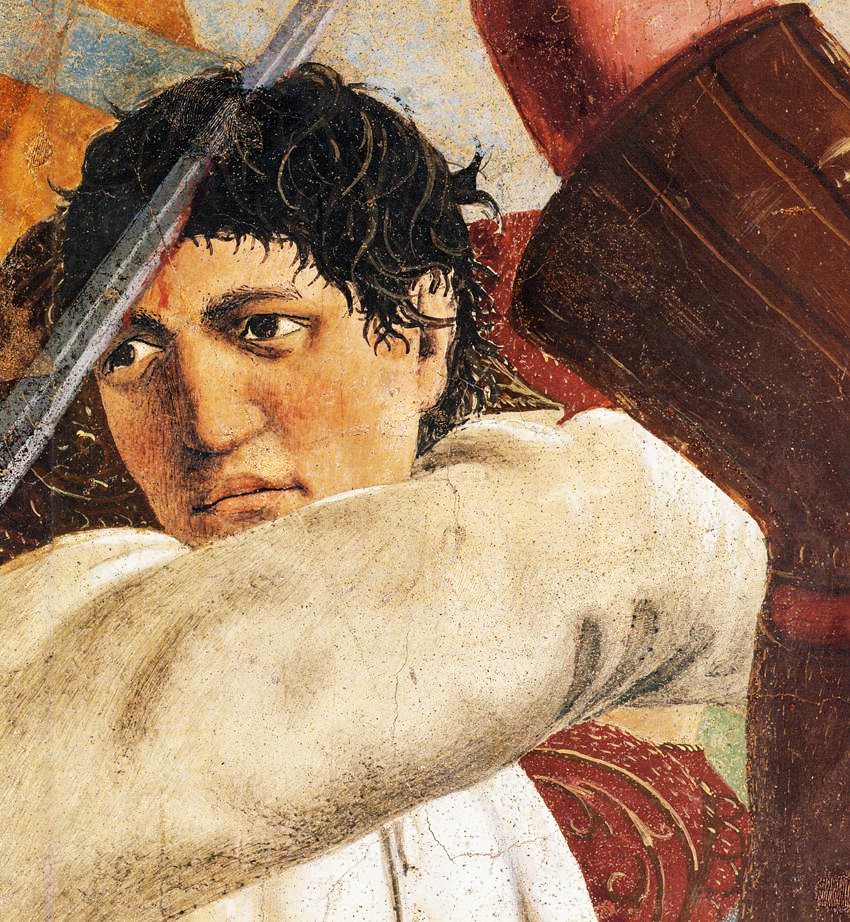
Piero della Francesca, Detail of The Exaltation of the Holy Cross
Italian, c. 1452-1466
Arezzo, Church of San Francesco 


"Jesus said to Nicodemus:
"No one has gone up to heaven
except the one who has come down from heaven, the Son of Man.
And just as Moses lifted up the serpent in the desert,
so must the Son of Man be lifted up,
so that everyone who believes in him may have eternal life."
(John 3:13-15, Gospel reading for the feast of the Exaltation of the Holy Cross)

This “lifting up” of the Son of Man was accomplished through the cross. And as stated by Fr. Richard Viladesau, currently Professor of Theology at Fordham University, in his book The Beauty of the Cross: the Passion of Christ In Theology and the Arts, from the Catacombs to the Eve of the Renaissance, “From its earliest times, Christianity was distinguished as being religio crucis – the religion of the cross. The cross has always been its most obvious and universal symbol; and in the contemporary world, we are once again reminded that it is the cross and its meaning that set Christianity apart from other world religions.” Fr. Viladesau goes on to discuss the ways in which the cross of Christ continues to be “a stumbling block and foolishness(1 Corinthians 1:23), viewed with horror and mistrust by non-Christians and post-Christians. 1

The history and legends surrounding the Cross are extensive and far reaching in scope. However, the feast of the Exaltation of the Holy Cross on September 14 focuses on two documented events in the history of the True Cross.

The first is the dedication of the basilica of the Holy Sepulchre in Jerusalem on September 14, 335. Built, by order of the Emperor Constantine, on top of the remains of Golgotha and the nearby burial place of Jesus, the basilica replaced the Roman temple of Venus that had been built atop them during the reign of Hadrian, approximately 100 years earlier.

The second is the Exaltation (or Triumph) of the Cross, when the Byzantine Emperor, Heraclius, returned the relic of the True Cross to Jerusalem in 628. It had been captured fourteen years earlier by the forces of the Sassanian Emperor of Persia, Chosroes II, as part of the long drawn out war between Persia and Byzantium that exhausted both empires and opened their territories up to eventual defeat by the armies of Islam in the later part of the 7th century. Heraclius deliberately scheduled this event for September 14th to tie it to the earlier, Constantinian event.

These real events not only formed the basis for the liturgical feast of the Exaltation of the Holy Cross they also became part of the iconography of the Legend of the True Cross. This iconography includes the actual events described above, mixed with folk legends and Old Testament typology. It consists of three distinct parts: The Finding and Proving of the True Cross, the Exaltation of the Holy Cross and the Legend of the Tree of Life (the Lignum vitae).
 
The iconography of the True Cross has its most complete and notable example in the work done by the Quattrocento master, Piero della Francesca, in the church of San Francesco in Arezzo.  This cycle of paintings brings together all three strands listed above.

The Finding and Proving of the True Cross

The Finding and Proving of the True Cross combines elements of actual history with folk legends. It is known from documentary evidence that excavations at Jerusalem following Constantine’s acceptance of Christianity had located the sites of the Crucifixion and Resurrection underneath the temple of Venus and that this had resulted in the construction of the Church of the Holy Sepulchre, dedicated in 335. 

It is also known from documentary evidence that by at least the year 340 AD a fragment of the Cross was being exhibited to pilgrims in Jerusalem. There is a very detailed account of this event in a letter recording the pilgrimage to Jerusalem of the nun, Egeria, dating from about 380 AD. 

The first mention of Saint Helena, mother of Constantine, in connection with the finding of the Cross is a mention by Saint Ambrose in a funeral oration on the death of the Emperor Theodosius I in 395. 3   It is known that she was in the Holy Land, visiting sites associated with the life of Christ, during the later half of the 320s and that her Roman palace became the site of the church of Santa Croce in Gerusalemme (Holy Cross in Jerusalem) where fragments of the True Cross and other possible relics are preserved. But whether Helena was instrumental in finding the Cross or whether she was even there at that exact time is open to dispute. What is not open to dispute is that by the middle of the 4th century elements of what was believed to be the True Cross were displayed on particular feast days in Jerusalem and that by the end of the 4th century fragments of this relic were being distributed to other churches throughout the Christian world. On this historical base were woven a series of legends and poetic extrapolations from the Old and New Testament. 


Piero della Francesca, The Finding and Proving of the True Cross
Italian, c. 1452-1455
 Arezzo,  Church of San Francesco
St. Helena is shown twice.  At the left she directs the removal of the Cross from the ground in which it was buried.  On the right she kneels in adoration as the Cross is proved to be the True Cross-- by raising a dead boy to life.

The Legend of the Tree of Life

The Legend of the Tree of Life is such a development from biblical typology. First stated by St. Paul in 1 Corinthians 15:22, the typological thought runs that: just as Adam is the first man, the first to disobey God’s commands and the first to bring death into the world, so Christ is the new Adam, a sinless sacrifice in accordance with His Father’s will, whose death brings eternal life. 

In the legend, the Archangel Michael gives a seedling of the Tree of Life from the Garden of Eden to Seth, one of Adam's sons.  Michael instructs Seth to place the seedlings in Adam’s mouth before his burial and, when his father dies, Seth complies.  This seedling grows into the tree from whose wood the Cross would eventually be made.

Piero della Francesca, The Death and Burial of Adam
Italian, c. 1452-1466
Arezzo, Church of San Francesco
This fresco reads from right to left.  At the right we see Adam as he dies. On the left we see his burial.  Between these two scenes and shown in perspective is the meeting between Seth and Michael the Archangel.


Having grown for many years the tree dies in the time of King Solomon and its wood is made into planks for a bridge. On her journey to visit Solomon, the Queen of Sheba comes upon the bridge and, in a flash of revelation, recognizes that it will bear the Savior of the World. She kneels before it in adoration. On her arrival at Solomon’s court, she tells him that his glory will be diminished by his descendant, who will hang on a cross made from the wood of the bridge. 

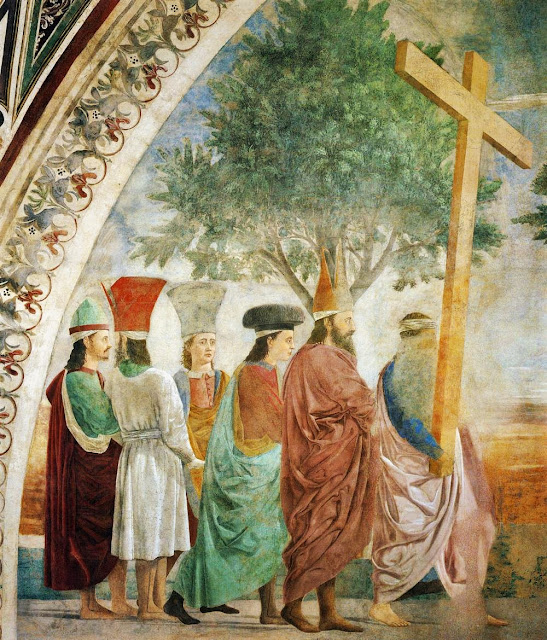
Piero della Francesca, The Queen of Sheba Venerates the Wood and Meets with Solomon
Italian, c. 1452-1466
Arezzo,  Church of San Francesco
In this picture we see the Queen of Sheba twice.  On the left, she is venerating the wood of the Tree of Life, which forms a bridge over a stream.  On the right, she is shown greeting King Solomon.


In order to prevent this from happening, Solomon orders that the wood be drowned at the bottom of a well. But in the time of Jesus it is found and removed just in time to be made into the Cross.
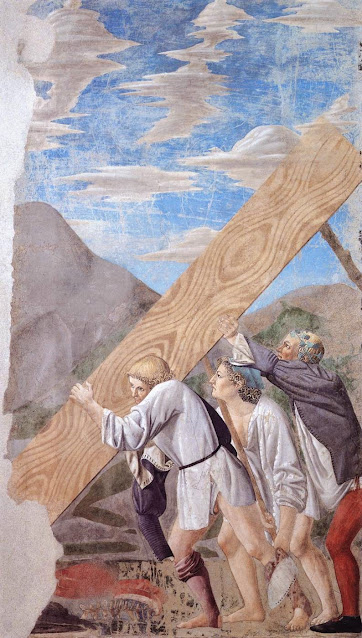
Piero della Francesca, The Burial of the Wood
Italian, c. 1452-1466
Arezzo,  Church of San Francesco


The Exaltation of the True Cross

The Exaltation of the Cross is a real event (see above) but, as recounted by Jacobus de Voragine in the Golden Legend (ca. 1260), has added elements that make it read like a medieval romance.4 

Pier della Francesca, The Exaltation of the Holy Cross
Italian, c. 1452-1466
Arezzo, Church of San Francesco 


The Legend and Piero della Francesca at Arezzo

Although there are individual works of art that touch on parts of the Legend, there are also a number of cycles of monumental church decoration focusing on the legend. The greatest of these is the cycle by Piero della Francesca in the church of San Francesco in Arezzo, located in Tuscany, between Florence and Rome. 

Overview of the Chapel of the Exaltation of the Holy Cross
Italian, c. 1452-1466
Arezzo, Church of San Francesco


Much ink has been spilled over this particular fresco cycle. It was painted sometime between 1452 and 1466, the specific dates being unknown as there is no known written documentation. The time frame is presumed from documents that establish that it was not in existence in 1452 and was finished in 1466. The church of San Francesco in Arezzo is a Franciscan foundation and there is a history of this subject matter in Franciscan churches.

The chapel in which the cycle is placed was the donation of the Bacci family and it is they who paid for the cycle, although the Franciscans probably advised, or perhaps even dictated, the subject matter.  The cycle includes episodes from the Legend, beginning with the death of Adam and the placing of the seeds of Tree of Life in his mouth by his son, Seth.

The scenes in the cycle are not arranged as a continuous narrative. Instead they are shown in related pairs, positioned across the width of the room from each other. Thus the beginning and ending of the cycle, the Death of Adam and the final Exaltation of the Holy Cross by Heraclius are positioned at the top of their respective, facing walls.

 In the middle tier, the interventions of the two queens, Helena and Sheba, face each other.

At the bottom, we see two small pictures of miraculous annunciations.  The first is the annunciation to Mary that resulted in the birth of Jesus the Savior,

Piero della Francesca, The Annunciation
Italian, c. 1452-1466
Arezzo, Church of San Francesco


The second is the annunciation of the Cross as a symbol of victory in a dream of Constantine.  This resulted in the conversion of Constantine, his victory over Maxentius and the eventual acceptance of Christianity by the Roman Empire.

Piero della Francesca, The Vision of Constantine
Italian, c. 1452-1466
Arezzo, Church of San Francesco


Beside them, on the long walls, are two large battle scenes (that of Constantine over his rival Maxentius and that of Heraclius over Chosroes II).

Piero della Francesca, The Victory of Constantine Over Maxentius
Italian, c. 1452-1466
Arezzo, Church of San Francesco

While difficult to see in the picture above, the association of this battle not only with the sign of the cross, but with the form of the Holy Cross itself, is made explicit when one looks at the detail of what Constantine is holding in his outstretched hand.  

Piero della Francesca, The Victory of Constantine Over Maxentius (detail)
Italian, c. 1452-1466
Arezzo, Church of San Francesco


Piero della Francesca, The Victory of Heraclius Over Chosroes II
Italian, c. 1452-1466
Arezzo, Church of San Francesco


Piero’s solid, rounded figures and geometrically arranged spaces produce an effect of almost dreamlike activity.  They seem almost doll-like, as they stare gravely with open eyes into space or toward heaven or with adoring intensity at the Cross.

Piero della Francesca, Detail from The Queen of Sheba Venerates the Wood and Meets with Solomon
Italian, c. 1452-1466
Arezzo,  Church of San Francesco


Piero della Francesca, Detail from The Finding and Proving of the True Cross
Italian, c. 1452-1455
 Arezzo,  Church of San Francesco


Piero della Francesca, Detail from The Exaltation of the Holy Cross
Italian, c. 1452-1466
Arezzo, Church of San Francesco


Even when they are gathered into conversational groups it is difficult to imagine that they are actually talking.

Piero della Francesca, Detail from The Meeting of Solomon and Sheba
Italian, c. 1452-1466
Arezzo, Church of San Francesco


Piero della Francesca, Detail from The Meeting of Solomon and Sheba
Italian, c. 1452-1466
Arezzo, Church of San Francesco


Even the battle scenes appear to take place in an atmosphere of extreme quiet, as though all the figures were holding their breath, even as they act. Each person seems wrapped in his or her own meditation.  They do not even react to injury.

Piero della Francesca, Deatail from The Battle of Heraclius
Italian, c. 1452-1466
Arezzo, Church of San Francesco


Piero della Francesca, Deatail from The Battle of Heraclius
Italian, c. 1452-1466
Arezzo, Church of San Francesco


Piero della Francesca, Deatail from The Battle of Heraclius
Italian, c. 1452-1466
Arezzo, Church of San Francesco


Born in the small Tuscan town of Borgo San Sepolcro, Piero learned his craft as a painter in Florence in the workshop of Domenico Veneziano. This was during the period in the mid-15th century when Florentine painters were learning to manipulate the principles of the new found technique of perspective and Piero became deeply involved in the development. In later life, he wrote treatises on mathematics, geometry and perspective. This study is reflected in the perspective that is evident in his True Cross cycle of paintings in Arezzo. He was also a student of the effects of light passing over solid objects. This is most obvious in the fresco of “The Dream of Constantine” which studies the effect of light in a nighttime scene. But it is also found throughout the cycle.


Piero della Francesca, Detail from The Vision of Constantine
Italian, c. 1452-1466
Arezzo, Church of San Francesco


Piero della Francesca, Detail from The Vision of Constantine
Italian, c. 1452-1466
Arezzo, Church of San Francesco


This cycle, therefore, stands at a special point in the history of Renaissance art, the point at which artists have begun to assimilate the use of perspective and the effects of light, but have not yet mastered these tools. Piero’s work points the way to Raphael, Caravaggio and Vermeer.

© M. Duffy, 2011, pictures revised and new material added 2022
_______________________________________________
1. Viladesau, Richard. The Beauty of the Cross: the Passion of Christ In Theology and the Arts, from the Catacombs to the Eve of the Renaissance, Oxford and New York, 2006, pp. 7-9. Some sections are available on the internet at: http://books.google.com/books?id=cTFh4tm9cMwC&printsec=frontcover&dq=richard+viladesau&hl=en&ei=tE9xTqLCEabF0AH4mvixCg&sa=X&oi=book_result&ct=result&resnum=5&ved=0CEQQ6AEwBA#v=onepage&q&f=false

See also his The Triumph of the Cross: the Passion of Christ in Theology and the Arts, from the Renaissance to the Counter-Reformation, Oxford and New York, 2008. Some sections of this book are also available at: http://books.google.com/books?id=3K_RKPz94nAC&printsec=frontcover&dq=richard+viladesau&hl=en&ei=tE9xTqLCEabF0AH4mvixCg&sa=X&oi=book_result&ct=result&resnum=2&ved=0CDUQ6AEwAQ#v=onepage&q&f=false

2. Baert, Barbara. A Heritage of Holy Wood: The Legend of the True Cross in Text and Image, Leiden, Koninklijke Brill, NV, 2004, p. 1. Some sections are available on the internet at: http://books.google.com/books?id=vVcRd2sldBIC&printsec=frontcover&dq=barbara+baert&hl=en&ei=vlJxTvy_M4rj0QH7nezfBg&sa=X&oi=book_result&ct=result&resnum=1&ved=0CDsQ6AEwAA#v=onepage&q&f=false

3. Baert, p. 2.

4. The Golden Legend or Lives of the Saints. Compiled by Jacobus de Voragine, Archbishop of Genoa, 1275. First Edition Published 1470. Englished by William Caxton, First Edition 1483, Edited by F.S. Ellis, Temple Classics, 1900 (Reprinted 1922, 1931.), Vol. 5, pages 60-65. It can be accessed on the internet at http://www.fordham.edu/halsall/basis/goldenlegend/GoldenLegend-Volume5.asp#Exaltation of the Holy Cross.

5. Baert, p. 11-12. Also, Lavin, Marilyn Aronberg in Piero della Francesca: The Legend of the True Cross in the Church of San Francesco in Arezzo, Ed. Anna Maria Maetzke and Carolo Bertelli. Milan, Skira editore, 2001, pp. 27-37.