Showing posts with label Durer. Show all posts

Tuesday, November 1, 2011

November 1 – Feast of All Saints

Celestial Rose, Illustration to Canto XXXII of
Paradiso, Third Book of the Divine Comedy
by Dante Alighieri
15th-Century Italian
Vatican City State, Vatican Library


On November 1 the Church celebrates the feast of All Saints. On this day we honor all those who through their lives, lived in faith and hope and with charity, have achieved the Beatific Vision of God. Some of them are saints who have been identified and formally recognized by the Church, but most are simply men, women and children who have passed without formal recognition and whose names are now forgotten. They are our ancestors in faith exactly as they are our ancestors in flesh and blood. They enjoy the peace, the glory and the vision of God that we hope eventually to attain.

For obvious reasons it is difficult to represent all the saints in art, but there are some works that come to mind.

The first is the literary image of the Celestial Rose from Canto XXXII of Paradiso, the final book of Dante’s Divine Comedy. Every saint in heaven has his or her seat in the petals of this rose. Representing this in art is impossible, but a 15th-century Italian manuscript now in the Vatican Library gives an idea of what it might look like.


A diagram of how Dante imagined the interior of the rose to accommodate the saints within its petals was prepared in connection with the publication of Dorothy Sayers' English translation of 1962.


The next image that comes to mind is the exquisite altarpiece by the Van Eyck brothers, Hubert and Jan in the cathedral of St. Bavo in Ghent. Known as the Ghent Altarpiece, its lower half represents the Adoration of the Mystic Lamb. Its inspiration comes from the description in the Book of Revelation of the Triumph of the Lamb (Rev. 7:9-10):

“After this I had a vision of a great multitude, which no one could count, from every nation, race, people, and tongue. They stood before the throne and before the Lamb, wearing white robes and holding palm branches in their hands.
They cried out in a loud voice:
“Salvation comes from our God, who is seated on the throne,
and from the Lamb.”
Hubert and Jan Van Eyck, Adoration of the Lamb, Lower Section of Altarpiece Interior
The Ghent Altarpiece
Netherlandish, 1425-1432
Ghent, Cathedral of St. Bavo
In the Van Eycks’ painting, which extends over five panels, the Lamb on the altar (who is Christ, especially Christ in the Sacrament of the Altar, the Eucharist) occupies the central position of the central panel. He is surrounded by angels holding the instruments of the Passion through which He has triumphed over death. Two kneeling angels incense Him. Two groups kneel before Him. To the left are the Old Testament prophets and heroes. To the right are the Apostles, Fathers and other male saints. Advancing from the distance are two other groups; additional male saints from the left and female saints, some of whom carry the martyr’s palm, from the right. In the side panels more saints advance. In the background we can see the New Jerusalem, composed of a combination of actual buildings from several towns and imaginary ones.

A final image is that of Albrecht Dürer’s Landauer Altarpiece, the Adoration of the Trinity. Clearly deriving from the same inspiration as the Van Eycks’ picture, Dürer interpreted the text less literally. He replaces the Lamb with the image of the Trinity and places the scene in the skies. But, the essentials of the image are the same; God is surrounded by His saints.
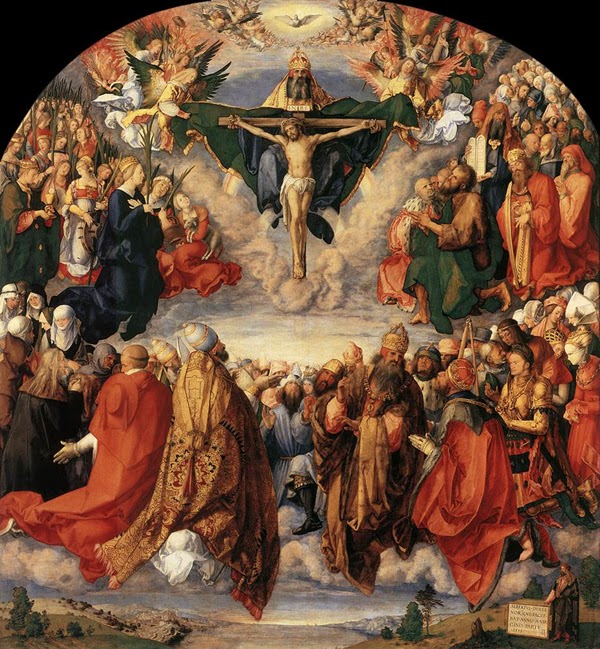
Albrecht Durer, Adoration of the Holy Trinity
German, 1511
Vienna, Kunsthistorisches Museum

These are the images of what we celebrate today.

© M. Duffy, 2011

Monday, July 18, 2011

Glorious Saint Anne – Iconography of Saint Anne, Day 2– The Meeting at the Golden Gate


The Meeting at the Golden Gate
From an Hours of the Virgin
French (Paris), c. 1490-1500
The Hague, Koninklijk Bibliothek,
MS KB 76 F14 fol.29r detail


According to the story in the Golden Legend, an angel announced to Anne and Joachim separately that God had heard their prayers for the gift of a child and that the child they would have would be “full of the Holy Ghost”1 and he gave each of them a sign. The sign was that they would meet each other at the Golden Gate of Jerusalem.

They each went to Jerusalem, to the Golden Gate, where they did meet “and glad to see each other… returned home, abiding joyously the promise divine. And Anne conceived and brought forth a daughter, and named her Mary.”2


After the Nativity of Mary the Meeting at the Golden Gate is the principal subject of the iconography of the couple, Joachim and Anne.

In all of the images there is a touching display of joy and real affection that is quite unusual in art.


Artists as diverse as Giotto
Giotto, The Meeting at the Golden Gate
Italian, c. 1304-1306
Padua, Arena Chapel

Benozzo Gozzoli

Benozzo Gozzoli, The Meeting at the Golden Gate
Italian, 1491
Castelfiorentino, Biblioteca Comunale


Filippo Lippi
Filippo Lippi, The Meeting at the Golden Gate
Italian, c. 1445
Oxford, Ashmolean Museum


Bartolomeo Vivarini
                                   
Bartolomeo Vivarini, The Meeting at the Golden Gate
Italian, c. 1473
Venice, Church of Santa Maria Formosa

Dürer
Albrecht Dürer, The Meeting at the Golden Gate
from Life of the Virgin 
German, 1504


and Boccaccino
Boccaccio Boccaccino, The Meeting at the Golden Gate
Italian, c. 1514-1515
Cremona, Cathedral

and various illuminators have been inspired by the evident warmth of the meeting.


The Meeting at the Golden Gate
From a Breviary
French (Paris), c. 1350
New York, Pierpont Morgan Library
MS M 75, fol. 573r


The Meeting at the Golden Gate
From a Fleur de Victoires by Jean Mansel
France, c. 1450-1475
Paris, Bibliotheque nationale de France
MS Francais 56, fol. 6r


One illuminator summed the entire story up on one sheet. This painter offers the Meeting at the Golden Gate as the central image being venerated by the family of the English king, Henry VII.

Workshop of the Master of the Speculum humanae salvationis, The Meeting at the Golden Gate Venerated by King Henry VII and His Family
From Ordinances of the Confraternity of the Immaculate Conception
English, 1503
Oxford, The Bodleian Libraries, Christ Church College Library
MS Christ Church 179, fol. 1v


The choice of image is appropriate, given that the union of Henry VII, the first Tudor monarch, with his wife, Elizabeth of York, the daughter of the next-to-last Yorkist king, Edward IV, symbolized the end of the period of civil war known as the Wars of the Roses. Surrounding the central image are four other images which tell the story of Joachim and Anne, from the rejection of Joachim’s offering (upper left) to the separate announcements by the angel to Joachim and Anne (bottom corners) to the conception of Mary (upper right). Between the images are images of the red rose of Lancaster and white flowers reflecting the white rose of York, the symbols from which the term “Wars of the Roses” is derived, as well as the portcullis, also used as a badge by Henry VII. The page may be dated as early as 1503 or as late as 1517. It comes from the Ordinances of the Confraternity of the Immaculate Conception which was founded in 1503. However, the last entry dates to 1517. Queen Elizabeth died in 1503 and King Henry in 1509. All but three of their children had predeceased their mother by 1503, so the image could be a memorial, looking backward from either late 1503 or 1517, rather than a recording document as of the foundation date.


The tale of Joachim and Anne's meeting has also been a source of inspiration to sculptors.

Benedikt Dreyer, The Meeting at the Golden Gate
German, c. 1515-1520
New York, Metropolitan Museum


Master of the Thomas Altar, The Meeting at the Golden Gate
German, c. 1520
Lübeck, Sankt-Annen Museum


Each image, in its different way, conveys a sense of the love of these two for each other and of their trust in the promise of God.
___________________________________
1. The Golden Legend or Lives of the Saints. Compiled by Jacobus de Voragine, Archbishop of Genoa, 1275. First Edition Published 1470. Englished by William Caxton, First Edition 1483, Edited by F.S. Ellis, Temple Classics, 1900 (Reprinted 1922, 1931.), Vol. 5, pp. 47-54.


© M. Duffy, 2011/2012, Images refreshed 2022.