Showing posts with label female martyrs. Show all posts

Sunday, July 20, 2025

Saint Margaret of Antioch – Dragon Slayer

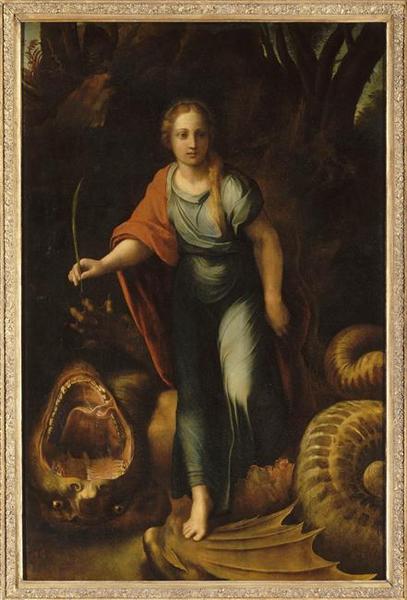
Charles Alphonse Dufresnoy, St. Margaret of Antioch
French, 1656
Evreux, Musée d'Art Histoire et Archéologie
There are several women honored as saints or blesseds by the Catholic Church who are named Margaret.  For example, there are St. Margaret of Scotland, St. Margaret of Cortona, St. Margaret Mary Alacoque, Blessed Margaret Pole and St. Margaret Clitherow.   But all of them (and I myself) draw their names from a woman who may or may not have lived.  This is St. Margaret of Antioch,  who is remembered by the Church on July 20.  She is little remembered today, but was a major saint in the Middle Ages through the Baroque.
 
This first St. Margaret was reputedly born in Syria, in the area around Antioch.  Antioch is a city with a long, long Christian tradition.  Indeed, it is in Antioch that the followers of the new way in Judaism were first called “Christians”.  It is the city that saw Saints Peter and Paul preach and is the city of one of the best known of the very early Christian martyrs, St. Ignatius of Antioch.   Ignatius was bishop of Antioch (the third ever, the first being St. Peter) in the latter decades of the first century and his letters tell us much about the beliefs and disciplines of the early Church.   The letters we have were written while he was in transit, under guard, from Antioch to Rome, where he died, as he had expressly hoped, torn to pieces by the big cats of the new Flavian Amphitheatre (which we know as the Colosseum).1  With this background, it is not surprising that a young woman named Margaret, who was a Christian, may have been born near the city, 

Guercino, St. Margaret of Antioch
Italian, c. 1630
Rome, Church of San Pietro in Vincoli


Margaret is, in fact, a name with deep roots in the Middle East, for it is derived from the Persian word for “pearl”.  In many languages there is a close association between the words for pearl and daisy.2  In French, for example, daisies are known as “marguerites”.  And women with the name Margaret have sometimes been gifted with the nickname “Daisy” in addition to the more common Margie, Maggie and Meg.  So, Margaret, probably in the sense of pearl, would not be an unusual name to find in a Syrian woman.

Chances are that there may have been an early Christian woman martyr in Syria or southern Anatolia named Margaret during one of the persecutions that beset the Church in the Roman Empire.  However, as with many of the early saints her story became embellished over time with stories of horrendous cruelties and fairytale elements.  In Margaret’s case these elements came to completely overshadow her human story.
    
According to the legend, Margaret was born on Antioch near the end of the third century, the daughter of a priest of one of the pagan cults, presumably for one of the gods or goddesses of the Roman pantheon.  Since her mother died when she was a baby, she was given to a wet nurse to raise.  The woman happened to be both a wool worker and a Christian and introduced Margaret to both.

On her coming of age, she was requested in marriage by a high ranking Roman official.  She refused him and refused to renounce her faith as well.  For this she was tortured (in some pretty horrific ways) and thrown into prison.  In prison she was attacked by Satan in two forms.  First, as a handsome young man who attempted to persuade her to surrender to the pleasures of the flesh.  Having failed at that, he decided to try terror, assumed the form of a dragon and swallowed her whole.  

Nothing daunted, Margaret either cut her way out of the dragon with a cross she had been holding when swallowed, or was miraculously released by the spontaneous explosion of the dragon when she made the sign of the cross from within his stomach.  For this reason, she is most frequently shown holding a cross and with a dead or dying dragon at her feet.

However, this reprieve was only temporary.  She was eventually beheaded during the persecution of Diocletian (303-305).4

Richard de Montbaston, Martyrdom of Margaret of Antioch
From a Golden Legend by Jacobus de Voragine
French (Paris), 1348
Paris, Bibliotheque nationale de France
MS Français 241, fol.159v


Margaret was an extremely popular saint during the medieval period and remained so into the Renaissance and Baroque periods.  She is the patron saint of a number of things and events, including pregnant women and childbirth.  Further, she is also one of the three women martyrs among the so-called "Fourteen Holy Helpers", early saints who were believed to have great power as helpers to those who invoked their intercession.

In art we see different aspects of her life.  Sometimes she is shown as a shepherdess or wool worker, a reference to the supposed occupation of her foster mother.


Mahiet and Collaborators, St. Margaret of Antioch as a Shepherdess
From a Speculum historiale by Vincentius Bellovacensis
French (Paris), c. 1335
Paris, Bibliotheque nationale de France
MS Arsenal 5080, fol. 288r


Jean Fouquet, St. Margaret of Antioch Spinning Wool
From the Hours of Etienne Chevalier
French (Tours), c. 1450-1460
Paris, Musée du Louvre
MS MI 1093


*Anonymous, Olybrius Sees Margaret Tending Sheep
German, Early 16th Century
Ottobeuren, Abbey Art Collection 


Francisco de Zurbaran, St. Margaret of Antioch as a Shepherdess
Spanish, c. 1630-1634
London, National Gallery


There are also a few images of her rejection of a suitor, which attracted the attention of the Roman authorities and led to her martyrdom.

* Anonymous, Margaret Rejects the Courtship of Olybrius
German, Early 16th Century
Ottobeuren, Abbey Art Collection


* Melchior Puchner, St. Margaret of Antioch Rejects Olybrius's Courtship
German, c. 1737
Bayrischzell, Church of St. Margaret


At other times it is the scenes of her eventual torture and martyrdom that we are shown.

Master of the Roman de Fauvel, Martyrdom of St. Margaret
From a Vies de Saints
French (Paris), c. 1300-1325
Paris, Bibliotheque nationale de France
MS Français 183, fol. 86v
This miniature shows both her escape from the dragon and her martyrdom.


Lodovico Carracci, Martyrdom of St. Margaret
Italian, 1616
Mantua, San Maurizio, Cappella di Santa Margherita


* Melchior Puchner, St. Margaret of Antioch Is Tortured with Scourges and Torches
German, c. 1737
Bayrischzell, Church of St. Margaret


* Melchior Puchner, Martyrdom of St. Margaret of Antioch
German, c. 1737
Bayrischzell, Church of St. Margaret


At times she is seen in her place in heaven as a martyr saint.  Here the dragon may appear as one of her attributes but always as a subdued, barely hinted at presence.    What is more important is the cross or martyr's palm that she holds.  She also is frequently shown holding a book.


St. Margaret of Antioch
Spanish (Burgos), c.1275-1325
New York, Metropolitan Museum of Art

St. Margaret of Antioch
Catalan (Lleida), 1330-1340
New York, Metropolitan Museum of Art, The Cloisters Collection


St. Margaret of Antioch
From the Cologne Missal
German (Cologne), 1150
Paris, Bibliotheque nationale de France
 MS Latin 12055, fol. 164v


Rogier van der Weyden, Saints Margaret and Apollonia
Flemish, c. 1445-1450
Berlin, Gemäldegalerie der Staatliche Museen zu Berlin


Jacques de Besançon, The Court of Heaven
From a Golden Legend by Jacobus de Voragine
French (Paris), c. 1480-1490
Paris, Bibliotheque nationale de France
MS Français 244, fol.156
In this image Margaret takes her place among the front ranks of the female martyrs.  She stands in the first row, wearing a dark blue dress and brownish cloak and carrying a cross over her right shoulder.


Annibale Carracci, St. Margaret of Antioch
Italian, c. 1597-1599
Rome, Church of Santa Caterina della Rosa


Peter Candid, St. Margaret of Antioch
Flemish, c. 1600
Private Collection


Jan Brueghel I, St. Margaret of Antioch
Flemish, c. 1600-1625
Private Collection


* Anonymous Bavarian Painter, St. Margaret of Antioch
German, 1722
Elbach, Church of St. Andrew


Ernest Hebert, St. Margaret of Antioch
French, c. 1877
Paris, Musée national Ernest Hebert


But, primarily she is seen in relation to her victory over the devil/dragon.  These images come from all the time periods.  Sometimes the dragon is a truly fierce monster, but quite frequently he is seen almost as a pet. Sometimes, Margaret is seen to be popping out of the dragon.  At other times she has already been completely liberated.  At still others she is standing victoriously atop the beast.


St. Margaret Emerging from the dragon
From the Livre d'images de Madame Marie
Belgian (Hainaut), c. 1285-1290
Paris, Bibliotheque nationale de France
MS Nouvelle acquisition française 16251, fol. 100r


St. Margaret Emerging from the Dragon
From the Sermons of Maurice de Sully
Italian (Milan or Genoa), c. 1320-1330
Paris, Bibliotheque nationale de France
MS Français 187, fol. 41r


Workshop of Agnolo Gaddi, St. Margaret of Antioch
Italian, c.1390
New York, Metropolitan Museum of Art
In this image Margaret is being ejected by the dragon by mouth rather than bursting through his belly.


Master of Marguerite d'Orléans, St. Margaret of Antioch
From the Heures de Marguerite d'Orléans
French (Rennes), c. 1430
Paris, Bibliotheque nationale de France
MS Latin 1156 B, fol. 176r
I suggest that you click on this image to enlarge it so you won't miss the detail of Margaret as a shepherdess in the right side of the margin and the two rather charming little dragons in the bottom margin who are looking up approvingly at the devil's discomfiture.


St. Margaret of Antioch
French (Toulouse), c. 1475
New York, Metropolitan Museum of Art


Jean Bourdichon, St. Margaret of Antioch
From the Grandes heures d'Anne de Bretagne
French (Tours), c. 1503-1508
Paris, Bibliotheque nationale de France
MS Latin 9474, 205v

The dragons in these two images above seem almost domesticated, almost pet-like.  Obviously, this was one little bit of fantasy that painters and sculptors (and even potters) could relate to, a kind of comic relief in their usual work of preparing images of the martyr saints that were often far from comic.


Workshop of Maestro Giorgio Andreoli, St. Margaret of Antioch
Majolica dish
Italian, 1527
New York, Metropolitan Museum of Art, Lehman Collection


However, Raphael (known through several copies by his students, such as Giulio Romano) and Titian suggest that there may have been a struggle to escape from the dragon.

Giulio Romano (after Raphael), St. Margaret of Antioch
Italian, c. 1518
Paris, Musée du Louvre


Titian, St. Margaret of Antioch
Italian, 1565
Madrid, Museo del Prado


At the end of the seventeenth century, an artist working in the circle of Giacomo Ceruti imagined the vanquished demon as partially returned to human form, a much more unsettling image for we see Satan resuming his appearance as a fallen angel.

Studio of Giacomo Ceruti, St. Margaret of Antioch
Itaian, c. 1601-1623
Private Collection


Even given the comic relief aspect, there is a deeper reference here, one with a Biblical foundation. For, it refers to what had been foretold in the book of Genesis, when God rebuked the "snake" who tempted Eve to sin "Then the LORD God said to the snake:  Because you have done this, cursed are you among all the animals, tame or wild; On your belly you shall crawl, and dust you shall eat all the days of your life.  I will put enmity between you and the woman, and between your offspring and hers; They will strike at your head, while you strike at their heel."  (Genesis 3:14-15)  

The dragon that devoured Margaret is the same snake that tempted Eve, both are personifications of Satan, the Devil, the Enemy who is both an enemy to God and to humanity.  Margaret is here seen as a reflection of the Virgin Mary, the quintessential "woman" of Genesis and of Revelation and the Second Eve, who, with the offspring of both her body (Jesus) and her faith (Margaret, the saints, and by extension, all Christians) will strike at his head. 5

Occasionally, images of Saint Margaret may have no references to any aspect of the story of her life, her martyrdom or her miraculous escape from the dragon, but may purely present her as an intercessor before God for a human person.  Such an image is the unusual one below.  In the lowest level of the picture we see a woman lying down, attended by others, some of whom are praying, hinting at a scene of childbirth.  In the middle section we see a king and queen giving thanks for the baby which the queen holds.  In the upper level we see St. Margaret kneeling in supplication before Christ, surrounded by angels both adults and cherubs.  One of the cherubs holds her martyr's palm, while a small group holds the cross of Christ.  Margaret's dragon is shown as flying off to the right at the border between the upper and middle sections, while an adult angel holds a cornucopia of flowers which he is about the send to earth.  The subject appears to be the birth of an heir to the aged Louis XIV.  This probably refers to the birth of the future Louis XV, who inherited his great-grandfather's throne at the age of five.


* Joseph Hartmann, Miracle of Saint Margaret of Antioch
German, 1757
Baumberg, Church of Saint Margaret


© M. Duffy, 2016.  Additional text and images added 2025.
* Indicates new images.
_________________________________________________________

  1.       For St. Ignatius of Antioch see http://www.newadvent.org/cathen/07644a.htm, which includes links to his letters.  O'Connor, John Bonaventure. "St. Ignatius of Antioch." The Catholic Encyclopedia. Vol. 7. New York: Robert Appleton Company, 1910. 20 Jul. 2016
  2.         https://en.wikipedia.org/wiki/Margaret
  3.           The story of the dragon was too much of a strain on the credulity of Jacobus de Voragine, who was quite happy with a great many other fantastic stories.  In his The Golden Legend, written in  he says “This swallowing and breaking of the belly of the dragon is said that it is apocryphal.” From The GOLDEN LEGEND or LIVES of the SAINTS, Compiled by Jacobus de Voragine, Archbishop of Genoa, 1275 First Edition Published 1470, ENGLISHED by WILLIAM CAXTON, First Edition 1483, VOLUME FOUR.  From the Temple Classics Edited by F.S. ELLIS First issue of this Edition, 1900 Reprinted 1922, 1931< http://legacy.fordham.edu/halsall/basis/goldenlegend/GoldenLegend-Volume4.asp&gt
  4.        MacRory, Joseph. "St. Margaret." The Catholic Encyclopedia. Vol. 9. New York: Robert Appleton Company, 1910. 20 Jul. 2016 .
  5. For more on the connections between the snake, the Virgin Mary and both Genesis and Revelations, see the articles "Annunciation – The World Created Anew" and "The Immaculate Conception" 

Tuesday, December 13, 2016

Saint Lucy of Syracuse – The Eyes Don’t Have It All!

Francisco de Zurbaran, Saint Lucy
Spanish, c.1625-1630
Washington, DC, National Gallery of Art


When growing up and all the way through my life I have always understood that the defining attribute of Saint Lucy was a pair of eyeballs on a dish.1 

This rather gruesome attribute is a reference to one of the aspects of her martyrdom.  So, in deciding to investigate her iconography in preparation for posting an essay on her feast day, I thought I had a fairly easy job in hand.  Turns out, I was not entirely right.  The plate of eyeballs is not her only attribute, the story of how they became her symbol may have a different twist and the reason why young Scandinavian girls go around on December 13th with a crown of candles on their heads (I could never figure the connection) has a good deal to do with Saint Lucy after all.

Saint Lucy (properly Saint Lucia of Syracuse) is one of those early martyrs whose lives and deaths are so shrouded in later legends that it is hard to get back to the real person that probably lived and died so long ago.  

Like other saints I have explored recently, such as Saint Margaret of Antioch or Saint Catherine of Alexandria, Lucy seems almost mythical.  However, she is not.


In fact, she is one of the saints listed among the early female martyrs in the Roman Canon of the Mass (or Eucharistic Prayer I, if you prefer), which can be traced back in its current form to the late sixth century.  This is the list that runs “Felicity, Perpetua, Agatha, Lucy, Agnes, Cecilia, Anastasia”.  It is reasonable to believe, therefore, that inclusion on this list is a pretty good guide to a person who really lived and suffered and who had been remembered by the Christian community for having done so, being recognized early as someone of particular significance.

Jean Bourdichon, Saint Lucy
From the Hours of Frederic of Aragon
French (Tours), 1501-1504
Paris, Bibliotheque nationale de France
MS Latin 10532, fol. 382


According to tradition, Lucia was born in the Sicilian town of Syracuse, with its mixture of Roman and Greek, in the later years of the third century.  Her father’s family name must have been Lucius, as Roman women took the feminine form of their father’s family name as one of their two names.  

Her family may have been Christian, or she became a convert at an early age and, like many other young Christian women, decided on the counter-cultural embrace of chastity.  As with so many others, in a culture where women had little chance of autonomy until they became widows, coming under the domination of first their fathers, and then their husbands (who were often chosen for them by their fathers), this decision brought her trouble.

After Jacopo Bassano, The Baptism of Saint Lucy by Saint Valentine
Italian, c.1600
Douai, Musée de la Chartreuse


In addition to wishing to remain unmarried, Lucy was determined to share her fortune (probably money intended as her dowry) with the poor, over opposition from her widowed mother.  Cleverly, Lucy persuaded her ailing mother to go on a pilgrimage to the tomb of Saint Agatha in Catania, also in Sicily.  On visiting the tomb, Lucy had a dream in which Saint Agatha appeared to her and promised that her mother would be cured.  When she woke up, Lucy found that her mother had indeed been cured.  Taking advantage of her mother's gratitude for the miraculous healing, Lucy managed to persuade her mother to allow her to distribute her money to the poor. 


+Anonymous, Saint Lucy and Her Mother at the Tomb of Saint Agatha
Italian, 1292
Melfi, Cappella di Santa Lucia


+Richard de Montbaston, Saint Lucy at the Tomb of Saint Agatha
From a Legenda aurea of Jacobus de Voragine
French (Paris), 1348
Paris, Bibliotheque nationale de France
MS Francais 241, fol. 13v


*The Master of Virgil, Saint Lucy and Her Mother at the Tomb of Saint Agatha
From a Lengenda aurea by Jaccobus de Voragine
French (Paris), 1404
Paris, Bibliotheque nationale de France
MS Francais 414, fol. 16v


Lorenzo Lotto, Saint Lucy at the Tomb of Saint Agatha
Italian, 1532
Iesi, Pinacoteca Civica
This picture tells the entire story of the visit of Lucy and her mother to the tomb of Saint Agatha.  It reads from left to right.  At the far left, Lucy and her mother attend Mass at an altar near the tomb.  In the center of the picture, Lucy sleeps at the foot of the tomb, while her mother kneels in prayer.  The the right of this, Lucy and her mother argue.  And, at the far right the victorious Lucy distributes her fortune to the poor.


A young man who had been a suitor for Lucy’s hand in marriage heard about this distribution of wealth and, probably angry about being deprived of money he felt was really his, denounced her to the Roman governor of Sicily.  


+Saint Lucia is presented to Proconsul Pascasius
Italian, 1292
Melfi, Chapel of St. Lucy


This was at the time of the Diocletian persecution, the last one endured by the early Church (recognition by Constantine was only a few years away).  So, Lucy was summoned to appear before the governor and there to offer sacrifice to the gods. 

 
Lorenzo Lotto, Saint Lucy Before the Governor
From the Saint Lucy Altarpiece
Italian, 1532
Iesi, Pinacoteca Civica

This was typically how Christians were placed into the category of impious traitors, since one of the gods in question was usually the “divine” Emperor.  

This sacrifice was considered a civic duty and those who refused (with the official exception of the Jews) were considered to be traitors to the state.  People were regularly required to make a public sacrifice to the gods and were actually given an official certificate to show that they had done their duty.

Lucy refused to sacrifice.  As usual this refusal was met with savage reprisals.  A common part of the story of the female martyrs is an attempt to corrupt them by placing them in a brothel.  This was tried with Lucy, but the legendary part of her story says that, on her refusal she became extremely heavy and could not be moved.  A team of oxen were called in to help move her, but she remained immobile.

The Master of the Legend of St. Lucy, The Legend of Saint Lucy
Flemish, 1480
Bruges, Sint-Jacobskerk
This altarpiece presents several "moments" n the early phases of the martyrdom of Saint Lucy.  At the left she bids farewell to her mother, in the center she faces the Governor and at the right the oxen attempt to move her.
Other images present the various aspects of the story. First comes the story of the attempt to coerce her to the brothel by using a team of oxen to move her.

A Team of Oxen Attempt to Move Saint Lucy
From a Picture Bible
French (Saint-Omer, Abby of St. Bertin), c.1190-1200
The Hague, Koninklijk Bibliothek
MS KB 76 F 5, fol. 40

Master of the Roman de Fauvel, A Team of Oxen Attempt to Move Saint Lucy
  From a Vies de saints
French (Paris), c. 1300-1325
Paris, Bibliotheque nationale de France
MS Francais 183, fol. 108

Domenico Gargiulio, A Team of Oxen Attempt to Move Saint Lucy
Italian, c.1650
Beauvais, MUDO, Musée de l'Oise

Following this failure to move her other tortures were applied.   One of them was the removal of her eyes. This particularly gruesome torment is the one that became one of her attributes. However, I have not yet uncovered any images of this particular torture.  Perhaps it was simply too frightening for artists, who must rely on their eyes to obtain work.3

Then they attempted to set her on fire, but she didn't burn.   
  
Mahiet and Collaborators, The Martyrdom of Saint Lucy
From a Speculum historiale by Vincentius of Beauvais
French (Paris), c.1334
Paris, Bibliotheque nationale de France
MS Arsenal 5080, fol. 281
This illumination shows three moments in her martyrdom. At the left, the oxen try to move her, while on the right she is being simultaneously burned and killed with a spear thrust.


*The Martyrdom of Saint Lucy
From a Legenda aurea by Jacobus de Voragine
German, 1362
Munich,Bayerische Staatsbibliothek
MS Cgm 6, fol. 10v


The Master of the Figdor Deposition, The Martyrdom of Saint Lucy
Dutch, c 1505-1510
Amsterdam, Rijksmuseum
A great deal is going on in this painting.  At the top, in the distance we can see the episode in which the oxen try to move Lucy, while in the upper right a male saint is being beheaded.  In the upper part of the middle ground,, at the left, a bound Lucy is being brought to the brothel.  In the lower part of the middle ground, at the right, Lucy receives Communion in a kind of grotto, suggesting the sometimes clandestine nature of the Mass in her time.  In the center foreground, Lucy is being simultaneously burned and stabbed as officials and apparently sympathetic executioners look on.  


Eventually, she was killed by a sword or spear thrust.  


The Martyrdom of Saint Lucy
From the Livre d'images de Madame Marie
Belgian (Hainaut), c. 1285-1290
Paris, Bibliotheque nationale de France
MS Nouvelle acquisition francaise 16251, fol. 99v


+Follower of the Polycratic Master, The Martyrdom of Saint Lucy
 From a Legenda aurea by Jacobus de Voragine
French (Paris), c. 1400
Rennes, Bibliotheque municipale
MS 266, fol. 15v


+Domenico Veneziano, The Martyrdom of Saint Lucy
Italian, c.1445
Berlin, Gemäldegalerie der Staatlichen Museen zu Berlin


Jean le Tavernier and Follower, The Martyrdom of Saint Lucy
From the Hours of Philip of Burgundy
Belgian (Oudenaarde), 1450
The Hague, Koninklijk Bibliothek
MS KB 76 F 2, fol. 278v


Peter Paul Rubens, Sketch of the Martyrdom of Saint Lucy
For the ceiling painting in the Jesuit Church at Antwerp
Flemish, c.1616-1620
Quimper, Musée des Beaux-Arts


Occasionally she is shown receiving Holy Communion either just before or during her execution.


*Master of the Coronation of the Virgin and Workshop, The Last Communion of Saint Lucy
From a Legenda aurea by Jacobus de Voragine
French, c. 1400
Paris, Bibliotheque nationale de Franc
MS Francais 242, fol. 9v


*Master of the Chronique scandaleuse, The Last Communion of Saint Lucy
From a Legenda aurea by Jacobus de Voragine
French (Paris), 1493
Paris, Bibliotheque nationale de France
MS VELINS-689, FOL. 13V


Veronese, The Martyrdom and Last Communion of Saint Lucy
Italian, c.1582
Washington, DC, National Gallery of Art


Govanni Battista Tiepolo, The Last Communion of Saint Lucy
Italian, c. 1747-1748
Venice, Church of Santi Apostoli


Her memory was preserved and devotion to her spread far beyond Sicily, reaching Rome by the sixth century and the rest of the Christian world in ensuing years. 


+Altichiero da Zavio, The Funeral of Saint. Lucy
Italian, c. 1378-1384
Padua, Oratory of Saint George


+Caravaggio, The Burial of Saint Lucy
Italian, 1608
Syracuse (Sicily), Bellomo Museum


She appears in the famous mosaic procession of virgin martyrs that stretches down the nave of the church of Sant’Apollinare Nuovo, built in 526.

The Procession of Female Martyrs
Byzantine, 526
Ravenna, San Apollinare Nuovo
Saint Lucy is the figure second from the right.  At this early stage all the female martyrs look alike.  No one has any particular attribute.
 

Lucy is considered to be the patron saint of the blind and her feast day is celebrated on December 13.  She is a particular patron of her native Sicily and of a neighborhood in nearby Naples on the mainland of Italy, best known from the famous song “Santa Lucia”.

The name Lucia/Lucy derives from the Latin word “lux” (genitive case = lucis, etc.) which means “light” and by extension “sight”, which can help explain where the association with her two main attributes, a lamp and the disembodied eyes derive from.  In addition to the story told above about the putting out of her eyes as a torture, there is a story that Lucy did this herself to dissuade her suitor.  I think this second story is highly unlikely and that it is much more likely that her eyes were blinded, assuming that they were, as a form of torture. 

Consequently, Lucy can be identified in art by either holding a lamp or holding a plate or dish with her eyes.  This does not mean, of course, that images of Lucy as a saint show her as blind.   In her sanctified state, she is whole again.   


St. Lucy with a Lamp

Jacopo del Casentino and Assistant, Saint Lucy
Italian, c.1330
El Paso, Museum of Art


Andrea di Bartolo, Saint Lucy
Italian, c.1400
Oxford, The Ashmolean Museum of Art and Archaeology


Meister Arnt, Saint Lucy
Dutch, 1478
Venray, Church of St. Peter in Chains


+Pietro Perugino, Saint Lucy
Italian, 1507
New York, Metropolitan Museum of Art


Saint Lucy with Her Eyes Attribute


Carlo Crivelli, Saint Lucy
Italian, 1430
Avignon, Musée du Petit Palais


Attributed to the Master of the Donato Commission, Saint Lucy
Leaves from an Book of Antiphons
Italian (Venice), c.1460-1470
London, British Library
MS Additional 22310, ff. 1-9, fol. 5v


Francesco del Cossa, Saint Lucy
Italian, c.1473-1474
Washington, DC, National Gallery of Art


Carlo Crivelli, Saint Lucy
Italian, c.1476
London, National Gallery


Francisco de Zurbaran, Saint Lucy
Spanish, c.1640
Chartres, Musée des Beaux-Arts


Lucy in the Sacra Conversazione

In addition to scenes from her life and her martyrdom Lucy appears in the Sacra Conversazione type of painting and in paintings with groupings that either contributed to the genre or derived from it. 


+Domenico Veneziano, Madonna and Child with Saints Francis, John the Baptist, Ambrose and Lucy
Italian, c. 1445
Florence, Galleria degli Uffizi

In fact, it is this painting of a Sacra Conversazione by the Quattrocento artist Domenico Veneziano that includes Saint Lucy which is frequently presented to students to introduce them to the concept of this category of painting.  


Anonymous, Madonna and Child with Saint Lucy
Italian, 1292
Melfi, Cappella di Santa Lucia


Hans Memling, The Madonna and Child in a Garden with Saints Catherine of Alexandria, Agnes, Cecilia, Lucy, Margaret of Antioch and an Unidentified Saint
German, c.1490
Paris, Musée du Louvre


Giovanni Bellini, The Madonna and Child with Saints Peter, Catherine of Alexandria, Lucy and Jerome
The San Zaccaria Altarpiece
Italian, 1505
Venice, Church of San Zaccaria


Giovanni Battista Cima da Conegliano, Saints Roch, Anthony Abbott and Lucy
Italian, c.1513
New York, Metropolitan Museum of Art


Workshop of Federico Barocci, The Madonna and Child in Glory with Saints Anthony Abbot and Lucy
Italian, c.1500
Paris, Musée du Louvre


Alessandro Allori, The Madonna and Child with Saints Francis and Lucy
Italian, 1583
Cardiff, National Museum of Wales


Sometimes she appears with a one, two or a group of other saints, either from the wings of a now dispersed altarpiece, or as witnesses or participants in some heavenly event.


Master of Saint Ildefonso, The Imposition of the Chausable on Saint Ildefonso
Spanish, c.1475-1500
Paris, Musée du Louvre


Frankfurt Master, Saints Agnes and Lucy
Flemish, 1492
Frankfurt am Main, Historisches Museum


Goswijn van der Weyden, Saints Dymphna and Lucy
Flemish, 1503-1505
Antwerp, Koninklijk Museum voor Schone Kunsten


Bartholomaeus Bruyn the Elder, Saints Bartholomew and Lucy
German, c. 1530-1535
Cologne, Wallraf-Richartz Museum


Giacomo Triga, Saint John the Baptist with Saints Gregory the Great, Mary Magdalene and Lucy
Italian, c. 1720
Vetralla, Cathedral

In Scandinavia, in spite of the fact that the Scandinavian nations are overwhelmingly Protestant in orientation, memory of her is still a living thing.  Due to the far northern location of Scandinavia the December days approaching the winter solstice there are extremely short and dark.  It is in the first weeks of December that the time of sunset seems to pause (although the time of sunrise continues to get later and later, right up to the date of the solstice) and the turn of the year toward summer begins to be felt.  At this point, on the feast of Saint Lucy, all over Scandinavia (and in Scandinavian enclaves elsewhere), a girl is chosen to become the light bearer for her community in a ceremony that occurs nowhere else.


She is dressed in white, symbolic of virginity, wears a red sash, symbolic of martyrdom, and, most astonishingly, wears a crown of burning candles on her head, as the bearer of the light that will return with spring.  She processes through the local church (and also through various other public places), followed by other white-robed girls, also carrying candles, who sing traditional hymns and songs.


I’ve never actually seen one of these processions, but they look beautiful, if a wee bit frightening due to the lighted candles.  Households also have a similar ceremony, in which the girl serves traditional refreshments, including some that recall Saint Lucy’s eyes, to her family and guests.

Buns on a plate -- their shape and decoration are
a reminder of St. Lucy's symbol


Thus, a girl from the Mediterranean island of Sicily is still remembered and celebrated as far away as the Arctic Circle, demonstrating again the unity of Christian faith that once reigned in Europe before the Reformation.   Some may object that the Vikings probably had some similar ceremony prior to becoming Christians and this may be true.  However, the specific linking of such a ceremony with an early Christian saint from far away Sicily, suggests that, like other pre-existing customs that became incorporated into the Christian year, this was not only the sanctification of a powerful folk symbol but, in itself, a sign of Christian unity.   


A reminder of the old, Catholic, roots of the Scandinavian tradition.  Here is a photo of the entrance procession for a special Mass for the blind that takes place in St. Patrick's Cathedral in New York on the feast of St. Lucy, including a candle-crowned girl in honor of the patron saint of the blind.  


© M. Duffy, 2016
In 2024 I have updated selected images, replacing them with more up to date ones. I also added several new images.
+ Indicates updated image.
* Indicates new image

________________________________________________________
  1. Most information about Saint Lucy and the history of the Roman Canon are derived from 1913 edition of  The Catholic Encyclopedia, which can be found online at http://www.newadvent.org/cathen/  Although over 100 years old the information contained in most entries is still very useful and it is still the “go to” reference point for much material.
  2. For information on how the Roman authorities viewed Christianity and the measures they used against it see Robert Louis Wilken, The Christians As the Romans Saw Them, Second Edition, New  York and New Haven, Yale University Press, 2003
  3. I would like to point out here that, contrary to myth, not all medieval manuscript illumination was done by monks.  Some manuscripts certainly were illuminated in monastery scriptoria, especially in the early parts of the Middle Ages.  Even then, however, the painters were talented professionals, certainly not your average monk and the best ones were cultivated by their monasteries, much as several hundred years later, Fra Angelico was encouraged in his art by his Dominican superiors.  But as time went on the monastery scriptoria could never have hoped to meet the demand for illustrated books and professional artists took over.  Therefore, the luxury manuscripts that appear toward the end of the Middle Ages are nearly all illuminated by professional lay painters, working for booksellers or the earliest form of "publishers".  They employed professional scribes to copy the texts and professional artists to paint the images that illustrated them.  Entire families were often involved in the craft, as for instance the team of Richard de Montbaston and his wife, Jeanne.  Sometimes the very same artists who painted full-scale altarpieces also did the delicate illuminations in luxury books.  One such is the painter Zanobi Strozzi, a pupil of Fra Angelico, who painted both book illustrations and panel paintings.  There was also a trade in lower priced books, with illustrations by less talented or less experienced artists.