Thursday, March 27, 2014

Man or Woman 2: John the Evangelist or Mary Magdalene? – Images of John as Evangelist

+Saint John the Evangelist
Enamel plaque
French (Limoges), c. 1175-1200
New York, Metropolitan Museum of Art,
Department of Medieval Art


The best starting point to find the true iconography of Saint John the Evangelist is the way in which he is portrayed purely as an evangelist. In these images there can be no confusion of identities of male or female that might appear in other contexts.


 Evangelist portraits appear most prominently in manuscripts of the Gospels that pre-date the year 1000, especially in the great “luxury” codices 1 produced by the artists that served the Carolingian court in the 9th century AD.  While there may have been similar images that appeared in other art forms, only those in the manuscripts and similar small, precious objects have survived the centuries.


+Saint John the Evangelist
From the Harley Codex Aureus
German (Aachen), c. 800-825
London, British Library
MS Harley 2788, fol. 161v


These images have their deep roots in author portraits that appeared frequently in pre-Christian works as the first image in a scroll or codex. With the appearance of the codex form it became logical to begin each of the four Gospel books with a “portrait” of its author. Thus we see portraits of Matthew, Mark, Luke and John at the points at which their respective Gospels begin. Generally speaking, they are placed on the left hand page (the verso page, in manuscript terminology), facing the opening page of their respective Gospels.


+Saint John the Evangelist
From the Codex Aureus of Lorsch
German (Lorsch), Before 814
Vatican City, Biblioteca Apostolica Vaticana
MS Pal.lat.50, fol.67v


+Saint John the Evangelist
From the Ebbo Gospels
French (Rheims), c. 816-841
Epernay, Bibliotheque Municipale
MS 1, fol. 135v
Here John is shown as a bearded elder and, unusually, is shown writing on a scroll instead 
of the newer book form of codex.


They are usually shown either in the act of writing their Gospel account or holding a codex (book) that represents it. In addition, they are frequently accompanied by their symbol. These symbols are based on the image of the four living creatures that support the throne of God as described in both the Old Testament Book of Ezekiel (Ezekiel 1:5-26) and the New Testament Book of Revelations (Revelation 4:6-8). The symbol associated with St. John as evangelist is the eagle.

In these “portraits” we can see that there is no particular defined image of St. John. He is shown as a young, beardless man in some and as an aged, bearded figure in others.


In the “insular” style of painting, found in Ireland and parts of Britain under Irish influence, the image is highly abstract,


+Saint John the Evangelist
From  the Book of Kells
Irish (Iona or Kells), c. 800
Dublin, Trinity College Library
MS 58, fol. 291v


+Saint John the Evangelist
From the Book of Mulling
Irish, c. 800
Dublin, Trinity College Library
MS 60, fol. 193v


In the images produced under the influence of the Carolingian court (Charlemagne and his immediate descendants and their circle) the images hark back to classical, late antique figures.


+Ivory plaque of Saint John the Evangelist
German (Aachen), 9th century
New York, Metropolitan Museum of Art, the Cloisters Collection


+The Four Evangelists
From the Aachen Treasury Gospels
German (Ada School), c. 820
Aachen, Cathedreal Schatzkammer
Fol. 13r
Here Saint John the Evangelist is shown as a bearded young man, accompanied by the eagle, his symbol.  However, two of the other evangelists, Mark and Luke, who are usually
portrayed as older, bearded, men are here depicted as young and beardless as well. 


+Enamel Plaque with Saint John the Evangelist
German (Rhine Valley), c.  1175-1200
New York, Metropolitan Museum of Art, Department of Medieval Art
On this plaque John is not only named, but the words he is shown to have written are the opening words of the Gospel of John, "In the beginning was the Word"


By the middle of the twelfth century, however, the image of the beardless (or nearly beardless) young man has become the dominant image of Saint John as evangelist and remains so from then on with very few exceptions. 


+Jacopo Torritti, Saints. John the Baptist, John the Evangelist and Anthony
Italian, 1296
Rome, Church of Santa Maria Maggiore, Apse Mosaic


+Saint John on Patmos
From a Biblie historiale of Girard des Moulins
French,  beginning of the 15th century
Paris, Bibliotheque Nationale de France
MS Arsenal 5058, fol. 558r


Further, the image of St. John as evangelist now appears in other media than manuscript, enamel or mosaic. 


+Luca Signorelli, The Apostles Peter and John
Italian, c. 1477-1482
Loreto, Basilica of the Santa Casa


+Hieronymous Bosch, Saint John on Patmos
Netherlandish, c. 1504-1505
Berlin, Gemäldegalerie der Staatliche Museen zu Berlin


Fra Bartolomeo, Vision of Saint Bernard with Saints Benedict and John the Evangelist
Italian, 1504
Florence, Uffizi


+Albrecht Duerer, Saints John the Evangelist and Peter
German, 1526
Munich, Alte Pinakothek


+Dominichino, Madonna and Child with Saints John the Evangelist and Petronius
Italian, 1629
Rome, Galleria Nazionale dell'Arte Antica, Palazzo Barberini
Here the figure of St. John is definitively identified by the pen and book, the eagle (embraced by a putto at the bottom right) and the poisoned chalice (held by another putto above St. John's right hand) which we will explore in another article.


Francesco Furini, Saint John the Evangelist
Italian, 1630s
Lyons, Musee des Beaux-Arts


Matthias Stomer, St. John the Evangelist
Dutch, 1640s
Rennes, Musee des Beaux-Arts


Alonso Cano, St. John the Evangelist
Spanish, 1646-1650
Budapest, Museum of Fine Arts


Camillo Rusconi, St. John the Evangelist
Italian, c. 1714-1718
Rome, Basilica of St. John Lateran


The few exceptions prove the rule. One interesting group is the series of frescoes in vaults that were produced by a series of Florentine artists from the mid-fifteenth to early sixteenth centuries.


Andrea del Castagno, St. John the Evangelist
Italian, 1542
Venice, Church of San Zaccaria, San Tarasio Chapel

Here St. John is shown as a bearded ancient, while at the same time, in other contexts and media, he was most prominently shown as the young, beardless man of a longstanding tradition.


Fra Angelico, Four Evangelists
Italian, 1447-1449
Vatican City, St. Nicholas Chapel


Domenico Ghirlandaio, Four Evangelists
Italian, 1485-1490
Florence, Church of Santa Maria Novella, Tornabuoni Chapel


Agnolo Bronzino, Sts. John the Evangelist, Mark, Francis of Assisi and Michael
Italian, c. 1541
Florence, Palazzo Vecchio, Chapel of Eleonora de Toledo


But, artists are always free to use either image, as two works by the sculptor, Alessandro Algardi, testify.  One is a full-length statue showing the beardless young man,

Alessandro Algardi, St. John the Evangelist
Italian, 1629
Rome, Church of San Silvestro in Capite
Here the figure is identified as St. John by the book, the eagle and the chalice. 


the other is a bust showing a bearded, older man.


Alessandro Algardi, St. John the Evangelist
Italian, 1640-1650
Genoa, Church of SS. Vittore e Carlo
Interestingly, there are no specific attributes of the saint included in this bust.  
The identification is presumably based on the fact that it appears to be the 
pendant (pair) to a bust identified as St. Mary Magdalene.  The pair may
be identical to the two busts mounted on the fluted columns on either side 
of the transept altar in SS. Vittore e Carlo, in which the central image
is the Crucifix.  The identification would then be logical as both figures 
appear as witnesses of the Crucifixion.  See image of the transept altar here.

In conclusion, we can say that, while artists could frequently choose how to imagine St. John the Evangelist in every art historical period, the image that had become the most common by the central middle ages was that of the beardless young man.

© M. Duffy, 2014/2022.  2024 Selected images have been refreshed with better quality images.
+ Indicates a refreshed image.

___________________________________
1. The Codex (plural = codices) is the form of book with which we today are most familiar, a series of leaves bound together along one edge to make a book. This form of book came into existence around the same time as the spread of Christianity. Prior to this the standard book form was the scroll. In the future the standard form is likely to be an electronic version that has some of the characteristics of both the scroll and the codex.

Sunday, March 23, 2014

Man or Woman/John the Evangelist or Mary Magdalene? – When Knowledge of Iconography Is Lost

Reproduction of "The Last Supper" by Leonardo DaVinci
Marble, c. 1920
New York, Church of Saint Jean Baptiste
Some time ago I happened to run into a friend as she was showing our parish church to her nephew (a young man in his 20s). Our parish of Saint Jean Baptiste in Manhattan has retained its magnificent, original, and quite elaborate altar from before Vatican II and, as is the case with many altars that date to the late 19th and early 20th centuries, the antependium (the front part of the altar, below the table) contains a replica of Leonardo DaVinci’s famous painting of the Last Supper. Our replica is in the form of a marble relief. Her nephew had a question about this scene, which she told him would best be directed to me. His question was a common but highly contemporary one. “Isn’t the person seated at Jesus’ right hand in this image a woman?”

This question and variations of it are common in the wider popular culture, especially following such books/films as The DaVinci Code. The assumption apparently arises because the figure is shown with long hair and a beardless face, amidst all the bearded disciples. Hence, this reasoning suggests, it must be a woman. Further, thanks to the influence of the speculation contained in Dan Brown’s book and other similar works of fiction the reasoning continues, if it is a woman, it must be Mary Magdalene (interestingly no one ever seems to suggest that it might be the Virgin Mary, Jesus' mother). 

 
Leonardo DaVinci, The Last Supper
Italian, 1498
Milan, Santa Maria delle Grazie


This entire scenario and its wide acceptance points to the disastrous gap that has opened in shared public knowledge regarding images of Christian art during the 20th century and which continues to widen in the 21st. Signs and symbolic references that once were instantly readable by almost everyone in Europe and North America are now as obscure and misunderstood to modern eyes as the hieroglyphs of Egypt were to Europeans prior to the discovery of the Rosetta Stone which made it possible to decipher the ancient writings. It is time to review some of these signs and symbols in the hope of bringing some sanity to the situation.


+Enamel Plaque of Saint John the Evangelist
German (Rhine Valley), c.1175-1200
New York, Metropolitan Museum of Art, Department of Medieval Art
John is here identified by name (Johannes) and is shown in the act of writing his Gospel, which begins with the words he has just written "In principio erat verbum"  ("In the beginning was the Word", the opening words of the text).


Saint John the Evangelist, described in the Gospels as one of the two sons of Zebedee (with his brother John), was one of the Twelve Disciples and also is identified with the writer of the Gospel of John, the most theologically oriented and profound of the Four Gospels. In addition, his name is associated with two Epistles and with the final book of the Bible, Revelation. He is also described as the “disciple whom Jesus loved".Further, he is one of the three disciples to whom Jesus manifested Himself in the Transfiguration and was the person to whom Jesus specifically commended his mother, Mary, as He hung on the Cross. So, John is no insignificant person and has frequently appeared in Christian art over the centuries. Thus, it is relatively easy to recover his iconography (the ways in which he is imaged).

The settings to which one may look with the expectation of finding images of Saint John the Evangelist are numerous. He should appear in:
  • images drawn from the Gospels, including the Crucifixion, the Transfiguration, the Last Supper, and the Agony in the Garden and in images of his calling by Jesus (in company with his brother James
  • in images of his later life, including his sufferings and his later writings.
  • as an evangelist. His evangelist symbol is the eagle, whose presence in an image is a dead giveaway that the person in it is John.
  • in images that include symbols derived from stories of his later life, which we will see later.
Below are links to the essays that examine each of these image categories to determine how John has been shown in art and, finally, how this is reflected in that famous DaVinci painting.


© M. Duffy, 2014/2022/2024
+ Indicates refreshed image 2024.
_______________________________________________
1.  References to the "Beloved Disciple" occur only in the Gospel of John at: 
John 13:23 - at the Last Supper,
John 19:26 - at the foot of the Cross,
John 20:2  -  on the morning of the Resurrection,
John 21:7   - on the seashore at Galilee and
John 21:20  - in a reference made by Peter following the "Feed my sheep" dialogue on the Galilee shore. 

Lent in Rome: The Station Churches

Recently one of the priests in my parish brought my attention to a relatively new book on the subject of the station churches of Rome. It is called Roman Pilgrimage: The Station Churches and is written by theologian and biographer George Weigel, in collaboration with art historian Elizabeth Lev, with photographs by Weigel’s son, Stephen.


The title reminds us of an ancient practice in Rome, recently revived. In the early and medieval Roman church, the practice developed of a pilgrimage from an assembly church to the station church on each day during Lent. During the move from the church of assembly to the designated church of the day people would pray the litany of the saints. Mass at the station church for the day would be offered as the high point of the pilgrimage.

The practice fell out of use during the period of the Avignon papacy in the fourteenth century. This is the period in which the papacy was hijacked by the French monarchy and was based in Avignon in southern France. Through the hard work of saints such as Catherine of Siena and others Pope Gregory XI returned to Rome in 1377. However, the practice did not resume with this return, although the stations themselves were remembered in the Roman Missal, each day in Lent bearing the notation of the church that had been the station for that particular day.
Crucifixion from Wooden Doors of Santa Sabina, the station
church for the first day of Lent, Ash Wednesday.
The doors are 5th century and this image of the Crucifixion is
the earliest known image.
Rome, Santa Sabina, 430-432

It was not until the middle years of the 20th century that interest in resuming this ancient practice revived. According to Weigel, in 1959 Pope John XXIII came to the first station church, Santa Sabina on the Aventine hill, to receive ashes on Ash Wednesday. But this action does not appear to have been repeated consistently until the pontificate of Blessed Pope John Paul II and has been continued by his successors. (Below is footage of the event with Pope Francis).


It is also, according to Weigel, a project which has been spurred into revival primarily through the efforts of English speakers, notably the priests and seminarians of the Pontifical North American College of Rome.

Interior of St.John Lateran, the station church for several of the days:  the First Sunday of Lent, Palm Sunday, Holy Thursday, Easter Vigil  and Saturday within the Octave of Easter.   Originally built by Constantine in 324, St. John Lateran is the mother church of Christianity and the cathedral seat of the Popes.

The book is a guide through Lent as well as through the station churches. Weigel’s daily essays focus on reflections based on the readings for each day of Lent. Lev’s short essays focus on elements of the churches and their decoration and are fairly short. Many, though by no means all, of the churches have occasionally featured in this blog (and offer another suggestion for discovery on it). Photographs are primarily in black and white, though there are three short sections of color photographs. This was, I’m sure, a decision that was made with the price of the book in mind. To have produced a book of color photos would have made the cost prohibitive for most individuals. In compensation, I would suggest that those who wish to view color photographs peruse the internet in addition to viewing the photos in the book. Some of the resources that can be used are listed in the Useful Links section of this blog (see tabs are the top of the page).

Story of Joshua, Mosaic from St. Mary Major, the station church for Wednesday of the First Week of Lent and for Wednesday of Holy Week
Rome, Santa Maria Maggiore, ca. early 5th century

Among the most interesting photographs are those taken during the actual station Masses that take place each day of Lent with the participants of the pilgrimage very much in evidence. That too is a very heartening thing to view for participation requires a certain amount of sacrifice on the part of the participants, since it begins each day in pre-dawn late winter darkness.

On the whole the book is a very worthwhile Lenten aid, offering intelligent meditations and a great deal of information on history and art in Rome and its implications for the wider, universal Church.
_______________________________________________________
The book is available in hardcover and also as an ebook from both Amazon and the iTunes store.  I have the hardcover edition, but one can surmise that the ebook version for color readers might be of some value if it permits you to zoom into the photographs. 

Wednesday, February 5, 2014

Saint Agatha, My Newest Patron


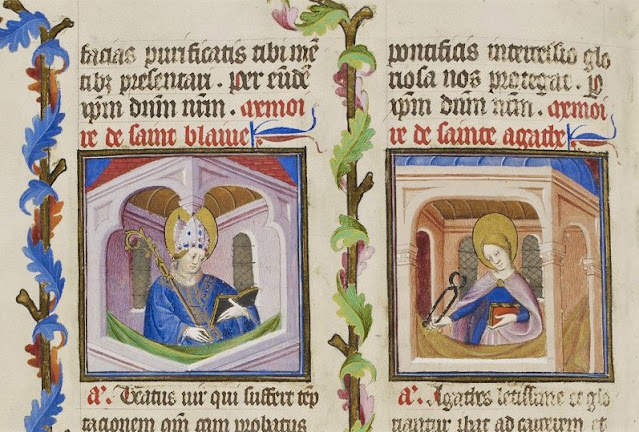
Attributed to Bartelemy d'Eyck, Saints Blaise and Agatha
From the Hours of Rene of Anjou
French (Aix-en-Provence), c. 1442-1444
London, The British Library
MS Egerton 1070, fol. 87v
The feast days of these two saints are February 3 and February 5, respectively.

Early in June of 2013 I inadvertently discovered a smallish lump on the top of my left breast. 

Initially I didn't feel very alarmed because I have been subject to skin cysts and abscesses for my entire life and reckoned on this being just another one.  However, the location is one that any woman should consider an especially sensitive area and worth following up on any change.  So, I quickly made an appointment to see my gynecologist.  

His reaction was more cautious than my own and he suggested some investigation.  There was an ultrasound, which seemed inconclusive, then a biopsy.  There were no results for weeks, July 4th came and went.  No news is generally good news, I thought.


Then, on the early afternoon of July 10th he called with the news that no one ever wants to  hear.  It was cancer.  It was, in fact, a fairly large breast cancer tumor.  My next move, he said was to "begin interviewing" breast surgeons, pronto.  Note the plural.  He was wise enough to know that sometimes you have to see multiple doctors to find the one for you.  He also gave me a couple of names.  

With that announcement my life turned upside down.  I quickly began interviewing doctors as well as investigating hospitals.  I visited doctors from Mount Sinai, New York-Presbyterian and Lenox Hill hospitals, but I eventually settled on a petite woman who is a surgeon at Memorial Sloan-Kettering Hospital, the famous cancer only hospital just a few blocks from my house.  It was a perfect fit.

There were many more tests in store, however.  Sloan-Kettering prefers to do their own tests and preparation work, so I had to do many of these over again.  Also, my primary care doctor wanted to do her own assessment about my ability to undergo the surgery.  So, it wasn't until September 12 that I was operated on.  By then the cancer, which was very aggressive, had grown large enough to be visible under my clothing!  

My left breast was completely removed and a lumpectomy was also done on the right, due to some suspicious cells found in it.  My vanity (and to tell the truth, my laziness) insisted on a reconstruction.  Unfortunately, I turned out to be one of the percentage of women who cannot tolerate the procedure for a reconstruction.  It caused incredible pain and complications and required a second surgery to reverse.  Healing was, therefore, a slow process.  It delayed the beginning of chemotherapy and was complicated by the fact that I had accepted an apartment in a very desirable senior residence in my neighborhood just before the diagnosis.  I paid three months of double rent in order not to lose that apartment and finally moved in mid-December, three weeks after starting chemotherapy.  It was a genuine ordeal.  Chemo ended in April, but it took nearly a year for things like my taste to return to normal.  Fortunately, while I did lose some hair, I never lost all of it.  My hair is very thick and it just thinned out a lot.

In those long, frightening months I gained a new patroness, Saint Agatha, patroness of women with breast cancer.  Thus my first new blog following the surgery was posted in honor of her feast day, which is February 5th. 

Agatha's Story

Agatha is among the most important of the female early Christian martyrs.  She is among those who are named in the Roman Canon, now called Eucharistic Prayer I.  They are, in order:  Felicity, Perpetua, Agatha, Lucy, Agnes, Cecilia and Anastasia.  By virtue of their being named in this most important prayer, used for centuries at almost every Mass, these women have a special place in Christian history and imagination.  Agatha was also believed to be a major influence on one of the other saints in this exclusive list, Saint Lucy, and has for centuries been a frequently imaged figure in Christian art. 


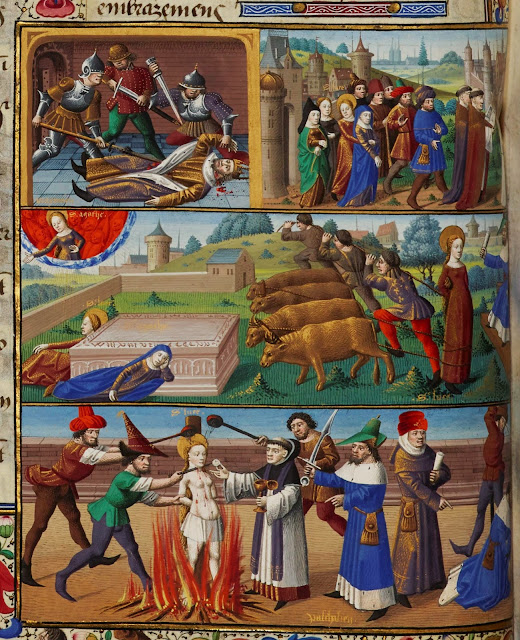
Maitre Francois and Collaborators, Saint Lucy Is Inspired by Saint Agatha, Leading to Her Own Martyrdom
From a Speculum historiale of Vincent of Beauvais
French (Paris), 1463
Paris, Bibliotheque nationale de France
MS Francais 51, fol. 95v


Lorenzo Lotto, Saint Lucy at the Tomb of Saint Agatha
Italian, 1532
Iesi, Pinacoteca Civica


Agatha, properly Agatha of Catania in Sicily, appears to have been martyred during the third century, probably in the persecution under the Emperor Decius.  As is true for many of the early martyrs, there is little doubt about the fact of her martyrdom and her early veneration by Christians.  However, there is virtually no contemporary evidence for the reason and the manner of it, aside from traditional beliefs. 1

According to these beliefs, Agatha was one of that group of early Christian women saints who apparently aroused the ire of their pagan contemporaries by their refusal to marry or to submit to sexual advances because of their Christian faith.  In an era when a woman had virtually no control over her own person, but was subject to the domination of first her father, who decided on her eventual destiny through his decision of whom she should marry, and then of her husband, once married, this refusal was evidence of major rebellion and was deeply unsettling.  Tales abound of the courage and fortitude of these young women as they withstood torture aimed at coercing them to accept arranged or lecherous marriages and efforts to detach them from their adherence to Christ.   In Agatha’s case she is reputed to have attracted the attention of Quintianus, the prefect of the region.  Her refusal of his advances drove him to extremes of cruelty, among which was confinement in a brothel, imprisonment and the eventual horror of cutting off her breasts.   

According to later legends, she was miraculously healed from this terrible injury by an apparition of Saint Peter himself, but eventually died in prison from the results of her ordeals.  


Giovanni Lanfranco, Saint Peter Healing Saint Agatha
Italian, c. 1614
Parma, Galleria Nazionale


I, for one, believe that there is often a kernel of truth in some of these tales, but it is impossible to know at this distance in time, what the true facts were.


Alessandro Turchi, Saint Agatha Attended by Saint Peter and an Angel in Prison
Italian, c. 1640-1645
Baltimore, The Walters Art Museum


Iconography of Saint Agatha

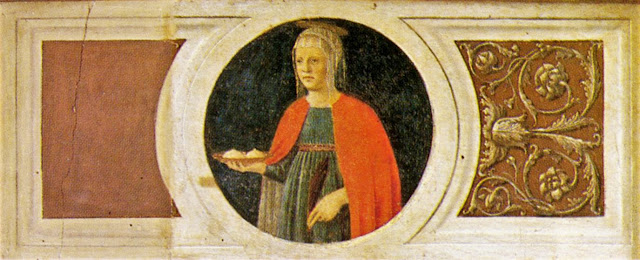
Be that as it may, the belief appears fairly early on that one of her torments was the hacking off of her breasts by the Roman authorities.  Hence, by the Middle Ages, Agatha is frequently shown holding a dish on which are placed her two breasts.  This is her identifying mark, her iconographic symbol.


Piero della Francesca, Saint Agatha
From the Polyptych of Saint Anthony
Italian, c. 1460
Perugia, Galleria Nazionale dell'Umbria


However, the earliest images of Agatha do not make reference to this event.  She appears as early as the sixth century in the procession of female martyrs in the nave of the church of Sant’Appolinare Nuovo in Ravenna.  


Saint Agatha in the Procession of Female Martyrs
Byzantine Mosaic, Second half of 6th century
Ravenna, Basilica of Sant'Appollinare Nuovo

She stands between Saints Agnes (identified by her familiar symbol of the lamb) and Pelagia.  Like most of the saints in the procession (and unlike Agnes) she has no special identifying marks.  Each of the figures stands before a palm tree and carries a crown made of leaves with a jeweled center.  These are traditional references to martyrdom and virtually identical to those borne by the figures of male martyr saints that march down the opposite side of the nave of Sant’Appolinare.


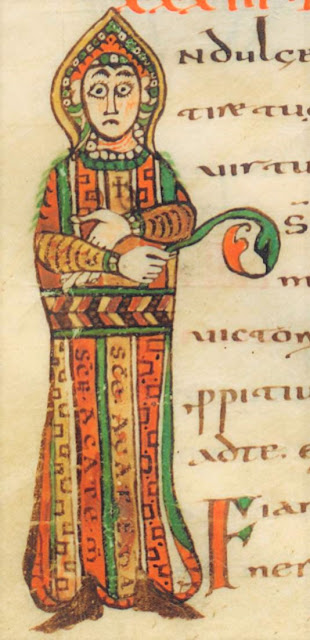
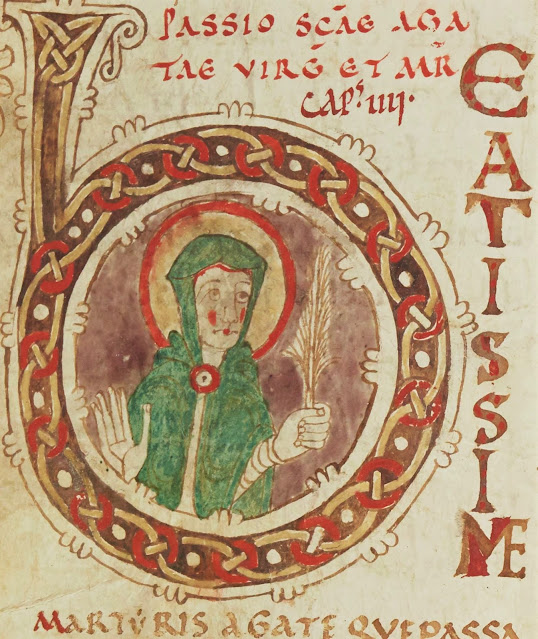
In the early medieval period Agatha appears as a sort of stock figure in illuminated manuscripts.   As in the mosaic at Sant’Appolinare there is no reference to the specific circumstances of her martyrdom. 

Attributed to Henri, Saint Agatha
From the Sacramentary of Gellone
French, c. 775-800
Paris, Bibliotheque nationale de France
MS Latin 12048, fol. 17v
It may be that the protective way in which this little figure of Saint Agatha crosses her arms over her torso is a hint at the manner of her martyrdom.  In her right hand she carries the martyr's palm, highly stylized.


Anonymous, Saint Agatha
From the Legendarium S. Matials Lemovocensis
French (Limoges), 10th-11th Century
Paris, Bibliotheque nationale de France
MS Latin 5301, fol. 44
There is reference to her martyrdom here (the palm), but nothing else.


These references come later in the Middle Ages and in subsequent centuries, when she begins to appear in two guises:  as a saint in heaven holding a specific reference to her ordeal and as the suffering martyr.


Part of the Heavenly Court

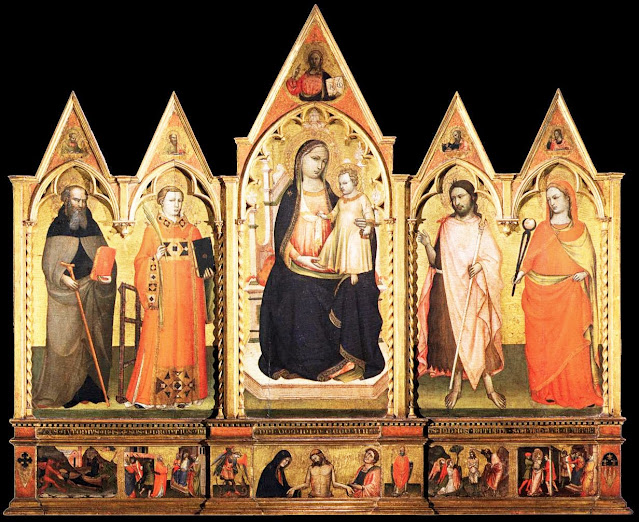
In the images of Agatha as a saint in glory she is frequently shown holding a platter or dish on which repose her breasts.  As the shape of the breasts resembles the shape of bells she is, for this reason, also the patron saint of bronze casters, among whose productions are bells.  


Lorenzo di Niccolo di Martino, Virgin and Child Enthroned with  Saints
Italian, c. 1404
Venice, Collezione Vittorio Cini
In this case she carries the shears with which her breasts were (in some traditions) cut off.


Vecchietta, Virgin of the Assumption with Saints
Italian, c. 1462-1463
Pienza, Cathedral


Francisco de Zurbaran, Saint Agatha
Spanish, c. 1630-1633
Montpelier, Musée Fabre


As the Suffering Martyr

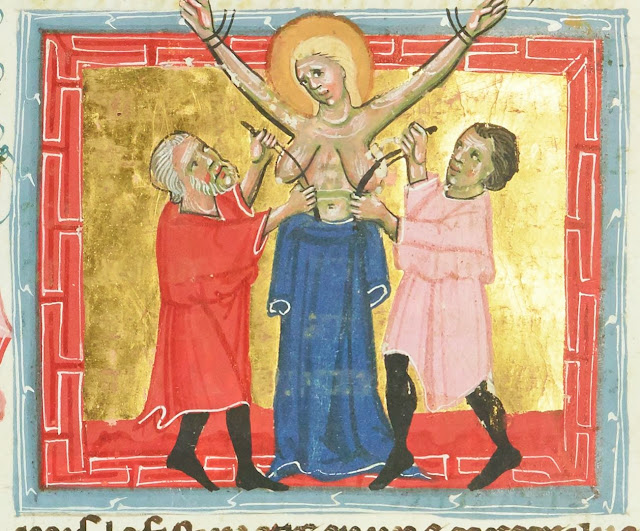
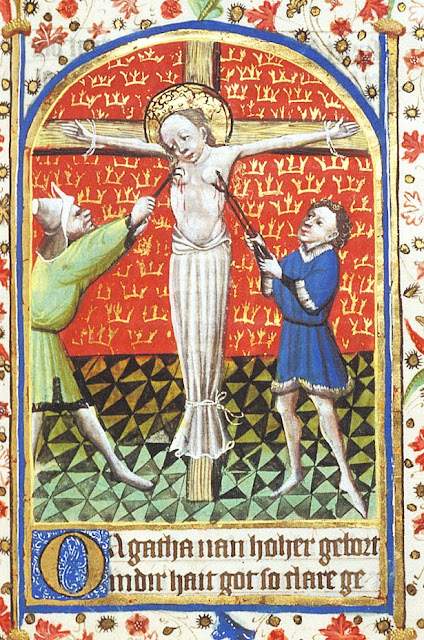
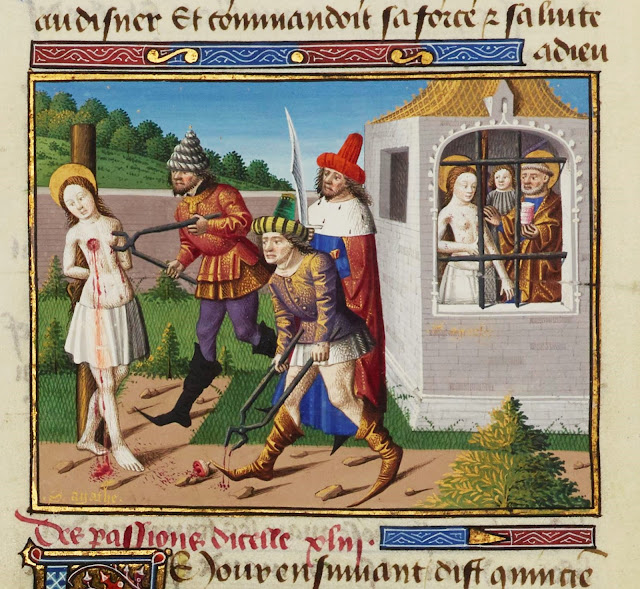
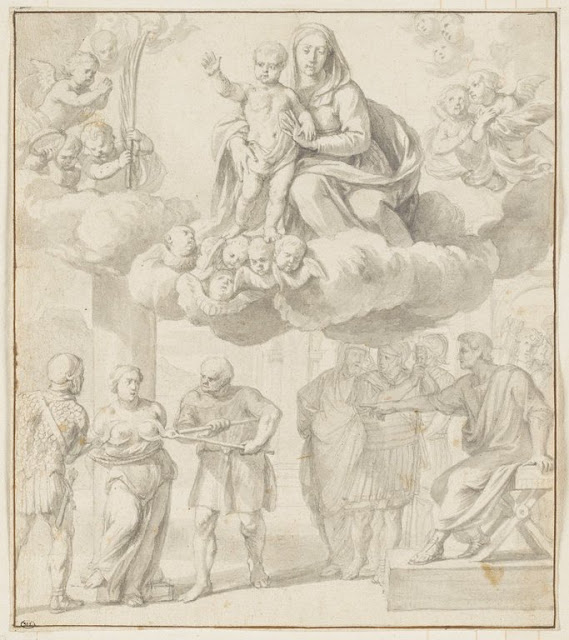
The other, suffering image, which appears to have been equally popular, shows her undergoing the act of her martyrdom, as her breasts are cut off.  This is shown in various ways. 

In most of the earliest of these images she is shown as if on a cross, with arms spread out.  


The Martyrdom of Saint Agatha
From the Carrow Psalter-Hours
English (East Anglia), c. 1250
Baltimore, Walters Art Museum
MS W.34, fol.19v


The Martyrdom of St. Agatha
From the Livre d'images de madame Marie
Belgian (Hainault), c. 1285-1290
Paris, Bibliotheque nationale de France
MS Nouvelle Aquisition Francaise 16251, fol. 97v


The Martyrdom of Saint Agatha
From the Sermons of Maurice de Sully
Italian (Milan or Genoa), c. 1320-1330
Paris, Bibliotheque nationale de France
MS Francais 187, fol. 38v


The Martyrdom of Saint Agatha
From a Prayerbook
Germany (Lower Rhineland), c. 1430-1435
London, British Library
MS Egerton 859, fol.29


In later images she is shown as if chained to a column. 

Maitre Francois and Workshop, The Martyrdom of Saint Agatha
From a Speculum historiale of Vincent of Beauvais
French (Paris), 1463
Paris, Bibliotheque nationale de France
MS Francais 51, fol.15v
On the right side of this image we see the scene of her healing by Saint Peter while in prison. He is attended by an angel.


Sebastiano del Piombo, The Martyrdom of Saint Agatha
Italian, 1520
Florence, Palazzo Pitti


Philippe de Champaigne, The Martyrdom of Saint Agatha
French, c. 1650-1675
Paris, Musée du Louvre


Both postures echo images of the sufferings of Jesus, as He was on the cross or at the scourging at the pillar, and underlines the martyr’s union with the suffering Christ.  Some effort is sometimes made to preserve her modesty, but in most images she is shown naked to the waist, as she probably was in actuality.  Most of the time the torturers attack her with what look like gardening shears or bolt cutters, a truly nasty idea. 

Most of the images have a curiously static, nearly symbolic, feel to them.  They are more like a frozen tableau of implied horror than a true reflection of it. 


However, there is one late image that stands out because it seems to capture the reality of what Agatha must have undergone.  This is a painting by Giovanni Battista Tiepolo now in the Gemäldegalerie in Berlin.  It shows not the moment of torture, but its aftermath. 


Giovanni Battista Tiepolo, The Martyrdom of St. Agatha
Italian, 1726
Berlin, Gemäldegalerie der Staatliche Museen zu Berlin


Agatha has collapsed on what appear to be steps.  She is supported by another woman who holds a bloody cloth up to cover her mutilated torso.  Behind Agatha stand the executioner, holding a bloodied sword, and an assistant, who holds the typical platter with her amputated breasts.  Agatha herself gazes upward toward the heavens, but her face reflects her pain, her shock and her steadfast faith.  

This is an image to which I can fully relate for it mirrors my own feelings about my diagnosis and the surgery that followed it.  Although done to save my life for the time being, the effect of the mastectomy and the painful aftermath has brought me to feel very close to this image of St. Agatha, my newest patron saint.  Even given the advanced surgery of our own time, this loss is a difficult one to come to terms with and, in my own case at least, has been an extremely painful experience.

I am aware that there are some who feel that Agatha should not be the patron of women with breast cancer because she did not lose her breasts to cancer.  I find this attitude ugly and small-minded.  Surely, she is the saint who, in her own sufferings, can relate most closely to those who suffer this mutilation for any reason.  Whether done in sanitary, hospital conditions in order to remove a life-threatening cancer (and I have personally known three women who have died from this disease) or whether done as a brutal act of torture the fact is the same, the pain is real even when mitigated by drugs, the healing is slow, if it happens at all, the loss is permanent.  

So, Saint Agatha, please pray for all women who have to suffer the amputation of breast tissue, for whatever reason. 

© M. Duffy, 2014 and 2024

_________________________________________________________
1.     1.   Kirsch, Johann Peter. "St. Agatha." The Catholic Encyclopedia. Vol. 1. New York: Robert Appleton Company, 1907. 5 Feb. 2014 .