Showing posts with label Body of Christ. Show all posts

Tuesday, June 17, 2025

Resources for Corpus Christi

Jean Bourdichon, Angels Holding the Host for Adoration
From Heures de Frédéric d'Aragon
French (Tours), c. 1501-1504
Paris, Bibliotheque nationale de France
MS Latin 10532, fol. 302


"Jesus said to the Jewish crowds:
"I am the living bread that came down from heaven;
whoever eats this bread will live forever;
and the bread that I will give
is my flesh for the life of the world."

The Jews quarreled among themselves, saying,
"How can this man give us his flesh to eat?"
Jesus said to them,
"Amen, amen, I say to you,
unless you eat the flesh of the Son of Man and drink his blood,
you do not have life within you.
Whoever eats my flesh and drinks my blood
has eternal life,
and I will raise him on the last day.
For my flesh is true food,
and my blood is true drink.
Whoever eats my flesh and drinks my blood
remains in me and I in him.
Just as the living Father sent me
and I have life because of the Father,
so also the one who feeds on me
will have life because of me.
This is the bread that came down from heaven.
Unlike your ancestors who ate and still died,
whoever eats this bread will live forever."

John 6:51-58 
(Gospel for the Solemnity of the Body and Blood of Christ)


The feast of Corpus Christi or Corpus Domini or The Most Holy Body and Blood of Christ is a special feast day of the Church.  It occurs on either the Thursday after Trinity Sunday (in many countries) or on the Sunday after Trinity Sunday (in the United States).  It focuses our attention on the mystery of the Eucharist, in which the bread and wine that we offer are transformed into the true Body and Blood of Christ.


It was officially established for the universal Church in 1264 by Pope Urban IV, who asked St. Thomas Aquinas to compose the liturgical prayers for the feast.  Thomas responded with some of the most beautiful prayers and hymns in the history of the Church.  Artists also developed a complex and fascinating repertoire of images which celebrate the same mystery.  In past essays I have described many of the ways in which artists have responded.  Here is a series of links which you can use to access this material.


Posts Examining the Related Iconography of the Manna in the Desert, an Old Testament Prefiguration of the Eucharist, and the Multiplication of the Loaves and Fish, a New Testament Prefiguration

Prefiguring Salvation –Manna in the Desert and the Bread from Heaven, Part I

Prefiguring Salvation -- Manna in the Desert and the Bread from Heaven, Part II

Prefiguring Salvation -- Manna in the Desert and the Bread from Heaven, Part III

Illustrating Miracles – Multiplication of the Loaves and Fish


© M. Duffy, 2021, 2022, 2023, 2024, 2025


Saturday, March 30, 2024

Meditation on the Passion – In the Tomb

Andrea Mantegna, Lamentation Over the Dead Christ
Italian, c. 1483
Milan, Pinacoteca di Brera

"After this, Joseph of Arimathea,
secretly a disciple of Jesus for fear of the Jews,
asked Pilate if he could remove the body of Jesus.
And Pilate permitted it.
So he came and took his body.
Nicodemus, the one who had first come to him at night,
also came bringing a mixture of myrrh and aloes
weighing about one hundred pounds.
They took the body of Jesus
and bound it with burial cloths along with the spices,
according to the Jewish burial custom.
Now in the place where he had been crucified there was a garden,
and in the garden a new tomb, in which no one had yet been buried.
So they laid Jesus there because of the Jewish preparation day;
for the tomb was close by."


Excerpt from the Passion of Our Lord Jesus Christ According to John
(John 19:92-42)
The Gospel reading for the Good Friday liturgy of the Lord's Passion 


From the late afternoon of Good Friday until the evening of Holy Saturday the Church keeps prayerful, quiet vigil. The tabernacles are empty, the altars are bare, no Mass is celebrated. We remember the second day (from sundown to sundown) of the Passion, the day on which Jesus’ body lies in the tomb. We ponder the sacrifice and await what we know is the joyful outcome. 


Artists have done this also. They have wondered, as we do, about what was happening on that second day. Taking their guide from the phrase in the Apostles Creed “He descended into Hell” some have imagined Jesus freeing Adam, Eve and the righteous ancestors from their bondage in Limbo. Others have imagined the Body of Jesus simply lying in the tomb. Still others have imagined the Body of Jesus tended by angels, who console and prepare Him for the Resurrection. Last year we looked at the first of these.1 This year we will look at the second and third images.

Probably the most astonishing image of the second of these types, the Dead Christ, comes from the brush of Andrea Mantegna, one of the great north Italian painters of the Quattrocento. Often called the Lamentation over the Dead Christ, it shows the body of Jesus, depicted in excruciating detail, in extreme foreshortening, with the nail-pierced feet immediately before our eyes. It is barely a Lamentation, receiving the title only because of the partial inclusion of two people, a man and a woman, at the extreme left edge. The woman is sometimes identified as Mary, but I am doubtful about this. Rather, I think these are two older people of Mantegna’s era and not the richest of his contemporaries either. The woman is shown wiping her eyes, the other figure (presumably a man) is barely visible in profile. This startling image, combining the 1st-century corpse with 15th-century people, still startles us as it must have startled his contemporaries. 

This image, not idealized, detailed, even brutal, became a model for other artists to follow. And, although it was never a popular image, there were followers. Among them were other artists with a realistic, almost scientific bent: Carpaccio, Hans Holbein the Younger, Philippe de Champaigne, Giuseppe Sammartino and others.

In these images we are presented with “just the facts”, a dead body, a cadaver.


Carpaccio, The Dead Christ
Italian, c.1520
Berlin, Gemäldegalerie der Staatliche Museen zu Berliln


Hans Holbein the Younger, The Dead Christ in the Tomb
German, 1521
Basel, Kunstmuseum


Zacharias Hegewald, The Dead Christ in the Tomb
German, c. 1630
Vienna, Kunsthistorisches Museum


Philippe de Champaigne, The Dead Christ
French, Prior to 1654
Paris, Musée du Louvre


Jean Delcour, The Dead Christ
Flemish, 1696
Liege, Cathedral of Saint Paul


Giuseppe Sammartino, The Dead Christ in a Shroud
Italian, 1753
Naples, Church of Santa Maria della Pieta dei Sangro


The last quarter of the nineteenth century saw a flurry of this imagery all over Europe.  This may perhaps be the result of an increased interest in death as a physical phenomenon that accompanied the rise of modern medical science that was taking place at the same time.


Eduard Adrian Dussek. The Dead Christ in the Tomb
Slovak, 1873
Vienna, Belvedere Museum


Wilhelm Truebner, Christ in the Tomb
German, 1874
Hamburg, Hamburger Kunsthalle


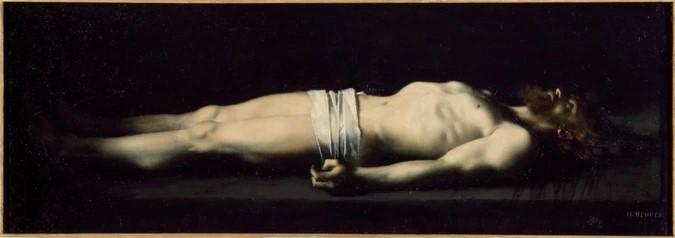
Jean-Jacques Henner, Jesus in the Tomb
French, 1879
Paris, Musée d'Orsay


Alphonse Legros, The Dead Christ
French, 1888
Paris, Musée d'Orsay


Henri Levi, The Dead Christ
French, c. 1893
Villefranche-sur-Saone, MuséPaul Din


Alexandre Charpentier, The Covered Christ
French, 1895
Paris, Musée d'Orsay


Gabriel Ferrier, Sorrow
French, 1903
Arras, Musée des Beaux-Arts


In the third type, the Dead Christ tended by angels, we see something very different. These images have a deep relationship with the Man of Sorrows image, especially the form of the Man of Sorrows in which Jesus is supported by another person. But, in this variation, the humans have been replaced by angels.

The angels are sometimes sad and sorrowing, sometimes busy working on preparing for the Resurrection. They support and prepare His physical Body for its new, glorified existence.


Giovanni Bellini, The Dead Christ Supported by two Angels
Italian, c. 1465-1470
London, National Gallery


Carlo Crivelli, The Dead Christ Supported by Angels
Italian, c. 1470
London, National Gallery


Antonello da Messina, The Dead Christ Supported by an Angel
Italian, c. 1474-1475
Madrid, Museo National del Prado


Giovanni Bellini, The Dead Christ Supported by  Angels
Italian, c. 1474
Rimini, Pinacoteca Comunale


Girolamo da Treviso, The Dead Christ Supported by Two Angels
Italian, c. 1475-1485
Milan, Pinacoteca di Brera


Giovanni Bellini, The Dead Christ Supported by Two Angels
Italian, c. 1480-1485
Berlin, Gemäldegalerie der Staatliche Museen zu Berlin


Pedro Berruguete, The Dead Christ with Two Angels
Spanish, 1480
Milan, Pinacoteca di Brera


The Dead Christ Mourned by Angels
Italian, 16th Century
Rome, Pinacoteca della Basilica di San Paolo fuori le mura


Rosso Fiorentino, The Dead Christ Supported by Angels
Italian, c. 1524-1526
Boston, Museum of Fine Arts
Rosso portrayed a typically Mannerist image of a contorted, unstable body barely supported by the angels.


Baccio Bandinelli, The Dead Christ Supported by Nicodemus
Italian, c. 1554-1559
Florence, Church of Santisssima Annunziata


Leandro Bassano, The Dead Christ Mourned by Angels
Italian, c. 1580
Cleveland, Museum of Arts


Tintoretto, The Dead Christ Adored by the Doges Pietro Lando  and Marcantonio Trevisan
Italian, c. 1580s
Venice, Palazzo Ducale


Veronese, The Dead Christ Supported by Two Angels
Italian, c. 1587-1589
Berlin, Gemäldegalerie der Staatliche Museen zu Berlin


Alessandro Allori, The Dead Christ with Two Angels
Italian, c. 1600
Budapest, National Museum
This tiny painting, painted on copper, is a bridge between the "scientific" Dead Christ and the Dead Christ with Angels.  Here the angels minister tenderly to the Body of Christ, preparing it for its new role. 


The Dead Christ Supported by Angels
German, c. 1600-1625
 London, Victoria and Albert Museum


Jacopo Palma the Younger, The Dead Christ with Two Angels_
Italian, c. 1600
Budapest, Szépmûvészeti Múzeum


Abraham Janssen van Nuyssen, The Dead Christ in the Tomb with Two Angels
Flemish, c. 1610
New York, Metropolitan Museum of Art


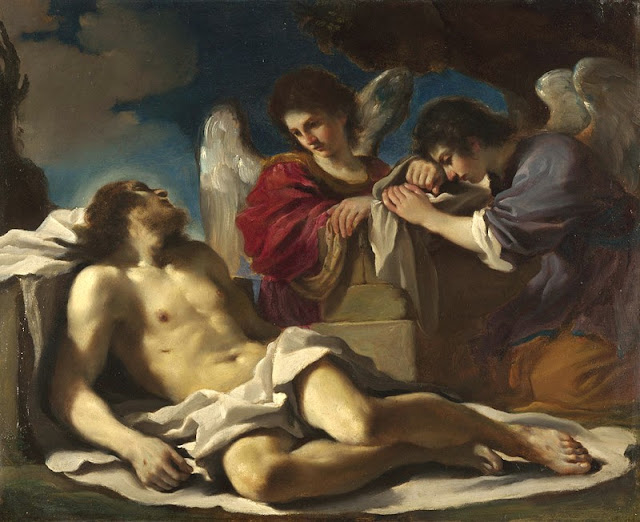
Guercino, Angels Weeping over the Dead Christ
Italian, c, 1517-1618
London, National Gallery


Alonso Cano, The Dead Christ Supported by an Angel
Spanish, c. 1646-1652
Madrid, Museo Nacional del Prado


Francesco Trevisani, The Dead Christ Supported by Angels
Italian, c. 1710
New York, Metropolitan Museum of Art


Edouard Manet, The Dead Christ With Angels
French, 1864
New York, Metropolitan Museum of Art


As he so often did, the French painter Jacques-James Tissot stood out in his interpretation of this theme.  His narrative paintings of the life of Jesus drew on the observations he made while residing in the Holy Land for more than a year.  Consequently, his interpretation of the body of Christ in the tomb is one that accords with the traditional burial customs of the area.  In his work the body of Jesus is not simply laid on a slab with a cloth under it.  It is swaddled in cloth from head to foot, much like a mummy.  This accords with both reality and the Biblical texts.  


James Tissot, Jesus in the Sepulchre
French, c. 1886-1894
New York, Brooklyn Museum


____________________________
1.  See also "O Key of David!  Come, break down the walls of death" at http://imaginemdei.blogspot.com/2011/12/o-key-of-david.html

© M. Duffy, 2012, 2018


Excerpts from the Lectionary for Mass for Use in the Dioceses of the United States of America, second typical edition © 2001, 1998, 1997, 1986, 1970 Confraternity of Christian Doctrine, Inc., Washington, DC. Used with permission. All rights reserved. No portion of this text may be reproduced by any means without permission in writing from the copyright owner.


Saturday, August 25, 2018

Prefiguring Salvation -- Manna in the Desert and the Bread from Heaven, Part III


The Fall of Manna
German, c. 1470
Detroit, Institute of Arts


This is the third of a series of three articles regarding the interpretation of the miracle of the manna and its relationship to Jesus' statements about his flesh as the bread from heaven.  Please be sure to read all three.  Links are provided in the first paragraphs of text below the quotation from Saint John.


"Jesus said to the crowds:
"I am the living bread that came down from heaven;
whoever eats this bread will live forever;
and the bread that I will give
is my flesh for the life of the world."

The Jews quarreled among themselves, saying,
"How can this man give us his flesh to eat?" 
Jesus said to them,
"Amen, amen, I say to you,
unless you eat the flesh of the Son of Man and drink his blood,
you do not have life within you. 
Whoever eats my flesh and drinks my blood
has eternal life,
and I will raise him on the last day. 
For my flesh is true food,
and my blood is true drink. 
Whoever eats my flesh and drinks my blood
remains in me and I in him. 
Just as the living Father sent me
and I have life because of the Father,
so also the one who feeds on me
will have life because of me. 
This is the bread that came down from heaven. 
Unlike your ancestors who ate and still died,
whoever eats this bread will live forever."

John 6:51-58 (Gospel for the Twentieth Sunday in Ordinary Time, Year B, August 19, 2018)

The Miracle of the Manna
From the Egmont Breviary
Dutch (Utrecht), c. 1435-1445
New York, Pierpont Morgan Library
 MS M87, fol. 253r


In this essay we continue to explore the ways in which artists' depiction of the miracle of the manna in the desert (Exodus 16) prefigures the self-giving sacrifice of Jesus and his gift of the Eucharist.

The lectionary for Mass is arranged so that the several portions of John 16 that describe Jesus’ response to the crowd’s request for a miracle are read as the Gospel for the four Sundays of August in Year B.1  

In Part I, we looked at the ways in which the miracle of manna was combined with other Old Testament events to throw light of the events of the New Testament.

In Part II we looked at the ways in which the miracle of the manna was combined with those New Testament events to point to a deeper reality.

Here we continue to explore the iconography of this great miracle, which sustained the Jewish people in their early wanderings and pointed 
the way for an even greater food that was to come for the human spirit.


Additional Images

When considering pictures that depict the scene of the manna in the desert we need to bear in mind that a particular image may be a sole image or it may be the still unidentified part of a larger whole.  

There are a large number of pictures whose original location is often obscure.  They may have a pendant2 picture that was destroyed in one of the numerous European wars, or they may have a pendant that still exists, unrecognized as such, in a public or private collection, possibly now on another continent, or they may indeed be solitary pictures, standing without any reference to another but with no clear indication of their original location and purpose.  

The Master of the Manna, The Israelites Gathering Manna
(Pendant to a panel of the Crucifixion)
Dutch, Late 15th Century
Douai, Musee de la Chartreuse

Simply Gathering

Most of them present the scene of the miraculous fall of manna in the desert as an activity for several people in a group.  Initially all the individuals shown were men, but figures of women and children were soon added.  


The Miraculous Rain of Manna
German, c. 1300
Meldorf, Evangelical Church Of St. John the Baptist

Michiel van der Borch, The Gathering of Manna and Quail
From Rhimebible by Jacob van Maerlant
Dutch (Utrecht), 1332
The Hague, Meermano Museum
MS RMMW 10 B 21, fol. 26r
This is perhaps the most puzzling of all the images I've seen.  I have no idea why all the figures, especially the soldiers, clad in contemporary chain mail look so very glum.  Perhaps it's the monotony of quail and manna every day.  


The Master of Death, Israelites Gathering Manna
From Histoire de la Bible et de l'Assomption de Notre-Dame
French (Paris), c. 1390-1400
New  York, Pierpont Morgan Library
MS M 526, fol. 16


Hektor Mullich and Georg Mullich, The Miracle of Manna
From a German Textual Misellany
German, c. 1450-1460
New York, Pierpont Morgan Library
MS M782, fol. 26v

The Israelites Gathering Manna
Italian, 16th Century
Verona, Santa Maria in Organo


Bernardino Luini, The Israelites Gathering Manna
Italian, c. 1509-1510
Milan, Pinacoteca di Brera


The Dalziel Brothers, After Arthur Boyd Houghton, The Israelites Gathering Manna
English, c. 1865-1881
New York, Metropolitan Museum of Art

James Tissot, The Gathering of Manna
French, c. 1896-1902
New York, Jewish Museum


Scenes with Moses or Aaron

Many of the pictures show the figures of Moses, Aaron or Joshua overseeing the work and sometimes joining in themselves. 

The Israelites Collecting Manna
From Histoires bibliques
French (Saint-Quentin), c. 1350
Paris, Bibliotheque nationale de France
MS Francais 1753, fol. 35
The Israelites Gathering Manna
Woodcut from the Nuremberg Bible
German, 15th Century
Cleveland, Museum of Art
Moses and the Israelites Offering Thanks to God for the Manna
Italian, c. 1415
Riffian, Nostra Signora al Cimitero
This image is rather unusual in that it shows Moses and the people offering thanks to God for the manna.  Usually they are depicted as simply collecting it. 
 
Master of Catherine of Cleves, The Isrealites Gathering Manna with Moses and Aaron
From Hours of Catherine of Cleves
Dutch (Utrecht), c. 1435-1445
New  York, Pierpont Morgan Library
MS M945, fol.137v
 
This is interesting in the way in which it depicts Moses and Aaron.  Moses is the figure at the extreme right, holding a rod and gesturing toward the sky.  He is identifiable by his traditional two "horns".  Aaron is the elaborately dressed figure in the center.  He is identifiable by his two peaked headdress, a sign of his priestly office.


The Fall of Manna
German, 16th Century
London, Victoria and Albert Museum


Bacchiacca, THe Israelites Gathering Manna
Italian, c. 1540-1545
Washington, National Gallery of Art


Jan Sadeler I, After Crispijn van den Broeck, The Israelites Gathering Manna
From Thesaurus sacrarum historiarum veteris testamenti
Flemish, 1585
London, British Museum


Francesco Bassano, The Israelites Gathering Manna
Italian, c. 1590
Richmond-upon-Thames (UK), Ham House, National Trust


Guido Reni, The Israelites Gathering Manna
Italian, c. 1614-1615
Ravenna, Cathedral


Nicolas Poussin, The Israelites Collecting Manna
French, c. 1637-1649
Paris, Musee du Louvre


Jacob Willemszoon de Wet, The Israelites Gathering Manna
Dutch, c. 1650
Ticknall, Derbyshire (UK), Clake Abbey, National Trust


The Israelites Gathering Manna
English, c. 1685-1689
London, Victoria and Albert Museum


Giovanni Battista Tiepolo, The Israelites Gathering Manna
Italian, c. 1750
Oxford, Ashmolean Museum of Art and Archaeology


Unusual Uses
 
Images of the miraculous fall of manna also seem to have been very popular among enamel workers and potters during the sixteenth and seventeenth centuries (i.e., 1500-1700). 
 

Plate with the Gathering of Manna
Italian, c. 1523-1525
London, Victoria and Albert Museum


Orazio Fontana, Wine Cooler with the Israelites Gathering Manna
Italian, c. 1565
Vienna, Kunsthistorisches Museum


Workshop of Pierre Reymond or Jean Reymond, The Israelites Gathering Manna and the Destruction of Pharoah's Host
French, c. 1575-1600
New York, Frick Collection


Antoine Conrade Workshop, A Dish with the Gathering of Manna
French, c. 1620-1645
New York, Metropolitan Museum of Art


A Tabernacle with the Gathering of Manna
Italian, Late 19th Century in the Style of the 17th Century
Philadelphia, Museum of Art


Unusual Images

Every now and then an odd image appears, as for example, the image from a German Book of Hours, dated to 1204, which shows a group of men, wearing typically “Jewish” hats, holding up cloths presumably filled with manna. 
  
The Miracle of the Manna
From a Book of Hours
German (Bamberg),  c. 1204-1219
New York, Pierpont Morgan Library
MS M739, fol. 16r
They stand, immobilized, against a green curtain, on a red colored ground.  Above their heads is the German statement “Hie regent in das himmlische brot vom himmel” (or “The heavenly bread (from heaven) is falling here.”  They are neither gathering manna, nor expressing joy or amazement, or indeed, doing anything except standing.


Another oddity is this seventeenth-century version by Dirk Metius.  
 
Dirck Metius, The Gathering of Manna with a Family Portrait of Willem van Loon, Margaretha Bas and Their Children
Dutch, 1648
Amsterdam, Koninklijke Nederlandse Akademie van Wetenschappen
It is a Dutch family portrait masquerading as a “history” painting.  In it, the family of Willem van Loon and his wife, Margaretha Bas, with their three boys and two girls, pose as a Hebrew family, depositing the manna they have collected in the brass vessel they have reserved for this purpose.

Links to Parts I and II:
Prefiguring Salvation – Manna in the Desert and the Bread from Heaven, Part I,
Prefiguring Salvation -- Manna in the Desert and the Bread from Heaven, Part II

__________________________________________________________
1,  These readings are: 
  • Eighteenth Sunday in Ordinary Time – John 6:24-35  
  • Nineteenth Sunday in Ordinary Time – John 6:41-51
  • Twentieth Sunday in Ordinary Time – John 6:51-58                                                                  
  • Twenty-first Sunday in Ordinary Time – John 6: 60-69


2.  Pendant.  In this sense and usage, means a companion piece.  Pendant paintings are usually ordered together by the patron.  The two (or more) paintings, when seen together, tell a more complete story than can either one alone, or they can illuminate a concept that could not be grasped so easily if shown in one picture.  One useful example, that can clarify what I mean by this, can be found in a recent exhibition in New York.  From February into April of this year the Frick Collection was host to an exhibition of 13 gigantic imaginary portrait paintings by the seventeenth-century Spanish painter, Francisco de Zurbaran.  The subjects were Jacob and his twelve sons.  Twelve of the paintings came from Auckland Castle in County Durham (UK).  One came from Grimsthorpe Castle, in the County of Lincolnshire (UK).  Each painting could easily stand on its own as a great work of art.  However, taken together they tell us something else.  Through the variety of costume, facial expression, gesture and stance, even through their hair styles and hats, they reveal their personalities and the ways in which they have fulfilled the prophecies made on them by their father, revealing their family dynamic and even commenting on their descendants, the twelve tribes of Israel.  So, while seeing each is an interesting aesthetic experience, seeing them together as a group, as they were intended to have been seen, adds many more layers of meaning to the experience for the viewer. 


© M. Duffy, 2018


Excerpts from the Lectionary for Mass for Use in the Dioceses of the United States of America, second typical edition © 2001, 1998, 1997, 1986, 1970 Confraternity of Christian Doctrine, Inc., Washington, DC. Used with permission. All rights reserved. No portion of this text may be reproduced by any means without permission in writing from the copyright owner.

Scripture texts in this work are taken from the New American Bible, revised edition © 2010, 1991, 1986, 1970 Confraternity of Christian Doctrine, Washington, D.C. and are used by permission of the copyright owner. All Rights Reserved. No part of the New American Bible may be reproduced in any form without permission in writing from the copyright owner.