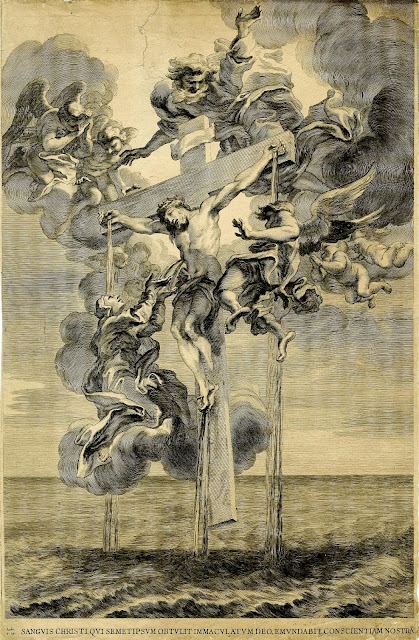
 |
Francois Spierre after Gian Lorenzo Bernini, Sanguis Christi
Italian, c. 1670
London, Trustees of the British Museum |
Since childhood one of my favorite prayers has always been
the Anima Christi:
“Soul of Christ, sanctify me
Body of Christ, save me
Blood of Christ, inebriate me
Water from Christ's side, wash me
Passion of Christ, strengthen me
O good Jesus, hear me
Within Thy wounds hide me
Suffer me not to be separated
from Thee
From the wicked enemy defend me
In the hour of my death call me
And bid me come unto Thee
That I may praise Thee with Thy
saints
and with Thy angels
Forever and ever”1
When I first came upon it as a child I wasn’t even sure what the word “inebriate”
meant. Later I learned that it means
basically to make intoxicated, to make drunk or, as the Merriam-Webster
definition has it “to exhilarate or stupefy as if by liquor”. I like the “to exhilarate” definition
best.
I mention this because one of the most affective images I have ever
seen is an engraving after a drawing by Gian Lorenzo Bernini that was published
in a 1972 article by Irving Lavin, one of my graduate school professors.2 It
shows a dramatic picture of Christ on the cross, raised high in the air,
surrounded by angels, with God the Father in the sky above and the Virgin Mary,
also raised into the air, kneeling to one side.
From the wounds of Christ blood pours in abundance, dropping from His
hands and feet into an ocean of blood already poured out below. From the wound in His side, blood pours into
the hands of His mother. This is the
image that I have carried in my mind for decades whenever I think of the Blood
of Christ which can inebriate. It is the
ocean of Divine Mercy that is available to us.
,%20Teylers%20Museum_2.jpg) |
Gian Lorenzo Bernini, Sangue di Cristo
Italian, c. 1669
Haarlem (NL), Teylers Museum |
Lavin’s 1972 article brought this image to the attention of the art
historical community. He pointed out that
this image was one of the very last works ever made by Bernini, being made when
the artist was 80 years old, two years before his death in 1680. In fact,
only the drawing was made by Bernini, although he commissioned an engraver
named Francois Spierre to make an engraving of it and also commissioned an
unnamed artist to make a painting, which he positioned at the foot of his own
bed. The engraving was actually intended
for use by Bernini’s nephew, Father Francesco Marchese, as the centering image
in a book which he wrote in 1670 called Unica
speranza del peccatore (The Sole Hope of the Sinner) which was
intended to serve as a guide for living a holy life and dying a holy death in
confidence of salvation through the effects of Christ’s sacrifice.
 |
Guillaume Courtois, Il Borgonone after Gian Lorenzo Bernini, The Blood of Christ
Italian, 17th Century
Private Collection
One of three known versions of paintings after Bernini's drawing. |
The visual representation of the saving power of Christ’s Blood has no
echo in our current, visually impoverished age.
Such an affecting image could probably not be produced today. It would probably be dismissed as too
gruesome. But it was not always so. The saving power of Christ’s Blood has a long
visual history in several different, but related groupings, none of them
sparing in their representation of the bloodiness of the sacrifice of Calvary.
The Mystic Winepress
The most common specific image of the saving power of the Blood of
Christ is the image known as the Mystic Winepress or Christ in the
Winepress.
Simply put, the image is one
in which Christ is shown standing, but sometimes lying or sitting, inside a
winepress, as though He was a bunch of grapes, while the pressing beam of the
press bears down on His body and His blood pours into the trough as if it was the
juice of the grape. It is a powerful
image and, to modern eyes, both a bit frightening and a bit bizarre. This is because the modern age has lost the
connections that would have been apparent to those who saw it during the late
middle ages and early modern period, when it was most frequently used.
It is very much a devotional picture, as are,
indeed, all these images of the power of Christ’s Blood. They are to be contemplated and revered as
visual expressions of a truth of faith.
 |
The Mystic Winepress Tapestry
Flemish, c. 1500
New York, Metropolitan Museum of Art
|
The Mystic Winepress was most frequently used in northern Europe. It occurs only rarely in Italy and scarcely
at all in the British Isles. So, one can
say that, with the exception of Italy, it is most frequent in countries where
the winepress was actually used in the production of wine.
The earliest example I could find dates to the end of the 14th
century, but it is already a developed image at this point, so it must have
appeared somewhat earlier in time. Rather
surprisingly, it is one of the few Catholic devotional images that was retained
by the Protestant reformers, who generally loathed and destroyed almost any
kind of religious imagery, especially imagery regarding the Eucharist. However, in both Catholic and Protestant
regions it seems to have mostly died out by 1600, although there is one late example from the
18th century.
 |
Allegory of the Eucharist
German, c. 1470-1490
Washington, National Gallery of Art
|
There are two types of presses in evidence in the images.
One is a contraption in which two stationary uprights
support a beam which is moved down by a centrally placed screw mechanism, or one in which the two uprights are screws which are used to move the central beam.
 |
Christ in the Winepress
German, c. 1400-1450
Karneid, Castle Chapel
 | The Mystic Winepress
From Tafel van den Dersten Ghelove
Dutch (possibly Utrecht), c. 1405-1410
New York, Pierpont Morgan Library
MS M 691, fol. 5r |
|
 |
Christ in the Winepress
Polish, c. 1430-1440
Krakow, Church of St. Francis of Assisi
|
|
 |
Christ in The Winepress
Tile Mold for Pastries
German, c. 1430-1470
Berlin, Kunstgewerbemuseum der Staatliche Museen zu Berlin |
 |
The Man of Sorrows and the Mystic Winepress
From the Hours of Catherine of Cleves
Dutch (Utrecht), c. 1435-1445
New York, Pierpont Morgan Library
MS. M 917-945, fol. 121
Here we see two related images. In the main picture, Christ directs the Blood from his wounded side toward the ground. In the lower margin the Mystic Winepress drains His Blood into the chalice used at Mass, underlining the connection between His death on Calvary and the Eucharistic celebration, the Mass.
|
 |
The Mystic Winepress
French, 1460-1470
Paris, Musée du Louvre |
,%20End%20of%20the%2015th%20Century_Paris,%20BIbliotheque%20nationale%20de%20France,%20MS%20Francais%20166,%20fol.%20123v_1.jpg) |
The Mystic Winepress
From the Bible moralisee de Philippe le Hardi
French (Provence), End of the 15th Century
Paris, BIbliotheque nationale de France,
MS Francais 166, fol. 123v |
 |
The Mystic Winepress
German, c. 1500
Ediger-Eller, Chapel of the Holy Cross |
|
 |
The Mystic Winepress Window
French, 1552
Conches-sur-Ouche, Church of Sainte-Foy |
 |
Anonymous after Maarten van Heemskerck,
The Fall and Salvation of Mankind, Christ in the Winepress
Dutch, 1568
London, British Museum
|
 |
Hieronymous Wierix, Christ in the Winepress
Flemish, c. 1600-1619
London, British Museum |
 |
Anonymous High Altar Frontal, Christ in the Winepress
German, c. 1740
Mindelheim, Jesuit Church of the Annunciation |
The other is a somewhat simpler form in
which there is only one stationary pole on which the beam is looped. At the other end of the trough is a screw on
which the other end of the beam is forced down.
In both kinds of press, the Cross is often substituted for the pressing
beam, so that Christ is pressed by the Cross itself, a further layer of
meaning.
 |
Christ in the Winepress
German or Danish, 15th Century
Brøns (DN), Parish Church |
 |
The Mystic Winepress
From Commentaries on the Gospel of John by Nicholas of Lyra
Austrian (Mondsee), c. 1400-1410
Vienna, Österreichischen Nationalbiliothek
MS cod 3676, fol. 14r
|
 |
Allegory of the Sacraments
German, 16th Century
Colmar, Bibliotheque municipal
MS 306
This image shows the relationship of the Blood of Christ to the sacraments. It is the power house that supplies the graces they confer. Directly below the winepress is the sacrament of the Eucharist, as the priest gives Holy Communion to a keeling lay person. On the left from top to bottom are Confirmation, Baptism and Penance. On the right from the top are Extreme Unction (now the Anointing of the Sick), Ordination and Marriage.
|
 |
Attributed to Bergognone, The Mystic Winepress
Italian, c. 1500
Milan, Santa Maria Incoronata
|
 |
Ego Sum Pastor Bonus
From a Book of Hours
Flemish (Tournai), 16th Century
New York, Pierpont Morgan Library
MS M 78, fol. 3v
|
 |
The Mystic Winepress
German, c. 1500
Munich, Bayerisches Nationalmuseum |
 |
The Mystic Winepress
From the Hours of Ulrich von Montfort
Swiss, ca.1515-1520
Vienna_Oesterreichische Nationalbibliothek
|
 |
Hieronymous Wierix, Christ in the Winepress
Flemish, c. 1600-1619
London, British Museum |
 |
Marco PIno, Christ in Glory above the Mystic Winepress
Italian, c. 1571
Vatican City, Pinacoteca Vaticana
Shown filling jars with the Precious Blood from the winepress are a Pope (probably either Gregory the Great or Urban IV) and Saint Jerome. Two other unidentified saints fill theirs in the background. |
 |
Mystic Winepress Window
French, c. 1600
Paris, Church of Saint Étienne-du-Mont |
The Fons Vitae
A development from the Mystic Winepress is the Fons Vitae or Fountain
of Life. This image is a little less
disturbing than the winepress to modern eyes, while remaining a bit
strange. In these pictures Christ stands
in or near a fountain into which His Blood is poured. In some images it pours directly from His
wounds, while in others it pours from some other source. In several images it is shown as the means by
which the sins of humanity are washed clean and forgiven.
 |
Allegory of the Eucharist
German, c. 1470-1490
Washington, National Gallery of Art
The Blood of Christ flows out to liberate souls in Purgatory.
|
 |
Fons Vitae
From a Diurnal
Dutch, c. 1470-1495
New York, Pierpont Morgan Library
MS W 27, fol. i |
 |
Goswijn van der Weyden, Fons Pietatis
Flemish, c. 1500
Götenborg (SV), Götenborg Konstmuseum
This image, by Rogier van der Weyden's nephew, is a twist on the traditional Mercy. Christ and His Mother kneel on either side of the fountain which is flowing with His Blood and plead for mercy on the souls in Purgatory to the Father who is shown in Heaven. Christ shows His wounds and the Virgin her breast as a reminder of the actions that warrant their pleas. Angels fill and empty chalices of Blood on those suffering in Purgatory.
|
 |
Jean Bellegame, Fount of Life
Flemish, 1500-152
Lille, Musée des Beaux-Arts
In another version of the same idea Bellegame presents us with the image of the way in which the Blood of Christ restores sinners to innocence. At the left, the weary sick souls of sinners enter and remove their garments, watched over by angels. In the center they enter the Fountain of Life, where the Crucified Christ pours His Blood into the fountain for them to bathe in. At the right the rejuvenated souls enter Paradise, welcomed by the saints.
|
 |
Adriaen Collaert after Ambrosius Francken, Faith Purifying Human Hearts with the Blood of Christ
Flemish, c. 1575-1612
London, British Museum
Another image of purification through the Blood of Christ.
|
 |
Jan Baptist Barbe, Fons Vitae with Four Jesuit Saints
Dutch, c. 1593-1649
London, British Museum
|
 |
Matthias Greuter, Allegory of the Fall and Redemption of Mankind
German, 1586-1638
London, British Museum
Here the Blood pours forth from the Lamb of God while Christ beckons the original sinners, Adam and Eve, to be saved.
|
 |
Hieronymous Wierix, Christ as the Fount of Life, Fons Vitae
Flemish, c. 1600
Amsterdam, Rijksmuseum |
The Sea of Blood
Bernini’s image is the culmination of a long series of images, going
back to Crucifixion scenes from at least the early 14th century,
such as the Crucifixion by Giotto in the Arena Chapel in Padua, in which angels
collect the Blood pouring from Christ’s wounds into vessels.
 |
Giotto, The Crucifixion
Italian, c. 1300-1304
Padua, Scrovegni/Arena Chapel |
 |
Attributed to Nicolo da Bologna, The Crucifixion
Single leaf from a Missal
Italian, c. 1390
Cleveland, Museum of Art
|
 |
The Crucifixion
German (Rhenish), c. 1450-1500
Frankfurt-am-Main, Staedelsches Kunstinstitut und Staedtische Galerie |
 |
Fiorenzo di Lorenzo, The Crucifixion
From a Missal (opening of the Canon, the Te Igitur)
Italian (Perugia), c. 1472-1499
New York, Pierpont Morgan Library
MS M 472, fol.131v
|
 |
Raphael, The Citta di Castello Altar
Italian, 1502-1503
London, National Gallery |
 |
Albrecht Dürer, The Crucifixion
from the Large Passion
German, 1510
Braunschweig, Herzog Anton Ulrich-Museum
|
 |
Dominicus Custos, The Crucifixion
Flemish, c. 1580-1612
Wolfenbüttel, Herzog August Bibliothek |
By the 15th century more allegorical images appeared, alongside the traditional Crucifixion image. In these images Christ Himself now purposefully directs a stream of His Blood, usually
from the wound in His side, into a vessel held by an angel or by the
personification of Faith.
 |
Giovanni Bellini, The Blood of the Redeemer
Italian, c. 1460-1465
London, National Gallery
|
 |
Christ and Charity
German, c. 1470
Cologne, Wallraf-Richartz Museum & Foundation Corboud
|
 |
Francesco Granacci, Christ the Redeemer
Italian, Early 16th Century (1500-1543)
Cardiff (UK), National Museum of Wales |
 |
Beham (Hans) Sebald, The Man of Sorrows at the Foot of the Cross
German, 1520
Braunschweig, Herzog Anton Ulrich-Museum
|
 |
Christ with the Instruments of the Passion
From the Hours of Charles V
Flemish (Brussels), c. 1535-1545
New York, Pierpont Morgan Library
MS M 696, fol. 37v |
By the end of the 15th century some images dispensed with specific
references to the event of the Crucifixion and placed Christ’s self-given Blood
into a more timeless realm, a reminder that the effects of the Crucifixion did
not stop with the event, but continue to have impact in the present.
 |
Jesu Salvator Mundi
Hand Colored Woodcut
Dutch, Late 15th Century
London, British Museum |
 |
The Savior Adored by Saint Catherine of Alexandria
and a Female Donor
From a Book of Hours
Flemish (Tournai), 1535
The Hague, Koninklijk Bibliotheek
MS KB 74 G 9, fol. 93v |
 |
Johann Sadeler after Maarten de Vos, The Church as Bride Receiving the Holy Spirit and Precious Blood
Flemish, c. 1576-1590
Wolfenbüttel, Herzog August Bibliothek |
 |
Hieronymous Wierix, The Blood of Christ Venerated by Saints Ignatius of Loyola and Stanislaus Kostka
Flemish, c. 1600-1619
London, British Museum |
 |
Hieronymous Wierix, The Blood of the Redeemer
Flemish, c. 1600-1619
London, British Museum |
 |
Jacob Neefs after David Herregouts, The Victory of the Kingdom of Christ
Flemish, 1649
Amsterdam, Rijksmuseum |
Some decades before Bernini created his image, Anthony van Dyck created one which is close to it in some aspects. Christ hangs, crucified, in a timeless location, while angels collect His blood in golden chalices. The image was widespread through Europe thanks to the engraving made after it by Wenceslaus Hollar.
 |
Anthony van Dyck, The Crucifixion with Angels
Flemish, c. 1632-1641
Toulouse, Musée des Augustins
|
 |
Wenceslaus Hollar, after Anthony Van Dyck
The Crucifixion with Angels
Czech, 1652
Amserdam, Rijksmuseum |
It is into this strain of images that Bernini’s image fits. The Cross is raised on high and the Blood of
Christ pours into the sea below, a sea of endless mercy for sinners.
 |
After Gian Lorenzo Bernini, Sanguis Christi
Italian, c. 1670
Ariccia, Museo del Barroco Romano
One of three known versions of paintings after Bernini's drawing. |
©M.
Duffy, 2017
* The title comes from the first verse of the hymn Pange lingua, written
by St. Thomas Aquinas in 1264 for the Feast of Corpus Christi at the request of
Pope Urban IV.
___________________________________________________________
- The Anima Christi prayer dates from the early fourteenth century and
was not, as was popularly believed, composed by St. Ignatius Loyola, although
he did much to spread its use. See: Frisbee, Samuel. "Anima Christi" The Catholic Encyclopedia,
Vol. 1. New York, Robert Appleton Company, 1907. <http://www.newadvent.org/cathen/01515a.htm>.
- Lavin, Irving. “Bernini’s Death”,
The Art Bulletin, Vol. 54, No. 2 (June, 1972), pp. 158-186. See also, Lavin, Irving. “Bernini’s Sangue di Cristo Rediscovered”, Institute
for Advanced Study Princeton, NJ, unpublished paper available at: <https://publications.ias.edu/sites/default/files/Lavin_Bernini%27sSangueDiCristoRediscovered-2015_Engl.pdf> Also: Petrucci, Francesco. “Il Sanguis Christi di Bernini”, Palazzo
Chigi, Ariccia, Lazio, Italy. Available
at < http://www.palazzochigiariccia.it/img/dipinti_inediti_barocco_romano/pdf/Bernini_Sanguis_Christi.pdf>
,%20c.%201501-1503_Paris,%20BNF_MS%20Latin%2010532,%20fol.%20302v.jpeg)


,%20Teylers%20Museum_2.jpg)


,%20End%20of%20the%2015th%20Century_Paris,%20BIbliotheque%20nationale%20de%20France,%20MS%20Francais%20166,%20fol.%20123v_1.jpg)


