Wednesday, April 23, 2014

An Awkward Resurrection Image

A Happy and Blessed Easter season to all!  The Lord is Risen!

This will be an interruption to my series of postings on the issue of the identification of the figure seated to the Jesus' left in the DaVinci Last Supper.  But I just couldn't resist an image I recently found of the Resurrection.  It definitely caused me to smile when I found it and I would like to share it with you.

Several years ago I wrote a series of essays for this blog regarding the iconography of the Resurrection. (See postings for April and May 2011 in the panel at the right of this web page.)  One of the essays was entitled Climbing From the Tomb.  In it I described one of the earliest depictions of the actual event of the  Resurrection.  In  this somewhat awkward and static treatment of the subject artists showed Jesus literally climbing from the grave.  It was superseded as time went on my more dynamic images as Jesus first hovered over, then finally burst from, the tomb.

This year, while trawling the growing body of images available on the internet from institutions around the world, I came across an image in a manuscript preserved here in New York at the Morgan Library.  It is a curious composition, more awkward than any that formed part of my original group of images of climbing.
Resurrection of Jesus from Book of Hours
French (Paris), 1485-1495
New York, Morgan Library
MS H3, fol. 199r

The manuscript is a Book of Hours, a medieval prayer book used mostly by the laity and often illustrated lavishly.  This particular book was painted in Paris in the last few decades of the fifteenth century.

The image in question clearly derives from the image of the Man of Sorrows (about which I also wrote in 2012).  The artist has modified a fairly standard image of the Man of Sorrows, that is Jesus shown in a state, sometimes dead and sometimes half awake, emerging half way from the tomb to display His wounds.  He has modified the gesture of Jesus toward the wound in His side into a gesture of blessing and covered the other hand in drapery.  The amusement enters when we see how he has introduced the "climbing" element.  He has added a curiously disembodied leg to the outside of the tomb.  It has no real relationship to the body of Jesus, except that provided by a swirl of drapery.   Its position is not one that is realistic in any sense of the word.  It's merely a sort of pasted on addition to an already familiar pose.  Seeing it shows that the painters of the other images I wrote about in 2011 were obviously more advanced in their ability to present a believable figure than the illuminator who prepared this book.

The derivation of this particular image in the Morgan Book of Hours is not surprising when you notice that this book (available for viewing on the Morgan website (here) has more images of the Man of Sorrows than I have ever seen.  Obviously, the illuminator was comfortable with this particular image and it colored every image where it could be used.  Indeed, even his many images of Christ in other situations are basically modifications of the same pose.   He appears to have had one basic image that he used over and over and over in this Book of Hours.

Friday, April 18, 2014

Man or Woman 5: St. John the Evangelist or Mary Magdalene? – Witnesses to the Crucifixion

Andrea de Firenze, Crucifixion
Italian, 1470-1377
Vatican City, Pinacoteca


“Standing by the cross of Jesus were his mother and his mother’s sister, Mary the wife of Clopas, and Mary of Magdala.  When Jesus saw his mother and the disciple there whom he loved, he said to his mother, “Woman, behold, your son.”  Then he said to the disciple, “Behold, your mother.” And from that hour the disciple took her into his home.” (John 19:25-27)

Each of the Gospels provides a listing of the witnesses to the Crucifixion, but only John mentions the presence of the Virgin Mary, mother of Jesus, and “the disciple whom he loved”, who is traditionally believed to be John himself.  Mark (Mark 15:40) and Matthew (Matthew 27:56) give us the names of Mary Magdalene and Mary, the mother of James and Joseph (or Joses) and another woman who is identified as the mother of the sons of Zebedee by Matthew and as Salome by Mark.  Luke mentions only that “all his acquaintances stood at a distance, including the women who had followed him from Galilee and saw these events” (Luke 23:49).
 
Yet, it is the description in the Gospel of John that has formed the visual imagery of the Crucifixion, almost from the earliest times.  This may be due to the extra drama introduced by the dialogue between Jesus, Mary and John, in which Jesus, as it were, gives his mother a new son and gives his disciple a second mother.  
Anonymous, Rabula Gospels
Syrian, 586
Florence, Biblioteca Medicea Laurenziana
MS Plutei 01.56, fol. 13r

It is this trio of Jesus, Mary and John that has formed our core image of the Crucifixion from as early as the sixth century.  In the Rabula Gospels, written in Syria in the late sixth century, we see this already to be true.  Other persons may be included in images of the Crucifixion, but these two figures are always there.  And the figure of John, while unmistakably dressed in male clothing, is always an image of the young, beardless man. 

  
Pontificale Shirborniensis, Crucifixion
English (Canterbury), 875-900
Paris, Bibliotheque nationale de France
MS Latin 943, fol. 4v


Missale S. Dionysii, Crucifixion
French (Arras), ca. 1050
Paris, Bibliotheque nationale de France
MS Latin 9436, fol. 16


Ivory, Crucifixion
Byzantine, ca. 950
New York, Metropolitan Museum of Art


Gospel Book, Crucifixion
German (Pruem), ca. 1100-1130
Paris, Bibliotheque nationale de France
MS Latin 17325, fol. 28


Apse Mosaic (detail)
Italian, 1130s
Rome, Basilica of San Clemente


Psalter, Crucifixion
English (possibly London), 1220-1230
New York, Morgan Library
MS G25, fol. 2v


Psalter of St. Louis and Blance of Castille
Crucifixion
French, ca. 1225
Paris, Bibliotheque nationale de France
MS Arsenal 1186, fol. 24


Ivoy Pax, Crucifixion
South German, ca. 1360-1370
New York, Metropolitan Museum of Art. the Cloisters


Rogier van der Weyden, Crucifxion
Netherlandish, ca. 1460
El Escorial, Monastery of St. Lorenzo


Pietro Perugino, Calitzin Triptych (center)
Italian, 1481-1485
Washington, D.C., National Gallery of Art


So ubiquitous were these images that nearly every church, even many of the most humble, included a statuary group of three figures, Jesus, Mary and John. 


Choir Screen, Crucifixion
German, ca. 1245
Naumberg, Cathedral


Hans Bol, Francois-Hercule de France
attending Mass from Prayer Book
Belgian (Antwerp), 1582
Paris, Bibliotheque nationale de France
MS Latin 10564, fol. 6v
Here we see a contemporary portrait of the Duke of Alencon, suitor of Elizabeth I,
attending Mass.  In the background we can see an example of a choir screen as it
appeared from inside the choir of the church.


This group might stand at the entrance to the church or atop a screen between the altar area and the nave (called in England a rood screen, from the old English word for cross).  Most were demolished in the Reformation and during subsequent centuries, but some survive in situ and parts of others survive in museums and private collections. 


Anonymous, Mourning Virgin
Austrian (Tyrol), 13th Century
New York, Metropolitan Musuem of Art
Anonymous, St. John the Evangelist
Austrian (Tyrol), 13th Century
New York, Metropolitan Museum of Art


Interestingly, the one person about whose presence there is complete agreement in the Gospels is Mary Magdalene.  Clearly, she was a witness.  However, it is not she who is shown at all times and in all places. Her presence appears primarily in later images of the Crucifixion, apparently beginning in the 14th century.


Giotto, Crucifixion
Italian, 1304-1306
Padua, Arena Chapel


Duccio, Crucifixion
Italian, 1308-1311
Siena, Museo dell'Opera del Duomo


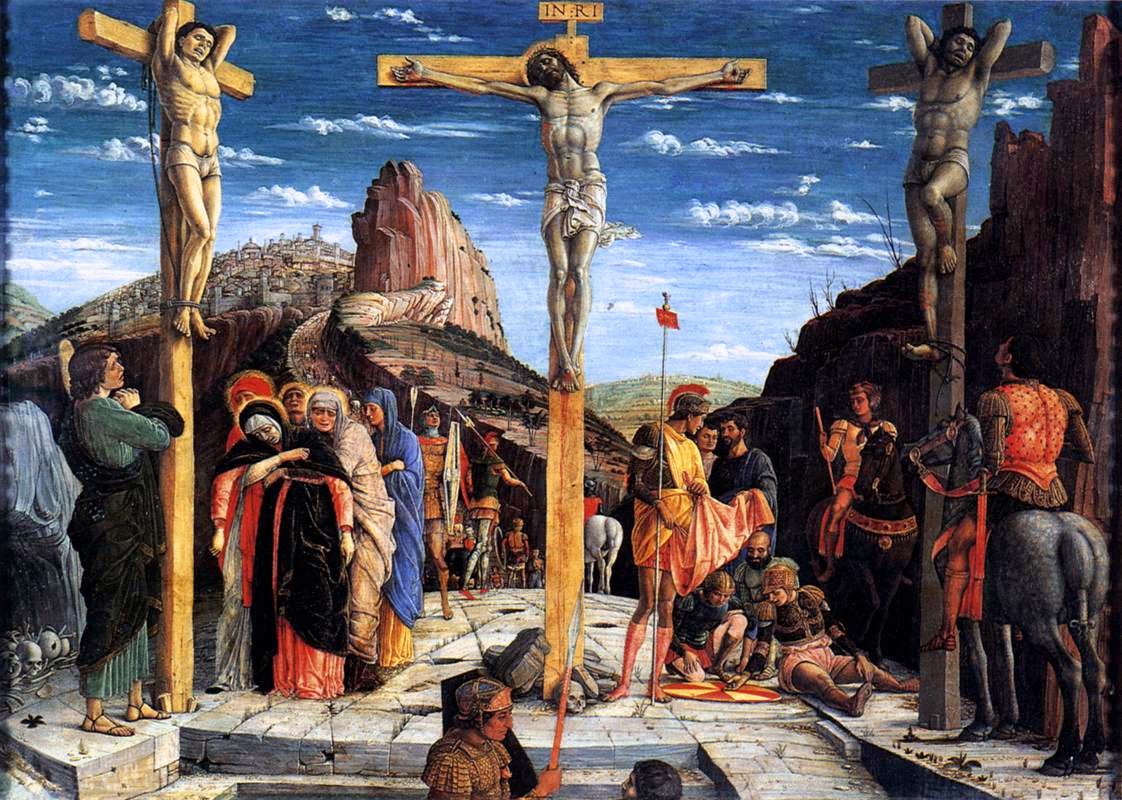
She is clearly distinguished from John whenever she is shown.  John is always shown in relation to the Virgin Mary, either as her exact pendant figure (one on each side of the cross) or as her masculine supporter.  Mary Magdalene is frequently seen only in relation to Jesus.  She is the emotionally reactive figure, kneeling at the foot of the Cross or bewailing the event.  She is usually shown in somewhat more extravagant feminine garb that the usually conservative Virgin.  Also she often, though not always, appears with unveiled hair.  She is very clearly female.  And her femininity reinforces John’s masculinity. 


Jan van Eyck, Crucifixion
Netherlandish, 1420-1425
New York, Metropolitan Museum of Art


Massaccio, Crucifixion
Italian, ca. 1426
Naples, Museo Nazionale di Capodimonte


Andrea Mantegna, Crucifixion
Italian, 1457-1459
Paris, Musee du Louvre


Anonymous, Crucifixion from
a Book of Hours
Franch (Paris), 1495-1500
New York, Morgan Library
MS H5, fol. 79r


Matthia Gruenwald, Crucifixion (central panel of the Isenheim Altar)
German, ca. 1515
Colmar, Musee d'Unterlinden


Gerard David, Crucifixion
Flemish, ca. 1515
Berlin, Staatliche Museen


Bernardino Luini, Crucifixion
Italian, ca. 1530
St. Petersberg, Hermitage


El Greco, Crucifixion
Greco-Spanish, 1598-1600
Madrid, Museo Nacional del Prado


Simon Vouet, Crucifixion
French, 1622
Genoa, Chiesa del Gesu


Nicolas Tournier, Crucifixion
French, ca. 1635
Paris, Musee du Louvre


Francesco Conti, Crucifixion
Italian, 1709
Florence, Basilica of San Lorenzo
Here the emotions that were building up over several centuries have exploded and St. John,
who  unusually sports a light beard, seems to have been overcome with as much emotion as
Mary Magdalene or the Blessed Virgin.


Constantine Brumidi, Crucifixion
Italian-American, 1870-1880
New York, Church of the Holy Innocents


Salvador Dali, Crucifixion (Corpus Hypercubus)
Spanish, 1954
New York, Metropolitan Museum of Art
More a concept than a work of visual storytelling Dali's picture is unusual in including only
the image of Mary Magdalene.


Nothwithstanding a few solitary examples, there is not, nor ever was, any visual confusion that John, a young beardless man, is the primary witness to the Crucifixion, in spite of the fact that the three Synoptic1 Gospels tell a somewhat different story!


© M. Duffy, 2014/2024

_____________________________________________
1. The Synoptic Gospels are the three Gospels attributed to Matthew, Mark and Luke, which share many of the same stories and other material, as opposed to the very different, more theologically oriented, Gospel of John.

Tuesday, April 8, 2014

Man or Woman 4: St. John the Evangelist or Mary Magdalen? -- Martyrdom, Miracles and Death of St. John the Evangelist

Anonymous, Martyrdom of St. John the Evangelist in Boiling Oil 
From a Psalter
Netherlands (Ghent), c. 1250-1275
London, British Library
MS Burney 345, fol. 70r


Previously, we have examined the ways in which St. John the Evangelist is depicted as an evangelist and have demonstrated that the figure often seen holding a chalice is also a depiction of a legendary incident in the life of John.  Now we will look at some other images of John generally based on legendary accounts.


As previously mentioned, John is traditionally known to have died in old age.  His death is generally presumed to have taken place at Ephesus in what is now Turkey.  This death in old age is unique among the apostles, most of whom met violent deaths as martyrs.  There were, however, non-canonical (i.e., not Biblical) stories that said that John had indeed suffered martyrdom, but had survived his ordeals.  


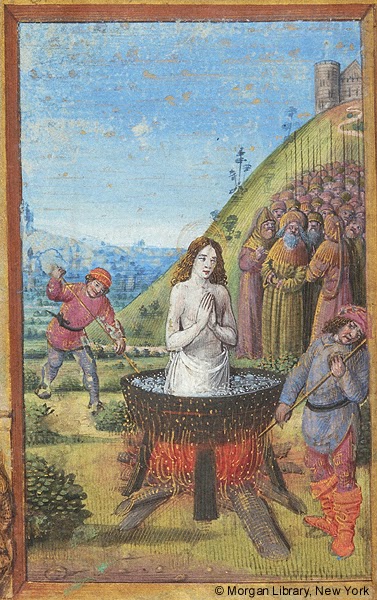
The story of his survival from poisoning inspired the account that provided the inspiration for the image of John holding the chalice that we looked at last.  He was also reputed to have been boiled in oil, once again by order of Emperor Domitian, but, like the Hebrews in the fiery furnace, to have emerged unhurt. 


This tradition was already well established by the year 200 when it was included by Tertullian, the early Christian writer from North Africa, in his Prescription against heretics: 
 "Since, moreover, you are close upon Italy, you have Rome, from which there comes even into our own hands the very authority (of apostles themselves). How happy is its church, on which apostles poured forth all their doctrine along with their blood! Where Peter endures a passion like his Lord's! Where Paul wins his crown in a death like John's,1  where the Apostle John was first plunged, unhurt, into boiling oil, and thence remitted to his island-exile!” 2 


Sarum Master, John the Evangelist Before Domitian and Martyrdom in Boiling Oil
From a Bible
English (Salisbury), c. 1250
Paris, Bibliotheque nationale de France
MS Francais 403, fol. 2


In the images of John’s martyrdom in the vat of boiling oil the figure is shown stripped.  Therefore there can be no question that this is a male figure.  However, in virtually all of them he is shown as the young, beardless man seen in the majority of images as evangelist and as the holder of the poisoned chalice.

Anonymous, Martyrdom of St. John the Evangelist in Boiling Oil
From a Psalter
German (Hildesheim), c. 1230-1240
Paris, Bibliotheque nationale de France
MS Nouvelle Acquisition Latine 3102, fol. 3v


Richard de Montbaston, Martyrdom of St. John
the Evangelist in Boiling Oil from
Legenda Aurea of Jacobus de Voragine
French (Paris), 1348
Paris, Bibliotheque nationale de France
MS Francais 241, fol. 122r


Bedford Master, Martyrdom of St. John Evangelist
in Boiling Oil, from Book of Hours
French (Paris), 1430-1435
New York, Morgan Library
MS M 359, fol. 13v


Anonymous, Martyrdom of St. John Evangelist
From a  Book of Hours
French (Tours), c. 1505-1515
New York, Morgan Library
MS M 250, fol. 137v


Charles le Brun, Martyrdom of St. John the Evangelist at the Porta Latina
French, c/ 1641-1642
Paris, Saint-Nicolas du Chardonnet


Daniele Ricciarelli (known as Daniele da Volterra), Martyrdom of St. John the Evangelist
Italian, c.1550-1566
Douai, Musee de la Chartreuse


There are also images of his preaching and miracles, which come from such apocryphal sources as the Acts of John and the later, popular, compilation of the Golden Legend. There are tales of conversions and of raisings from the dead, as well as other miracles. In all of these John is almost always depicted as the young, beardless man.


Sarum Master, St. John Evangelist Preaching and Overturning Idols at the Temple of Diana
From a Bible
English (Salisbury), c. 1250
Paris, Bibliotheque nationale de France
MS Francais 403, fol. 44r


Sarum Master, St. John Evangelist Preaching and the Baptism of Drusiana
From a Bible
English (Salisbury), c. 1250
Paris, Bibliotheque nationale de France
MS Francais 403, fol. 41v

Sarum Master, St. John Evangelist Returning to Ephesus, the Raising of Drusiana and the Miracle of the Two Poor Young Men
From a Bible
English (Salisbury), c. 1250
Paris, Bibliotheque nationale de France
MS Francais, 403, fol. 43v


Mahiet and Assistants, Miracle of the Two Poor Young Men
From Speculum historiale of Vincentius Bellovacensis
French (Paris), c. 1335
Paris, Bibliotheque national de France
MS Arsenal 5080, fol. 119


It is only in the rare images of the death of John, as related in the Acts of John, that we see him as an older bearded man.  
Sarum Master, Death of St. John Evangelist
from Bible
English (Salisbury), ca. 1250
Paris, Bibliotheque nationale de France
MS Francais 403, fol. 44v (detail)
Note that John is shown here as bearded and with a tonsure, but
his soul, being carried to heaven by angels, is shown as
a beardless youth.

Jean Poyer, Death of St. John Evangelist
from Hours of Henry VIII
French (Tours), ca. 1500
New York, Morgan Library
MS H8, fol. 174r
Note that the bottom half of the page includes an image from Revelations in which a
youthful John also holds the poisoned chalice.


Jean Jouvenet, Apotheosis of St. John the Evangelist
French, ca. 1702
Rouen, Musee des Beaux-Arts
Yet, even here, where the soul of John is shown being received in heaven, that soul is the young, beardless man with whom the viewers were most familiar that is shown.


© M. Duffy, 2014/2022__________________________________________________ 
1.       Reference is to the death by beheading of both St. Paul and St. John the Baptist.

2.       Tertullian, Prescription against heretics, Chapter 36.  Translated by Peter Holmes. From Ante-Nicene Fathers, Vol. 3. Edited by Alexander Roberts, James Donaldson, and A. Cleveland Coxe. (Buffalo, NY: Christian Literature Publishing Co., 1885.) Revised and edited for New Advent by Kevin Knight. <http://www.newadvent.org/fathers/0311.htm>.