Friday, February 6, 2015

The Joyful Mysteries – The Annunciation, Part V: Telling The Whole Story

Some images of the Annunciation try to place the event in the context of other events which are related to it.  They can be thought of as didactic images, telling us something that will add to our understanding of the miraculous event that is the primary focus of the work of art.

Fra Angelico, Annunciation
Italian, ca. 1426
Madrid, Museo Nacional del Prado
This great painting by Fra Angelico surrounds the Annunciation with two parts of the "whole" story.  Adam and Eve are excluded from Paradise at the left while, in the pradella at the bottom, are scenes from Mary's life.

Among the possibilities for storytelling in this way are images that include:

Adam and Eve
Master of the Rouen Echevinage, Annunciation
French (Rouen), 1495-1505
New York, Pierpont Morgan Library
MS M 129, fol. 21r


As previously noted in other articles (notably here), by the mid-second century (ca. 150 AD) St. Paul’s idea of equating Christ with Adam as a new creation, who through His obedient acceptance of the human condition and human death cancelled the sin of Adam, the first human (1 Corinthians 15:21-22), had taken root and been expanded to identify Mary as the new Eve.  By her obedient acceptance of and acquiescence to God’s word Mary had cancelled out the sin of Eve, the first woman and the first to cooperate with evil.


Thus, it is not surprising to find the image of Adam and Eve as a secondary focus in scenes of the Annunciation.  We find it in the background or in the decoration of the space in which the Annunciation scene is set.   As we have seen, even the setting of the Annunciation in a garden has this resonance.  But some images make the connection very definite.  In the image at left, statues of Adam and Eve are positioned on the arch under which Mary and Gabriel are standing.  They are literally overseeing the scene.


Prototypes

In addition to pictures that include the one scene of temptation and fall is a category that includes other prototypes.  This tradition appears as early as the 12th century in the famous Klosterneuburg altarpiece by the Mosan metalworker, Nicholas of Verdun and was made especially popular in the later Middle Ages through the medium of the Speculum humanae salvationis or the Biblia pauperum which were books directed particularly toward the laity.  The typical form was to combine a scene from the life of Christ (Time Under Grace) with two Old Testament scenes, the first from the books that dealt with the history of the world up to the giving of the Ten Commandments (Time Before the Law), the second from the subsequent history of Israel (Time Under the Law).    In this scheme, the scene of the Annunciation (from Under Grace) appears sandwiched between the Temptation of Eve or the Fall of Man (Before the Law) and another scene, frequently that of Gideon and the Fleece (Under the Law).

Rambures Master, Annuciation with Prototypes (Temptation of Eve and Gideon and the Fleece)
from Biblia pauperum
Northern France (Hesdin of Amiens), ca, 1470
The Hague, Meermano Museum 
MS MMW 10A 16, fol. 21r


I have described the image of the Temptation and/or Fall (from Genesis) several times (notably here).  The image of Gideon and the Fleece is less well known.  It is taken from the Book of Judges (Judges 6:36-40).  This tells the story of how, Gideon, needing reassurance that God is actually asking him to undertake the defense of Israel, challenges God to give him a sign. 
 “Gideon said to God, “If indeed you are going to save Israel through me, as you have said,
I am putting this woolen fleece on the threshing floor, and if dew is on the fleece alone, while all the ground is dry, I shall know that you will save Israel through me, as you have said.”
That is what happened. Early the next morning when he wrung out the fleece, he squeezed enough dew from it to fill a bowl.
Gideon then said to God, “Do not be angry with me if I speak once more. Let me make just one more test with the fleece. Let the fleece alone be dry, but let there be dew on all the ground.”
That is what God did that night: the fleece alone was dry, but there was dew on all the ground.”

The medieval imagination saw this event (what we might call a double-blind challenge to God) both as a prototype for the miraculous impregnation of the Virgin Mary by the Holy Spirit (the fleece impregnated with dew) and as a reference to her perpetual virginity (the fleece kept dry).  It is also in keeping with other images, drawn from the Old Testament, that the liturgy of the Church uses when referring to the Incarnation, such as the well-known verse from Isaiah, known as the Rorate Caeli from its Latin words, that is used frequently during Advent, the liturgical period of four weeks of preparation for Christmas (“Let justice descend, you heavens, like dew from above, like gentle rain let the clouds drop it down.  Let the earth open and salvation bud forth; let righteousness spring up with them! Isaiah 45:8) 1

Jan Joest of Kalkar, Annunciation
Dutch, 1508
Kalkar Kleve, Church of St. Nicholas
In the background of the Annunciation we see Gideon with the fleece on the left
and the Meeting at the Golden Gate between Mary's parents at the right.


Mary’s Background History
A third way in which artists expanded the Annunciation iconography with other references is by including scenes from the apocryphal texts that gave details of the lives of her parents, Joachim and Anne, and of the story of her own conception.  In some pictures, the Annunciation is surrounded with the scenes of her family story from the rejection of Joachim’s sacrifice because he is childless, to the separate annunciations of Mary’s birth to her parents, their meeting at the Golden Gate of Jerusalem, Mary’s birth, her presentation by her parents for service in the Temple, the choice of Joseph as her future husband and her betrothal to him.

Fra Angelico, Predella of Prado Annunciation
Italian, ca. 1426
Madrid, Museo Nacional del Prado
The predella of the Prado Annunciation (at top of page) presents scenes from the life of Mary.  From left to right:  the Betrothal of Mary and Joseph, the Visitation, the Adoration of the Magi, the Presentation of Jesus in the Temple, the Assumption of the Virgin Mary.

Master of Philippe of Guelders, Annunciation
from a Book of Hours
French (Paris), 1435-1515
New York, Pierpont Morgan Library
MS M 117, fol. 28r
The scene of the Annunciation is surrounded by smaller images from the lives of Mary's parents, Joachim and Anne.


 All these images have a didactic purpose.  They are trying to offer the viewer a more complete sense of the importance of the central image and its place in the continuing history of Israel.


Annunciation
from a Book of Hours
French (Rouen), 1450-1500
Paris, Bibliotheque nationale de France
MS Nouvelle acquisition latine 3134, fol. 25r

It should be remembered as well, that many of the pictures that we see today as independent panels or canvases may have originally come from situations that are similar to those I have discussed.  But, whereas the images I am showing here included these ancillary scenes within the one piece, it was far more common to include an Annunciation in a location where it was but one of a series of paintings telling the more complete story, for the event of the Annunciation is both an end and a beginning. 


Petrus Christus, Annunciation
Flemish, 1452
Bruges, Groeninge Museum
This image combines the Annunciation with the past and the future.  Images of the prophets and from the history of Joachim and Anne are the sculptures that surround the doorway and the Coronation of Mary as Queen of Heaven is the image in the roundel at the top of the stained glass window.


It is the end of the story of God’s dealings with humanity from Creation on that can be grouped under the medieval categories of Before the Law and Under the Law.  

Chief Associate of Maitre Francois, Annunciation
from The Phoenix Hours
French, 1475-1499
New York, Columbia University Library
Rare Books and Manuscripts Division
MS BP 96, fol. 33

At the same time, it is the first event in the recreation of the world in a renewed time, which can be designated as the time Under Grace.   Through her assent to the angel’s message, the Divine Word enters the world and remakes it through His life, death and resurrection.  Time is renewed and sanctified and humanity is given the means of salvation.  

© M. Duffy, 2015


    1.  Raw, Barbara C., “As Dew in Aprille”, The Modern Language Review, Vol . 55, No. 3, 1960, p[p. 411-414.

Scripture texts in this work are taken from the New American Bible, revised edition © 2010, 1991, 1986, 1970 Confraternity of Christian Doctrine, Washington, D.C. and are used by permission of the copyright owner. All Rights Reserved. No part of the New American Bible may be reproduced in any form without permission in writing from the copyright owner.


Wednesday, February 4, 2015

Mary's Birthday

The 14th Century Virgin of Notre Dame de Paris 
 
 
The host site for this blog collects lots of 
statistics, for example, how many visitors for each day, week, month; where in the world they are coming from; what sites are referring them to this blog; what search engines they are using; what operating systems their computers have and, among some other things, what questions they are inputting to the search engines they are using.
 
 In recent weeks I have noted that one question keeps recurring.  It is "Mary's birthday is ..... March?"  Well, the question is a good one, but the presumption on which it is based is a bit of a problem because Mary's birthday is not in March at all.

There is probably a conflation going on here in the mind or minds of the questioners.  The two things being conflated are both events in the life of the Blessed Virgin Mary and both are feasts of the Church.  One is in March, but the other one is in September.
  
The Annunciation, about which I have recently been blogging quite a lot (with a few more to go) is celebrated on March 25th.  No brain surgery needed to see why that date was selected to celebrate the important event, the Incarnation of the Lord through the assent of Mary to the message of the Angel Gabriel.  It was placed on March 25th because it had been decided to celebrate the Birth of the Lord (the Nativity) on December 25th.  By counting back nine months from the birthdate, we arrive at March 25th.

Philippe de Champaigne, Annunciation
French, ca. 1645
London, Wallace Collection


The other date is the birthday of the Virgin Mary.  This was set on September 8th, with the date of her conception set nine months earlier, on December 8th.  This is known as the Immaculate Conception, not because there was no sex involved in it but because, to prepare her spiritually for her future role as the Mother of Jesus (Mother of God), she was granted the grace to be formed without any participation in the root sin of humanity, Original Sin.

Boccacio Boccaccino, Birth of the Virgin
Italian, 1514-1515
Cremona, Cathedral


So, let's get this straight. Mary's birthday is NOT in March.  It is in September.  But both days (in March and in September) celebrate the same event in different ways, which is the Incarnation of the Divine Word as a human being through a remarkable  young woman who was specially prepared by God for her important role in it.  

© M. Duffy, 2015
 
 
(2019 update.  The statue in Notre Dame de Paris survived the disastrous fire of April 15, 2019 in spite of standing very close to the center of the building where the vaults collapsed when the burning spire (fleche) pierced them.)


Monday, January 26, 2015

Get There While You Can


El Greco, View of Toledo
Greco-Spanish, 1597-1599
New York, Metropolitan Museum of Art
About two months ago I wrote an article outlining the amazing array of offerings in the museums of New York City available between the beginning of November and the end of January.  The distractions of two bouts of bronchitis and the flurry of activity surrounding Christmas and New Year, plus my concentration on researching and writing my still unfinished articles about the Joyful Mysteries of the Rosary meant that I didn’t take the time to properly review and recommend any of those exhibitions.  

This is unfortunate, especially in the case of the recently closed exhibition of the paintings and tapestries of Pieter Coecke van Aelst.  That was a simply spectacular show, which ended with a weekend devoted to a scholarly symposium on Coecke and his period, part of which I attended. 

El Greco, St. Luke
Greco-Spanish, ca. 1600-1605
New York, Hispanic Society of America

However, several of the exhibitions are still open, at least through next Sunday, February 1, and two in particular are not to be missed if possible.

The Met will close two important exhibitions on February 1.  
El Greco, Holy Family
Greco-Spanish, ca. 1585
New York, Hispanic Society of America


The first is a lovely little show of the El Grecos in the Met’s own collection, including the two usually seen only in the Lehman wing, reminding us once again of the depth of the Met's holdings.  These are supplemented by several paintings from the little known collections of the Hispanic Society of America, which is located in a corner of Manhattan (at Broadway and 155th Street) not usually visited by tourists and seldom even by New Yorkers.   Indeed, I myself visited it for the first time only two years ago. 

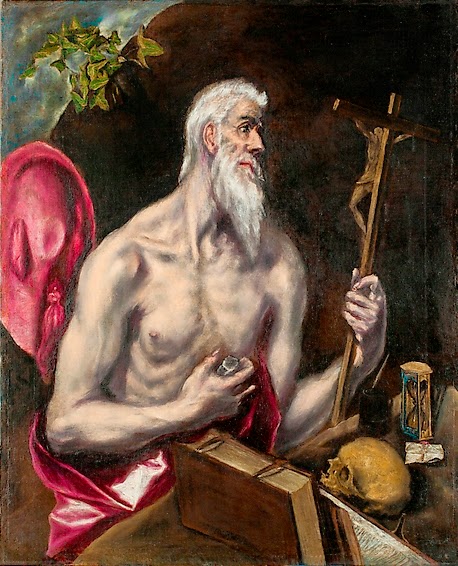
The paintings from the Hispanic Society make a welcome addition to round out the Met’s familiar holdings.  They include a lovely Holy Family, featuring a very substantial Baby Jesus, a sensitive St. Luke and a Penitent St. Jerome which provides a nice pendant to the Met’s St. Jerome as a Cardinal from the Lehman Collection. 
El Greco, Penitent St. Jerome
Greco-Spanish, c. 1600
New York, Hispanic Society of America
El Greco, St. Jerome
Greco-Spanish, 1600-1614
New York, Metropolitan Museum of Art, Lehman Collection


But, the star among the Hispanic Society pictures, as far as I am concerned, is a beautiful head of St. Francis of Assisi.

El Greco, St. Francis of Assisi
Greco-Spanish, ca. 1590
New York, Hispanic Society of America
As the Met notes, the St. Francis head has been cut from a much larger canvas, one of the myriad paintings of St. Francis that came from the studio of the master.  But the head itself is so beautifully painted that it is probably from the hand of El Greco himself.  And, happily, it does not really suffer from its cut out state.  Instead, the profile view, seen against a black background produces almost the effect of a sculptural profile bust.  The effect is startling and very impressive.  The reproduction at left does not do it justice.   You should see it if you can.

It should also be noted that the Frick is also running a small complementary exhibition of its own three El Greco paintings.  This will also close on February 1. 


Bartholomeus Spranger, Self-Portrait
Belgian, c.1585
Vienna, Kunsthistorisches Museum
The second exhibition that warrants viewing at the Met called Bartholomeus Spranger:  Splendor and Eroticism in Imperial Prague.  

Like Coecke van Aelst, Spranger was an artist from a period of time and an area of Europe little known to American museum goers -- the later Northern Renaissance and Mannerist periods.  In the last ten years the Met has presented three shows devoted to the work of artists from this time and place.  The first, in the autumn of 2010, was of the work of Jan Gossart (sometimes known as Mabuse).  The second and third are the two recent/current exhibitions of Coecke van Aelst and Spranger.

All three men originated in the Belgian town of Antwerp, but had their success in other locations and under the patronage of members of the Burgundian Hapsburg royal family.  All three were extremely important in blending the art of the earlier Northern Renaissance artists, with their near miraculous oil painting techniques, and the classical art of the Italian Renaissance during that interesting and still not quite understood period known as Mannerism, with its exaggerated forms and complicated compositions.  All three started out as painters, but created some of their most interesting and important work as designs for tapestries, stained glass,  gold work, engravings and other "minor arts" to be executed by others. 
Bartholomeus Spranger, Lamentation of the Dead Christ
Belgian, c. 1576
Munich, Bayerisches Staatsgemaeldiesammlungen

Of the three, Spranger is the youngest.  Spranger received his initial training in Antwerp, then went on to work in Italy at Parma as an assistant to the painter Bernardino Gatti and, most importantly, in Rome where he worked with the artist Giulio Clovio in service to Cardinal Alessandro Farnese and to Pope Pius V.  After the death of Pope Pius he moved on to the service of the Emperor Maximilian II at Vienna (from 1575) and then to the service of Rudolf II at Prague, beginning in 1580.

Bartholomeus Spranger, Odysseus and Circe
Belgian, ca. 1580-1582
Vienna, Kunsthistorisches Museum


Bartholomeus Spranger, God the Father
with The Holy Spirit and Angels
Belgian, ca. 1582
Vienna, Kunsthistorisches Museum


He remained in Prague for most of the rest of his life, dying there in 1611.

All these movements and parts of his life are displayed in the three rooms of the exhibition, including a modern interpretation of what a portion of the Kunstkammer of Rudolf II might have resembled: combining paintings, drawings, prints, animal skeletons (on loan from the American Museum of Natural History across Central Park), ivory carvings and other curiosities into one grand display.

Partial view of the Met's installation reproducing the
Kunstkammer of Rudolf II
The large painting is Spranger's Jupiter and Antiope
of about 1596 from the Kunsthistorisches Museum in Vienna


Like Arcimboldo, about whom I have written previously, Spranger’s paintings easily fit right into this type of display. 
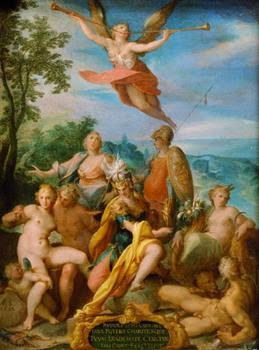
Bartholomeus Spranger, Allegory of Fame
Belgian, 1592
Vienna, Kunsthistorisches Museum
This allegory refers to the hoped for victory
of Rudolf II over an invading Turkish army.
In reality, Rudolf suffered a defeat.


Like his fellow Mannerists Spranger’s oeuvre mixes Christian religious scenes with allegories and with stories of the doings of the pagan gods of antiquity, depending on the taste and requirements of the patron for whom he worked.

Hendrick Goltzius after Bartholomeus Spranger, Feast of the Gods at the Marriage of Cupid and Psyche
Belgian, 1587
New York, Metropolitan Museum of Arts
This engraving, following a drawing by Spranger in the Albertina Museum in Vienna, made Spranger famous throughout late 16th century Europe.  The original drawing  is displayed alongside the Met's own copy of the print (seen here).

Bartholomeus Spranger, Adoration of the Kings
Belgian, ca. 1595
London, National Gallery
Bartholomeus Spranger, Vanitas
Belgian, ca. 1600
Krakow, Wawel Castle


Many of the objects in the exhibition come from the Kunsthistorisches Museum and the Albertina in Vienna and from other collections in Germany, Hungary, the Czech Republic, Romania, Poland and Liechtenstein. For this reason alone the show is worth seeing and even more rewarding when seen as part of the wider European phenomenon of Mannerism that is represented by Spranger, Coecke van Aelst and Gossart in the north, by the artists of the School of Fontainebleau in France, El Greco in Spain and the Italian Mannerists like Rosso, Pontormo, Parmigianino, Giulio Romano, Vasari and others in Italy.

Bartholomeus Spranger, Noli Me Tangere
Belgian, ca. 1590-1600
Bucharest, National Museum of Art of Romania
Bartholomeus Spranger, Angelica and Medoro
Belgian, ca. 1600
Munich, Alte Pinakothek


Bartholomeus Spranger, Venus at the Forge of Vulcan
Belgian, ca. 1610
Vienna, Kunsthistorisches Museum
So, if you can make it this week, get there while you can (but stay safe during the impending snow storm and wait till the end of the week, if possible).


© M. Duffy, 2015

Thursday, January 22, 2015

The Joyful Mysteries – The Annunciation, Part IV: "As If She Were A Dove That Dwelt There"

Jan van Eyck, Annunciation
Netherlandish, ca. 1435
Washington DC, National Gallery of Art


“And Mary was in the temple of the Lord as if she were a dove that dwelt there….. “ Protoevangelium of James:  8 1


The tradition that Mary spent time in the temple as a girl and young woman comes from the Protoevangelium of James, one of the numerous non-canonical or apocryphal books purporting to tell the story of Christ, that came into being around the middle of the second century.


The Protoevangelium focused on the story of Mary, from her own birth through Herod’s massacre of the innocents and the flight into Egypt.  Though recognized as not being canonical quite early in the Church’s history, the Protoevangelium contains numerous stories that have worked their way into Christian culture over the centuries and that have provided many of the stories that have been illustrated by artists since the Middle Ages,


Among these stories are the traditions of Mary’s consecration to the service of God in the Temple as a girl and those surrounding St. Joseph’s choice as her husband-to-be. 


For this reason, many artists have shown the Annunciation as happening in a large, imposing building or even a recognizable church, which is the artist’s way of placing Mary in the setting of the Temple.


The theme seems to have become popular during the late Middle Ages.  Mostly, artists have imagined the Temple as something with which they were familiar -- a church.


The theme appears to have developed most obviously in Northern Europe and the structures which were imagined were the Gothic cathedrals of the north.


Mazarine Master, Annunciation
from Hours of Phillippe the Good, also called the Hours of Joseph Bonaparte
French (Paris), c. 1400-1425
Paris, Bibliotheque nationale de France
MS Latin 10538, fol. 31


Boucicaut Master, Annunciation
from Hours of Jeanne Bessonnelle
French (Paris), c. 1400-1425
Paris, Bibliotheque nationale de France
MS Latin 1161, fol. 31

Annunciation
from a Book of Hours
French (Rouen), 1450-1500
Paris, Bibliotheque nationale de France
MS Nouvelle acquisition latine 3134, fol. 25r


Jean Fouquet, Annunciation
from Hours of Etienne Chevalier
French, (Tours), 1452-1460
Chantilly, Musée Condé  
MS. 71


Petrus Christus, Annunciation
Flemish, 1452
Bruges, Groeninge Museum

Master of Charles of France, Annunciation
Two Leaves from Hours of Charles of France
French (Paris), 1465
New York, Metropolitan Museum of Art, the Cloisters


Mary may appear at the entrance of the building or she may be seen inside the body of the church, which is usually indicated by the inclusion of an altar, sometimes with a priest seen standing there.

Master of the Hartford Annunciation, Annunciation
French, c. 1480
Hartford, CT, Wadsworth Atheneum


Matthias Grünwald, Annunciation
German, 1515
Colmar, Musée d'Unterlinden


Although these are to be understood as the Temple, they are, in all practical terms, churches in which the Catholic liturgy can take place and where it may actually be taking place at the same time as the artist is showing us the Annunciation event.  This juxtaposition ties past time with present time, the Annunciation of Christ’s birth in the flesh through the human body of Mary with the transformation of the ordinary materials of bread and wine into His Sacramental Body and Blood on the altar.


As time went on the application of the classical forms of the Italian Renaissance began to alter the setting.  The building began to resemble something that more closely approximates what we might today imagine as the temple.

Jean Bourdichon, Annunciation
from Hours of Frederic d'Aragon
French (Tours), 1501-1504
Paris, Bibliotheque nationale de France
MS Latin 10532, fol. 16


Jean Bourdichon, Annunciation
from Grandes Heures of Anne de Bretagne
French (Tours), 1503-1508
Paris, Bibliotheque nationale de France
MS Latin 9474, fol. 26v


Noel Bellemare and Workshop, Annunciation
Leaf from a Book of Hours
French, c. 1530-1535
Cleveland, Museum of Art

Maertan van Heemskerck, Annunciation
Dutch, 1546
Haarlem, Frans Halsmuseum


Paris Bordone, Annunciation
Italian, 1545-1550
Caen, Musée des Beaux-Arts

It was made explicit in Veronese’s painting at San Sebastiano in Venice by the inclusion of spiraling columns, known as Solomonic columns, because they were believed to duplicate the columns that stood in Solomon’s Temple at Jerusalem.

Paolo Veronese, Annunciation
Italian, 1558
Venice, Church of San Sebastiano


These columns from the Temple were believed to be identical with spiral columns that were given by Constantine to St. Peter’s basilica at the time of its construction in the fourth century to surround the still visible tomb of St. Peter.  These columns are still kept there today, though not in their original location.  Their form was the direct inspiration for the four enormous bronze columns, designed by Bernini and completed in 1633, that currently support the baldacchino over the main altar of the “new” St. Peter’s.2

Gianlorenzo Bernini,
Baldacchino of St. Peter's Basilica
Italian, Completed 1633
Vatican, St. Peter's Basilica

Artists continued to create works that placed the Annunciation to Mary in the Temple context, right up to recent times.

Alonso Cano, Annunciation
Spanish, 1655-1657
Castres, Musée Goya


Mathieu Le Nain, Annunciation
French, c. 1660
Autun, Musée Rolin


Joseph Rogues, Annunciation
French, 1815
Toulouse, Musée des Augustins


Charles Lorin, Annunciation
French, 1910-1914
New York, Church of St. Jean Baptiste


George Hawley Hallowell, Annunciation
American, Before 1926
Boston, Fogg Museum

Another development in this theme appears in a handful of pictures that show Mary in the Temple, wearing some of the vestments of a Catholic priest or acting in the place of a priest.  3

Boucicaut Master, Annunciation
from Book of Hours
French, 1415-1425
New York, Pierpont Morgan Library
MS M 1000, fol. 33r

Instead of seeing her in remote proximity to the altar, at which the priest stands, she may be seen at the altar or lectern acting as a liturgical minister in her own right.

Again, this is a conflation of past and present.  She is seen as uniting the two moments and actions, the Incarnation and the Consecration.


Master of the Aix Annunciation, Annunciation
French, 1445
Aix-en-Provence, Church of Sainte-Marie-Madeleine


To Be Continued

© M. Duffy, 2015
______________________________________________________
1. Translated by Alexander Walker. From Ante-Nicene Fathers, Vol. 8.   Edited by Alexander Roberts, James Donaldson, and A. Cleveland Coxe, Buffalo, NY: Christian Literature Publishing Co., 1886. Revised and edited for New Advent by Kevin Knight.
2.  J.B. Ward-Perkins, “The Shrine of St. Peter and Its Twelve Spiral Columns” in The Journal of Roman Studies, Vol. 42, Parts 1 and 2, 1952, pp. 21-33.
3.  Anne L. Clark, “The Priesthood of the Virgin Mary:  Gender Trouble in the Twelfth Century”, Journal of Feminist Studies in Religion, Vol. 18, No. 1, Spring 2002, pp. 5-24.