Showing posts with label Descent into Limbo. Show all posts

Saturday, April 8, 2023

Something Strange Is Happening Today -- The Lord Jesus Is Breaking Down the Gates of Hell

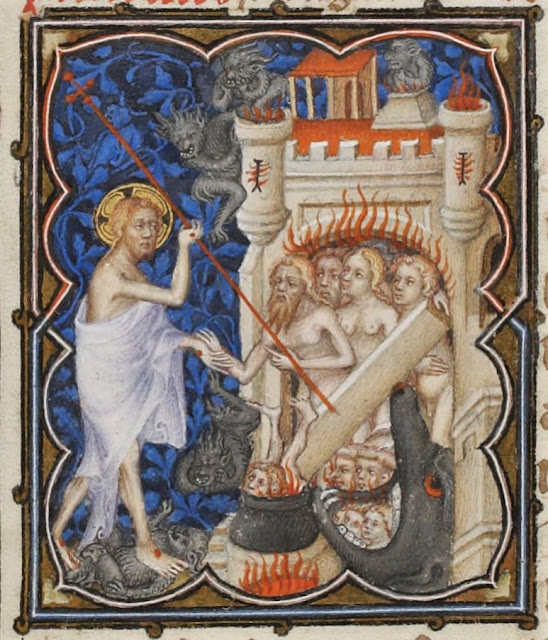
Pseudo-Jacquemart, The Harrowing of Hell
From the Petites Heures of Jean de Berry
French (Bourges), c. 1385-1390
Paris, Bibliotheque nationale de France
MS Latin 18014, fol. 166r


The Apostles Creed, prayed by virtually every Christian denomination that uses a creed, says of Jesus the "He descended into hell" following His death and before the Resurrection. 


The fact that this subject is found in the Apostles Creed testifies to its early appearance in Christian belief, as does the Ancient Homily for Holy Saturday, which is a reading from the Divine Office for Holy Saturday.  


This beautiful reading, part of the Office of Readings of the Liturgy of the Hours for Holy Saturday states:

"Something strange is happening—there is a great silence on earth today, a great silence and stillness. The whole earth keeps silence because the King is asleep. The earth trembled and is still because God has fallen asleep in the flesh and he has raised up all who have slept ever since the world began. God has died in the flesh and hell trembles with fear.

He has gone to search for our first parent, as for a lost sheep. Greatly desiring to visit those who live in darkness and in the shadow of death, he has gone to free from sorrow the captives Adam and Eve, he who is both God and the son of Eve. The Lord approached them bearing the cross, the weapon that had won him the victory. At the sight of him Adam, the first man he had created, struck his breast in terror and cried out to everyone: “My Lord be with you all.” Christ answered him: “And with your spirit.” He took him by the hand and raised him up, saying: “Awake, O sleeper, and rise from the dead, and Christ will give you light.”

I am your God, who for your sake have become your son. Out of love for you and for your descendants I now by my own authority command all who are held in bondage to come forth, all who are in darkness to be enlightened, all who are sleeping to arise. I order you, O sleeper, to awake. I did not create you to be held a prisoner in hell. Rise from the dead, for I am the life of the dead. Rise up, work of my hands, you who were created in my image. Rise, let us leave this place, for you are in me and I am in you; together we form only one person and we cannot be separated.

For your sake I, your God, became your son; I, the Lord, took the form of a slave; I, whose home is above the heavens, descended to the earth and beneath the earth. For your sake, for the sake of man, I became like a man without help, free among the dead. For the sake of you, who left a garden, I was betrayed to the Jews in a garden, and I was crucified in a garden.

See on my face the spittle I received in order to restore to you the life I once breathed into you. See there the marks of the blows I received in order to refashion your warped nature in my image. On my back see the marks of the scourging I endured to remove the burden of sin that weighs upon your back. See my hands, nailed firmly to a tree, for you who once wickedly stretched out your hand to a tree.

I slept on the cross and a sword pierced my side for you who slept in paradise and brought forth Eve from your side. My side has healed the pain in yours. My sleep will rouse you from your sleep in hell.

The sword that pierced me has sheathed the sword that was turned against you.

Rise, let us leave this place. The enemy led you out of the earthly paradise. I will not restore you to that paradise, but I will enthrone you in heaven. I forbade you the tree that was only a symbol of life, but see, I who am life itself am now one with you. I appointed cherubim to guard you as slaves are guarded, but now I make them worship you as God. The throne formed by cherubim awaits you, its bearers swift and eager. The bridal chamber is adorned, the banquet is ready, the eternal dwelling places are prepared, the treasure houses of all good things lie open. The kingdom of heaven has been prepared for you from all eternity."
1


This belief is that during the time between His death on the Cross and the Resurrection, Jesus descended to limbo to free the souls of the previously deceased just who were confined in waiting there.  Limbo is a place of darkness and peace, but not of the Presence of God, which had been lost through Original Sin.   Their souls were confined to limbo because they had been barred from entering heaven by Adam's sin, but they were set free by Christ's saving death.  For them He truly became the Key of David, breaking down the walls of death and leading the captives to freedom and joy.  

There is a long tradition of images in art illustrating this subject. 

In the East the tradition culminates in the dramatic and dynamic Anastasis of the church of Saint Saviour in Chora in Istanbul, in which Christ seems to drag Adam and Eve from their graves.  

Anastasis (The Harrowing of Hell)
Byzantine, c. 1316-1321
Istanbul, Church of Saint Saviour in Chora

In the West the image appears in the Klosterneuberg Altarpiece by Nicholas of Verdun, as well as in many paintings.

Nicholas of Verdun, Harrowing of Hell
Mosan (Meuse region), 1181
Klosterneuberg Austria, Klosterneuberg Priory

There are two distinct types of iconography that apply to most of these images. In one, Christ breaks down actual gates, which are often shown thrown to the ground or hanging off their hinges.  

The Harrowing of Hell
From the Psalter of Christina of Markyate_
English (St. Alban's), c. 1124-1145
Hildesheim, Dombibliothek
Page 49


Workshop of Duccio, The Harrowing of Hell
Italian, c. 1308-1311
Siena, Museo dell'Opera del Duomo


Giotto Workshop, The Harrowing of Hell
Italian, c. 1320-1325
Munich, Bayerische Staatsgemäldesammlungen, Alte Pinakothek


Fra Angelico, The Harrowing of Hell
Italian, c. 1437-1445
Florence, Museo di San Marco


Master of the Osservanza, The Harrowing of Hell
Italian, c. 1445
Cambridge (MA), Fogg Museum


In the other, Christ leads or sometimes drags the souls of the dead from the 'mouth of hell', shown as the jaws of a whale-like monster or from a cave that resembles an open mouth.

The Harrowing of Hell
From Miniatures of the Life of Christ
French (Northern), c. 1170-1180
New York, Pierpont Morgan Library
MS M 44, fol. 11v


Andrea da Firenze, The Harrowing of Hell
Italian, c. 1365-1368
Florence, Santa Maria Novella, Capella Spagnuolo


Alabaster Relief, The Harrowing of Hell
English, c. 1440-1470
London, Victoria and Albert Museum


Luca Penni, The Harrowing of Hell
Italian, c. 1547-1548
New York, Metropolitan Museum of Art


In both types He carries the staff, topped with a cross or with a pennant bearing a cross, that is His banner of victory over death.

Later images show Christ dragging the souls of the just from a more generalized image of a limbo jammed with just souls in waiting.  In these images the iconography of the gates or the mouth of hell is not as emphasized as in the earlier images.


The Harrowing of Hell
From a Book of Homilies
German (Lower Rhine), c. 1320-1350
Baltimore, The Walters Art Museum
MS W. 148, fol. 21r


Friedrich Pacher, The Harrowing of Hell
German, c. 1460s
Budapest, Museum of Fine Arts


Andrea Mantegna, The Harrowing of Hell
Italian, 1468
Private Collection 


Agnolo Bronzino, The Harrowing of Hell
Italian, 1552
Florence, Church of Santa Croce


Tintoretto, The Harrowing of Hell
Italian, 1568
Venice, Church of San Cassiano


© M. Duffy, 2023, 2024

1.  Office of Readings, Holy Saturday.  Source is:  Patrologiae cursus completus ...: Series graeca. Edited by Jacques Paul Migne, France, 1864, Volume 4, Section 43, "Seven Homilies", Paragraphs 440-463, "Sancto et magno Sabbato".


Thursday, May 11, 2017

Iconography of the Resurrection – Christ Presents the Redeemed to His Mother

Thedor van Thulden, Christ Presents the Redeemed
to His Mother
Flemish, 1660
Dublin, National Gallery of Ireland


In the late fifteenth century and into the early part of the sixteenth century, a new iconography of the Resurrection was introduced by artists. 


Instead of the simple encounter between Mother and Son, joyously reuniting after the terrible experience of the Crucifixion and Entombment, which we have looked at previously, artists began to imagine an encounter that would take into account the time between Good Friday afternoon and Easter Sunday morning.  This is the time of Christ’s descent into Limbo and His liberation of the souls of the righteous that had been imprisoned there, awaiting His salvific act.  In this new iconographic subject, Christ presents the liberated souls to His mother. 1 


The earliest of these images show Christ, appearing to the Virgin Mary, His Mother, very much in the same manner we have already looked at before.  


However, this time He is not alone or accompanied only by angels.  The first person with Him is an older, white-bearded man, whose head is encircled with a golden halo.  Some have identified this as the patriarch, Abraham, but I am not so sure.  Would it not be logical that the first person among the righteous dead should be the other person who had the most impact on the life of Jesus, His stepfather, Saint Joseph?  Tradition suggests that Joseph was already dead before Jesus began His public ministry and Joseph’s proximity in time, space and affection suggest that the halo is not inappropriate.  I think that these present us with a reconstituted Holy Family image.

Christ Presents the Redeemed (Saint Joseph?) to His Mother
from a Book of Hours
French (Tours), c. 1495-1505
New York, Pierpont Morgan Library
MS M 12, fol. 25v

In the background of one of these images we can also see that Adam and Eve kneel behind the older man.  They are easily recognized by their nakedness.  They are prominent not simply because they are the mother and father of all humanity, but because it is their sin that was the reason for the Incarnation, the enfleshment of the Word of God, the Second Person of the Trinity, through Mary.  In these images the first Adam and the first Eve meet the new Adam (Christ) and the new Eve (Mary). 

Follower of Jean Pichore, Christ Presents the Redeemed to His Mother
From a Book of Hours
French (Paris), c. 1490-1500
New York, Pierpont Morgan Library
MS M 7, fol. 20r

Quite rapidly they are joined by a host of other predecessors.  They crowd behind Jesus as He approaches Mary to present them to her.  Different painters included different people, but often the group obviously includes:  Abraham, Moses and David.  Also discernible in some are Saints Anne and Joachim, the grandparents of Jesus, and Saint John the Baptist, as well as Saint Joseph.


Juan de Flandes, Christ Presents the Redeemed to His Mother
Flemish (Active Spain), c. 1500
London, National Gallery

There is a more formal tone in these pictures than in those that simply show the reunion of Mother and Son.  Although Mary’s setting remains humble, she is approached by the souls of the redeemed as if already the Queen of Heaven, which she will become on her death and assumption into heaven. 


Fernando Yanez de la Almedinam, Christ Presents the Redeemed to His Mother
Spanish, c. 1510-1518
Madrid, Museo Nacional del Prado


Jan Mostaert, Triptych
Left:  Christ Presents the Redeemed to His Mother
Enschede, Rijksmuseum Twenthe
Right: The Redeemed, with a Portrait of the Donor, presumed to be Mary of Burgundy
 Dutch, c. 1515-1525
Madrid, Museo Thyssen-Bornemisza


Simon Bening, Christ Presents the Redeemed to His Mother
from The Stein Quariptych
Flemish (Bruges), c. 1525-1530
Baltimore (MD), Walters Art Gallery
MS W 442, D 58r


Bernaert (Barend) van Orley, Christ Presents the Redeemed to His Mother
Flemish, c. 1525-1540
Private Collection
Over time, the simple setting of Mary’s room becomes transformed with the addition of clouds of glory, singing angels and other Baroque touches. 


Alessandro Allori, Christ Presents the Redeemed to His Mother
Italian, c. 1580-1590
Florence, Museo di San Marco


Ludovico_Carracci, Christ Presents the Redeemed to His Mother
Italian, 1601
Bologna, Church of Corpus Domini


Theodor van Thulden, Christ Presents the Redeemed to His Mother
Flemish, c. 1650
Paris, MusĂ©e du Louvre


Cosmas Damian Asam, Christ Presents the Redeemed to His Mother
German, 1718-1720
Aldersbach, Former Convent Church of the Assumption


Engraving by Giuseppe Camerata After a Painting of Andrea Vaccaro, Christ Presents the Redeemed to His Mother
Italian, c. 1750-1760
London, British Museum


After the eighteenth century this motif ceased to be used by artists or requested by patrons.


© M. Duffy, 2017

  1. Breckenridge, James D., "Et Prima Vidit:  The Iconography of the Appearance of Christ to His Mother". Art Bulletin, Vol. 39, Number 1, March 1957, pp. 28-32.  As far as I can tell, no one has written on this particular motif since this 1957 article.

Saturday, April 23, 2011

Holy Saturday

Fra Angelico and assistants, Meditation on the Passion
Italian, 1441-1442
Florence, Convent of San Marco
The atmosphere of the church on this day is one of contemplative silence. No Mass is celebrated today, until the evening when we begin the Vigil of Easter. We enter into the mood of the disciples. We are slightly stunned, quiet, reflective. But, we know the end of the story, as they did not. So we are also filled with hope and a suppressed excitement. We visit the Confessional, prepare the altar, practice our music, clean our houses, and dye our eggs. We know that the morning to come will change our lives. For those preparing for Baptism at Easter Vigil a completely new life, in Christ, will begin this evening.

So, I will leave you with two things today.


First is an image, not by Giotto, our companion this Holy Week, but by the mid-fifteenth century Dominican painter, Fra Angelico. It is a visual meditation on all the events of the Week just passed, a “Meditation on the Passion”. It comes from the Convent (now the Museum) of St. Mark in Florence. Fra Angelico and his assistants painted it for their Dominican brethren in the early 1440s.

In it we see the Virgin Mary pondering the image of her crucified Son.  He stands (as the Man of Sorrows) in the tomb, surrounded by the instruments of the Passion (the sponge on a reed, the spear, the nails, the Cross) and by vignettes of he events (the kiss of Judas, Peter's denial, the Mocking of Christ, the exchange of the silver bribe).  At the front right we see St. Thomas Aquinas kneeling in adoration, his pen in one hand, his closed book in the other.  Thomas, in addition to his theological work (Summa Theologica) was also a poet and authored many great hymns, many still in use. 

Fra Angelico and assistants, Christ in Limbo
Italian, 1441-1442
Florence, Convent of San Marco
Second is a beautiful piece of Christian literature, which speaks of this quiet day, and another work from San Marco by Fra Angelico and his assistants, which illustrates it. The author of the “Ancient Homily on Holy Saturday” is not known, but the beauty of his words is as effective today as they were when they were first written centuries ago.  I have read it several times at a Holy Saturday morning Tenebrae service and it never fails to move me deeply.

“Something strange is happening -- there is a great silence on earth today, a great silence and stillness. The whole earth keeps silence because the King is asleep. The earth trembled and is still because God has fallen asleep in the flesh and he has raised up all who have slept ever since the world began. God has died in the flesh and hell trembles with fear.

He has gone to search for our first parent, as for a lost sheep. Greatly desiring to visit those who live in darkness and in the shadow of death, he has gone to free from sorrow the captives Adam and Eve. The Lord approached them bearing the Cross, the weapon that had won him the victory. At the sight of him Adam, the first man he had created, struck his breast in terror and cried out to everyone: 'My Lord be with you all.' Christ answered him: 'And with your spirit.' He took him by the hand and raised him up, saying: 'Awake, o sleeper, and rise from the dead, and Christ will give you light.'

I am your God, who for your sake have become your son. Out of love for you and your descendants I now by my own authority command all who are held in bondage to come forth, all who are in darkness to be enlightened, all who are sleeping to arise. I order you, O sleeper, to awake. I did not create you to be held a prisoner in Hell. Rise from the dead, for I am the life of the dead. Rise up, work of my hands, you who were created in my image. Rise, let us leave this place, for you are in Me and I in you; together we form one person and cannot be separated.

For your sake I, your God, became your son; I, the Lord, took the form of a slave; I, Whose home is above the heavens, descended to the earth and beneath the earth. For your sake, for the sake of man, I became like a man without help, free among the dead. For the sake of you, who left a garden, I was betrayed to the Jews in a garden, and I was crucified in a garden.

See on My Face the spittle I received in order to restore to you the life I once breathed into you. See there the marks of the blows I received in order to refashion your warped nature in my image. On My back see the marks of the scourging I endured to remove the burden of sin that weighs upon your back. See My hands, nailed firmly to a tree, for you who once wickedly stretched out your hand to a tree.

I slept on the cross and a sword pierced My side for you who slept in paradise and brought forth Eve from your side. My side has healed the pain in yours. My sleep will rouse you from your sleep in Hell. The sword that pierced Me has sheathed the sword that was turned against you.

Rise. Let us leave this place. The enemy led you out of the earthly paradise. I will not restore you to that paradise, but will enthrone you in heaven. I forbade you the tree that was only a symbol of life, but see, I who am life itself am now one with you. I appointed cherubim to guard you as slaves are guarded, but now I make them worship you as God. The throne formed by cherubim awaits you, its bearers swift and eager. The bridal chamber is adorned, the banquet is ready, the eternal dwelling places are prepared, the treasure houses of all good things lie open. The kingdom of heaven has been prepared for you from all eternity. “

__________________________________________
You may also want to read my essay "Meditation on the Passion -- Waiting" (here).