 |
| Andrea Vicentino, Battle of Lepanto Italian, 1603 Venice, Palazzo Ducale |
The feast of the Blessed Virgin Mary, under the title of Our Lady of the Rosary, is celebrated on October 7th each year. This feast was established, under the name of Our Lady of Victory, by Pope Saint Pius V in 1571.
Pope Saint Pius V, the Almost Forgotten Pope
Pius, who reigned from 1566 – 1572, is one of those late 16th-century Counter Reformation popes remembered for helping to pull the Church out of the confusion and gloom that descended on it after the shock of the Reformation. After the frequent scandals that had accompanied the lives of the prince-popes of the High Renaissance (men like Alexander VI, Julius II, Leo X) these were mostly pious men of purpose, who lead fairly austere lives. Pius himself, born Antonio Ghislieri, was a friend of the great Saint Charles Borromeo, one of the leading figures of the Counter-Reformation.Among the notable events of Saint Pius’ pontificate are the reforms of the breviary and of the liturgy. It is Pius who authorized the Roman Missal that was in use until 1970. However, Pius is mostly remembered in the English speaking world for the promulgation of the bull “Regnans in excelsis“. In this bull, Pius excommunicated Queen Elizabeth I and released her subjects from their allegiance. Although well meant, this set the stage for such sad events as the death of Mary Queen of Scots, the Armada, and the Elizabethan government’s persecution of English Catholics, who were now deemed to be traitors almost by definition.
 | |
|
What Pius is not remembered for among English speakers is his leadership of the Holy League which gained a tremendous victory in the last great naval battle of the classical world. That is the last great battle between naval forces composed almost entirely of oar-powered galleys. The foe was the previously all-conquering Muslim Ottoman navy.
 |
| Martin Rota. The Holy League Croatian, c.1571 London, Trustees of the British Museum Here Pope Pius V is shown with his arms spread over the shoulders of King Philip II of Spain (left) and the Doge Alvise I Mocenigo (right) joining hands to form the Holy League of 1571. God the Father and the Holy Spirit are seen above them, while a male angel holds a crown above the head of the King and a female angel holds the cap of the Doges above the head of Doge Mocenigo. |
Lepanto, the Forgotten Battle
Most western people today know little of the Ottoman Empire, although they may have heard of it. From the 14th century the Ottoman Turks (the name comes from the founder of the ruling line, Osman) expanded their rule throughout the remains of the old Byzantine Empire, until, by 1400, all that remained of the Empire was the city of Constantinople itself and some tributary territories in the Balkans and Greece. In spite of desperate efforts by the Byzantines, their Empire, direct descendent of the ancient Roman Empire, fell to the Ottomans, led by their young Sultan, Mehmet II, on May 19, 1453. Mehmet imposed his religion on his empire, favoring those who converted to Islam and oppressing those who remained Christian, thus laying the foundation for much of the conflict in the region in the centuries that have followed.The Ottomans also organized a fleet, which began to capture the islands of the Mediterranean, and they began to harass the Mediterranean mainland, especially in Italy.
 | |
|
In 1570 they began their attack on Cyprus, then a possession of the Venetian Republic. Finally, the powers of Southern Europe became willing to follow the urgings of Pope Pius and to unite in the Holy League. They gathered a fleet to meet the Turkish navy. The command was given to Don John of Austria, an illegitimate son of the former Holy Roman Emperor, Charles V, and, therefore, half-brother to Philip II of Spain.
 |
| Modern Reproduction of the Standard carried by the flagship of Don John of Austria |
Spain, Genoa, Venice and the Papal States formed the backbone of the Christian fleet. On board the Spanish ship, Marquesa, was a young man who would later become known world-wide as the author of “Don Quixote”, Miguel de Cervantes.
 |
Giorgio Vasari, Allegory of the Holy League Italian, c. 1572 Vatican City, Apostolic Palace, Sala Regia Here we see the Holy League, presented as a version of the Three Muses. They represent (from left to right) Spain, the Holy See and Venice. They are being given crowns of victory by winged putti. In the background are the two opposing fleets. On the right are figures representing the defeated Ottomans who are being attacked by fish and rats, dumped on them by angry putti. In the center, a putto catches our eye and directs our attention to a map of the engagement. |
The ships of the Holy League met the Turkish fleet on October 7, 1571 off the coast of Greece, at Lepanto, which is now called the Gulf of Patras.
 |
Fernando Bertelli, The Battle of Lepanto Italian, c. 1572 Vatican City, Apostolic Palace, Gallery of Maps |
Both fleets were primarily composed of oared galleys. The ships of the Holy League gained a tremendous victory, sinking or capturing the majority of the ships in the Turkish fleet.1
 |
| Martin Rota, Battle Formations at Lepanto Croatian, c. 1571 or later Boston, Museum of Fine Arts |
By all accounts, the battle was an extraordinarily ugly fight.2 The Turks lost not only a disproportionate number of ships, but huge numbers of sailors and soldiers, by some estimates as many as twice the Christian losses.
 |
| Adriaen Collaert, the Battle of Lepanto Flemish, after 1571 London, Trustees of the British Museum |
Contemporary or near-contemporary paintings and engravings suggest some of the ferocity of the battle and, especially, the rather tight engagements that were at its core.
 |
Giorgio Vasari, Battle of Lepanto Italian, c. 1572-1573 Vatican City, Apostolic Palace, Sala Regia |
 |
Luca Cambiaso, Battle of Lepanto Italian, c. 1573 San Lorenzo del Escorial, Monastery of El Escorial |
 |
| Andries van Eertvelt, the Battle of Lepanto Flemish, c.1629 Private Collection |
 |
Andries van Eertvelt, the Battle of Lepanto Flemish, c.1640 Private Collection |
The victory helped to lift the pressure of Turkish aggression from the mainland Mediterranean countries. Although the Turks were able to replace the ships quickly, it took them much longer to replace the lost seamen. They continued to press into Central Europe by land for another hundred years, but the security Southern Europe gained from the victory of Lepanto helped to usher in the age of the Baroque in Italy and Spain.
While the Holy League fleet was at sea the Pope had urged Catholic Europe to pray, in particular to pray the Rosary. The sailors and soldiers of the fleet were also urged to pray the Rosary before the battle began. The victory was, therefore, credited to Our Lady’s intercession. In gratitude, Pope Pius instituted the feast of Our Lady of Victory on October 7. The name of the feast was subsequently changed by his successor, Gregory XIII, to Our Lady of the Rosary, which is how we celebrate it to this day.
Our Lady of the Rosary
 |
Tommaso Dolabella, Battle of Lepanto Italian, c. 1625-1630 Krakow, Wawel Castle The painting is divided into two distinct zones, the land and the sea. On the left, the battle is being fought on land with prayer. We see a procession, including lay men and clerics, carrying a banner of the Blessed Virgin and including a priest carrying the Blessed Sacrament, imploring God's intercession on behalf of the Holy League. On the right the battle is being fought at sea. Prominently featured are the banners of the Venetian state, of the Papal States and of the House of Habsburg, as well as many banners bearing the crescent of the Ottoman Empire. |
While the Holy League fleet was at sea the Pope had urged Catholic Europe to pray, in particular to pray the Rosary. The sailors and soldiers of the fleet were also urged to pray the Rosary before the battle began. The victory was, therefore, credited to Our Lady’s intercession. In gratitude, Pope Pius instituted the feast of Our Lady of Victory on October 7. The name of the feast was subsequently changed by his successor, Gregory XIII, to Our Lady of the Rosary, which is how we celebrate it to this day.
 |
| Johann Jakob Zeiller, Pope Pius V Prays to the Madonna and Child During the Battle of Lepanto German, c. 1762-1763 Ottobeuren, Monastery Church of Saints Theodore and Alexander |
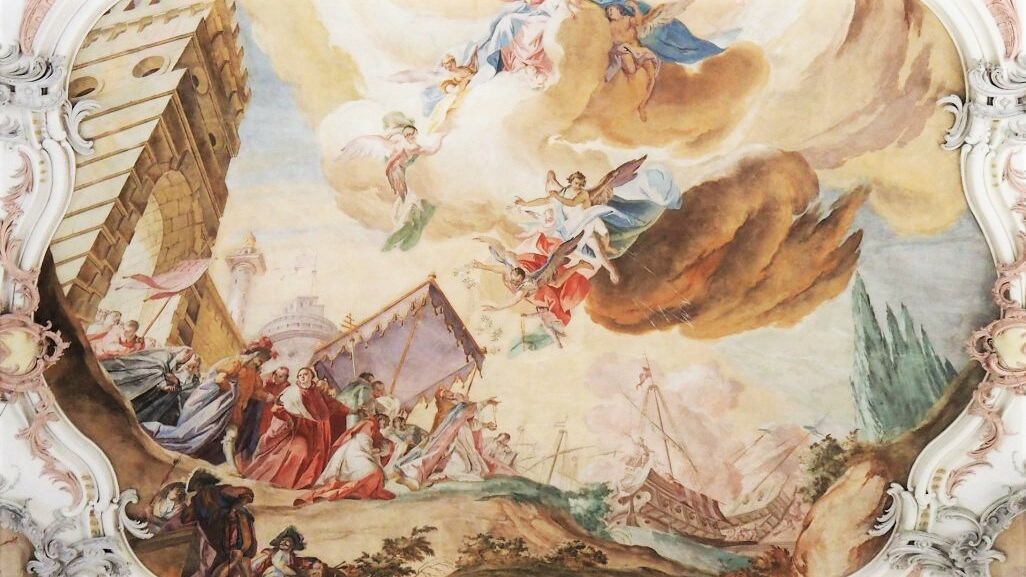 |
Franz Martin Kuen, Thanksgiving Procession and Feast of the Rosary at Rome After the Victory at Lepanto German, 1768 Erbach Alb-Donau-Kreis, Church of St. Martin |
Many of the artists who have pictured the Battle of Lepanto were Venetian, quite appropriate since Venetian ships played a major part in the battle. Among them are the contemporary painters, Tintoretto, Titian and Veronese.
Tintoretto seems to have done a painting of the battle shortly after the battle itself. Unfortunately, his work was destroyed in a fire a few years after it was painted, but is known to us through a copy.
 |
Copy after Tintoretto, Battle of Lepanto Italian, c. 1572 Destroyed by Fire 1577 |
It undoubtedly served as the model for many of the paintings that followed.
Allegorical Interpretations
Titian’s picture “Philip II Offering the Infante Don Fernando To Heaven” is a predominantly secular image (Victory (or an angel) hands the palm of victory to Philip’s baby son, Ferdinand, as Philip holds him. In the background is a scene of the battle, in the foreground, a Turkish prisoner.
 |
Titian, Philip II Offering the Infante Don Fernando to Heaven Italian, c. 1573-1575 Madrid, Museo Nacional del Prado |
Titian also painted an allegorical picture which promoted Spain's leadership in the struggle against both the Muslim Turks and the emerging heresies of Protestant Northern Europe, while recalling the role the Spanish monarchy had played in the reconquest of Spain from the Muslim Moors. Spain, personified as two warrior women (presumably representing the double crowns of Castille and Aragon), come to the aid of the near naked figure of Religion, who is beset and apparently wounded by serpents, which infest the tree stump behind her. On the left we can see the burning ships of the Turkish fleet at Lepanto. The two commissions together suggest how Philip II, who was the great-grandson of Ferdinand and Isabella, wished to be seen by the world.
 |
Titian, Spain Comes to the Aid of Religion Italian, 1572-1575 Madrid, Museo Nacional del Prado |
On the other hand, Veronese’s picture “The Battle of Lepanto”, while giving us a view of the battle, actually celebrates the miraculous intercession of the Virgin Mary. The upper portion of the picture presents a view of heaven, where among the clouds and choirs of angels, the city of Venice, la Serenissima herself, clad in white, kneels before Our Lady. Saints, including Peter, Rocco, Justine and Mark, join her in supplication, urging Mary to intercede. From heaven rays of light fall to earth, underlining the intercession that she grants.
 |
Paolo Veronese, Battle of Lepanto Italian, c. 1572 Venice, Gallerie dell'Accademia |
However, like Titian, Veronese also painted another work that offers a slightly more secular view of the battle and its aftermath. This is The Allegory of the Battle of Lepanto, painted by Veronese in the late 1570s or early 1580s and possibly repainted in part sometime later.
 |
| Paolo Veronese Allegory of the Battle of Lepanto Italian, c. 1577-1582 Venice, Palazzo Ducale |
In it we see the victorious Venetian admiral, Sebastiano Venier, in his later years when he was Doge of Venice, being presented to Christ by Faith, holding a chalice, and St. Justine, holding the palm of martyrdom and the knife that killed her. Between them is the figure of the lion of St. Mark, one of the emblems of the Venetian Republic. Speculation has suggested that the figure now seen as Christ was originally that of St. Mark, the patron of Venice. This seems a distinct possibility, especially since Christ appears to be holding an anchor stone, which would seem to be a more appropriate attribute of St. Mark. In the left background there is a scene from the battle. This heavenly reception for Venier is his reward for the victory.
Decline and Revival
Interest in the battle has declined over the intervening centuries, especially after the final defeat of the Ottoman Empire at the Battle of Vienna in 1683, which stopped further Ottoman invasions of Europe and began a long process of retreat and decline for the Ottomans.
Very few paintings were made after its memory was superseded by the internal European wars of the seventeenth, eighteenth and nineteenth centuries.
 |
Juan Luna, The Battle of Lepanto Filipino, 1887 Madrid, Palacio del Senado |
One might think that, because Lepanto is now a widely ignored event, it has not been painted in the twentieth or twenty-first century. But, in 2001, the American artist, Cy Twombly, who lives in Rome, executed a twelve painting series , called “Lepanto” for the Venice Biennale.
 |
| Cy Twombly, Lepanto American, 2001 |
Although abstract, the pictures do evoke the confusion and intensity of the battle and their bright colors recall both the rays of light from heaven in Veronese’s painting and the bloody decks of contemporary accounts. The cycle has since been exhibited in New York, Houston and Munich. So, there is still some resonance from the battle even in the secular world.
 |
Cy Twombly, Lepanto American, 2001 |
 |
| Cy Twombly, Lepanto American, 2001 |
And so, every October 7th for the last 451 years Catholics have celebrated this victory that freed Southern Europe from a serious threat, guaranteed the continuing existence of Catholic Christianity and allowed a breathing space in which the arts could flourish.**
© M. Duffy, 2008, 2016. Images updated and new images added, 2022.
____________________________________________
* For an account of the Ottoman's second attempt to take Vienna, see The Holy Name of Mary
** In 2024 Pope Francis has requested all Christians, Catholic and non-Catholic to devote October 7 to prayer and fasting for peace. This is, in a way, a continuation of the call by Pope Pius V for recitation of the rosary leading up to the battle of Lepanto. That victory brought a kind of peace and, one hopes, that prayer and fasting on October 7, 2024 will bring peace as well.
1. For a summary of the battle and its importance see https://www.britannica.com/event/Battle-of-Lepanto
A longer and much more thorough description can be found in the recent book Empires of the Sea by Roger Crowley.
Crowley, Roger. Empires of the Sea: The Siege of Malta, the Battle of Lepanto and the Contest for the Center of the World, Random House, New York, 2009.
2. For a description of the intense battle see http://www.nobility.org/2010/10/07/short-stories-on-honor-chivalry-and-the-world-of-nobility-no-14/
Also see Crowley, Empires of the Sea op cit.


