Wednesday, February 5, 2014

Saint Agatha, My Newest Patron


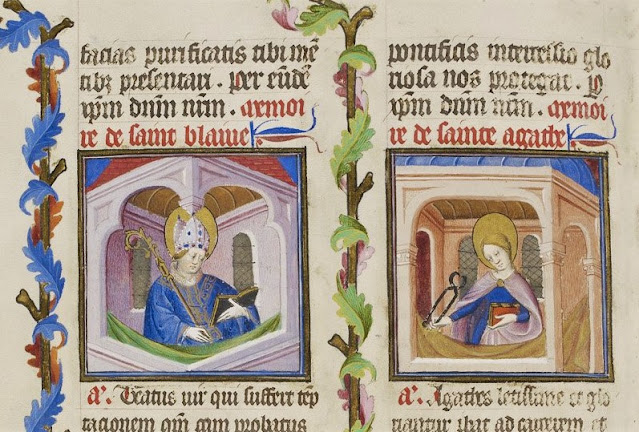
Attributed to Bartelemy d'Eyck, Saints Blaise and Agatha
From the Hours of Rene of Anjou
French (Aix-en-Provence), c. 1442-1444
London, The British Library
MS Egerton 1070, fol. 87v
The feast days of these two saints are February 3 and February 5, respectively.

Early in June of 2013 I inadvertently discovered a smallish lump on the top of my left breast. 

Initially I didn't feel very alarmed because I have been subject to skin cysts and abscesses for my entire life and reckoned on this being just another one.  However, the location is one that any woman should consider an especially sensitive area and worth following up on any change.  So, I quickly made an appointment to see my gynecologist.  

His reaction was more cautious than my own and he suggested some investigation.  There was an ultrasound, which seemed inconclusive, then a biopsy.  There were no results for weeks, July 4th came and went.  No news is generally good news, I thought.


Then, on the early afternoon of July 10th he called with the news that no one ever wants to  hear.  It was cancer.  It was, in fact, a fairly large breast cancer tumor.  My next move, he said was to "begin interviewing" breast surgeons, pronto.  Note the plural.  He was wise enough to know that sometimes you have to see multiple doctors to find the one for you.  He also gave me a couple of names.  

With that announcement my life turned upside down.  I quickly began interviewing doctors as well as investigating hospitals.  I visited doctors from Mount Sinai, New York-Presbyterian and Lenox Hill hospitals, but I eventually settled on a petite woman who is a surgeon at Memorial Sloan-Kettering Hospital, the famous cancer only hospital just a few blocks from my house.  It was a perfect fit.

There were many more tests in store, however.  Sloan-Kettering prefers to do their own tests and preparation work, so I had to do many of these over again.  Also, my primary care doctor wanted to do her own assessment about my ability to undergo the surgery.  So, it wasn't until September 12 that I was operated on.  By then the cancer, which was very aggressive, had grown large enough to be visible under my clothing!  

My left breast was completely removed and a lumpectomy was also done on the right, due to some suspicious cells found in it.  My vanity (and to tell the truth, my laziness) insisted on a reconstruction.  Unfortunately, I turned out to be one of the percentage of women who cannot tolerate the procedure for a reconstruction.  It caused incredible pain and complications and required a second surgery to reverse.  Healing was, therefore, a slow process.  It delayed the beginning of chemotherapy and was complicated by the fact that I had accepted an apartment in a very desirable senior residence in my neighborhood just before the diagnosis.  I paid three months of double rent in order not to lose that apartment and finally moved in mid-December, three weeks after starting chemotherapy.  It was a genuine ordeal.  Chemo ended in April, but it took nearly a year for things like my taste to return to normal.  Fortunately, while I did lose some hair, I never lost all of it.  My hair is very thick and it just thinned out a lot.

In those long, frightening months I gained a new patroness, Saint Agatha, patroness of women with breast cancer.  Thus my first new blog following the surgery was posted in honor of her feast day, which is February 5th. 

Agatha's Story

Agatha is among the most important of the female early Christian martyrs.  She is among those who are named in the Roman Canon, now called Eucharistic Prayer I.  They are, in order:  Felicity, Perpetua, Agatha, Lucy, Agnes, Cecilia and Anastasia.  By virtue of their being named in this most important prayer, used for centuries at almost every Mass, these women have a special place in Christian history and imagination.  Agatha was also believed to be a major influence on one of the other saints in this exclusive list, Saint Lucy, and has for centuries been a frequently imaged figure in Christian art. 
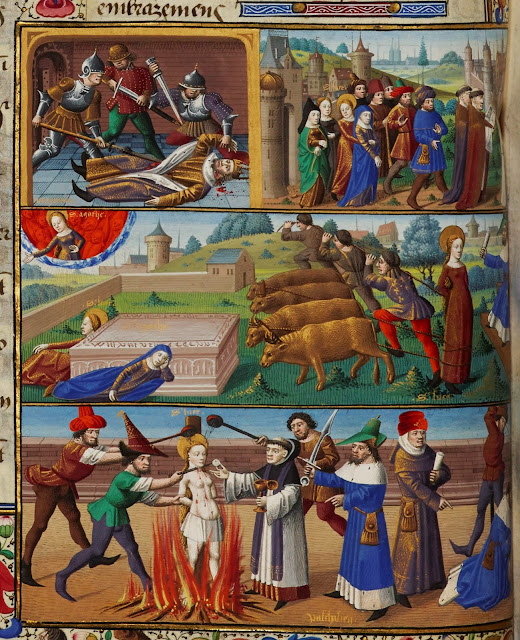

Maitre Francois and Collaborators, Saint Lucy Is Inspired by Saint Agatha, Leading to Her Own Martyrdom
From a Speculum historiale of Vincent of Beauvais
French (Paris), 1463
Paris, Bibliotheque nationale de France
MS Francais 51, fol. 95v


Lorenzo Lotto, Saint Lucy at the Tomb of Saint Agatha
Italian, 1532
Iesi, Pinacoteca Civica


Agatha, properly Agatha of Catania in Sicily, appears to have been martyred during the third century, probably in the persecution under the Emperor Decius.  As is true for many of the early martyrs, there is little doubt about the fact of her martyrdom and her early veneration by Christians.  However, there is virtually no contemporary evidence for the reason and the manner of it, aside from traditional beliefs. 1

According to these beliefs, Agatha was one of that group of early Christian women saints who apparently aroused the ire of their pagan contemporaries by their refusal to marry or to submit to sexual advances because of their Christian faith.  In an era when a woman had virtually no control over her own person, but was subject to the domination of first her father, who decided on her eventual destiny through his decision of whom she should marry, and then of her husband, once married, this refusal was evidence of major rebellion and was deeply unsettling.  Tales abound of the courage and fortitude of these young women as they withstood torture aimed at coercing them to accept arranged or lecherous marriages and efforts to detach them from their adherence to Christ.   In Agatha’s case she is reputed to have attracted the attention of Quintianus, the prefect of the region.  Her refusal of his advances drove him to extremes of cruelty, among which was confinement in a brothel, imprisonment and the eventual horror of cutting off her breasts.   

According to later legends, she was miraculously healed from this terrible injury by an apparition of Saint Peter himself, but eventually died in prison from the results of her ordeals.  


Giovanni Lanfranco, Saint Peter Healing Saint Agatha
Italian, c. 1614
Parma, Galleria Nazionale


I, for one, believe that there is often a kernel of truth in some of these tales, but it is impossible to know at this distance in time, what the true facts were.


Alessandro Turchi, Saint Agatha Attended by Saint Peter and an Angel in Prison
Italian, c. 1640-1645
Baltimore, The Walters Art Museum


Iconography of Saint Agatha

Be that as it may, the belief appears fairly early on that one of her torments was the hacking off of her breasts by the Roman authorities.  Hence, by the Middle Ages, Agatha is frequently shown holding a dish on which are placed her two breasts.  This is her identifying mark, her iconographic symbol.
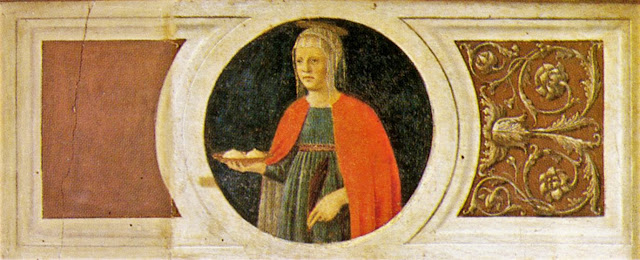


Piero della Francesca, Saint Agatha
From the Polyptych of Saint Anthony
Italian, c. 1460
Perugia, Galleria Nazionale dell'Umbria


However, the earliest images of Agatha do not make reference to this event.  She appears as early as the sixth century in the procession of female martyrs in the nave of the church of Sant’Appolinare Nuovo in Ravenna.  


Saint Agatha in the Procession of Female Martyrs
Byzantine Mosaic, Second half of 6th century
Ravenna, Basilica of Sant'Appollinare Nuovo

She stands between Saints Agnes (identified by her familiar symbol of the lamb) and Pelagia.  Like most of the saints in the procession (and unlike Agnes) she has no special identifying marks.  Each of the figures stands before a palm tree and carries a crown made of leaves with a jeweled center.  These are traditional references to martyrdom and virtually identical to those borne by the figures of male martyr saints that march down the opposite side of the nave of Sant’Appolinare.


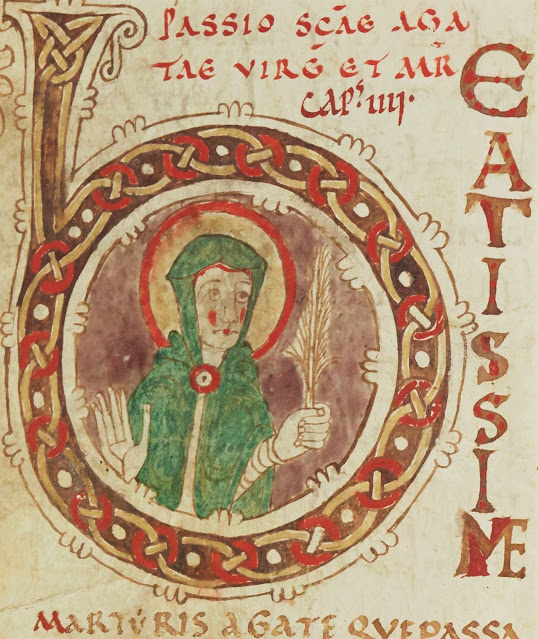
In the early medieval period Agatha appears as a sort of stock figure in illuminated manuscripts.   As in the mosaic at Sant’Appolinare there is no reference to the specific circumstances of her martyrdom. 
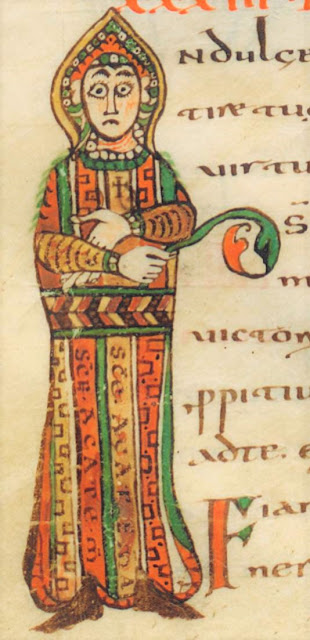
Attributed to Henri, Saint Agatha
From the Sacramentary of Gellone
French, c. 775-800
Paris, Bibliotheque nationale de France
MS Latin 12048, fol. 17v
It may be that the protective way in which this little figure of Saint Agatha crosses her arms over her torso is a hint at the manner of her martyrdom.  In her right hand she carries the martyr's palm, highly stylized.


Anonymous, Saint Agatha
From the Legendarium S. Matials Lemovocensis
French (Limoges), 10th-11th Century
Paris, Bibliotheque nationale de France
MS Latin 5301, fol. 44
There is reference to her martyrdom here (the palm), but nothing else.


These references come later in the Middle Ages and in subsequent centuries, when she begins to appear in two guises:  as a saint in heaven holding a specific reference to her ordeal and as the suffering martyr.


Part of the Heavenly Court

In the images of Agatha as a saint in glory she is frequently shown holding a platter or dish on which repose her breasts.  As the shape of the breasts resembles the shape of bells she is, for this reason, also the patron saint of bronze casters, among whose productions are bells.  
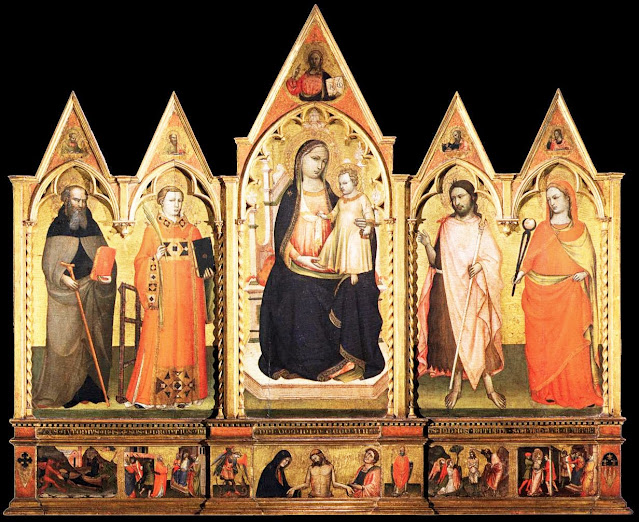

Lorenzo di Niccolo di Martino, Virgin and Child Enthroned with  Saints
Italian, c. 1404
Venice, Collezione Vittorio Cini
In this case she carries the shears with which her breasts were (in some traditions) cut off.


Vecchietta, Virgin of the Assumption with Saints
Italian, c. 1462-1463
Pienza, Cathedral


Francisco de Zurbaran, Saint Agatha
Spanish, c. 1630-1633
Montpelier, Musée Fabre


As the Suffering Martyr

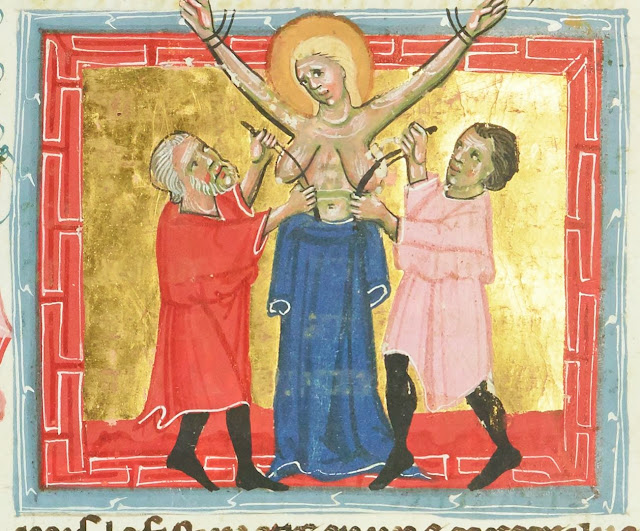
The other, suffering image, which appears to have been equally popular, shows her undergoing the act of her martyrdom, as her breasts are cut off.  This is shown in various ways. 

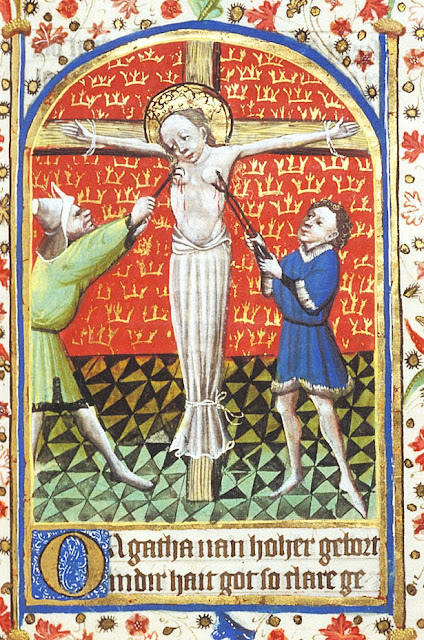
In most of the earliest of these images she is shown as if on a cross, with arms spread out.  


The Martyrdom of Saint Agatha
From the Carrow Psalter-Hours
English (East Anglia), c. 1250
Baltimore, Walters Art Museum
MS W.34, fol.19v


The Martyrdom of St. Agatha
From the Livre d'images de madame Marie
Belgian (Hainault), c. 1285-1290
Paris, Bibliotheque nationale de France
MS Nouvelle Aquisition Francaise 16251, fol. 97v


The Martyrdom of Saint Agatha
From the Sermons of Maurice de Sully
Italian (Milan or Genoa), c. 1320-1330
Paris, Bibliotheque nationale de France
MS Francais 187, fol. 38v


The Martyrdom of Saint Agatha
From a Prayerbook
Germany (Lower Rhineland), c. 1430-1435
London, British Library
MS Egerton 859, fol.29


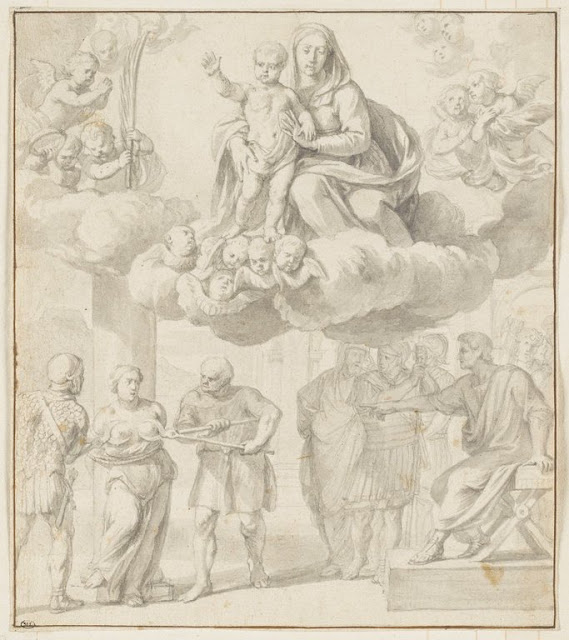
In later images she is shown as if chained to a column. 
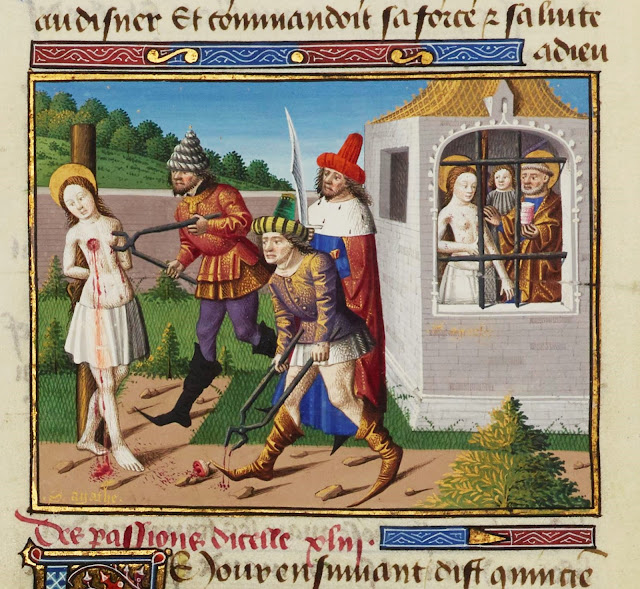
Maitre Francois and Workshop, The Martyrdom of Saint Agatha
From a Speculum historiale of Vincent of Beauvais
French (Paris), 1463
Paris, Bibliotheque nationale de France
MS Francais 51, fol.15v
On the right side of this image we see the scene of her healing by Saint Peter while in prison. He is attended by an angel.


Sebastiano del Piombo, The Martyrdom of Saint Agatha
Italian, 1520
Florence, Palazzo Pitti


Philippe de Champaigne, The Martyrdom of Saint Agatha
French, c. 1650-1675
Paris, Musée du Louvre


Both postures echo images of the sufferings of Jesus, as He was on the cross or at the scourging at the pillar, and underlines the martyr’s union with the suffering Christ.  Some effort is sometimes made to preserve her modesty, but in most images she is shown naked to the waist, as she probably was in actuality.  Most of the time the torturers attack her with what look like gardening shears or bolt cutters, a truly nasty idea. 

Most of the images have a curiously static, nearly symbolic, feel to them.  They are more like a frozen tableau of implied horror than a true reflection of it. 


However, there is one late image that stands out because it seems to capture the reality of what Agatha must have undergone.  This is a painting by Giovanni Battista Tiepolo now in the Gemäldegalerie in Berlin.  It shows not the moment of torture, but its aftermath. 


Giovanni Battista Tiepolo, The Martyrdom of St. Agatha
Italian, 1726
Berlin, Gemäldegalerie der Staatliche Museen zu Berlin


Agatha has collapsed on what appear to be steps.  She is supported by another woman who holds a bloody cloth up to cover her mutilated torso.  Behind Agatha stand the executioner, holding a bloodied sword, and an assistant, who holds the typical platter with her amputated breasts.  Agatha herself gazes upward toward the heavens, but her face reflects her pain, her shock and her steadfast faith.  

This is an image to which I can fully relate for it mirrors my own feelings about my diagnosis and the surgery that followed it.  Although done to save my life for the time being, the effect of the mastectomy and the painful aftermath has brought me to feel very close to this image of St. Agatha, my newest patron saint.  Even given the advanced surgery of our own time, this loss is a difficult one to come to terms with and, in my own case at least, has been an extremely painful experience.

I am aware that there are some who feel that Agatha should not be the patron of women with breast cancer because she did not lose her breasts to cancer.  I find this attitude ugly and small-minded.  Surely, she is the saint who, in her own sufferings, can relate most closely to those who suffer this mutilation for any reason.  Whether done in sanitary, hospital conditions in order to remove a life-threatening cancer (and I have personally known three women who have died from this disease) or whether done as a brutal act of torture the fact is the same, the pain is real even when mitigated by drugs, the healing is slow, if it happens at all, the loss is permanent.  

So, Saint Agatha, please pray for all women who have to suffer the amputation of breast tissue, for whatever reason. 

© M. Duffy, 2014 and 2024

_________________________________________________________
1.     1.   Kirsch, Johann Peter. "St. Agatha." The Catholic Encyclopedia. Vol. 1. New York: Robert Appleton Company, 1907. 5 Feb. 2014 .


Wednesday, June 12, 2013

Eucharistic Miracles and Final Ends at the Morgan Library

Faithful Receiving The Eucharist From Christ
from DuBois Hours
English (probably Oxford), c. 1325-1330
New York, Pierpont Morgan Library
MS M700, fol. 121r
(Please note that this essay was originally written in conjunction with a temporary exhibition at the Pierpont Morgan Library in New York, which ran from May to September in 2013.)*


The last section of the current exhibition “Illuminating Faith: The Eucharist in the Life and Art of the Middle Ages” focuses on the topic of Eucharistic miracles.

Miraculous Hosts began to appear in the High Middle Ages, that is, in the same time period in which the Church finally came to agreement on an understanding of what transpired at the consecration of the Mass. This was the doctrine of Transubstantiation. Transubstantiation means that at the consecration the substance of the bread and wine are transformed into the Body and Blood of Christ, while still retaining the appearances of bread and wine. Although the reality of the presence of Christ in the consecrated elements has been believed by the Church from the earliest times, this formulation ended several centuries of debate on the mechanism of the transformation, which was most famously represented by the debates between Paschasius Radbertus and Ratramnus in the 9th century. It was St. Thomas Aquinas in the 13th century who formulated the philosophical ground for an understanding of what had been believed from the earliest centuries. 1


Belief in the actual presence of Christ in the Eucharist, the Real Presence, which endures beyond the celebration of Mass is and has been the belief of the Catholic Church from the very beginning. Eucharistic miracles reflect this belief.

They fall into several different categories. There are visions, bleeding Hosts and other manifestations of Christ’s Presence in the Host.

Visions

The exhibition includes images of the Mass of St. Gregory, during which Pope Gregory's fervent prayer for a sign to enlighten a doubting member of the congregation was answered by a vision of Christ as the Man of Sorrows, which appeared at the elevation and was visible to everyone in the church.

Jean Poyer, Mass of St. Gregory
from Hours of Henry VIII
French (Tours), 1500
New York, Morgan Library
MS H8, fol. 168r

In addition there is an image of the vision of St. Bridget of Sweden who saw the Host turn into a child as the priest held it up for the elevation.
Eucharistic Vision of St. Brigid of Sweden
From Devotional Miscellany
Italian (Naples), c. 1345-1400
New York, Pierpont Morgan Library
MS M498, fol. 4v

There is also a charming image of the miracle of St. Anthony of Padua and the mule, which I explained in an earlier article (here). In this image not only does the mule kneel to the Host, but so does St. Anthony, plus the Host in this image levitates.
Miracle of St. Anthony and the Mule
from Breviary of Eleanor of Portugal
Belgian (Bruges), c. 1500
New York, Pierpont Morgan Library
MS 52, fol. 411v-412r

Bleeding Hosts

However, the main focus of the exhibition is on one of the instances of bleeding Hosts, the Sacred Bleeding Host of Dijon.2 

This Host, which survived in honor for 350 years, was a gift from Pope Eugenius IV to Duke Philip the Good of Burgundy in 1433. Philip built a chapel for it, known as the Sainte Chapelle. in his capital at Dijon. An indication of the esteem in which the Bleeding Host was held is indicated by the name, which is the same as the Parisian chapel built for the relic of the Crown of Thorns by Philip’s ancestor, St. Louis.
Sacred Bleeding Host of Dijon
from a Book of Hours
French (Poitiers), c. 1475
New York, Pierpont Morgan Library
MS M1001, fol. 17v
This image shows the appearance of the Bleeding Host in great detail.

Bleeding Hosts were assumed to be the results of physical desecration of the Wafer by non-believers, especially Jews (the most frequently encountered non-Christians in medieval Europe). The Host of Dijon had bloody marks in areas specific to the wounds of Christ, a feature that made it particularly notable to the devout.

From 1433 to 1794, when it was burned by the French revolutionaries, the Host was shown intense devotion. This was only increased when, in 1505, King Louis XII of France received a cure after making a pilgrimage to the Host. In gratitude, he donated his crown to the shrine.
Sacred Bleeding Host of Dijon Adored By a Cleric
Single Leaf From a Gradual Choir Book
French (Dijon), c. 1536-1537
New York, Pierpont Morgan Library
MS M1144, fol. 1r
The show includes some of the vast amount of material that must have been produced. For example, images of the Host were sold as souvenirs in the cloisters attached to the chapel, just as similar items are sold at shrines today. But these souvenirs were often hand painted. The purchaser could bring the image home and add it to his or her own books of devotion, be those illuminated or printed.

Sacred Bleeding Host of Dijon Adored by a Couple
Souvenir Image added in the 1540s  to Heures a l'usiage de Romme
Printed in Paris, 1501
New York, Pierpont Morgan Library
PML 129355, MS fol. 9v


Interest in the Host of Dijon continued through the centuries until the Host was destroyed in the aftermath of the French Revolution.

In 1825, following the restoration of the monarchy in France, a Mass of Reparation was established and is celebrated in Dijon on February 10th to this day.

In the 19th century a micro-organism called micrococinus prodigiosus that grows on bread and which turns red and liquid was discovered. It is hypothesized that it is this organism that gave rise to a large number of medieval bleeding Hosts. Whether this was the case with this Host can neither be proved nor disproved since it was destroyed before the micro-organism was discovered.

The phenomenon of bleeding hosts has continued to the present.  Some of these have been examined scientifically and found to have no natural cause.  The case remains open.


Effects


Finally, another image in the exhibition should be mentioned. It offers a brief glimpse of the effects of the reception of Holy Communion, both good and bad.

In the center of this picture we see the Crucifixion, with Christ on the cross, His Blood flowing into a chalice, standing on an altar. On either side we see communicants whose actions paint the moral of the picture. The good Communion is shown on the left. These individuals make sincere, good confessions in the foreground; receive Communion in the proper spirit in the middle ground. In the background we see their souls being carried to heaven by angels. On the right side, we see the effects of a bad communion. These individuals make an insincere, bad confession in the foreground, but receive Communion in the middle ground. The effects of this insincerity appear in the background, as demons carry their souls to hell.
Good and Bad Communions
from a Book of Hours
Italian (possibly the Veneto), c. 1425-1450
New York, Pierpont Morgan Library
MS 1089, fol. 118v

The image makes clear the words of St. Paul “Therefore whoever eats the bread or drinks the cup of the Lord unworthily will have to answer for the body and blood of the Lord. A person should examine himself, and so eat the bread and drink the cup. For anyone who eats and drinks without discerning the body, eats and drinks judgment on himself.”
(1 Corinthians 11:27-29)

If you are in the New York area I strongly urge that you get to the Morgan Library and see for yourself the amazing variety of images of this most important subject.

© M. Duffy, 2013 
________________________________________________
1. LaVerdiere, Eugene S.S.S., The Eucharist in the New Testament and the Early Church, Liturgical Press, Collegeville, MN, 1996. Substantial sections of this book can be viewed at http://books.google.com/books?id=j1BjjBe4dL4C&pg=PA1&dq=LaVerdiere+%22oldest+attestation%22&hl=en&sa=X&ei=g6-3UaTnJvin4APytIGoAg&ved=0CC8Q6AEwAA#v=onepage&q=LaVerdiere%20%22oldest%20attestation%22&f=false
See also: 


2. You can learn more about the Sacred Bleeding Host of Dijon in this slideshow narrated by Roger Wieck, the curator of the Morgan exhibition (here). Just bear in mind that in his introductory remarks about the Host Mr. Wieck uses the past tense to explain Eucharistic beliefs, making it sound a bit like they only applied in the Middle Ages. Not so.  This is still the faith of the Church today, so a better tense for his remarks should have been the present.

*  Some images are available at http://www.themorgan.org/exhibitions/images/illuminating-faith


Wednesday, June 5, 2013

The Feast of Corpus Christi at the Morgan Library

Philippe de Champaigne, Vision of St. Juliana of Liege
French, c. 1645-1650
Birmingham, Alabama, Barber Institute of Fine Arts
(Please note that this essay was originally written in conjunction with a temporary exhibition at the Pierpont Morgan Library in New York, which ran from May to September in 2013.)*

The highpoint of the Morgan exhibition “Illuminating Faith: the Eucharist in the Art and Life of the Middle Ages” is the section entitled “Feast of Corpus Christi”. The wall card that introduces this section of the show gives a very good exposition of the history of the establishment of this important feast, the feast of the Most Holy Body and Blood of Christ. It was officially established for the universal Church by Pope Urban IV in 1264, although its actual adoption in individual countries took another 70-75 years.

This feast, honoring the Body and Blood of Christ, was initially proposed by St. Juliana of Liège (also known as Juliana of Montcornillon). Juliana was a nun of the Premonstratensian order, a religious order founded by St. Norbert in 1120. One of the purposes of the orders he founded is the defense of and spread of devotion to the Blessed Sacrament, which is the Body and Blood of Christ in the Eucharist.

For many years, beginning in her 20s, Juliana had a vision in which she saw the full moon shining brightly except for one black spot. Over time she came to understand that the full moon was a symbol for the round, white Host, the Body of Christ, which is also the Church (known as the Mystical Body of Christ) and that the black spot was an indication that something was missing from the Body of Christ.

Eventually, she determined that what was missing was a feast which celebrated the Body of Christ in all its aspects. Her spiritual director, the Canon John of Lausanne, contacted a number of theologians who agreed that her visions were genuine and not in conflict with any Church teaching. Therefore, in 1246 a feast in honor of the Blessed Sacrament was established for the diocese of Liège by the bishop, Robert de Thorete.

In 1261 one of the theologians who had been consulted about her visions in the 1240s became Pope Urban IV. In 1264 he established the feast of Corpus Christi for the universal Church on the Thursday following the Sunday celebration of the Holy Trinity. St. Thomas Aquinas was asked by the Pope to compose the Office and prayers for the new universal feast and his beautiful work is still part of the celebration of the feast today. Indeed, his great poems for the feast, which include the sequence “Lauda Sion” and the hymn “Pange Lingua” (the last two verses of which are the well-known Benediction hymn “Tantum Ergo”) are in frequent use by the Church at other times as well. The feast is still celebrated on the Thursday after Trinity Sunday in some countries, while in others, including the United States, it is celebrated on the Sunday following Trinity Sunday.

St. Juliana is frequently shown holding a monstrance, the special reliquary that is used to hold the Body of Christ for adoration outside of Mass.

The Morgan Exhibition includes many images related to the establishment and spread of the feast. Through these images it charts some of the influences that form the non-specific background in which the feast was promulgated (the establishment of the feast for the diocese of Liège under Juliana’s influence being the specific background). Among these are the history of miraculous Masses, such as the Mass of St. Giles, as well as an increasing number of representations of representations of several “ordinary” Masses in prayer books, missals and other books of devotion.

Funeral Mass 
From a Psalter
Belgian (Liege), c. 1280
New York, Pierpont Morgan Lirary
MS M183, fol.252v
Mass of St. Giles Witnessed by Charlemagne and
Gisela of Chelles
From a Psalter
Belgian (Liege), c. 1290-1305
New York, Pierpont Morgan Library
MS M155, fol. 97v


Mass
From a Breviary
Italian (Bologna), c. 1315-1325
New York, Pierpont Morgan Library
MS M373, fol. 303v

Some of the images focus on one of the special aspects of the celebration of this feast, the Eucharistic procession. This is a major aspect of the feast to this day.
Heavenly Procession of the Blessed Sacrament
From a Gospel Book
Italian (Padua), 1436
New York, Pierpont Morgan Library
MS M180, fol. 68r (detail)

Processions of the Blessed Sacrament take place both inside and outside of churches, sometimes as a highly public event involving large crowds of people. One such takes place annually through the streets of Rome, from the Basilica of St. John Lateran to the Basilica of St. Mary Major. Thousands of people take part, including the pope. This year, Pope Francis walked the entire distance with the people.

In spite of Pope Urban IV establishment of the feast it did not spread immediately to all corners of Christendom. Its spread took about fifty years and in some areas much longer. It became widespread only in the period 1311-1317.

The exhibition recalls many aspects introduced into the Church on the establishment of the feast. Among these are the opportunities it offered for lay involvement, in offering adoration and in participating in the Eucharistic procession.

Corpus Christi Procession
From a Missal
French (possibly Angers), ca. 1427
New York, Pierpont Morgan Library
MS M146, fol. 141 (detail)
Charles the Bold of Burgundy and Isabelle of 
Portugal Adoring the Blessed Sacrament
From the Diurnal of Isabelle de Bourbon
French (Amiens), c. 1455
New York, Pierpont Morgan Library
MS M221, fol. 80v


One of the most interesting images on view comes from the Farnese Hours, the best known work by the illuminator Giulio Clovio, made for Cardinal Alessandro Farnese in 1546. In an impressive two-page spread we see a Corpus Christi procession moving through St. Peter’s Square. This is the old square, before the transformations made by Michelangelo, Maderno and Bernini.
Papal Corpus Christi Procession in St. Peter's Square
from Farnese Hours
Italian (Rome), 1546
New York, Pierpont Morgan Library
MS M69, fol. 72v-73r

The image unites the earthly world with the heavenly world, as angels descend from heaven where the Holy Trinity appears surrounded by angels and saints. And the procession depicted is reflected today by the procession through the streets of Rome that takes place each Thursday after Holy Trinity, most recently on May 30, 2013.

As the Church teaches, the Communion of Saints unites all believers, living and dead, in one Mystical Body of Christ. On the feast of Corpus Christi, as this last image suggests, the entire Mystical Body, living and dead, in heaven and on earth, comes together in adoration of the supreme symbol of unity, the Blessed Sacrament.

© M. Duffy, 2013

* Some images are available at http://www.themorgan.org/exhibitions/images/illuminating-faith