Showing posts with label Adoration of the Trinity. Show all posts

Friday, December 23, 2011

O Emmanuel! Savior of all people, come and set us free!

Hubert and Jan Van Eyck, Adoration of the Lamb
Central Panel of the Ghent Altarpiece
Netherlandish, c. 1425-1432
Ghent, Cathedral of St. Bavo

The seventh and final "O Antiphon", for December 23rd, reads "O Emmanuel, king and lawgiver, desire of the nations, Savior of all people, come and set us free, Lord our God".  The title, Savior of all people, applies to Christ through his Passion and Death. 

There are many works of art that show the Crucifixion, most often in a narrative sense.  However, the text of this antiphon is more suggestive of contemplation and adoration of Christ as Crucified Savior.  Three works of art come to mind as an interpretation of the subject.  


The first is the Adoration of the Lamb by Hubert and Jan van Eyck, painted for the chapel of the Vidjt family in the Cathedral of St. Bavo in Ghent between 1425 and 1432.  It represents a scene from the book of Revelation  (Rev. 7:9-10).  The blessed in heaven "from every nation, race, people, and tongue" adore the Lamb that was slain.  The Lamb is, of course, Christ and His placement on the altar reminds us of the Sacrifice of the Mass, which is a daily participation in His Passion, Death and Resurrection. For more on this see my post Worthy Is the Lamb.


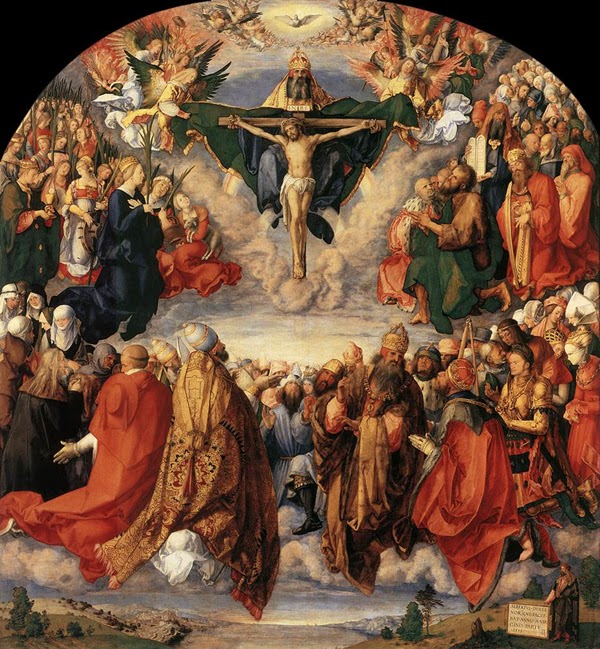
The second is the Landauer Altarpiece by Albrecht Dürer, dated to 1511. It is an image of the Adoration of the Holy Trinity by all the saints.  Here, the Crucified Christ is displayed by God the Father for the adoration of all, the ultimate revelation of the God of Mercy and Love.  See also The Holy Trinity -- Love Made Visible and The Holy Trinity -- The Throne of Grace.


Albrecht Dürer, Adoration of the Holy Trinity
German, 1511
Vienna, Kunsthistorisches Museum


The final image is an engraving after a drawing by Gianlorenzo Bernini of the Blood of Christ.  It was engraved as the frontispiece of the book Unica speranza del peccatore (The Only Hope of the Sinner) by F. Marchese, published in Rome in 1670.  In this work, the Crucified Christ, on the cross, is held high by angels in adoring postures.  His blood pours down, forming an endless ocean of grace for sinners to draw upon.  For more on this see "Of the Blood, All Price Exceeding, Shed by Our Immortal King".


 F. Spierre after a painting by Gianlorenzo Bernini, The Blood of Christ
Engraved as the frontispiece of Unica speranza del peccatore by F. Marchese,
Italian, 1670
Vatican, Vatican Library

These pictures remind us of the reason for which the anticipated Emmanuel came to us.  As the carol "Hark the Herald Angels Sing" tells us, to make "God and sinners reconciled". 

© M. Duffy, 2011.  2024 all images have been updated.

Tuesday, November 1, 2011

November 1 – Feast of All Saints

Celestial Rose, Illustration to Canto XXXII of
Paradiso, Third Book of the Divine Comedy
by Dante Alighieri
15th-Century Italian
Vatican City State, Vatican Library


On November 1 the Church celebrates the feast of All Saints. On this day we honor all those who through their lives, lived in faith and hope and with charity, have achieved the Beatific Vision of God. Some of them are saints who have been identified and formally recognized by the Church, but most are simply men, women and children who have passed without formal recognition and whose names are now forgotten. They are our ancestors in faith exactly as they are our ancestors in flesh and blood. They enjoy the peace, the glory and the vision of God that we hope eventually to attain.

For obvious reasons it is difficult to represent all the saints in art, but there are some works that come to mind.

The first is the literary image of the Celestial Rose from Canto XXXII of Paradiso, the final book of Dante’s Divine Comedy. Every saint in heaven has his or her seat in the petals of this rose. Representing this in art is impossible, but a 15th-century Italian manuscript now in the Vatican Library gives an idea of what it might look like.


A diagram of how Dante imagined the interior of the rose to accommodate the saints within its petals was prepared in connection with the publication of Dorothy Sayers' English translation of 1962.


The next image that comes to mind is the exquisite altarpiece by the Van Eyck brothers, Hubert and Jan in the cathedral of St. Bavo in Ghent. Known as the Ghent Altarpiece, its lower half represents the Adoration of the Mystic Lamb. Its inspiration comes from the description in the Book of Revelation of the Triumph of the Lamb (Rev. 7:9-10):

“After this I had a vision of a great multitude, which no one could count, from every nation, race, people, and tongue. They stood before the throne and before the Lamb, wearing white robes and holding palm branches in their hands.
They cried out in a loud voice:
“Salvation comes from our God, who is seated on the throne,
and from the Lamb.”
Hubert and Jan Van Eyck, Adoration of the Lamb, Lower Section of Altarpiece Interior
The Ghent Altarpiece
Netherlandish, 1425-1432
Ghent, Cathedral of St. Bavo
In the Van Eycks’ painting, which extends over five panels, the Lamb on the altar (who is Christ, especially Christ in the Sacrament of the Altar, the Eucharist) occupies the central position of the central panel. He is surrounded by angels holding the instruments of the Passion through which He has triumphed over death. Two kneeling angels incense Him. Two groups kneel before Him. To the left are the Old Testament prophets and heroes. To the right are the Apostles, Fathers and other male saints. Advancing from the distance are two other groups; additional male saints from the left and female saints, some of whom carry the martyr’s palm, from the right. In the side panels more saints advance. In the background we can see the New Jerusalem, composed of a combination of actual buildings from several towns and imaginary ones.

A final image is that of Albrecht Dürer’s Landauer Altarpiece, the Adoration of the Trinity. Clearly deriving from the same inspiration as the Van Eycks’ picture, Dürer interpreted the text less literally. He replaces the Lamb with the image of the Trinity and places the scene in the skies. But, the essentials of the image are the same; God is surrounded by His saints.

Albrecht Durer, Adoration of the Holy Trinity
German, 1511
Vienna, Kunsthistorisches Museum

These are the images of what we celebrate today.

© M. Duffy, 2011