Showing posts with label legends of St. Anne. Show all posts

Saturday, July 26, 2025

Glorious Saint Anne – The Iconography of Saint Anne


Masaccio, Madonna and Child with Saint Anne
Italian, 1424
Florence, Uffizi Gallery


The course of the year has come round, once again, to the middle of July and the start of the period in which the Church turns to honor Saint Anne and her husband, Saint Joachim, parents of the Virgin Mary and grandparents of Jesus.  As it has every July since 1892, my home parish in New York will be honoring St. Anne during the nine day novena and feast day, from July 17th to July 26th.   The schedule is shown below.

 
During the ten-day period in 2011, I posted a series of essays on the iconography of Saint Anne.  The list of topics is shown below.  I refer readers to them.  I've updated some with additional images, as I've found them during the past year. 


I have also published additional images of Saint Anne in annual supplements.  To see these click on the year or title:
Saint Anne at the Met
2014
2016
2017
2018
2019


Please note that there was no updates for 2023 or 2024.  Circumstances have prevented that work.  In 2023, a computer crash destroyed the image files and in 2024 a fall prevented any work being done.  I am still trying to catch up.

In the meantime, you may want to join in the daily prayer to Saint Anne, recited during each day of the novena.  

You can access the 2025 novena schedule here Eglise Saint Jean Baptiste.

Luca Vescia, Saint Anne and Mary
Italian, 1911
New York, Saint Jean Baptiste Church, Shrine of Saint Anne


Novena Prayer to Saint Anne
"O glorious Saint Ann, you are filled with compassion for those who invoke you and with love for those who suffer! Heavily burdened with the weight of my troubles, I cast myself at your feet and humbly beg of you to take the present intention which I recommend to you in your special care.

Please recommend it to your daughter, the Blessed Virgin Mary, and place it before the throne of Jesus, so that He may bring it to a happy issue. Continue to intercede for me until my request is granted. But, above all, obtain for me the grace one day to see my God face to face, and with you and Mary and all the saints to praise and bless Him for all eternity. Amen."


© M. Duffy, 2025.


Monday, July 26, 2021

Iconography of Saint Anne -- Subject guide

Hans Wydyz (or Weiditz),Madonna and Child with Saint Anne
German, c. 1520
Freiburg-im-Briesgau, Augustinermuseum


Here's a list of my remarks on the iconography of Saint Anne.  You can link directly from the list to the article you want to read. 

1.   Introduction, Background of Joachim and Anne plus Annunciation of Mary's Birth
2.   The Meeting of Anne and Joachim at the Golden Gate
3.   Birth of Mary
4.   Presentation of Mary in the Temple
5.   Saint Anne as Teacher (Education of the Virgin Mary)
6.   Anne, Root of the Tree of Salvation (the Anna selbdritt image)
7.   Saint Anne, Grandmother
8.   Saint Anne, Matriarch of the Holy Kindred
9.   Saint Anne in the Communion of Saints
10. Saint Anne, Patron and Intercessor


I have added new material for the iconography of Saint Anne most of the years since 2011.  Please refer to the annual July links below or on the right for these.  


An unforeseen health condition made it impossible to post one for 2021.  But I hope to make up for this in the next few days with an update for 2022.

Please pray for me and especially ask Saint Anne to intercede for me so that I can continue to add to the available knowledge of her iconography through the centuries.

© M. Duffy, 2022


Tuesday, July 26, 2016

2016 -- Saint Anne Update

Bernardino Luini, Saint Anne
Italian, 1523
Philadelphia, Museum of Fine Art
July 26th is the feast day of Saints Anne and Joachim, the parents of the Virgin Mary and the grandparents of Jesus.  They, especially St. Anne, have been important saints for most of the life of the Church and frequently featured in Christian art.  

Over several years I have posted various images of Saints Anne and Joachim.  The number keeps growing because, as the internet becomes a more widely available tool, the number of museums and libraries that are making their collections available online keeps growing.  Further, museums and libraries that were early participants in making collections available by releasing parts of their holdings keep adding to their online presence.  Since Anne and Joachim have been important for so long, we are still only seeing the tip of the iceberg of images that probably exist.
 
Each year I propose to continue to add to the collection of images available through this blog as new ones become accessible.   I will endeavor to link these images with the essays about their iconological type which I did in 2011. 


So, now I present the 2016 additions to the iconography of St. Anne.


Jean Bellegambe, Pregnant Saint Anne
French, c.1500
Douai, Musée de la Chartreuse


Master of the Getty Epistles, Education of the Virgin Mary
from Book of Hours
French (Tours), 1525-1540
New York, Pierpont Morgan Library
MS M 452, fol. 140r

Education of the Virgin (ivory carving)
 (Chinese?), 17th century
Paris, Musée Guimet, Musée national des Arts asiatiques


Anna Selbdritt
German (Bavarian), 1472
Paris, Musée de Cluny, Musée nationale du  moyen age
Circle of Daniel Mauch, Anna Selbdritt
German, c.1500
Marseille_Musée Grobet Labadie


Defendente Ferrari, Madonna and Child with Saint Anne
Italian, 1528
Amsterdam, Rijksmuseum
Dirk van Hoogstraten, Virgin and Child with Saint Anne
Dutch, 1630
Amsterdam, Rijksmuseum


Jean Fouquet, Holy Kindred
from Hours of Etienne Chevalier
French (Tours), 1452-1460
Paris, Bibliotheque nationale de France
MS Nouvelle acquisition latine 1416

Master of the Legend of Saint Anne, Holy Kindred
Netherlandish, 1475
Philadelphia, Museum of Art

Master of the Legend of Saint Anne, Holy Kindred
Netherlandish, 1475
Philadelphia, Museum of Art

Attributed to  Matthaeus Gutrecht the Younger, Holy Kindred
German, c.1500-1510
Philadelphia, Museum of Art


Wood Carving, Holy Kindred
Austrian (Tyrol), c.1515-1520
London, Victoria and Albert Museum

Colin Nouailher, Holy Kindred
French, 1545
Paris, Musée du Louvre

Saint Anne's mother, identified by the name of Emerencia or Emerantia, was often included in the Holy Kindred or the Anna Selbdritt images.  But, occasionally, she was accorded an image of her own.

Jan Provost, St. Emerencia, Mother of Saint Anne
Flemish, c.1500
Paris, Musée du Louvre

St. Anne, Patron and Intercessor

Bartel Bruyn the Younger, Catharina von Siegen, nee Kannegiesser, with Saint Anne and Virgin and Child
German, c..1565-1575
Philadelphia, Museum of Art


 Prayer to Saint Anne
"O glorious Saint Ann, you are filled with compassion for those who invoke you and with love for those who suffer! Heavily burdened with the weight of my troubles, I cast myself at your feet and humbly beg of you to take the present intention which I recommend to you in your special care.

Please recommend it to your daughter, the Blessed Virgin Mary, and place it before the throne of Jesus, so that He may bring it to a happy issue. Continue to intercede for me until my request is granted. But, above all, obtain for me the grace one day to see my God face to face, and with you and Mary and all the saints to praise and bless Him for all eternity. Amen."


Wednesday, July 23, 2014

2014 - Saint Anne Update


Willem Vrelant, Anna selbdritt
from a Book of Hours
Flemish, ca. 1460
The Hague, Koninjlijk Bibliothek
MS 76F7, fol. 25v (detail)


Three years ago I wrote extensively about the iconography of Saint Anne, mother of Mary and grandmother of Jesus (see here for listing of the articles).  At the time, the iconographic image that was most of a revelation to me was that known as the Anna Selbdritt.  Although a few of these images were very well known, the fact that it was a recognizable iconographic type was not well known.  Therefore, the few images that I was able to find at the time were nearly all new to me. 


In anticipation of the 122nd annual novena in honor of St. Anne that has taken place in my parish every July since 1892 I decided to search for some additional images of St. Anne to add to those that appeared in my blog postings of three years ago.  In the search I discovered many, many more Anna Selbdritt images, most dating to the period in which devotion to Saint Anne was very popular (approximately the late 15th through mid-sixteenth centuries), but some of more recent date.  Nearly all come from northern European countries.


Some belong to the tradition of seated figures:  Jesus seated on Mary, who herself sits on the lap of Anne or at her feet.

Anonymous, Anna Selbdritt
North German, 1307
Stralsund, St. Nicholas Church
(the statue was seriously damaged during the Reformation

Fra Bartolomeo, Drawing for Saint Anne Altarpiece
Italian, ca. 1510
Florence, San Marco Museum

Others belong to what is known as the "bench type" or the side-by-side tradition, where Anne and Mary, holding the infant Jesus, sit side by side.


Anna Selbdritt with Donor, Victor of Carben
German, early 15th Century
Cologne, Cathedral of Saint Peter

Master of the Mansi Magdalen, Madonna and Child with Saint Anne
Netherlands, ca. 1515-1525
Remagen, Arp Museum Bahnhof Rolandseck
On loan from Rau Collection for UNICEF

Some take a variant view in which a seated Anne holds Jesus, while a sometimes child-sized Mary stands beside her.  

Anna Selbdritt
German (Franconia), ca. 1480
New York, Metropolitan Museum of Art, Cloisters Collection

Wilhelm Mengelberg, Anna Selbdritt
German, 1908
Cologne, Basilica of the Holy Apostles
This early 20th century image shows that the tradition has continued for a very long time.

Others belong to the tradition in which an outsized Anne holds a small Mary and an even smaller Jesus.

Madonna and Child with Saint Anne
Spanish, 1270-1290
Budapest, National Museum of  Fine Arts
Madonna and Child with Saint Anne
German, 1400-1450
Minden, Cathedral Treasury

Madonna and Child with Saint Anne
German, late 15th Century
Speyer, Cathedral Museum of the Palatinate

Madonna and Child with Saint Anne
German, early 16th Century
Aachen, Sürmondt-Ludwig Museum

These images, coming from many locations, over a number of centuries, prove how much and how deeply St. Anne was revered in the Middle Ages, into the Renaissance and beyond.


There is one further image that is quite charming and comes from the eighteenth century in Austria. It's not high art, but it is a charming continuation of the tradition.

Madonna and Child with Saint Anne
Austria, 18th Century
Graz, Joanneum Museum


© M. Duffy, 2014


Monday, July 25, 2011

Glorious Saint Anne – Iconography of Saint Anne, Feast Day, July 26 – Saint Anne, Patron and Intercessor

Masters of the Dark Eyes, Anna Geperts and Her Daughter
From a Prayer Book
Dutch or Flemish, ca. 1500
The Hague, Koninlijk Bibliothek,
MS KB 135 E 19, fol.1v


Most modern people encounter Saint Anne, not through a visual or written source, but through a name – Anne, Ann, Anna, Hannah, Aña, Aine, Anya and countless other variations. Of all the people who bear her name and of the churches, schools and other institutions named after her, she is the Patron Saint.

She is also the Patroness of: grandmothers, women who have trouble conceiving, unmarried women (hence the pseudo-prayer “Saint Anne, Saint Anne, find me a man”), miners, the French region of Brittany (which takes in the shrine of Sainte Anne d'Auray with its famous “pardon” or pilgrimage in her honor) and the Canadian province of Quebec, with its major shrine at Sainte Anne de Beaupre.


In many works of late medieval art women named Anne requested that their own portraits be added as donor images. In these works they are shown kneeling before her in prayer.

Madonna and Child with Saint Anne
From the Hours of Pierre de Bosredont
France (Langres), ca. 1465
New York, Morgan Library
MS G.55, fol. 112v

They frequently also requested a closer relationship with Saint Anne. In these cases they are shown kneeling in prayer before the the central image of the work of art as Saint Anne presents them to that central subject (often a Madonna and Child or scene of the Crucifixion).

Master of the Legend of Saint Ursula, Anna Nieuwenhove Presented by Saint Anne
Flemish, late 15th Century
New York, Metropolitan Museum of Art, Lehman Collection


Jean Bourdichon, Anne de Bretagne in Prayer Accompanied by Her Patron Saints
From the Grandes Heures d'Anne de Bretagne
France (Tours), 1503-1508
Paris, Bibliotheque nationale de France
MS Latin 9474, fol. 3
Here Saint. Anne appears alongside two royal saints as patrons of Anne de Bretagne, Duchess of Brittany and twice Queen of France (consort to Charles VIII and Louis XII).


These images demonstrate Saint Anne’s role as intercessor for those who claim her as their Patron or for those who request her prayers.

The Catholic doctrine of intercession is frequently misunderstood by non-Catholics (and some Catholics). It is based on the Christian belief in the Communion of Saints, the union of all the faithful, living and dead, in Christ.


Lucas Cranach the Elder, Saint Anne with Donor
German, ca. 1514
Pedralbes, Thyssen-Bornemisza Collection


As the Compendium of the Catechism of the Catholic Church states regarding the Communion of Saints:

 “This expression also refers to the communion between holy persons (sancti); that is, between those who by grace are united to the dead and risen Christ. Some are pilgrims on the earth; others, having passed from this life, are undergoing purification and are helped also by our prayers. Others already enjoy the glory of God and intercede for us. All of these together form in Christ one family, the Church, to the praise and glory of the Trinity.” 1

Since all members of the Communion are alive in Christ, “death no longer has power” (Romans 6:9). So, just as we can request the intercessory prayer of persons still living in this world, we can request the intercessory prayers of those who, having passed from this life, live now in “the glory of God” (see above).


There is no “now” and no “then” in God. In 2011, we can request the intercession of Saint Anne just as readily as our predecessors of 500 years ago, such as does Anna Nieuwenhove in a painting by the Master of the Saint Ursula Legend (above) or her contemporary Anne de Valois (also known as Anne de France) in the beautiful Bourbon Altarpiece by the Master of Moulins (identified as Jean Hey) or as readily as we can request the intercessory prayer of our own contemporary friend named Anne. 


Master of Moulins (Jean Hey), Bourbon Altarpiece
French, ca. 1498
Moulins, Cathedral

Master of Moulins (Jean Hey). Saint Anne with Anne de Valois
Detail of  the Bourbon Altarpiece
French, ca. 1498
Moulins, Cathedral


So, on this feast of Saints Joachim and Anne it is fitting to close with this prayer to Saint Anne:

O glorious Saint Anne, you are filled with compassion for those who invoke you, and with love for those who suffer. Heavily burdened with the weight of my troubles, I cast myself at your feet and humbly beg of you to take the present intention, which I recommend to you in your special care.

Please recommend it to your daughter, the Blessed Virgin Mary, and place it before the throne of Jesus, so that He may bring it to a happy issue.

Continue to intercede for me until my request is granted. But, above all, obtain for me the grace on day to see my God face to face, and with you and Mary and all the saints to praise and bless him for all eternity. Amen.


 Saints Anne and Joachim, pray for us.


Anonymous Alabaster Carver, Mary with Saints
Anne and Joachim
English, 15th Century
New  York, Metropolitan Museum of Art


Joos van Cleve, Madonna and Child with Saints Joachim 
and Anne
Flemish, 1541
Brussels, Musées Royaux des Beaux-Arts


_________________________________

1. Compendium of the Catechism of the Catholic Church, Vatican, Libreria Editrice Vaticana, 2005, #195

© M. Duffy, 2011.  Images refreshed 2022.

Glorious Saint Anne – Iconography of Saint Anne, Day 9 – Saint Anne in the Communion of Saints

Guglielmo Girarldi and Workshop,The Celestial Rose
From the Divina Comedia by Dante Alighieri
Made for Federico da Montefeltro, Duke of Urbino
Italian (Urbino), c. 1474-1478
Vatican City, Biblioteca Apostolica Vaticana
MS Urb. lat. 365, fol. 286v 

One of the distinctive beliefs of the Catholic Church is something called the "Communion of Saints".  This is the belief that all the faithful, living and dead, form part of a Body of which the Head is Christ. Since there is no “now” and no “then” in God all members of the Communion are alive in Christ, “death no longer has power” (Romans 6:9). 

As the Catechism of the Catholic Church explains "When the Lord comes in glory, and all his angels with him, death will be no more and all things will be subject to him. But at the present time some of his disciples are pilgrims on earth. Others have died and are being purified, while still others are in glory, contemplating 'in full light, God himself triune and one, exactly as he is". 1

On the merits of her position as grandmother of the Savior Anne is an honored member of that portion of the Communion of Saints that is in the Presence of God.


Her place in this Communion is an exalted one. In Paradiso, the final book of his Divine Comedy Dante Alighieri places St. Anne among the highest ranks of the Blessed in his image of the Celestial Rose. (Paradiso, Canto XXXII)
  
Diagram of the Rose, from Sayers, Paradiso, 1962 1
                                               
She is located on the same level as Saint John the Baptist, Saint Peter, Saint John and Moses.

Diagonal to Peter there see Anna,
Gazing upon her daughter in such content
Her look ne’er falters while she sings Hosanna. 2


In art Saint Anne frequently appears in works that depict the Madonna and Child along with other saints.

Ercole de Roberti, Madonna and Child with Saint Anne and Other Saints
Italian, 1480
Milan, Pinacoteca di Brera

She is most often pictured as attendant on them, sometimes clearly visible with them, as in the paintings by Ercole de Roberti and Peter Paul Rubens

Peter Paul Rubens, Holy Family with Saint Anne, Saint Francis and the Young Saint John the Baptist
Flemish, ca. 1630s
New York, Metropolitan Museum of Art


but is sometimes deep in the shadowed background, as in this painting by Jusepe Ribera.

Jusepe Ribera, Holy Family with Saint Anne and Saint Catherine of Alexandria
Spanish, 1648
New York, Metropolitan Museum of Art

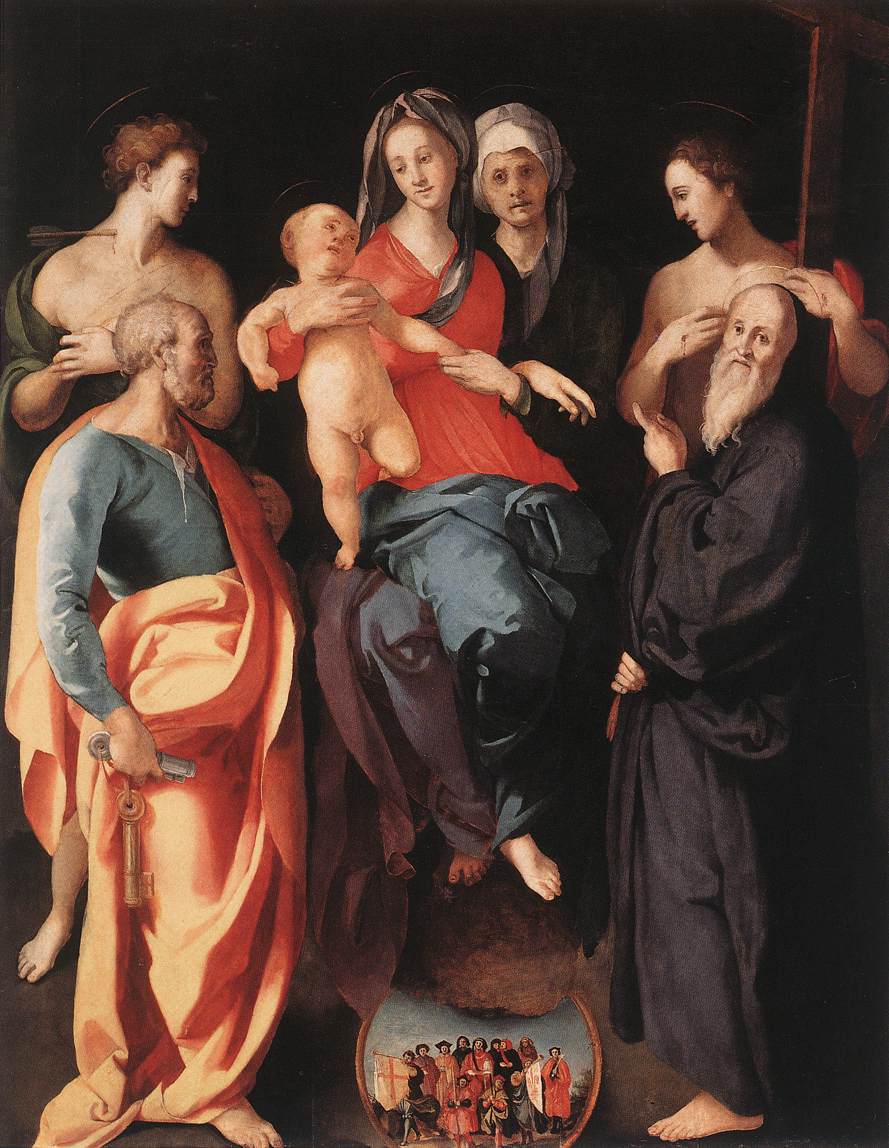
In some, such as in these paintings by Pontormo and Lorenzo Lotto, she is still physically in contact with Mary.

Jacopo Pontormo, Madonna and Child with Saint Anne and Other Saints
Italian, 1529
Paris, Musée du Louvre


Lorenzo Lotto, Madonna and Child with Saint Anne, Saint Jerome and a Donor
Italian, 1534
 Florence, Galleria degli Uffizi 


Occasionally, she appears independently in the ranks of other saints. One interesting example (below) shows her in a group of saints that includes Saint Christopher, Saint Gereon of Cologne and Saint Peter. Here Mary and Jesus are presented as though they were attributes (aids to identification) just like the Christ Child on Saint Christopher’s shoulders or the keys and tiara of Saint Peter.


Anonymous, Saints Christopher, Gereon of Colgne, Peter and Anne
German, c. 1480
Cologne, Wallraf-Richertz Museum


Another image of Anne appears in a curious work by Giovanni Maria Butteri.


Giovanni Butteri, Madonna and Child with Saint Anne and Members of the Medici Family as Saints
Italian, 1575
Florence, Museo della Cenacola di Andrea del Sarto

Here Anne dominates an image of the Madonna and Child surrounded by members of the Florentine ruling family, the Medici, masquerading as several saints. Among the identified portraits are Eleonora de Toledo as Mary and her husband, Duke Cosimo I as Saint Cosmas, both deceased at the time the work was painted. Other saints in the group have also been identified with various then-living members of the family.3  


_________________________________________________________________

  1. Catechism of the Catholic Church, Libreria Editrice Vaticana, Vatican City, 1993, Part 1, Section 2, Chapter 3, Article 9, Paragraph 5, Item 2, Number 954.
  2. Canto XXXII, verses 133-135. The Comedy of Dante Alighieri the Florentine, Cantica III (Il Paradiso) (translated by Sayers, Dorothy L. and Reynolds, Barbara), London, Penguin Books, 1962.
  3.  Murphy, Caroline. Murder of a Medici Princess, Oxford, Oxford University Press, 2008, pp.264-265


© M. Duffy, 2011.  Images refreshed 2022.