Showing posts with label Easter Sunday. Show all posts

Saturday, April 4, 2026

Links for the Easter Season


Anthony van Dyck, The Resurrection
Flemish, c. 1631-1632
Hartford (CT), Wadsworth Athenaeum

Alleluia! 

Alleluia!

Alleluia!


The days of Lent and the days of sadness that are the Triduum are past and Easter 2026 has arrived!

Alleluia! 

Alleluia!

Alleluia!


I wish you a happy and profoundly inspiring Easter Season.


Alleluia! 

Alleluia!

Alleluia!


To guide some of your explorations of the themes of this joyful season I recommend to you the links below.  They lead to some of the commentary that I have written over the years regarding the iconography of the Easter Season, which extends from this happy day till Pentecost and Trinity Sunday.

Please feel free to explore the art created to imagine the Resurrection and the days immediately following, all the way through to the feast of the Holy Trinity.  I hope that considering these events and the pictures that artists have created to illustrate them over the centuries will help you to feel more connected to the long tradition of Christian art offered to the glory of God and to the living Church of our own time.

Links have constantly been improved over the years.  New images, better quality images and new material are constantly being incorporated.  If the original publication date suggests the material is now old, it isn't.  I am constantly revising and housekeeping.

Please note that over the course of the Easter Season I will be overhauling every one of the essays listed below to swap out old images with few pixels for newer ones with a greater number of pixels, giving you more visible details when you enlarge the images.  I will also be adding new images that turn up in the course of my hunt for improved ones (and this happens all the time).  Much more material turns up every year!  So, check back often to see what's new.

The Resurrection, the Incredulity of Thomas, Emmaus


Title

Link

The Women at the Tomb


Noli Me Tangere


Jesus, the Gardener


The Incredulity of St. Thomas (Doubting Thomas)


Emmaus -- The Journey


Emmaus -- The Recognition


Climbing from the Tomb


Hovering over the Tomb


Bursting from the Tomb


An Awkward
Resurrection Image


Apparitions 


Good Shepherd Sunday


The Lake of Galilee -- The Disciples Go Fishing


Commission to Peter -- The Good Shepherd Transfers Responsibility


The Commission to the Apostles


Christ Appears to His Mother


Christ Presents the Redeemed to His Mother


The Ascension


Striding into the Sky


Lifted in a Mondorla or on a Cloud


The Disappearing Feet


The Direct Approach


Pentecost


Tongues of Fire    


https://imaginemdei.blogspot.com/2016/05/tongues-of-fire.html

At This Sound, They Gathered In a Crowd


A Dove Descending  


The Holy  Trinity


Worthy Is The Lamb


Father, Son, Spirit


Iconography of the
Holy Trinity –
Imagining The Unimaginable


The Holy Trinity -- Love Made Visible


The Holy Trinity -- The Throne of Grace


© M. Duffy, 2020, 2021, 2022, 2023, 2024, 2025, 2026

Tuesday, April 18, 2017

Iconography of the Resurrection -- Jesus the Gardener

Fra Bartolomeo, Noli Me Tangere
Italian, c. 1506
Paris, Musédu Louvre
Jesus is carrying a hoe


“Mary stayed outside the tomb weeping. And as she wept, she bent over into the tomb and saw two angels in white sitting there,
one at the head and one at the feet where the Body of Jesus had been.

And they said to her, “Woman, why are you weeping?”
She said to them, “They have taken my Lord,
and I don’t know where they laid him.”

When she had said this, she turned around and saw Jesus there,
but did not know it was Jesus.
Jesus said to her, “Woman, why are you weeping?
Whom are you looking for?”
She thought it was the gardener and said to him,
“Sir, if you carried him away, tell me where you laid him, and I will take him.”
Jesus said to her, “Mary!” 
She turned and said to him in Hebrew, “Rabbouni,” which means Teacher.
Jesus said to her, “Stop holding on to me, for I have not yet ascended to the Father.
But go to my brothers and tell them, ‘I am going to my Father and your Father,
to my God and your God.’”

Mary went and announced to the disciples, “I have seen the Lord,”
and then reported what he had told her.”
(John 20:11-18)


The dramatic encounter of Mary Magdalene and Jesus on Easter morning, as told in the Gospel of St. John, is known as the iconographic subject called the "Noli me tangere", from Christ's admonition "Stop holding on to me!" to her.  In 2011 I reviewed some of the images associated with this iconography. This year I decided to update that essay (and many others) with some new images.  Over the last several years the amount of material available for art research on the internet has expanded incredibly and many more images are now available for studying these subjects.
Noli Me Tangere
German, c. 1300-1350
Mendig, Niedermendig, Catholic Parish Church  of Saint Cyriacus
Jesus is shown carrying a shovel.

In the course of looking at newly available images of the Noli me tangere type I was struck by something that had not been so obvious six years ago.  There is an iconographical offshoot of the subject that focuses on just one portion of a sentence in the Gospel narrative and weaves a story out of it.  This is the subject of the Risen Jesus depicted in the Noli me tangere image as a gardener.
Master Francois and Collaborators, Noli Me Tangere, the Women at the Tomb, the Tomb Guards 
Being Bribed by the Priests
from Speculum historiale by Vincentius Bellovacensis
French, 15th Century
Paris, Bibliotheque nationale de France
MS Francais 50, fol. 233
At the far left in the upper register the Risen Jesus carries a shovel.

 In the Gospel, John explains Mary's initial inability to recognize the Risen Jesus by saying that "She thought it was the gardener" (John 20:15).  This is, of course, in keeping with the Gospel reports of others who failed to recognize Him after the Resurrection.  In some way He was the same, but different and, in a certain sense, He seems to have veiled Himself from them in order for Him to greet them first.  Thus it is with Mary to whom He speaks and with the disciples at Emmaus with whom He breaks bread and with the larger group of disciples on the shore of the Lake of Galilee when He invites them to breakfast.  
Master of the Flemish Boethius. Noli Me Tangere
from Vita Jesu Christi by Ludolphe de Saxe
French, c. 1480
Paris, Bibliotheque nationale de France
MS Francais 181, fol. 155
This Jesus carries a shovel and wears a farmer's hat.
Artists sought to remind their audience of this non-recognition part of the story by equipping the Risen Jesus with gardening equipment: spades, hoes, etc. and, in a few cases, a gardener's hat.  This strand seems to begin in the fourteenth century, so far as I have found to this point.  It ends in the eighteenth century, again so far as I have found to date.  And the artists who have produced works with Jesus the Gardener are among some of the most illustrious in the history of art.


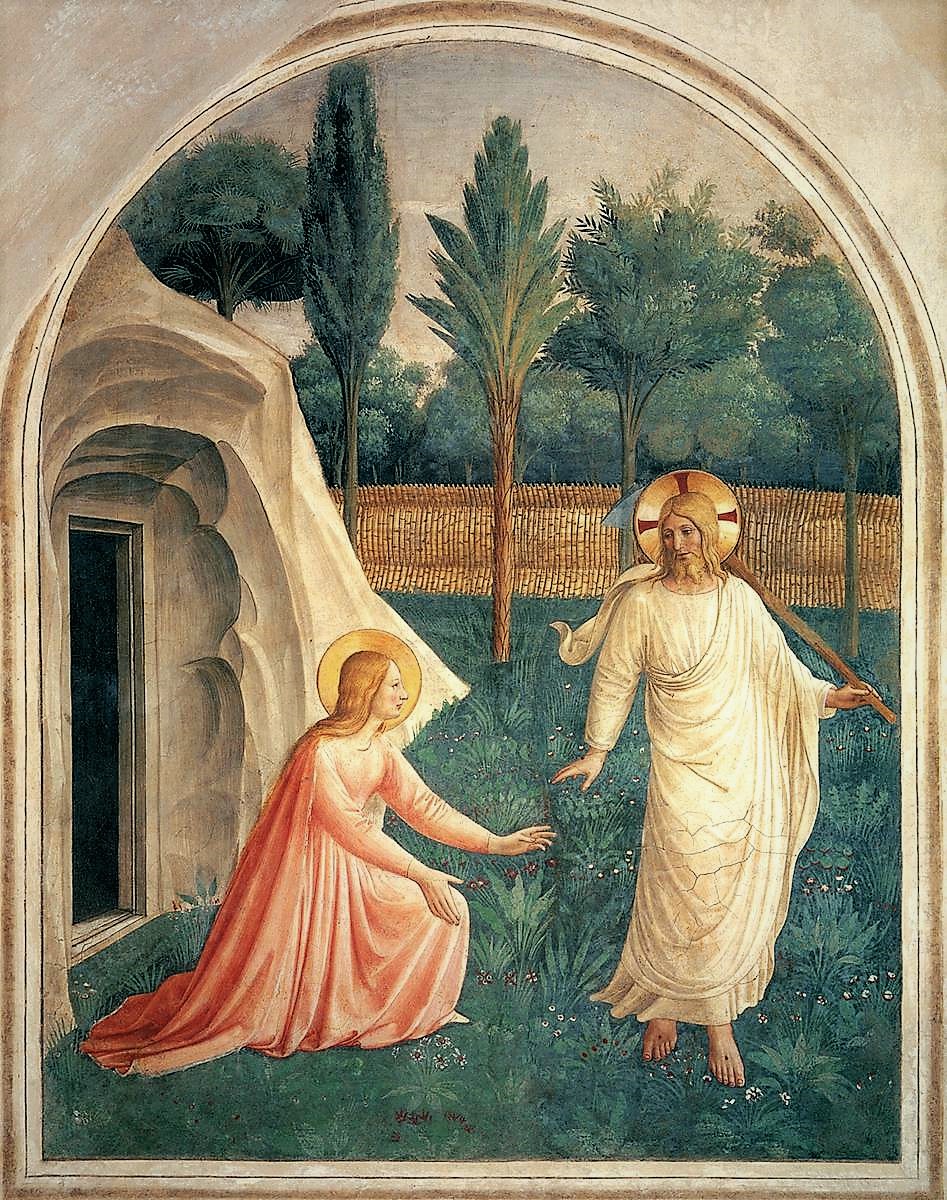
Fra Angelico, Noli Me Tangere
 Italian, 1440-1442
Florence, Convento di San Marco
Fra Angelico and his assistants show Jesus carrying a hoe over His left shoulder.


Perugino, Noli Me Tangere
Italian, 1500-1505
Chicago, Art Institute
Here again Jesus carries a hoe.
Jacob Crenelisz van Oostsanen, Noli Me Tangere
Dutch, 1507
Kassel_Staatliche Museen
In this picture Jesus holds a shovel.
Correggio, Noli Me Tangere
Italian, c. 1525
Madrid, Museo Nacional del Prado
In this beautiful Correggio painting, a cultivator, shovel and gardener's straw hat lie on the ground next to Jesus.

Titian, Noli Me Tangere
Italian, c. 1514
London, National Gallery
That is a garden hoe, and not a cross, that Jesus is holding in His left hand.

Franciabigio, Noli Me Tangere
Italian, 1520-25
Florence, Museo del Cenacolo di San Salvi
Once more Jesus carries a hoe over His shoulder.

Jacopo Pontormo, Noli Me Tangere
Italian, 1530s
Private Collection
Pontormo's Jesus has the head of the hoe looped over His left arm.
Bronzino, Noli Me Tangere
Italian, c. 1560
Paris, Musée du Louvre
Jesus is holding a shovel in His right hand as Mary approaches.

Lelio Orsi, Noli Me Tangere
Italian, c. 1575
Hartford (CT), Wadsworth Athenaeum
In this dancelike encounter with Mary Magdalene, Jesus again holds a hoe in His right hand.

Francesco Albani, Noli Me Tangere
Italian, c. 1620-1625
Paris, Musée du Louvre
Instead of the Resurrection banner, Jesus is carrying a shovel in this image.

Giovanni Battista Caracciolo, Noli Me Tangere
Italian, c. 1620
Prato, Museo Civico
In this dramatically Caravaggesque picture Jesus carries what is probably a shovel (we can see only the shaft) and wears a
very wide brimmed gardener's hat.  

Rembrandt, The Risen Christ Appearing to Mary
Dutch, 1638
London, Collection of Her Majesty Queen Elizabeth II
In Rembrandt's picture Jesus wears the gardening hat, carries a shovel and appears to have a kind of knife tucked into His belt.  

Alonso Cano, Noli Me Tangere
Spanish, c. 1640
Budapest, Szépmûvészeti Múzeu
Cano's Jesus holds a shovel.

Carle van Loo, Noli Me Tangere
French, c. 1740
Private Collection
The Jesus in Van Loo's image also holds a shovel.


© M. Duffy, 2017