|
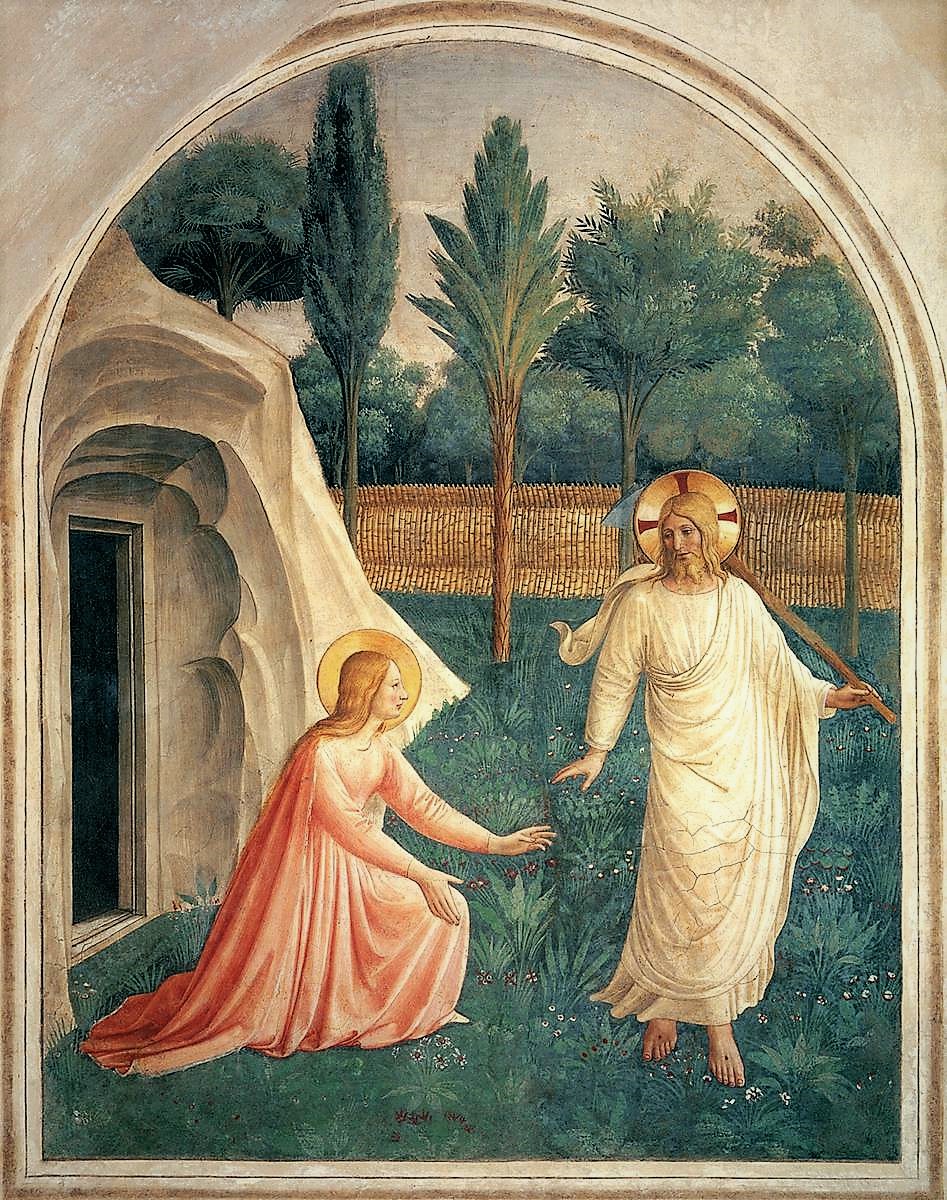
Christ at Emmaus
From a Picture Bible
French, c. 1190-1200
The Hague, Koninklijk Bibliotheek
MS KB 76 F 5, fol. 22v
|
“And it happened that, while he was with them at table,
he took bread, said the blessing, broke it, and gave it to them.
With that their eyes were opened and they recognized him,
but he vanished from their sight.
Then they said to each other, “Were not our hearts burning within us
while he spoke to us on the way and opened the Scriptures to us?”
So they set out at once and returned to Jerusalem
where they found gathered together the Eleven and those with them who were saying,
“The Lord has truly been raised and has appeared to Simon!”
Then the two recounted what had taken place on the way
and how he was made known to them in the breaking of the bread.”
(Luke 24:30-35) Gospel for Third Sunday of Easter, May 8, 2011
As discussed in my previous post, images from the journey to Emmaus are somewhat scarce, but images of the moment of recognition at the dining table (what came to be called “The Supper at Emmaus”), are numerous and often the work of great painters.
Prior to 1600 there were already images of this scene. Among them are an early 12th century French pictorial Bible from the Benedictine abbey of St. Bertin, now in the Koninklijk Bibliotheek at the Hague, seen above. Most of them are combined with images of the journey to Emmaus, either within the same image or as a part of a group of images related to the Resurrection, as, in fact, is this one.
 |
Scenes from the Resurrection narratives
From a Picture Bible
French, c. 1190-1200
The Hague, Koninklijk Bibliotheek
MS KB 76 F 5, fol. 22v
|
At its simplest, the scene of the recognition shows Jesus and the two disciples seated at a table. Jesus is always shown holding, or actually in the act of breaking, a piece of bread. The disciples are shown reacting in some manner.
 |
The Disciples Recognize Jesus
From Miniatures of the Life of Christ
France (Northeast), c. 1170-1180
New York, Pierpont Morgan Library
MS M 44, fol. 13r
|
 |
Pacino di Bonaguida, The Disciples Recognize Jesus
From Scenes from life of Christ and the Life of Blessed Gerard of Villamagna
Italian (Florence), c. 1315-1325
New York, Pierpont Morgan Library
MS M 643, fol.14v |
 |
Ivory Panel From a Box, The Disciples Recognize Jesus
French, 15th Century
Paris, Musée de Cluny, Musée national du Moyen Age
|
 |
Master of Catherine of Cleves, The Disciples Recognize Jesus
From the Hours of Catherine of Cleves
Dutch (Utrecht), c. 1435-1445
New York, Pierpont Morgan Library
MS M 945, fol. 139r
|
 |
Jean Poyer, The Disciples Recognize Jesus
From the Prayer Book of Anne de Bretagne
French (Tours), c. 1492-1495
New York, Pierpont Morgan Library
MS M 50, fol. 8r |
From about the year 1500 more figures began to appear. Serving men and women are added, as are cats and dogs and children. Also added are figures contemporary with the painting itself who become visionary witnesses to the scene and, therefore, invite us into the scene as witnesses as well.
 |
Marco Marziale, The Disciples Recognize Jesus
Italian, 1506
Venice, Gallerie dell'Accademia
|
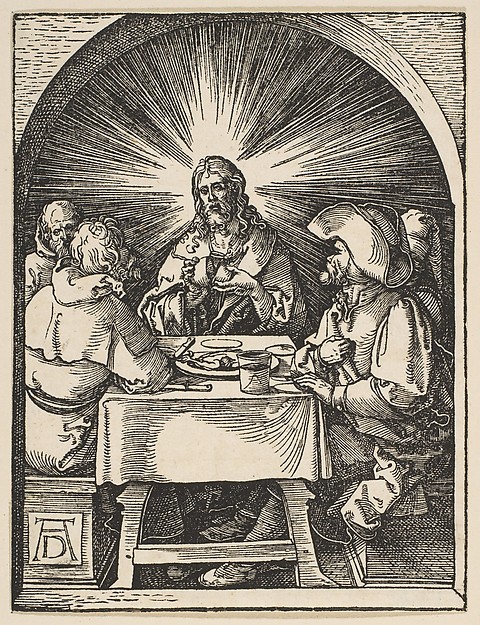 |
Albrecht Durer, The Disciples Recognize Jesus
Woodcut, From The Small Passion
German, c. 1510
New York, Metropolitan Museum of Art
|
 |
The Disciples Recognize Jesus
Dutch, c. 1520
Amsterdam, Rijksmuseum |
The painting by Jacopo Pontormo, dated 1525, and possibly based on Durer's composition, begins to take us in a new direction. The seated figures are shown sitting around the table, not all together on one side that faces us. Therefore, the two disciples are shown with their backs to us and are not yet reacting, because Jesus has not yet broken the bread.
 |
Jacopo Pontormo, The Supper at Emmaus
Italian, 1525
Florence, Galleria degli Uffizi |
In addition to the two disciples and wait staff Pontormo has added two pious witnesses, who show their astonishment, even before the disciples. Since the painting was commissioned for the Carthusian monastery of Galluzo the witnesses are, no doubt, Carthusian monks. Typically for a Mannerist painter, the figures, especially the Biblical figures, are shown in slightly contorted poses.
More importantly, Christ is shown not actually breaking the bread but apparently blessing it. This gesture would be the one that future works would use most often.
Pontormo has also added a pair of cats and a small dog at the bottom of the picture. One cat peers out from under the chair of the disciple in green, while the puppy and the other cat appear at the extreme left of the bottom of the picture. All the animals look outwards from the picture, at us, and thus draw us into the picture as witnesses also. (The eye in a triangle, a symbol for the presence of God may not be original to the picture, but may have been added later.)
During the sixteenth century and into the first half of the seventeenth century, the blessing gesture almost completely replaced the breaking of the bread as the action of the Risen Jesus. Very often the disciples are shown as still not recognizing Him, in keeping with the Gospel for "he was made known to them in the breaking of the bread" (Luke 24:35), and, therefore, by implication, not until then.
 |
Titian, Supper at Emmaus
Italian, c. 1530s
Paris, Musée du Louvre
|
 |
Jacopo Bassano, Supper at Emmaus
Italian, c. 1538
Cittadella, Parish Church, Sacristy
|
 |
Tintoretto, Supper at Emmaus
Italian, c. 1542-1543
Budapest, Szépmûvészeti Múzeum
|
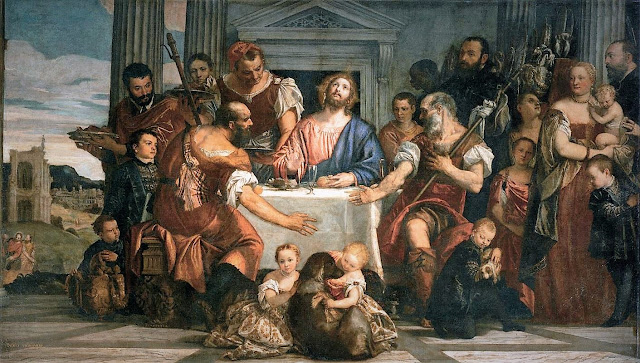 |
Paolo Veronese, Supper at Emmaus
Italian, c. 1560
Paris, Musée du Louvre
Presumably the large number of extra figures in this work are members of the family who commissioned this painting. They join the disciples and the serving man and woman as witnesses. And in their very familiar humanity invite us, their fellows to join them.
|
 |
Francesco Bassano, Supper at Emmaus
Italian, c. 1560-1580
Paris, Musée du Louvre
In this picture the subject of the work is positioned off center and in the background, while the largest part of the composition is occupied by the innkeeper and his staff and their animals as they go about their routine. This insistence on routine may well be the core of the painting, since it reminds us that miraculous things may be taking place while we obliviously go about our daily chores.
|
 |
Pedro Orrente. Supper at Emmaus
Spanish, c. 1620s
Budapest, Szépmûvészeti Múzeum
This work shares the same kind of character as the work above. The important action is happening in the midst of daily life, but off to the side as it were.
|
One hundred years later, at the beginning of the seventeenth century, Michelanglo Merisi da Caravaggio, known simply as Caravaggio, refocused attention on the central action of the Supper at Emmaus, the interaction between Jesus and the disciples.
 |
Caravaggio, Christ at Emmaus
Italian, 1601
London, National Gallery
|
Drawing on and transforming the existing tradition, Caravaggio produced what became the definitive image of the subject for the future. This is the “Supper at Emmaus” in the National Gallery, London. Dating from around 1601 Caravaggio’s picture takes up the composition from Durer and his successors and transforms it. There are the same elements: the Risen Jesus, the two disciples, the innkeeper, the table. But now everything is seen close up. We cannot see the legs of the table, only the top and sides. Instead of a showing the moment just before the instant of recognition, we are shown the reactions of surprise and astonishment of the disciples as they recognize who their companion really is. Moreover Caravaggio uses his striking trademark dramatic lighting to highlight the principal actors. And to underscore the reality of the scene, the table is set with foods other than the bread alone that we have seen in the previous works, even including some fowl and most beautifully delineated of all, as basket containing fruit. The basket of fruit is presented in dramatic perspective, as though it were partially over the edge of the table and, thus, protruding into our space, making us witnesses as well.
Moreover, the gestures of Christ and the reaction of the disciples suggest that the reference to “the breaking of the bread” as more than a reference to a Biblical quotation or to a simple act. They suggest, in fact, a reference to the Eucharist. In pictorial terms they are saying that the Eucharist is the place where we recognize the Risen Lord. Indeed, Caravaggio made this quite explicit in his painting. By juxtaposing the bread of the disciples with the basket of fruit and its very prominent bunch of grapes, Caravaggio is highlighting two traditional symbols for the Eucharist -- bread and grapes. The dramatic blessing gesture of Christ also suggests the moment of Consecration in the Mass.
The drama apparent in Caravaggio’s image had an immediate and enormous impact on representations in later work. Beginning almost immediately the influence of this painting spread through Europe, causing other artists to create imitations, according to their level of skill. Some adopted the same moment of recognition as Caravaggio, while others stuck to the older tradition of representing the blessing just before the recognition.
 |
Caravaggio, Supper at Emmaus
Italian, c. 1605-1606
Milan, Pinacoteca di Brera
In a sense, Caravaggio was one of the earliest painters to imitate his own painting. This picture, made about four years later than the first, reverts to the earlier formula of the blessing before breaking bread and is less specific about the Eucharistic elements.
|
 |
Bartolomeo Cavarozzi, Supper at Emmaus
Italian, c. 1615-1625
Los Angeles, J. Paul Getty Museum
A blatant case of imitation, this picture appropriates many of Caravaggio's 1601 painting motifs, but the effect is somewhat diminished.
|
 |
Gerrit van Honthorst or Matthias Stomer, Supper at Emmaus
Dutch, c. 1615-1620
Pommersfelden, Schloss Weissenstein
Honthorst and Stomer (or Stom) were among the early followers of Caravaggio in northern Europe. They were also particularly interested in the effects of light from a candle shining in the darkness. The light effects helped them to increase the sense of drama in their work, as it does here for the dramatic moment of recognition.
|
And gradually also, the dramatic lighting was first used, and then manipulated, to create a distinction around the figure of Jesus which is not found in the Caravaggio painting. Over time the figure of Jesus came to be "illumined" with supernatural light. As with the other variations on this subject, the artists who worked on these pictures ranged from the merely competent to the great masters.
 |
Antonio Giarola, Supper at Emmaus
Italian, c. 1620-1630
Rennes, Musée des Beaux-Arts
|
 |
Diego Velazquez, The Supper at Emmaus
Spanish, c. 1620
New York, Metropolitan Museum of Art
|
 |
Jacopo da Empoli, Supper at Emmaus
Italian, c. 1620
St. Petersburg, State Hermitage Museum
|
 |
Hendrick Terbrugghen, Supper at Emmaus
Dutch, c. 1621
Berlin, Schloss Sanssouci |
 |
Abraham Bloemaert, Supper at Emmaus
Dutch, 1622
Brussels, Koninklijke Museum voor Schone Kunsten
Bloemaert's painting has some additional overtones in its Eucharistic references. Not only is there the bread and wine but what looks like a standing rack of lamb, a possible reference to Jesus as the Lamb of God. Above all, however, the two lit candles provide a reference to the rubrics for the celebration of Mass, which requires that two lit candles should be in place on the altar during Mass.
|
 |
Attributed to Trophime Bigot, Supper at Emmaus
French, c. 1620-1630
Chantilly,Musée Condé
|
 |
Rembrandt van Rijn, Supper at Emmaus
Dutch, c. 1629
Paris, Musée Jacquemart-Andre
|
 |
Dirck Santvoort, Supper at Emmaus
Dutch, 1633
Paris, Musée du Louvre |
Rembrandt's painting of about 1629, with its night effects lighting that silhouetted the figure of Jesus against the light, creating an aura of light around Him, was picked up by later artists to silhouette Him as well. However, in the later paintings He is the source of the light as well as the figure revealed by it.
 |
Jean Restout. Supper at Emmaus
French, 1735
Lille, Palais des Beaux-Arts
|
 |
Charles Antoine Coypel
French, c. 1730-1740
Paris, Musée Carnavalet
|
 |
Joseph Winterhalder the Younger, Supper at Emmaus
Czech, c. 1772-1773
Vienna, Belvedere Museum
|
 |
Philip James de Loutherbourg, Supper at Emmaus
French, 1797
Birmingham (UK), Birmingham Museums Trust
|
Not every artist joined in the explosion of light effects. Some remained solidly rooted in telling the story. Many, though not all, of these artists were French or Flemish.
 |
Anonymous. Supper at Emmaus
French, First half of 17th Century
Nantes, Musée des Beaux-Arts
It is a pity that the identity of the artist who created this fine painting is not known to us. He has borrowed the drama of Caravaggesque lighting effects, but used the natural light of daylight for his effects. This is the moment of blessing before the actual breaking of the bread, since the disciples have not yet reacted to His gestures. One of them pours a glass of wine, adding some Eucharistic symbolism to the picture.
|
 |
Aartus Wolffort, Supper at Emmaus
Flemish, c. 1630
Private Collection
The imitation of Caravaggio is obvious. I must say that I am rather fond of this picture. The artist clearly identifies one of the men as Saint James the Greater, by the distinctive capelet adorned with cockle shells and a miniature staff. Other painters included smaller cockle shells in their works, sometimes on both disciples. However, the large size and the inclusion of the staff point decisively to Saint James as the identity of this disciple. In addition, the faces of the old serving man or tavern owner and of the younger man with the pie, which may be a self-portrait, are rather engaging.
|
 |
Philippe de Champaigne, Supper at Emmaus
Franco-Flemish, c. 1650
Ghent, Museum voor Schone Kunsten, |
One of them is this work by Philippe de Champaigne. In Champaigne's painting, Christ is recognized in the act of offering a piece of broken bread to one of the disciples, thus actually performing the act for which the Gospel's say that He was recognized. We are witnessing the very moment of recognition. Champaigne also includes much local color, two attendants, a view of landscape and even a grey tabby cat who is shown trying to get his paws on some of the meat from the table.
Other French artists (and Champaigne himself) continued to work with this vision of the subject.
 |
Peter Paul Rubens, Supper at Emmaus
Flemish, 1638
Madrid, Museo Nacional del Prado
|
 |
The LeNain Brothers, Supper at Emmaus
French, 1645
Paris, Musée du Louvre
|
 |
Jacob Jordaens, Supper at Emmaus
Flemish, c. 1645-1665
Dublin, National Gallery of Ireland
|
 |
Laurent de La Hyre. Supper at Emmaus
French, 1656
Grenoble, Musée de Grenoble
|
 |
Philippe de Champaigne, Supper at Emmaus
French, 1656
Angers, Musée des Beaux-Arts
|
 |
Attributed to Jean Jouvenet, Supper at Emmaus
French, c. 1690-1700
Nantes, Musée des Beaux-Arts
|
 |
Pierre Joseph Verhaghen, Supper at Emmaus
Flemish, 1772
Vienna, Kunsthistorisches Museum
|
 |
Willem Herreyns, Supper at Emmaus
Belgian, 1808
Antwerp, Cathedral of Our Lady
|
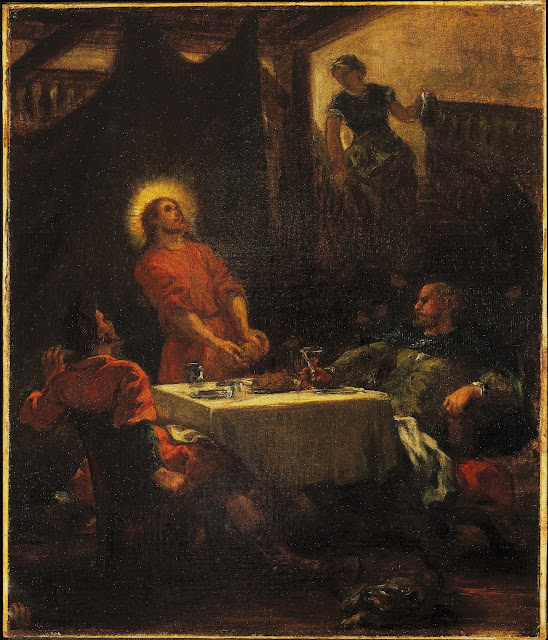 |
Eugene Delacroix, Supper at Emmaus
French, 1853
New York, Brooklyn Museum
|
 |
Carl Heinrich Bloch, Supper at Emmaus
Danish, 1870s
Provo (UT), Brigham Young University Museum of Art
|
 |
Henry Ossawa Tanner, Supper at Emmaus
American, 1905
Paris, Musée d'Orsay |
Beginning in the 1890s the subject of the Supper at Emmaus and the recognition of the Risen Jesus by His two disciples underwent a series of deformations.
First there were some attempts to set the scene in the current day and in current situations. So, instead of a scene set in an inn we find scenes of the Risen Jesus breaking bread in bourgeois dining rooms and in a working class cafe.
 |
Jacques Emile Blanche, Supper at Emmaus
French, c. 1891-1892
Rouen, Musée des Beaux-Arts
|
 |
Leon-Augustin L'Hermitte, Friend of the Humble-Supper at Emmaus
French, 1892
Boston, Museum of Fine Arts
|
 |
Pascal-Adolphe Jean Dagnan Bouveret, Supper at Emmaus
French, c. 1896-1897
Pittsburgh, Carnegie Museum of Art |
After 1900 any resemblance to the work of the past was purely at the will of the artist. Most chose to do something else while keeping the title.
 |
Jean-Louis Forain, Supper at Emmaus
French, c. 1912-1913
Washington, National Gallery of Art
In Forain's work only one disciple looks to Jesus while the other seems intent on studying the surface of the table. Servers are only just bringing the food, so there is no bread to be broken as yet and the disciples are still unable to recognize Jesus.
|
 |
Alfred Manessier. Supper at Emmaus
French, 1944
Paris, Centre national d'art et de culture Georges-Pompidou
The Cubist filter through which the artist is working means that, while we can recognize the figures of Jesus and the two disciples, interaction among them is invisible.
|
© M. Duffy 2011, amended 2017