Showing posts with label saints. Show all posts

Sunday, July 20, 2025

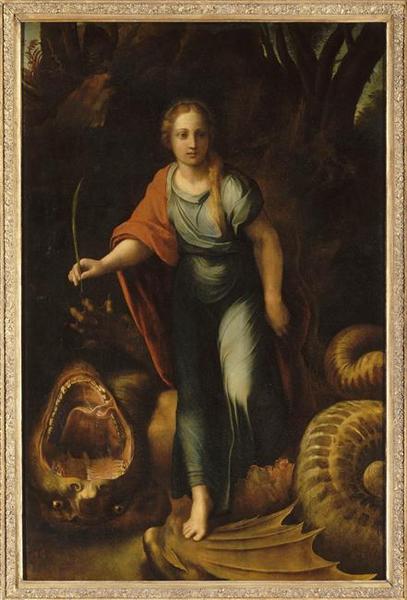
Saint Margaret of Antioch – Dragon Slayer

Charles Alphonse Dufresnoy, St. Margaret of Antioch
French, 1656
Evreux, Musée d'Art Histoire et Archéologie
There are several women honored as saints or blesseds by the Catholic Church who are named Margaret.  For example, there are St. Margaret of Scotland, St. Margaret of Cortona, St. Margaret Mary Alacoque, Blessed Margaret Pole and St. Margaret Clitherow.   But all of them (and I myself) draw their names from a woman who may or may not have lived.  This is St. Margaret of Antioch,  who is remembered by the Church on July 20.  She is little remembered today, but was a major saint in the Middle Ages through the Baroque.
 
This first St. Margaret was reputedly born in Syria, in the area around Antioch.  Antioch is a city with a long, long Christian tradition.  Indeed, it is in Antioch that the followers of the new way in Judaism were first called “Christians”.  It is the city that saw Saints Peter and Paul preach and is the city of one of the best known of the very early Christian martyrs, St. Ignatius of Antioch.   Ignatius was bishop of Antioch (the third ever, the first being St. Peter) in the latter decades of the first century and his letters tell us much about the beliefs and disciplines of the early Church.   The letters we have were written while he was in transit, under guard, from Antioch to Rome, where he died, as he had expressly hoped, torn to pieces by the big cats of the new Flavian Amphitheatre (which we know as the Colosseum).1  With this background, it is not surprising that a young woman named Margaret, who was a Christian, may have been born near the city, 

Guercino, St. Margaret of Antioch
Italian, c. 1630
Rome, Church of San Pietro in Vincoli


Margaret is, in fact, a name with deep roots in the Middle East, for it is derived from the Persian word for “pearl”.  In many languages there is a close association between the words for pearl and daisy.2  In French, for example, daisies are known as “marguerites”.  And women with the name Margaret have sometimes been gifted with the nickname “Daisy” in addition to the more common Margie, Maggie and Meg.  So, Margaret, probably in the sense of pearl, would not be an unusual name to find in a Syrian woman.

Chances are that there may have been an early Christian woman martyr in Syria or southern Anatolia named Margaret during one of the persecutions that beset the Church in the Roman Empire.  However, as with many of the early saints her story became embellished over time with stories of horrendous cruelties and fairytale elements.  In Margaret’s case these elements came to completely overshadow her human story.
    
According to the legend, Margaret was born on Antioch near the end of the third century, the daughter of a priest of one of the pagan cults, presumably for one of the gods or goddesses of the Roman pantheon.  Since her mother died when she was a baby, she was given to a wet nurse to raise.  The woman happened to be both a wool worker and a Christian and introduced Margaret to both.

On her coming of age, she was requested in marriage by a high ranking Roman official.  She refused him and refused to renounce her faith as well.  For this she was tortured (in some pretty horrific ways) and thrown into prison.  In prison she was attacked by Satan in two forms.  First, as a handsome young man who attempted to persuade her to surrender to the pleasures of the flesh.  Having failed at that, he decided to try terror, assumed the form of a dragon and swallowed her whole.  

Nothing daunted, Margaret either cut her way out of the dragon with a cross she had been holding when swallowed, or was miraculously released by the spontaneous explosion of the dragon when she made the sign of the cross from within his stomach.  For this reason, she is most frequently shown holding a cross and with a dead or dying dragon at her feet.3 

However, this reprieve was only temporary.  She was eventually beheaded during the persecution of Diocletian (303-305).4

Richard de Montbaston, Martyrdom of Margaret of Antioch
From a Golden Legend by Jacobus de Voragine
French (Paris), 1348
Paris, Bibliotheque nationale de France
MS Français 241, fol.159v


Margaret was an extremely popular saint during the medieval period and remained so into the Renaissance and Baroque periods.  She is the patron saint of a number of things and events, including pregnant women and childbirth.  Further, she is also one of the three women martyrs among the so-called "Fourteen Holy Helpers", early saints who were believed to have great power as helpers to those who invoked their intercession.

In art we see different aspects of her life.  Sometimes she is shown as a shepherdess or wool worker, a reference to the supposed occupation of her foster mother.


Mahiet and Collaborators, St. Margaret of Antioch as a Shepherdess
From a Speculum historiale by Vincentius Bellovacensis
French (Paris), c. 1335
Paris, Bibliotheque nationale de France
MS Arsenal 5080, fol. 288r


Jean Fouquet, St. Margaret of Antioch Spinning Wool
From the Hours of Etienne Chevalier
French (Tours), c. 1450-1460
Paris, Musée du Louvre
MS MI 1093


*Anonymous, Olybrius Sees Margaret Tending Sheep
German, Early 16th Century
Ottobeuren, Abbey Art Collection 


Francisco de Zurbaran, St. Margaret of Antioch as a Shepherdess
Spanish, c. 1630-1634
London, National Gallery


There are also a few images of her rejection of a suitor, which attracted the attention of the Roman authorities and led to her martyrdom.

* Anonymous, Margaret Rejects the Courtship of Olybrius
German, Early 16th Century
Ottobeuren, Abbey Art Collection


* Melchior Puchner, St. Margaret of Antioch Rejects Olybrius's Courtship
German, c. 1737
Bayrischzell, Church of St. Margaret


At other times it is the scenes of her eventual torture and martyrdom that we are shown.

Master of the Roman de Fauvel, Martyrdom of St. Margaret
From a Vies de Saints
French (Paris), c. 1300-1325
Paris, Bibliotheque nationale de France
MS Français 183, fol. 86v
This miniature shows both her escape from the dragon and her martyrdom.


Lodovico Carracci, Martyrdom of St. Margaret
Italian, 1616
Mantua, San Maurizio, Cappella di Santa Margherita


* Melchior Puchner, St. Margaret of Antioch Is Tortured with Scourges and Torches
German, c. 1737
Bayrischzell, Church of St. Margaret


* Melchior Puchner, Martyrdom of St. Margaret of Antioch
German, c. 1737
Bayrischzell, Church of St. Margaret


At times she is seen in her place in heaven as a martyr saint.  Here the dragon may appear as one of her attributes but always as a subdued, barely hinted at presence.    What is more important is the cross or martyr's palm that she holds.  She also is frequently shown holding a book.


St. Margaret of Antioch
Spanish (Burgos), c.1275-1325
New York, Metropolitan Museum of Art

St. Margaret of Antioch
Catalan (Lleida), 1330-1340
New York, Metropolitan Museum of Art, The Cloisters Collection


St. Margaret of Antioch
From the Cologne Missal
German (Cologne), 1150
Paris, Bibliotheque nationale de France
 MS Latin 12055, fol. 164v


Rogier van der Weyden, Saints Margaret and Apollonia
Flemish, c. 1445-1450
Berlin, Gemäldegalerie der Staatliche Museen zu Berlin


Jacques de Besançon, The Court of Heaven
From a Golden Legend by Jacobus de Voragine
French (Paris), c. 1480-1490
Paris, Bibliotheque nationale de France
MS Français 244, fol.156
In this image Margaret takes her place among the front ranks of the female martyrs.  She stands in the first row, wearing a dark blue dress and brownish cloak and carrying a cross over her right shoulder.


Annibale Carracci, St. Margaret of Antioch
Italian, c. 1597-1599
Rome, Church of Santa Caterina della Rosa


Peter Candid, St. Margaret of Antioch
Flemish, c. 1600
Private Collection


Jan Brueghel I, St. Margaret of Antioch
Flemish, c. 1600-1625
Private Collection


* Anonymous Bavarian Painter, St. Margaret of Antioch
German, 1722
Elbach, Church of St. Andrew


Ernest Hebert, St. Margaret of Antioch
French, c. 1877
Paris, Musée national Ernest Hebert


But, primarily she is seen in relation to her victory over the devil/dragon.  These images come from all the time periods.  Sometimes the dragon is a truly fierce monster, but quite frequently he is seen almost as a pet. Sometimes, Margaret is seen to be popping out of the dragon.  At other times she has already been completely liberated.  At still others she is standing victoriously atop the beast.


St. Margaret Emerging from the dragon
From the Livre d'images de Madame Marie
Belgian (Hainaut), c. 1285-1290
Paris, Bibliotheque nationale de France
MS Nouvelle acquisition française 16251, fol. 100r


St. Margaret Emerging from the Dragon
From the Sermons of Maurice de Sully
Italian (Milan or Genoa), c. 1320-1330
Paris, Bibliotheque nationale de France
MS Français 187, fol. 41r


Workshop of Agnolo Gaddi, St. Margaret of Antioch
Italian, c.1390
New York, Metropolitan Museum of Art
In this image Margaret is being ejected by the dragon by mouth rather than bursting through his belly.


Master of Marguerite d'Orléans, St. Margaret of Antioch
From the Heures de Marguerite d'Orléans
French (Rennes), c. 1430
Paris, Bibliotheque nationale de France
MS Latin 1156 B, fol. 176r
I suggest that you click on this image to enlarge it so you won't miss the detail of Margaret as a shepherdess in the right side of the margin and the two rather charming little dragons in the bottom margin who are looking up approvingly at the devil's discomfiture.


St. Margaret of Antioch
French (Toulouse), c. 1475
New York, Metropolitan Museum of Art


Jean Bourdichon, St. Margaret of Antioch
From the Grandes heures d'Anne de Bretagne
French (Tours), c. 1503-1508
Paris, Bibliotheque nationale de France
MS Latin 9474, 205v

The dragons in these two images above seem almost domesticated, almost pet-like.  Obviously, this was one little bit of fantasy that painters and sculptors (and even potters) could relate to, a kind of comic relief in their usual work of preparing images of the martyr saints that were often far from comic.


Workshop of Maestro Giorgio Andreoli, St. Margaret of Antioch
Majolica dish
Italian, 1527
New York, Metropolitan Museum of Art, Lehman Collection


However, Raphael (known through several copies by his students, such as Giulio Romano) and Titian suggest that there may have been a struggle to escape from the dragon.

Giulio Romano (after Raphael), St. Margaret of Antioch
Italian, c. 1518
Paris, Musée du Louvre


Titian, St. Margaret of Antioch
Italian, 1565
Madrid, Museo del Prado


At the end of the seventeenth century, an artist working in the circle of Giacomo Ceruti imagined the vanquished demon as partially returned to human form, a much more unsettling image for we see Satan resuming his appearance as a fallen angel.

Studio of Giacomo Ceruti, St. Margaret of Antioch
Itaian, c. 1601-1623
Private Collection


Even given the comic relief aspect, there is a deeper reference here, one with a Biblical foundation. For, it refers to what had been foretold in the book of Genesis, when God rebuked the "snake" who tempted Eve to sin "Then the LORD God said to the snake:  Because you have done this, cursed are you among all the animals, tame or wild; On your belly you shall crawl, and dust you shall eat all the days of your life.  I will put enmity between you and the woman, and between your offspring and hers; They will strike at your head, while you strike at their heel."  (Genesis 3:14-15)  

The dragon that devoured Margaret is the same snake that tempted Eve, both are personifications of Satan, the Devil, the Enemy who is both an enemy to God and to humanity.  Margaret is here seen as a reflection of the Virgin Mary, the quintessential "woman" of Genesis and of Revelation and the Second Eve, who, with the offspring of both her body (Jesus) and her faith (Margaret, the saints, and by extension, all Christians) will strike at his head. 5

Occasionally, images of Saint Margaret may have no references to any aspect of the story of her life, her martyrdom or her miraculous escape from the dragon, but may purely present her as an intercessor before God for a human person.  Such an image is the unusual one below.  In the lowest level of the picture we see a woman lying down, attended by others, some of whom are praying, hinting at a scene of childbirth.  In the middle section we see a king and queen giving thanks for the baby which the queen holds.  In the upper level we see St. Margaret kneeling in supplication before Christ, surrounded by angels both adults and cherubs.  One of the cherubs holds her martyr's palm, while a small group holds the cross of Christ.  Margaret's dragon is shown as flying off to the right at the border between the upper and middle sections, while an adult angel holds a cornucopia of flowers which he is about the send to earth.  The subject appears to be the birth of an heir to the aged Louis XIV.  This probably refers to the birth of the future Louis XV, who inherited his great-grandfather's throne at the age of five.


* Joseph Hartmann, Miracle of Saint Margaret of Antioch
German, 1757
Baumberg, Church of Saint Margaret


© M. Duffy, 2016.  Additional text and images added 2025.
* Indicates new images.
_________________________________________________________

  1.       For St. Ignatius of Antioch see http://www.newadvent.org/cathen/07644a.htm, which includes links to his letters.  O'Connor, John Bonaventure. "St. Ignatius of Antioch." The Catholic Encyclopedia. Vol. 7. New York: Robert Appleton Company, 1910. 20 Jul. 2016
  2.         https://en.wikipedia.org/wiki/Margaret
  3.           The story of the dragon was too much of a strain on the credulity of Jacobus de Voragine, who was quite happy with a great many other fantastic stories.  In his The Golden Legend, written in  he says “This swallowing and breaking of the belly of the dragon is said that it is apocryphal.” From The GOLDEN LEGEND or LIVES of the SAINTS, Compiled by Jacobus de Voragine, Archbishop of Genoa, 1275 First Edition Published 1470, ENGLISHED by WILLIAM CAXTON, First Edition 1483, VOLUME FOUR.  From the Temple Classics Edited by F.S. ELLIS First issue of this Edition, 1900 Reprinted 1922, 1931< http://legacy.fordham.edu/halsall/basis/goldenlegend/GoldenLegend-Volume4.asp&gt
  4.        MacRory, Joseph. "St. Margaret." The Catholic Encyclopedia. Vol. 9. New York: Robert Appleton Company, 1910. 20 Jul. 2016 .
  5. For more on the connections between the snake, the Virgin Mary and both Genesis and Revelations, see the articles "Annunciation – The World Created Anew" and "The Immaculate Conception" 

Tuesday, January 28, 2025

Saint Thomas Aquinas – Eloquent Ox, Angelic Doctor

Carlo Crivelli, Saint Thomas Aquinas
From the Demidoff Altarpiece
Italian, 1476
London, National Gallery


During 2016 the Order of Preachers, the religious order founded by Saint Dominic, celebrated the 800th anniversary of their approval by Pope Honorius III.  

Eight hundred years is a long time and during that period much has happened in the world.  In those centuries, the Dominican order has produced many great saints.  One of the greatest of these is the saint whose feast day is celebrated on January 28.  He is perhaps the greatest philosopher and theologian of the western church between the death of Saint Augustine in the early fifth century till today.  He is Saint Thomas Aquinas.  And January 2025 marks the end of a three-year celebration leading up to his 800th birthday in 2025.  As part of that celebration, his skull, preserved with his body at Toulouse in France, was sent on a tour of the eastern United States, stopping at major churches served by the Dominican order.  I was fortunate enough to join in the evening of veneration at the nearby church of Saint Vincent Ferrer in New York.  It was a moving experience to behold his skull, the bone that once encased the mind of this incredible saint who was a theologian, philosopher, mystic and poet.


Reliquary containing the skull of Saint Thomas Aquinas at the Church of Saint Vincent Ferrer, New York
December 16, 2024
(Photo: Margaret Duffy)


Woman and children venerating the relic of Saint Thomas Aquinas at the Church of Saint Vincent Ferrer, New York
December 16, 2024
(Photo: Jeffrey Bruno)


Life and Importance

Saint Thomas was born in 1225 into the noble family of the Counts of Aquino in Roccasecca in the Lazio region of Italy.  Thomas’ early education took place in the monastery of Montecassino and was continued in Naples.  In Naples he encountered the Dominican order for the first time and resolved to join them.  His family was appalled by his decision and took drastic measures to change his mind, basically kidnapping him and confining him in a family castle for a year while they tried to change his mind.  He proved adamant and was finally released and allowed to join the Dominicans.  


Master of Catherine of Cleves, Saint Thomas Aquinas
from Hours of Catherine of Cleves
Dutch (Utrecht), c. 1435-1445
New York, Pierpont Morgan Library
MS M 917, fol. 287


He was sent to Paris, then the center of advanced education in Europe, where he studied under his fellow Dominican, Albert the Great.  Saint Albert was impressed by the boy’s intellect and took him along as an assistant when he was moved to Cologne in 1248.  It was during this time that the quiet Thomas was given the name of “dumb ox” by his fellow students.  Saint Albert is reputed to have admonished them by saying “We call him the dumb ox, but he will give such a bellow in learning as will be heard all over the world.” While in Cologne he became a teacher.  He later moved back to Paris, where he also gained his master and doctorate degrees.1 


Anonymous Woodcut, Saint Thomas Aquinas
Italian, c. 1450
Washington, DC, National Gallery of Art


Later in his relatively brief life he was sent by his order from place to place to teach his fellow Dominicans, especially those of the Italian province based at Santa Sabina in Rome.  While in Rome he was also appointed as papal theologian.  In Rome he began the work that has been considered his masterpiece ever since, the Summa Theologica.  This massive work covers practically the entire world of thought and belief and has been a foundational document for both the church and western philosophical and theological thought from that day to this.  Saint Thomas is renowned for applying Aristotelian logic to both the natural world and to Christian revelation.


+ Francisco de Herrera, Saint Thomas Aquinas
Spanish, c. 1656
Seville, Museo de Bellas Artes


In addition to being one of the great intellects of the West, Thomas was also a mystic and poet.  Numerous accounts from his own time suggest that he had attained a high state of mystical union with God, evidenced by reports of levitations and visions.

One of the requests he received as papal theologian that also called upon his poetic talents  came from Pope Urban IV in 1264.  Pope Urban asked him to compose the prayers and hymns for the newly approved feast of Corpus Christi (or Corpus Domini).  This feast, in honor of the Body and Blood of Christ manifested in the Eucharist, had begun in northern Europe and had spread to the entire church.  The beautifully poetic material Thomas prepared is still used to this day and includes some of the best known Catholic hymns in honor of the Blessed Sacrament.  Among them are the “Pange lingua”, sung every year on Holy Thursday and Corpus Christi.  The last two verses are the text for the hymn “Tantum Ergo” which is sung at every Benediction service.  Also still in use is the sequence he composed for the feast, “Lauda Sion”, as well as the prayers for the Divine Office and for the Mass of Corpus Christi.  Numerous other prayers still in use are also attributed to Saint Thomas.  While the Summa may not have become a household word for every Catholic, virtually everyone has been touched at one time or another by these hymns and prayers. 


In 1274 Thomas was teaching in Naples when he was summoned by Pope Gregory X to meet him in Lyons for a Council.  Saint Thomas began his journey, but fell ill on the way while still south of Rome.  He was welcomed into the Cistercian monastery of Fossanova and died there on March 7.  He was 49.  His exemplary life and work resulted in his canonization in 1323.  In 1667 he was given the rare title of Doctor of the Church. 


Saint Thomas in Art

The iconography of Saint Thomas Aquinas can be divided into several categories, depending on the approach of the artist (or his/her patron) to the subject.  There are: portraits and “triumphs”, scenes from his life and/or his legend, as one of a group of saints and as imagined by Dante in the Divine Comedy.  We will look at all of them below.


Jacques Callot, Saint Thomas Aquinas
From Les Images de Tous les Saincts et Saintes de l'Année
French, 1636
New York, Metropolitan Museum of Art


Portraits
The simplest images of Saint Thomas are portraits.  No “real” portraits of Saint Thomas were done in his lifetime.  Indeed, the concept of a portrait as we understand it was not even conceivable during the century in which he lived.  What images there were that attempted to convey a representation of an individual person were highly stylized.  But we do see such images within 100 years of his death.

At first they are stylized as might be expected, but as time progressed they became more and more individuated until a recognizable type had evolved.


Jean le Noir and collaborators, Saint Thomas Aquinas Teaching
From the Breviary of Charles V
French (Paris), c. 1364-1370
Paris, Bibliotheque nationale de France
MS Latin 1052, fol. 348v


Jacopo Landini, Saint Thomas Aquinas
Italian, c. 1350-1400
Avignon, Musée du Petit Palais


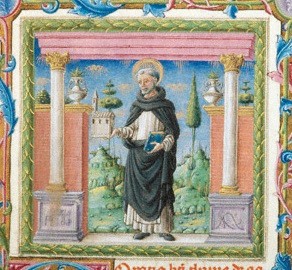
He is presented in his Dominican habit of black and white, and usually displays or carries a book and pen.  He may have the image of the radiant sun on his chest, a symbol of the radiant light he shed on philosophical and theological thought.


Fra Angelico, Saint Thomas Aquinas
Italian, c. 1440-1445
Venice, Collezione Vittorio Cini


Attributed to Sandro Botticelli, Saint Thomas Aquinas
Italian, c. 1481-1482
Riggisberg (Switzerland), Abegg Collection


Master of James IV of Scotland, Saint Thomas Aquinas
From the Breviary of Queen Isabella of Castile
Flemish (Ghent), c. 1497
London, British Library
MS Additional 18851, fol. 331v 


Jean Bourdichon, Saint Thomas Aquinas
From Hours of Frederic of Aragon
French (Tours), c. 1501-1504
Paris, Bibliotheeque nationale de France
MS Latin 10532. fol. 364v


He may also carry a model of a church, shown sometimes in a partially ruinous state.  I have not been able to find any solid information on the meaning of this symbol.


Tomaso da Modena, Saint Thomas Aquinas
From the Beauchamp/Warwick Hours and Psalter
Italian, c. 1430-1487
New York, Pierpont Morgan Library
MS M 893, fol. 263r


* Thomas Christian Scheffler, Saint Thomas Aquinas Meditating on the Annunciation
German, c. 1750-1751
Dillingen, Church of the Assumption


Because of his work on composing the liturgy for the feast of Corpus Christi and his general devotion to the Holy Eucharist, he is very often depicted with a monstrance in his hand or nearby.


Peter Paul Rubens, The Defenders of the Eucharist
Flemish, 1625
Madrid, Museo Nacional del Prado
In this great Eucharistic tapestry design by Rubens, Saint Thomas Aquinas holds the central position among Saints Ambrose, Augustine, Gregory the Great, Clare of Assisi, Norbert and Jerome.


Abraham van Deipenbeeck, Saint Thomas Aquinas
Flemish, Before 1675
Valenciennes, Musée des Beaux-Arts


Saint Thomas Aquinas
Italian, 18th Century
Nardò, Church of San Domenico


Thomas’ Life and Legend

Thomas’ life was largely spent in study, lecturing, writing and prayer, the life of an intellectual and a saint, but not the most picturesque of actions.  However, there are a number of images that have come down to us that illustrate his activities.

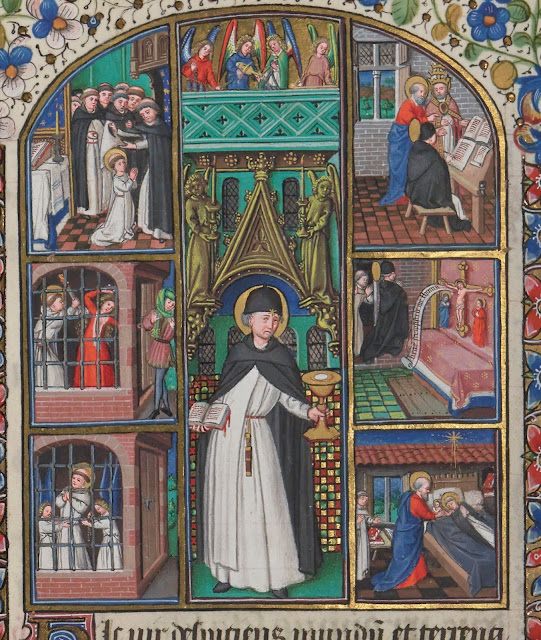
Life of Saint Thomas Aquinas
From the Hours of Louis of Savoy
French (Savoy), c. 1445-1460
Paris, Bibliotheque nationale de France
MS Latin 9473, fol. 174v
This illumination shows multiple events from the life of Saint Thomas. Beginning at the upper left we see Thomas receiving the habit of the Dominican Order, below that are two scenes from his imprisonment by his brothers: his encounter with the prostitute hired by the brothers to tempt him and, below that, his visitation by angels who placed a belt (indicating chastity) on his waist. On the right are scenes from his later life: in his study in conversation with Saints Peter and Paul, levitating in ecstasy before the Crucifix from which Christ spoke to him and Saint Paul bringing the Christ Child to him on his deathbed, while a newly appearing star that was interpreted as a sign of his impending death shines down. 


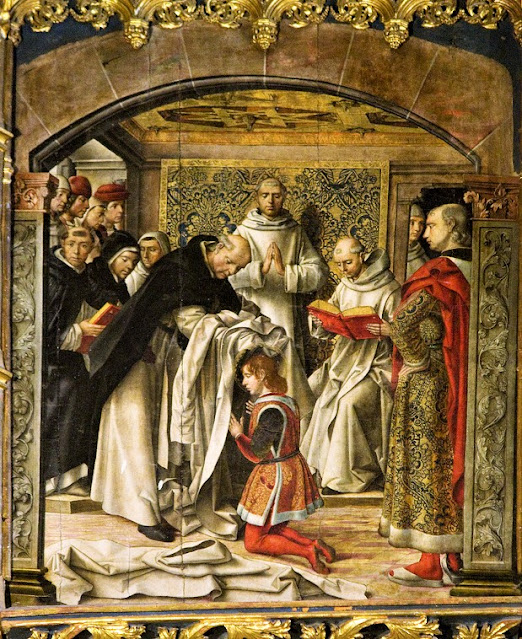
Pedro Berruguete, Saint Thomas Aquinas Receives the Dominican Habit
Spanish, c. 1494-1500
Avila, Royal Monastery of Santo Tomas


There are also a number of pictures that present “events” from the legends that sprang up about him.

Erhard Altdorfer, Scenes from the Life of Saint Thomas Aquinas
From the Altar of Saint Thomas Aquinas
German, c. 1520
Lübeck, Sankt-Annen Museum


 Among these is the story of an event from the time of his imprisonment by his family.  His brothers were reported to have hired a prostitute to entice him to abandon his Dominican vow of chastity.


Bernardo Daddi, The Temptation of Saint Thomas Aquinas
Italian, 1338
 Berlin, Gemäldegalerie der Staatliche Museen zu Berlin


Diego Velazquez, The Temptation of Saint Thomas Aquinas
Spanish, c. 1631-1632
Oriola, Museo Diocesano del Arte Sacro 

According to the legend, her appearance had the opposite effect.  Thomas is reported to have beaten her off with a firebrand and expelled her from his prison room.  Following this heroic defense of his virtue he was visited in a dream by two angels who bound his waist with a belt.  This imaginary belt is credited with preserving him from temptations of the flesh for the rest of his life.


Other life events that were often depicted were Thomas as assistant to Saint Albert the Great, Thomas inspired by the Holy Spirit, Thomas visited by Saints Peter and Paul, Thomas presenting his liturgy for the feast of Corpus Christi to Pope Urban IV and Thomas visiting and visited by his Franciscan contemporary Saint Bonaventure.


Sassetta, Saint Thomas Aquinas Inspired by the Holy Spirit
Italian, 1423
Budapest, National Museum
The tiny dove of the Holy Spirit can just be made out against the arch of the yellowish door to the left of the figure of Saint Thomas. 


Bartolomeo degli Erri, Saint Thomas Aquinas Visited by Saints Peter and Paul
Italian, ca. 1470
New York, Metropolitan Museum of Art


Taddeo di Bartolo,  Saint Thomas Aquinas Presenting the Office of Corpus Christi to Pope Urban IV
Italian, c. 1400
Philadelphia, Museum of Art


Alessandro da Bologna, Saint Thomas Aquinas Visiting Saint Bonaventure
From Legend and Life of Saint Francis of Assisi by Saint Bonaventure 
Italian, 1504
London, British Library
MS Harley 3229, fol. 26


Anonymous, Saint Bonaventure Visiting Saint Thomas Aquinas
Peruvian, 18th Century
Philadelphia, Museum of Art
In this charming painting Saint Thomas has been given wings.  This is presumably due to his title of "Angelic Doctor".  


But it is a series of author portraits by the Neapolitan illuminator Matteo Felice and his workshop that probably most accurately depict the daily activities of Saint Thomas Aquinas.  Felice and his workshop were active in Naples in the decades around 1500 and illuminated a number of important books, including this set of works by Aquinas.


Matteo Felice and Workshop, Saint Thomas Aquinas Writing
From Super Isaaiam by Thomas Aquinas
Italian (Naples), c. 1489-1492
Paris, Bibliotheque nationale de France
MS Latin 495, fol. 1r


Matteo Felice and Workshop, Saint Thomas Aquinas Writing
From Expositio in Paauli epistolam ad romanos by Thomas Aquinas
Italian (Naples), c. 1489-1492
Paris, Bibliotheque nationale de France
MS Latin 674, fol. 1r


Matteo Felice and Workshop, Saint Thomas Aquinas Teaching
From Sententia super librum de caelo et mundo by Thomas Aquinas
Italian (Naples), c. 1489-1492
Paris, Bibliotheque nationale de France
MS Latin 6525, fol. 1r


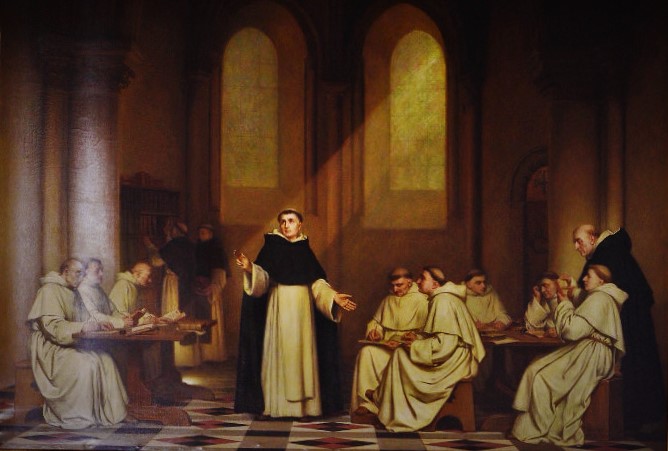
A much later painting adds another idea of what a day in the life of Thomas Aquinas may have been like.

Louis Francois Prosper Roux, Saint Thomas Aquinas Dictating
French, 1877
Le Puy-en-Velay, Musee Crozatier


The Vision of the Speaking Crucifix

Related to the scenes from his life and the legends that grew up about him are a series of images of a particular vision granted to him near the end of his life.  In 1273 it was reported by one of his brothers that as Thomas knelt (or stood or levitated) in front of a crucifix a voice came from the cross and said "You have written well of me, Thomas. What reward would you have for your labor?" to which Thomas replied "Nothing but you, Lord."


The Vision of Saint Thomas Aquinas
From the Psalter and Hours of Alfonso V of Aragon
Spanish (Aragon), c. 1442
London, British Library
MS Add 28962, fol. 36r


Master of James IV of Scotland, The Vision of Saint Thomas Aquinas
From the Breviary of Queen Isabella of Castile
Flemish (Ghent),c. 1497
London, British Library
MS Additional 18851, fol. 348r 
This image is interesting in that it includes two witnesses to the vision of Saint Thomas.  Thee is a fellow Dominican friar and a person in secular dress.  The event was apparently witnessed by at least one person.  Saint Thomas is shown seated, but in an attitude of prayer.  In addition, an angel hovers above him with a crown to show Thomas' sanctity.


Francesco Morandini, The Vision of Saint Thomas Aquinas
Italian, c. 1590-1593
Prato, Church of San Domenico


Santi di Tito, The Vision of Saint Thomas Aquinas
Italian, 1593
Florence, Convento di San Marco


Workshop of Jacopo Tintoretto, The Vision of Saint Thomas Aquinas   
Italian, 1598
Chioggia, Church of San Domenico


* Otto van Veen, Saint Thomas and the Speaking Crucifix
From Vita D. Thomae Aquinitatis
Antwerp 1610, p. 17
Flemish, 1610
London, The Warburg Institute


 It was after this incident that Thomas was reputed to have told a friend that after his experience “all that I have written seems like straw to me”. 


Other Visions

This was not the only vision that Saint Thomas Aquinas received during his lifetime.  He also appears to have received visions of angels (including the two who presented him with the belt following his family's attempt to divert him from his intentions of becoming a friar).  These visions are not as well represented in his iconography but there are at least two that I have found.  


The Vision of Saint Thomas Aquinas
From Festes nouvelles by Jean Golein
French (Paris), 15th Century
Paris, Bibliotheque nationale de France
MS Francais 242, fol. 323r


Francesco Zugno, The Vision of Saint Thomas Aquinas
Italian, c. 1725-1750
Troyes, Musee des Beaux-Arts et d'archeologie
Note that in this charming picture the "Angelic Doctor" actually has wings!


*Johann Anwander, Saint Thomas Aquinas Receiving Angelic Inspiration
German, 1762
Dillingen, Church of the Assumption


Allegories

Fra Angelico, The San Domenico Altarpiece
Italian, c. 1423-1424
Fiesole, Church of San Domenico
Saint Thomas is the Domincan figure to the left of the painting.


In addition to the pictures that are based on what is known of his life and of the legends embroidered onto it there are what might be called allegorical pictures of Thomas Aquinas.

These are images in which Thomas is seen as one of a group of saints and of a group of pictures called The Triumph of Saint Thomas Aquinas.  The group pictures are usually composed of other Dominican saints, especially Saint Dominic, founder of the Order of Preachers, and Saint Peter Martyr, one of the earliest Dominican saints.


Fra Angelico, The Madonna and Child with Saints Dominic and Thomas Aquinas
Italian, c. 1445
St. Petersberg, State Hermitage Museum


Saint Thomas Aquinas as an Intercessor


Images in this category show Saint Thomas as an intercessor for others, living (at the time of the painting) or dead.

Filippino Lippi, The Annunciation with a Donor and Saint Thomas Aquinas
Italian, c. 1489-1491
Rome, Church of Santa Maria sopra Minerva
Here Saint Thomas the donor of the picture, who appears to be a cardinal, to the Blessed Virgin depicted as at the Annunciation.


* Matthäus Günther, Saints Vincent Ferrer and Thomas Aquinas Interceding for Souls in Purgatory
German, 1758
Indersdorf, Abbey Church
Here the two Dominican saints, Vincent Ferrer who was famed as a preacher, and Thomas Aquinas intercede for the souls in Purgatory.  Each friar saint has angel wings and each has a golden trumpet.  Saint Vincent holds a paten, the gold plate on which the Host rests during Mass, which is filled with Hosts.  Saint Thomas holds a golden chalice from which the Blood of Christ flows over clouds to fall into the fires of Purgatory to extinguish them.  Above and to the left of the two angelic saints is Saint Catherine of Siena who is receiving the rosary from the Virgin and Child, unfortunately cut off in this view.  To the right of the two saints an angel (?, cut off) holds a golden cornucopia from which spill three floral crowns, one of white, one of purple and one of gold.  These three crowns represent the three groups of the mysteries of the rosary:  the Joyful, the Sorrowful and the Glorious Mysteries.


The Triumphs of Saint Thomas Aquinas

In the Triumph pictures Saint Thomas is seen as the central figure of the composition, usually shown seated and holding an open book.2


Lippo Memmi, The Triumph of Saint Thomas Aquinas
Italian, c. 1343
Pisa, Church of Santa Caterina


Andrea da Firenze, The Triumph of Saint Thomas Aquinas
Italian, c. 1366-1367
Florence, Church of Santa Maria Novella. Cappellone degli Spagnoli


Benozzo Gozzoli, The Triumph of Saint Thomas Aquinas
Italian, c. 1470-1475
Paris, Musée du Louvre


Filippino Lippi, The Triumph of Saint Thomas Aquinas
Italian, c. 1489-1491
Rome, Church of Santa Maria sopra Minerva, Carafa Chapel


He is surrounded by other figures, often comprising angels, saints and other philosophers and theologians.  At his feet in the majority of the pictures is a prone figure, often identified as Averroës, the Spanish Arabic philosopher.

Averroës (born Ibn Ruěd) was an important twelfth century philosopher, one of the Spanish Arabs through whom the writings of Aristotle re-entered Western Europe.  He died approximately 27 years before Saint Thomas was born.  Thomas wrote an important refutation of Averroës theory of the soul, "De unitate intellectus contra Averroistas", which upheld the Christian understanding of the individual character of the soul and individual immortality.  This is the specific “triumph” that is celebrated in these pictures, as well as the entire body of Thomas’ works.


Some much later works depict Thomas Aquinas as one of the most prominent figures of the development of Theology.


+ Matthäus Günther, The Holy Trinity Surrounded by Art and Science
German, 1760
Aldersbach, Former Cistercian Abbey


* Johann Anwander, The Virgin Mary on the Throne of Solomon, Surrounded by Saints and Venerated by Bishops
German, 1762
Dillingen, University
Saint Thomas Aquinas is here depicted as one of the white statues that are attached to the pillars of the Throne of Solomon.  He is the first statue to the left of the Throne.


The Apotheosis of Saint Thomas Aquinas

Another group of works might be called an apotheosis of Saint Thomas Aquinas.  In these pictures Thomas is seen as entering into heaven or resident there as one of the Doctors of the Church, with the earlier doctors:  Saints Ambrose, Augustine of Hippo, Jerome and Gregory the Great.


Francesco Solimena, Saint Thomas Aquinas Received in Heaven
Italian, c. 1625-1649
Lille, Musée des Beaux-Arts


Francisco de Zurbaran, The Apotheosis of Saint Thomas Aquinas
Spanish, c. 1631
Seville, Museo de Bellas Artes


Jakob Vogel, Saint Thomas Aquinas With the Doctors of the Church
German, c. 1732
Bamberg, Former Domincan Convent of Saint Christopher


Saint Thomas in Dante

Finally, there is a small group of manuscript illustrations of the Divine Comedy of Dante in which Saint Thomas is included in the heaven of the Sun, where he introduces those who share this place in heaven with him.3

The number of spirits differ in these illustrations, but most likely include Saint Thomas himself, along with Saint Dominic and Saint Francis of Assisi.  


Master of the Antiphoner of Padua; Dante and Beatrice Meet Saint Thomas Aquinas
From Dante Alighieri, The Divine Comedy
Italian, c. 1300-1350
London, British Library
MS Egerton 943, fol. 146


The Heaven of the Sun
From Dante Alighiei, The Divine Comedy
Italian (Florence), c. 1345-1355
New York, Pierpont Morgan Library
MS M 676, fol. 103

Giovanni di Paolo; Dante and Beatrice Meet Saint Thomas Aquinas
From Dante Alighieri, The Divine Comedy
Italian, c. 1444-1450
London, British Library
MS Yates Thompson 36, fol. 148


A marvelous summation of Saint Thomas’ life is expressed in the words of Frederick Copleston, S.J., the historian of philosophy:  “it was a life devoted to the pursuit and defence of truth, a life also permeated and motivated by a deep spirituality … he was a great deal more than a professor or theologian, for he was a Saint, and even if his devotion and love are not allowed to manifest themselves in the pages of his academic works, the ecstasies and mystical union with God of his later years bear witness to the fact that the truths of which he wrote were the realities by which he lived”.4

© M. Duffy, 2016, additional text and images added 2023, selected images updated 2024.
Several new images and selected updated images were added in 2025.
+ Indicates updated image
* Indicates new image.
_____________________________________________________________

  1.       Butler, Rev. Alban.  The Lives of the Fathers, Martyrs, and Other Principal Saints, Vol. III, Dublin, James Duffy, 1866, pp. 38-55.  See also:  Kennedy, Daniel. "Saint Thomas Aquinas." The Catholic Encyclopedia. Vol. 14. New York: Robert Appleton Company, 1912. 28 Jan. 2016 .
  2.              For a discussion of these pictures see:  Polzer, Joseph.  "The "Triumph of Thomas" panel in Santa Caterina, Pisa. Meaning and Date", Mitteilungen des Kunsthistorischen Institutes in Florenz,  Vol.  37. Bd., H. 1 (1993), pp. 29-70.
  3.        Dante Alighieri, Divine Comedy, Paradiso, Cantos 10-12. 
  4.         Copleston, Frederick, S.J.  A History of Philosophy, Volume II Medieval Philosophy, New York, Doubleday, 1993, p. 304.