Showing posts with label Man of Sorrows. Show all posts

Saturday, March 30, 2024

Meditation on the Passion – In the Tomb

Andrea Mantegna, Lamentation Over the Dead Christ
Italian, c. 1483
Milan, Pinacoteca di Brera

"After this, Joseph of Arimathea,
secretly a disciple of Jesus for fear of the Jews,
asked Pilate if he could remove the body of Jesus.
And Pilate permitted it.
So he came and took his body.
Nicodemus, the one who had first come to him at night,
also came bringing a mixture of myrrh and aloes
weighing about one hundred pounds.
They took the body of Jesus
and bound it with burial cloths along with the spices,
according to the Jewish burial custom.
Now in the place where he had been crucified there was a garden,
and in the garden a new tomb, in which no one had yet been buried.
So they laid Jesus there because of the Jewish preparation day;
for the tomb was close by."


Excerpt from the Passion of Our Lord Jesus Christ According to John
(John 19:92-42)
The Gospel reading for the Good Friday liturgy of the Lord's Passion 


From the late afternoon of Good Friday until the evening of Holy Saturday the Church keeps prayerful, quiet vigil. The tabernacles are empty, the altars are bare, no Mass is celebrated. We remember the second day (from sundown to sundown) of the Passion, the day on which Jesus’ body lies in the tomb. We ponder the sacrifice and await what we know is the joyful outcome. 


Artists have done this also. They have wondered, as we do, about what was happening on that second day. Taking their guide from the phrase in the Apostles Creed “He descended into Hell” some have imagined Jesus freeing Adam, Eve and the righteous ancestors from their bondage in Limbo. Others have imagined the Body of Jesus simply lying in the tomb. Still others have imagined the Body of Jesus tended by angels, who console and prepare Him for the Resurrection. Last year we looked at the first of these.1 This year we will look at the second and third images.

Probably the most astonishing image of the second of these types, the Dead Christ, comes from the brush of Andrea Mantegna, one of the great north Italian painters of the Quattrocento. Often called the Lamentation over the Dead Christ, it shows the body of Jesus, depicted in excruciating detail, in extreme foreshortening, with the nail-pierced feet immediately before our eyes. It is barely a Lamentation, receiving the title only because of the partial inclusion of two people, a man and a woman, at the extreme left edge. The woman is sometimes identified as Mary, but I am doubtful about this. Rather, I think these are two older people of Mantegna’s era and not the richest of his contemporaries either. The woman is shown wiping her eyes, the other figure (presumably a man) is barely visible in profile. This startling image, combining the 1st-century corpse with 15th-century people, still startles us as it must have startled his contemporaries. 

This image, not idealized, detailed, even brutal, became a model for other artists to follow. And, although it was never a popular image, there were followers. Among them were other artists with a realistic, almost scientific bent: Carpaccio, Hans Holbein the Younger, Philippe de Champaigne, Giuseppe Sammartino and others.

In these images we are presented with “just the facts”, a dead body, a cadaver.


Carpaccio, The Dead Christ
Italian, c.1520
Berlin, Gemäldegalerie der Staatliche Museen zu Berliln


Hans Holbein the Younger, The Dead Christ in the Tomb
German, 1521
Basel, Kunstmuseum


Zacharias Hegewald, The Dead Christ in the Tomb
German, c. 1630
Vienna, Kunsthistorisches Museum


Philippe de Champaigne, The Dead Christ
French, Prior to 1654
Paris, Musée du Louvre


Jean Delcour, The Dead Christ
Flemish, 1696
Liege, Cathedral of Saint Paul


Giuseppe Sammartino, The Dead Christ in a Shroud
Italian, 1753
Naples, Church of Santa Maria della Pieta dei Sangro


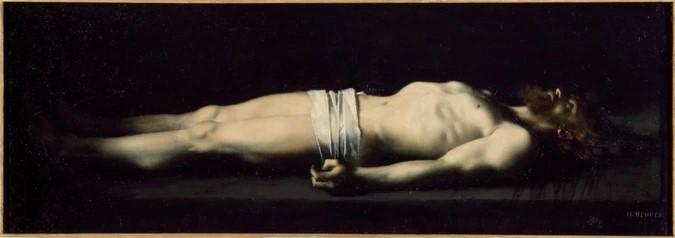
The last quarter of the nineteenth century saw a flurry of this imagery all over Europe.  This may perhaps be the result of an increased interest in death as a physical phenomenon that accompanied the rise of modern medical science that was taking place at the same time.


Eduard Adrian Dussek. The Dead Christ in the Tomb
Slovak, 1873
Vienna, Belvedere Museum


Wilhelm Truebner, Christ in the Tomb
German, 1874
Hamburg, Hamburger Kunsthalle


Jean-Jacques Henner, Jesus in the Tomb
French, 1879
Paris, Musée d'Orsay


Alphonse Legros, The Dead Christ
French, 1888
Paris, Musée d'Orsay


Henri Levi, The Dead Christ
French, c. 1893
Villefranche-sur-Saone, Musée Paul Din


Alexandre Charpentier, The Covered Christ
French, 1895
Paris, Musée d'Orsay


Gabriel Ferrier, Sorrow
French, 1903
Arras, Musée des Beaux-Arts


In the third type, the Dead Christ tended by angels, we see something very different. These images have a deep relationship with the Man of Sorrows image, especially the form of the Man of Sorrows in which Jesus is supported by another person. But, in this variation, the humans have been replaced by angels.

The angels are sometimes sad and sorrowing, sometimes busy working on preparing for the Resurrection. They support and prepare His physical Body for its new, glorified existence.


Giovanni Bellini, The Dead Christ Supported by two Angels
Italian, c. 1465-1470
London, National Gallery


Carlo Crivelli, The Dead Christ Supported by Angels
Italian, c. 1470
London, National Gallery


Antonello da Messina, The Dead Christ Supported by an Angel
Italian, c. 1474-1475
Madrid, Museo National del Prado


Giovanni Bellini, The Dead Christ Supported by  Angels
Italian, c. 1474
Rimini, Pinacoteca Comunale


Girolamo da Treviso, The Dead Christ Supported by Two Angels
Italian, c. 1475-1485
Milan, Pinacoteca di Brera


Giovanni Bellini, The Dead Christ Supported by Two Angels
Italian, c. 1480-1485
Berlin, Gemäldegalerie der Staatliche Museen zu Berlin


Pedro Berruguete, The Dead Christ with Two Angels
Spanish, 1480
Milan, Pinacoteca di Brera


The Dead Christ Mourned by Angels
Italian, 16th Century
Rome, Pinacoteca della Basilica di San Paolo fuori le mura


Rosso Fiorentino, The Dead Christ Supported by Angels
Italian, c. 1524-1526
Boston, Museum of Fine Arts
Rosso portrayed a typically Mannerist image of a contorted, unstable body barely supported by the angels.


Baccio Bandinelli, The Dead Christ Supported by Nicodemus
Italian, c. 1554-1559
Florence, Church of Santisssima Annunziata


Leandro Bassano, The Dead Christ Mourned by Angels
Italian, c. 1580
Cleveland, Museum of Arts


Tintoretto, The Dead Christ Adored by the Doges Pietro Lando  and Marcantonio Trevisan
Italian, c. 1580s
Venice, Palazzo Ducale


Veronese, The Dead Christ Supported by Two Angels
Italian, c. 1587-1589
Berlin, Gemäldegalerie der Staatliche Museen zu Berlin


Alessandro Allori, The Dead Christ with Two Angels
Italian, c. 1600
Budapest, National Museum
This tiny painting, painted on copper, is a bridge between the "scientific" Dead Christ and the Dead Christ with Angels.  Here the angels minister tenderly to the Body of Christ, preparing it for its new role. 


The Dead Christ Supported by Angels
German, c. 1600-1625
 London, Victoria and Albert Museum


Jacopo Palma the Younger, The Dead Christ with Two Angels_
Italian, c. 1600
Budapest, Szépmûvészeti Múzeum


Abraham Janssen van Nuyssen, The Dead Christ in the Tomb with Two Angels
Flemish, c. 1610
New York, Metropolitan Museum of Art


Guercino, Angels Weeping over the Dead Christ
Italian, c, 1517-1618
London, National Gallery


Alonso Cano, The Dead Christ Supported by an Angel
Spanish, c. 1646-1652
Madrid, Museo Nacional del Prado


Francesco Trevisani, The Dead Christ Supported by Angels
Italian, c. 1710
New York, Metropolitan Museum of Art


Edouard Manet, The Dead Christ With Angels
French, 1864
New York, Metropolitan Museum of Art


As he so often did, the French painter Jacques-James Tissot stood out in his interpretation of this theme.  His narrative paintings of the life of Jesus drew on the observations he made while residing in the Holy Land for more than a year.  Consequently, his interpretation of the body of Christ in the tomb is one that accords with the traditional burial customs of the area.  In his work the body of Jesus is not simply laid on a slab with a cloth under it.  It is swaddled in cloth from head to foot, much like a mummy.  This accords with both reality and the Biblical texts.  


James Tissot, Jesus in the Sepulchre
French, c. 1886-1894
New York, Brooklyn Museum


____________________________
1.  See also "O Key of David!  Come, break down the walls of death" at http://imaginemdei.blogspot.com/2011/12/o-key-of-david.html

© M. Duffy, 2012, 2018


Excerpts from the Lectionary for Mass for Use in the Dioceses of the United States of America, second typical edition © 2001, 1998, 1997, 1986, 1970 Confraternity of Christian Doctrine, Inc., Washington, DC. Used with permission. All rights reserved. No portion of this text may be reproduced by any means without permission in writing from the copyright owner.


Tuesday, March 26, 2024

The Third Sorrowful Mystery – The Crowning with Thorns


Caravaggio, Crowning with thorns
Italian, 1602
Vicenza, Banca Popolare di Vicenza


"And the soldiers wove a crown out of thorns and placed it on his head, and clothed him in a purple cloak, and they came to him and said, “Hail, King of the Jews!” And they struck him repeatedly."
(John 19:2-3)


It has always seemed to me that the decades of the Rosary are structured in a very defined way. Like the most important intervals in the musical scale, the first, third and fifth decades of each series of Mysteries have always seemed to focus on the most important of the scenes that they bring to memory. In the Joyful Mysteries the third is the Birth of Jesus. In the Glorious Mysteries the third is the Descent of the Holy Spirit (Pentecost). It seems, therefore, odd that the third of the Sorrowful Mysteries is not the Crucifixion, but the Crowning with Thorns. For example, I can easily imagine a scenario in which the Crucifixion is the third, followed by the Descent from the Cross and the Entombment.


But, on reflection, I realized that the traditional list of the Sorrowful Mysteries actually does make sense. The Crowning with Thorns has something very important to teach us. For, the cruel mockery devised by the Roman soldiers is the inversion and perversion of the actual truth. In their twisted way they demonstrate the reality they did not recognize. Jesus is a king, greater than any they could imagine. His kingdom, as he told Pilate, is not of this world and it is achieved, not through dealing out violence as a conqueror, but through receiving the violence of his tormentors; not through self-aggrandizement, but through humiliation; not through subjecting others but in subjecting His human will to the Father’s divine will. It is, therefore, indeed the pinnacle of the Sorrowful Mysteries, that makes sense of the two preceding mysteries and of the two that follow it.

The iconography of the subject of the crowning with thorns is related to three other subjects that I discussed in 2012: the Mocking of Christ, the Ecce Homo and the Man of Sorrows. All three of these subjects, however, look at Jesus following the crowning. Here I will look at some pictures that show the action of the crowning.


The earliest image of the Crowning with Thorns comes from a Roman sarcophagus from the cemetery of Domitilla.  Its depiction of the event is more symbolic than realistic.  It depicts a serene Christ standing at ease, while a Roman soldier holds the crown of thorns above his head.  

Sarcophagus with Scenes from the Passion of Christ
Roman, c. 350
Vatican City, Vatican Museums, Museo Pio-Cristiano


This serenity continued into the Middle Ages.  Early images were often static, showing Christ seated, while two soldiers are posed as if attempting to force the thorns more deeply into his head.  Often this is done by using long poles which the soldiers pull and push to drive the thorns in.  The use of poles instead of hands or shorter clubs emphasizes how dangerous and cruel these thorns were


Crowing with Thorns
From a Psalter
German (Magdeburg), c. 1265
Munich, Bayerisches Staatsbibliothek
MS Clm 23094, fol. 50v


Master Henri, The Crowning with Thorns
From Livre d'images de Madame Marie
Flemish (Hainaut), c. 1285-1290
Paris, Bibliotheque nationale de France
MS NAF 16251, fol. 35v


The Crowning with thorns
From Speculum humanae salvationis
France (Alsace), 1370-1380
Paris, Bibliotheque nationale de France
MS Latin 511, fol. 21v (detail)


The Crowning with Thorns
From Pelerinage du Jesu-Christ by Guillaume de Degulleville
French (Rennes), c. 1425-1450
Paris, Bibliotheque nationale de France
MS Francais 376, fol. 216r


The Crowning with Thorns
Austrian, c. 1395-1405
Heiligenkreuz (AT), Monastery Collection


The Crowning with Thorns
Austrian, c. 1465
Mühlbachl (AT), Pilgrimage Church of Maria Waldrest


However, beginning in the fourteenth century, the number of tormentors begins to increase, as does the level of violence.  Whereas, in the earlier compositions, the two tormentors were posed in a balanced arrangement, with one on each side and Jesus in the middle, now they are posed more unevenly.  One tormentor is frequently moved to stand or squat in front of Jesus.  The scene becomes one of the entire theme of the mocking of Christ than just the isolated event of the crowning with thorns.  


Giotto, The Mocking of Christ
Italian, c. 1304-1308
Padua, Scrovegni/Arena Chapel


Duccio, The Mocking of Christ
Italian, c. 1308-1311
Siena, Museo dell'Opera del Duomo


Master of the Vigilius Legend, The Mocking of Christ
Italian, c. 1395-1400
Sarnthein (IT), Church of Saint Cyprian


Christ Crowned with Thorns Before Caiaphas
From a Voyage d'outre mer by Sir John Mandeville
Czech, c. 1410-1420
London, British Library
MS Add. 24189, fol. 12r


The Mocking of Christ
Italian, c. 1464
Mellaun (IT), Church of Saint John the Evangelist


Master of the Freisinger Passion, The Crowning with Thorns
German, c. 1480-1490
Munich, Bayerische Staatsgemaeldesammlungen, Staatsgalerie in der Burg zu Burghausen


The Mocking of Christ
German, c. 1490-1510
Tirschenreuth (DE), Cathedral of the Assumption


Master of the Dresden Prayerbook, The Crowning with Thorns and the Ecce Homo
From the Breviary of Queen Isabella of Castille
Flemish, c. 1497
London, British Library
MS Additional 18851, fol. 103v


Over time, painters increased the amount of difference between the face of the suffering Christ and the brutal, even bestial faces of the soldiers.

Circle of Rueland Frueauf, The Crowning with Thorns
Austrian, c. 1500-1510
Regensburg, Museum der Stadt Regensburg


The Crowning with Thorns
German, c. 1500
Frankfurt-an-der-Oder, Church of Saint Gertuaud


Hans Holbein the Elder, The Mocking of Christ
From the Karlsheimer Altar
German, 1502
Munich, Bayerische Staatsgemaeldesammlunger, Alte Pinakothek


Hans Holbein the Elder, The Mocking of Christ
German, c. 1504
Augsburg, Staatsgalerie im Schaezler-Palais


Hans Schäufelin, The Mocking of Christ
German, c. 1506-1507
Berlin, Gemäldegalerie dere Staatlichen Museen zu Berlin


Hans Nagl, The Mocking of Christ
German, c. 1515-1525
Ingolstadt (DE), Church of Our Lady
The style in which this early 16th century painter has depicted the figures of Christ and the soldiers is an astonishing forshadowing of the style  of some early 20th century German Expressionists, in particular those who formed the group known as Die Brucke (The Bridge), such as Ernst Ludwig Kirchner, Karl Schmidt-Rotluff, Emil Nolde and others. *


Christ Crowned with Thorns
German, c. 1520
Institute of Material Culture of the Middle Ages and the Early Modern Period, Austria
CC BY-NC-ND.


Christ crowned with thorns
German, c. 1525-1530
Heldsdorf (RO), Church


Hans Schäufelin, The Mocking of Christ
German, c. 1525-1530
Augsburg, Staatsgalerie im Schäzler-Palais


Pierre Reymond, The Mocking of Christ
French (Limoges), c. 1535-1540
Los Angeles, Los Angeles County Museum of Art


Lambert van Noort, The Crowing with Thorns
Flemish, Mid-16th Century
Antwerp, Musée Royale des Beaux-Arts


Hans Mielich, The Mocking of Christ
German, c. 1530-1572
Ingolstadt (DE), Church of Our Lady


Jan Sadeler, The Mocking of Christ
Flemish, c. 1570-1590
Braunschweig (DE), Harzog Anton Ulrich Museum


Otto van Veen, The Mocking of Christ
Flemish, c. 1590-1629
Munich, Bayerische Staatsgemäldesammlungen, Staatsgalerie Neuburg


Beginning with the work of Hieronymous Bosch, the focus of the depictions of the Crowning with Thorns moved closer to the subject, closer to the figure of Jesus and of the faces of those who are torturing him.   Sometimes this focus could be very close indeed, giving the viewer a sense of participation as a witness to the event.


Hieronymus Bosch, The Mocking of Christ
Dutch, c. 1495-1500
El Escorial, Monasterio de San Lorenzo


Hieronymous Bosch, Christ Crowned with Thorns
Dutch, c. 1495-1500
London, National Gallery


However, the earliest of these images still retain something of the static quality of the medieval images.  They are more representations of cruelty and pain, than accurate pictures of these emotions.


Titian appears to have revised this, as he revised so many other images. In his several images of the crowning he introduces, through effects of light and shadow and motion, recognition of the pain that this act must have caused and of the violence of the attack.


Titian, The Crowning with thorns
Italian, 1542
Paris, Musée du
 Louvre


Titian, The Crowning with thorns
Italian, c. 1572-1576
Munich, Bayerische Staatsgemäldesammlungen, Alte Pinakotek


These elements were picked up on by his younger north Italian compatriot, Caravaggio and, through his followers, to the greater European context. 


Caravaggio or a Follower, The Crowning with thorns
Italian, c. 1602-1603
Vienna, Kunsthistorisches Museum


Bartolomeo Manfredi, The Crowning with Thorns
Italian, c. 1600-1622
Munich, Bayerische Staatsgemaeldesammlungen, Staatsgalerie im Neuen Schleissheim


Artists who followed the shadowy style set by Caravaggio, who were called the Caravaggisti, began to use their shadowy compositions to study the effect of light in darkness.  The subject of  Christ's tortures, which took place at night, was an especially appropriate one to use to experiment with the effects of artificial light on the human and inanimate forms in their depictions.  This was especially true of artists from northern Europe.  


Leonello Spada, The Mocking of Christ
Italian, c. 1615
Rome, Palazzo Barberini


Valentin de Boulogn, The Mocking of Christ
French, c. 1616-1617
Munich, Bayerische Staatsgemaeldesammlungen, Alte Pinakothek


Anthony van Dyck, The Crowning with thorns
Flemish, c. 1618-1620
Rome, Galleria Corsini


Anthony van Dyck, The Crowning with thorns
Flemish, c. 1618-1620
Madrid, Museo Nacional del Prado


Hendrick Terbrugghen, The Mocking of Christ
Dutch, 1620
Copenhagen, Statens Museum for Kunst


Gerrit van Honthorst, Christ Crowned with Thorns
Dutch, c. 1620
Los Angeles, J. Paul Getty Museum


Valentin de Boulogne, The Crowning with thorns
French, c. 1627-1628
Munich, Bayerische Staatsgemäldesammlungen, Alte Pinakotek


Jan Willem Janssens
Flemish, c. 1650
Ghent, Museum voor Schone Kunsten


Jan Willem Janssens, The Mocking of Christ
Flemish, c. 1650
Toilouse, Musée des Augustins


Samuel van Hoogstraten, Christ Crowned with Thorns
Dutch, 1657
Munich, Bayerische Staatgemäldesammlungen, Alte Pinakothek


David Teniers the Younger, The Mocking of Christ
Flemish, c. 1660-1690
Munich, Bayerische Staatgemäldesammlungen, Staatsgalerie Neuburg


Jacob van Oost the Elder,The Mocking of Christ
Flemish, 1661
Bruges, Groeninge Museum


Carlo Antonio Bussi, The Mocking of Christ
Italian, 1690
Voecklabruck (AT), Church of Saint Agidius


Francesco Trevisani, The Mocking of Christ
Italian, c. 1696
Rome, Galleria Colonna


It was this heightened, emotionally charged image that continued to be transmitted within European art, down to the end of the nineteenth century and into the twentieth.


James Tissot, The Crowning with Thorns
French, c. 1886-1894
New York, Brooklyn Museum


Emil Nolde, The Mocking of Christ
German, 1909
Berlin, Brucke-Museum


Georges Rouault, Christ Mocked by Soldiers
French, 1932
New York, Museum of Modern Art
© 2024 Artists Rights Society (ARS), New York- ADAGP, Paris


Otto Dix, The Mocking of Christ
From Das Evangelium nach Matthäus
German, 1960
Private Collection


© M. Duffy, 2013.  Revised and expanded, with additional images 2024.


*  Some examples for the similarity of style that come to mind are:

Ernst Ludwig Kirchner


Ernst Ludwig Kirchner, The Street, Dresden
German, 1908
New York, Museum of Modern Art


Emil Nolde


Emil Nolde, The Crucifixion
German, 1912
Neukirchen, Stiftung Seebull Ada and Emil Nolde


Karl Schmidt-Rottluff, Kristus (Christ)
German, 1919
New Haven, Yale University Art Gallery


One could make a case that the flattened, jagged forms in German Expressionism are only a more recent occurrence of forms that are native to German art, jazzed up with some quotations from African art like those in some of the early works of Picasso.  

Scripture texts in this work are taken from the New American Bible, revised edition © 2010, 1991, 1986, 1970 Confraternity of Christian Doctrine, Washington, D.C. and are used by permission of the copyright owner. All Rights Reserved. No part of the New American Bible may be reproduced in any form without permission in writing from the copyright owner.