Showing posts with label Dead Christ. Show all posts

Friday, April 3, 2026

The Day of Gloom and the Coming of the Light

Paolo Veronese, The Dead Christ Supported By Angels
Italian, c. 1587-1589
Berlin, Gemäldegalerie der Staatliche Museen zu Berlin


On a typical Holy Saturday the church is quiet, the tabernacle empty, the altar stripped. People come for services such as Tenebrae, made up of readings, songs and symbolic acts such as the snuffing out of candles or for Confession to ask God for forgiveness.


 Basically, the prevailing mood is quiet, a little gloomy even, but with a hint of excitement nonetheless.


Underneath it all is a sense of expectation.  And, in the evening, as darkness descends, we gather (or perhaps watch on the net or on TV) to celebrate the Easter Vigil, the Great Vigil, in which the darkness of the tomb is turned to the light of Resurrection.


As the massive newly carved and lit Paschal Candle is carried down the aisle of the darkened church we will be confronted with a symbolic image that has come down to us from remote centuries, for the light represents the Risen Christ.  As we light our individual candles from the One Candle the church gradually fills with light.  What was obscure and gloomy just moments ago can be seen clearly.  It is a magnificent symbol of the Resurrection, of the share we each have in it and of the effect that spreading that light can have on the world.  

Deacon Singing the Exultet 
From  an Exultet Roll
Italian (Montecassino), c. 1072
In this scene he gestures toward the Paschal Candle, which is being incensed

For more information on the images that relate to both the day of waiting and of the Paschal Candle, please click on the following:

The Harrowing of Hell here

The Dead Christ in the Tomb here

Easter Vigil and the Paschal Candle here

©  M. Duffy, 2015, updated 2020 and 2021 and 2022

Saturday, March 30, 2024

Meditation on the Passion – In the Tomb

Andrea Mantegna, Lamentation Over the Dead Christ
Italian, c. 1483
Milan, Pinacoteca di Brera

"After this, Joseph of Arimathea,
secretly a disciple of Jesus for fear of the Jews,
asked Pilate if he could remove the body of Jesus.
And Pilate permitted it.
So he came and took his body.
Nicodemus, the one who had first come to him at night,
also came bringing a mixture of myrrh and aloes
weighing about one hundred pounds.
They took the body of Jesus
and bound it with burial cloths along with the spices,
according to the Jewish burial custom.
Now in the place where he had been crucified there was a garden,
and in the garden a new tomb, in which no one had yet been buried.
So they laid Jesus there because of the Jewish preparation day;
for the tomb was close by."


Excerpt from the Passion of Our Lord Jesus Christ According to John
(John 19:92-42)
The Gospel reading for the Good Friday liturgy of the Lord's Passion 


From the late afternoon of Good Friday until the evening of Holy Saturday the Church keeps prayerful, quiet vigil. The tabernacles are empty, the altars are bare, no Mass is celebrated. We remember the second day (from sundown to sundown) of the Passion, the day on which Jesus’ body lies in the tomb. We ponder the sacrifice and await what we know is the joyful outcome. 


Artists have done this also. They have wondered, as we do, about what was happening on that second day. Taking their guide from the phrase in the Apostles Creed “He descended into Hell” some have imagined Jesus freeing Adam, Eve and the righteous ancestors from their bondage in Limbo. Others have imagined the Body of Jesus simply lying in the tomb. Still others have imagined the Body of Jesus tended by angels, who console and prepare Him for the Resurrection. Last year we looked at the first of these.1 This year we will look at the second and third images.

Probably the most astonishing image of the second of these types, the Dead Christ, comes from the brush of Andrea Mantegna, one of the great north Italian painters of the Quattrocento. Often called the Lamentation over the Dead Christ, it shows the body of Jesus, depicted in excruciating detail, in extreme foreshortening, with the nail-pierced feet immediately before our eyes. It is barely a Lamentation, receiving the title only because of the partial inclusion of two people, a man and a woman, at the extreme left edge. The woman is sometimes identified as Mary, but I am doubtful about this. Rather, I think these are two older people of Mantegna’s era and not the richest of his contemporaries either. The woman is shown wiping her eyes, the other figure (presumably a man) is barely visible in profile. This startling image, combining the 1st-century corpse with 15th-century people, still startles us as it must have startled his contemporaries. 

This image, not idealized, detailed, even brutal, became a model for other artists to follow. And, although it was never a popular image, there were followers. Among them were other artists with a realistic, almost scientific bent: Carpaccio, Hans Holbein the Younger, Philippe de Champaigne, Giuseppe Sammartino and others.

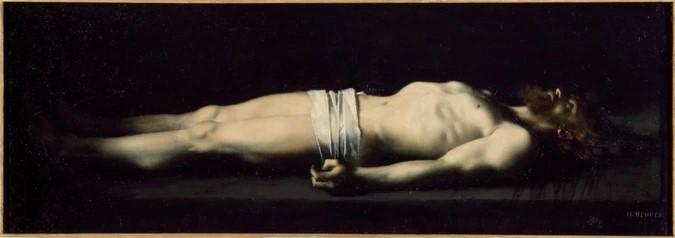
In these images we are presented with “just the facts”, a dead body, a cadaver.


Carpaccio, The Dead Christ
Italian, c.1520
Berlin, Gemäldegalerie der Staatliche Museen zu Berliln


Hans Holbein the Younger, The Dead Christ in the Tomb
German, 1521
Basel, Kunstmuseum


Zacharias Hegewald, The Dead Christ in the Tomb
German, c. 1630
Vienna, Kunsthistorisches Museum


Philippe de Champaigne, The Dead Christ
French, Prior to 1654
Paris, Musée du Louvre


Jean Delcour, The Dead Christ
Flemish, 1696
Liege, Cathedral of Saint Paul


Giuseppe Sammartino, The Dead Christ in a Shroud
Italian, 1753
Naples, Church of Santa Maria della Pieta dei Sangro


The last quarter of the nineteenth century saw a flurry of this imagery all over Europe.  This may perhaps be the result of an increased interest in death as a physical phenomenon that accompanied the rise of modern medical science that was taking place at the same time.


Eduard Adrian Dussek. The Dead Christ in the Tomb
Slovak, 1873
Vienna, Belvedere Museum


Wilhelm Truebner, Christ in the Tomb
German, 1874
Hamburg, Hamburger Kunsthalle


Jean-Jacques Henner, Jesus in the Tomb
French, 1879
Paris, Musée d'Orsay


Alphonse Legros, The Dead Christ
French, 1888
Paris, Musée d'Orsay


Henri Levi, The Dead Christ
French, c. 1893
Villefranche-sur-Saone, Musée Paul Din


Alexandre Charpentier, The Covered Christ
French, 1895
Paris, Musée d'Orsay


Gabriel Ferrier, Sorrow
French, 1903
Arras, Musée des Beaux-Arts


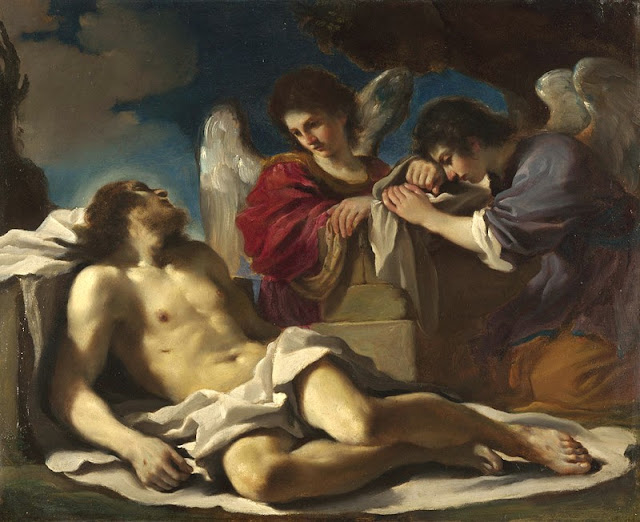
In the third type, the Dead Christ tended by angels, we see something very different. These images have a deep relationship with the Man of Sorrows image, especially the form of the Man of Sorrows in which Jesus is supported by another person. But, in this variation, the humans have been replaced by angels.

The angels are sometimes sad and sorrowing, sometimes busy working on preparing for the Resurrection. They support and prepare His physical Body for its new, glorified existence.


Giovanni Bellini, The Dead Christ Supported by two Angels
Italian, c. 1465-1470
London, National Gallery


Carlo Crivelli, The Dead Christ Supported by Angels
Italian, c. 1470
London, National Gallery


Antonello da Messina, The Dead Christ Supported by an Angel
Italian, c. 1474-1475
Madrid, Museo National del Prado


Giovanni Bellini, The Dead Christ Supported by  Angels
Italian, c. 1474
Rimini, Pinacoteca Comunale


Girolamo da Treviso, The Dead Christ Supported by Two Angels
Italian, c. 1475-1485
Milan, Pinacoteca di Brera


Giovanni Bellini, The Dead Christ Supported by Two Angels
Italian, c. 1480-1485
Berlin, Gemäldegalerie der Staatliche Museen zu Berlin


Pedro Berruguete, The Dead Christ with Two Angels
Spanish, 1480
Milan, Pinacoteca di Brera


The Dead Christ Mourned by Angels
Italian, 16th Century
Rome, Pinacoteca della Basilica di San Paolo fuori le mura


Rosso Fiorentino, The Dead Christ Supported by Angels
Italian, c. 1524-1526
Boston, Museum of Fine Arts
Rosso portrayed a typically Mannerist image of a contorted, unstable body barely supported by the angels.


Baccio Bandinelli, The Dead Christ Supported by Nicodemus
Italian, c. 1554-1559
Florence, Church of Santisssima Annunziata


Leandro Bassano, The Dead Christ Mourned by Angels
Italian, c. 1580
Cleveland, Museum of Arts


Tintoretto, The Dead Christ Adored by the Doges Pietro Lando  and Marcantonio Trevisan
Italian, c. 1580s
Venice, Palazzo Ducale


Veronese, The Dead Christ Supported by Two Angels
Italian, c. 1587-1589
Berlin, Gemäldegalerie der Staatliche Museen zu Berlin


Alessandro Allori, The Dead Christ with Two Angels
Italian, c. 1600
Budapest, National Museum
This tiny painting, painted on copper, is a bridge between the "scientific" Dead Christ and the Dead Christ with Angels.  Here the angels minister tenderly to the Body of Christ, preparing it for its new role. 


The Dead Christ Supported by Angels
German, c. 1600-1625
 London, Victoria and Albert Museum


Jacopo Palma the Younger, The Dead Christ with Two Angels_
Italian, c. 1600
Budapest, Szépmûvészeti Múzeum


Abraham Janssen van Nuyssen, The Dead Christ in the Tomb with Two Angels
Flemish, c. 1610
New York, Metropolitan Museum of Art


Guercino, Angels Weeping over the Dead Christ
Italian, c, 1517-1618
London, National Gallery


Alonso Cano, The Dead Christ Supported by an Angel
Spanish, c. 1646-1652
Madrid, Museo Nacional del Prado


Francesco Trevisani, The Dead Christ Supported by Angels
Italian, c. 1710
New York, Metropolitan Museum of Art


Edouard Manet, The Dead Christ With Angels
French, 1864
New York, Metropolitan Museum of Art


As he so often did, the French painter Jacques-James Tissot stood out in his interpretation of this theme.  His narrative paintings of the life of Jesus drew on the observations he made while residing in the Holy Land for more than a year.  Consequently, his interpretation of the body of Christ in the tomb is one that accords with the traditional burial customs of the area.  In his work the body of Jesus is not simply laid on a slab with a cloth under it.  It is swaddled in cloth from head to foot, much like a mummy.  This accords with both reality and the Biblical texts.  


James Tissot, Jesus in the Sepulchre
French, c. 1886-1894
New York, Brooklyn Museum


____________________________
1.  See also "O Key of David!  Come, break down the walls of death" at http://imaginemdei.blogspot.com/2011/12/o-key-of-david.html

© M. Duffy, 2012, 2018


Excerpts from the Lectionary for Mass for Use in the Dioceses of the United States of America, second typical edition © 2001, 1998, 1997, 1986, 1970 Confraternity of Christian Doctrine, Inc., Washington, DC. Used with permission. All rights reserved. No portion of this text may be reproduced by any means without permission in writing from the copyright owner.


Friday, April 6, 2012

Meditation on the Passion – The Man of Sorrows

Michele Giambono, The Man of Sorrows Adored By 
Saint Francis of Assisi
Italian, c. 1430
New York, Metropolitan Museum of Art

“See, my servant shall prosper,
he shall be raised high and greatly exalted.
Even as many were amazed at him—
so marred were his features,
beyond that of mortals
his appearance, beyond that of human beings—
So shall he startle many nations,
kings shall stand speechless;
For those who have not been told shall see,
those who have not heard shall ponder it.”
(Isaiah 52:13-15)
Excerpt from the First Reading for Good Friday Liturgy of the Passion of the Lord 


Among the many images that evoke the Passion the one that is probably the most shocking to our modern eyes is that of the Man of Sorrows. In fact, even among Catholics it is now little known, having been supplanted long ago by other images, such as the Sacred Heart, or more recently, by the Divine Mercy. I confess that I, myself, had never seen it prior to my second year in graduate school and, at first sight, I found it extremely shocking. Yet, it was once one of the best known and most wide spread of all visual meditations on the Passion.


The Man of Sorrows image has many variations and relationships to other images. Interpretation of these relationships is extraordinarily complex, far too complex to deal with in one article. Consequently, I will limit myself to merely describing the most common and simplest variation.

An Imago pietatis Icon (similar to those which entered Italy in the 13th Century)
Byzantine (Mount Sinai, St. Catherine's Monastery), c. 1300 (Casing Italian, c. 1380)
Rome, Basilica of Santa Croce in Gerusalemme

The Beginnings

The image of the Man of Sorrows appears to have developed first in Byzantine art, entering Western art by about 1300, probably via Rome and Venice. 1 From that point it spread throughout the West, so that there are examples readily available from nearly every country in Europe by 1500. And it is in the West that the tremendous development in the theme took place.

At its most basic the image of the Man of Sorrows is: a half-length image of the crucified Jesus, showing His wounds. He may be shown as crowned with thorns or with the crown removed. His arms may be folded over His torso or they may be extended at His sides. Sometimes He seems to be sitting upright on his own power, sometimes His body is supported by others. In every case His wounds are visible. His head is inclined to His right.  And, most importantly, in the original image He is shown as dead, with closed eyes.


The Master of the Borgo Crucifix
Italian, c. 1255-1260
London, National Gallery


The Man of Sorrows
Italian, 14th Century
Cologne, Wallraf-Richartz-Museum and Fondation Corboud


Pietro Lorenzetti, The Man of Sorrows
Italian, c. 1340-1345
Altenburg, Lindenau-Museum Gemäldesammlung


Naddo Ceccarelli, The Man of Sorrows
Italian, c. 1347
Vienna, Liechtenstein Museum


Sano di Pietro, The Man of Sorrows
Italian, c. 1440
Dresden, Gemäldegalerie Alte Meister


Variations

Among the earliest variations on the image are those works that include the Cross or sometimes just a crossbeam behind the image of the Crucified.


Niccolo di Tommasso, The Man of Sorrows with the Cross
Italian, c. 1370
New York, Metropolitan Museum of Art, The Cloisters Collection


Jacobello del Bonomo, The Man of Sorrows with the Cross
Italian, c. 1385-1400
London, National Gallery


Lorenzo Monaco, The Man of Sorrows
Italian, c. 1415-17
Private Collection


Bartolomeo Caporali, The Man of Sorrows with the Cross and Whips
Italian, c. 1475-1500
Oxford, Ashmolean Museum of Art and Archaeology


The Man of Sorrows with the Cross
From an Illustrated Vita Christi
English (Norfolk), c. 1480-1490
Los Angeles, J. Paul Getty Museum
MS 101, fol. 95v


Cristoforo Mayorana, The Man of Sorrows with the Cross
From a Book of Hours
Italian (Naples), 1483
New York, Pierpont Morgan Library
MS M 1052, fol. 102r


Follower of Perugino, The Man of Sorrows with the Cross
Italian, c. 1500
Berlin, Gemäldegalerie der Staatliche Museum zu Berlin

Developments

But the most frequent image during the 14th and 15th centuries was that of the half-length figure or a bust, sometimes seen as dead, with closed eyes, but sometimes rather disturbingly awake and making eye contact with the viewer, even showing us his wounded hands and side.  These were, above all, devotional images and they appeared in every kind of medium imaginable, including illumination, wall and panel painting, sculpture, goldsmith’s work, lapidary.  In addition, the image can now be demonstrated to have spread throughout Europe.

Initially, the image of Jesus was naked above the waist, as time went on draperies were added, evoking the mocking by the Roman soldiers at the time the Crown of Thorns was pressed on His head.

Master of the Bible of Jean de Sy, Life Size Image of Christ's Wound and the Man of Sorrows
From a Book of Hours
French (Paris), c. 1370-1380
New York, Pierpont Morgan Library
MS M 90, fol. 130r
This rather startling image combines what was believed to be a life size representation of the spear wound in Christ's side with the image of the Man of Sorrows.


Giovanni Bellini, The Man of Sorrows
Italian, c. 1460-1469
Milan, Museo Poldi Pezzoli

Master of Mary of Burgundy, The Man of Sorrows
Flemish, c. 1480
Berlin, Kupferstichkabinett der Staatliche Museen zu Berlin


Simon Marmion, The Man of Sorrows
French, 1480
Strasbourg, Musée des Beaux-Arts


Anonymous Lombard Artist, The Man of Sorrows
Italian, c. 1490-1500
Milan, Museo Nazionale della Scienza e Tochnologia Leonardo da Vinci


Giovanni Santi, The Man of Sorrows
Italian, c. 1490
Private Collection


Israhel van Meckenem the Younger, The Man of Sorrows
German, c. 1490
Berlin, Kupferstichkabinett der Staatliche Museen zu Berlin


Hans Memling, The Man of Sorrows
Flemish, After 1490
Esztergom, Christian Museum


Albrecht Bouts, The Man of Sorrows
Dutch, c. 1500
Lyon, Musée des Beaux-Arts


Colijn de Coter, The Man of Sorrows
Flemish, c. 1500
Private Collection


Jan Mostaert, The Man of Sorrows
Dutch, c. 1500
Moscow, Pushkin Museum, Collection Dmitry Ivanovich Shchukin


Cristoforo Solari, The Man of Sorrows
Italian, ca. 1500
Dayton (OH), Art Institute


The Man of Sorrows
German, c. 1500
Paris, Musée du Louvre


Workshop of Giovanni Bellini, The Man of Sorrows
Italian, c. 1510-1515
Besancon, Musée des Beaux-Arts


Simon Bening, The Man of Sorrows
From the Da Costa Hours
Flemish (Bruges), c. 1510-1520
New York, Pierpont Morgan Library
MS M 399, fol. 42r


Workshop of Aelbert Bouts, The Man of Sorrows
Dutch, c. 1525
New York, Metropolitan Museum of Art


Lucas Cranach the Younger, The Man of Sorrows
German, c. 1540
Bremen, Museum im Roselius-Haus


Bernardo de Mora, The Man of Sorrows
Spanish, 1659
Granada, Capilla Real
 

Influence

However presented, The Man of Sorrows image causes us to ponder the sufferings of Jesus and evokes in us a sense of pity. Indeed, in Latin it is known as the “Imago Pietatis”, in French, it is the “Christ du pitié”, in German the “Schmerzensmann”. This fits into what we know of some emotional forms of medieval piety and it enjoyed a long life from its introduction till around 1600, when its basic form faded. However, it had a strong influence on other images, which have continued, even into the modern world. It affected, among others: the Ecce Homo, Deposition, Lamentation and Burial images, and other images that are no longer so much with us, such as the Dead Christ supported by saints and angels and images of the Holy Face. 

In a more subtle way, the identification of the Dead Jesus with Isaiah’s Suffering Servant through the image of the Man of Sorrows has influenced the wider culture, beyond Catholicism. One example is found in the music of Georg Friedrich Handel’s “Messiah”.  Below is a recording by the great English mezzo-soprano, Sarah Connolly.


© M. Duffy, 2012 and 2018


Scripture texts in this work are taken from the New American Bible, revised edition © 2010, 1991, 1986, 1970 Confraternity of Christian Doctrine, Washington, D.C. and are used by permission of the copyright owner. All Rights Reserved. No part of the New American Bible may be reproduced in any form without permission in writing from the copyright owner.
___________________________________

1. Passion in Venice: Crivelli to Tintoretto and Veronese, The Man of Sorrows in Venetian Art, edited by Catherine Puglisi and William Barcham, New York and London, Museum of Biblical Art in association with D. Giles Limited, p. 10. This book is the exhibition catalog for the exhibition “Passion in Venice: Crivelli to Tintoretto and Veronese” at the Museum of Biblical Art, New York from February 11 to June 12, 2011. In addition to the catalog entries for the works in the exhibition, the book includes informative essays on the Man of Sorrows image, primarily in Venice and the Veneto (the area of mainland Italy traditionally controlled by Venice). This is, however, merely a minute slice of the enormous diversity and geographic spread of the image.