2.jpg) |
Luca Signorelli, The Scourging of Christ
Italian, c. 1480
Milan, Pinacoteca di Brera |
"Then Pilate took Jesus and had him scourged."
Gospel for Good Friday, the Passion of Our Lord Jesus Christ According to John
(John 19:1)
The Gospel of John is the only one of the Four Gospels that actually says that Pilate had Jesus scourged. The three Synoptic Gospels imply that something like this happened, either at the hands of the Romans under Pontius Pilate or at the hands of the Jewish Temple guards, who first arrested Him. They make references to rough treatment or say that Pilate said that he would have Jesus flogged. Nevertheless, Christian tradition affirms that Jesus suffered the horrific torture of scourging.
We now know from archaeological evidence that much of what tradition says is actually true to the period. We have evidence that includes the skeleton of a crucified man who had been nailed to a cross through the feet, just like Jesus was (see discussion here), and we have plenty of evidence for the terrible whip, the flagrum (plural: flagra) used by the Roman army.
These vicious implements, multiple strand whips to which hard pieces of metal or other materials were added, were intended to inflict as much damage as possible, ripping skin at times. The name flagrum is related to the verb “to flay”, which means to remove the skin from. We know that they existed and that they were used for discipline and for punishment.
 |
| Roman Flagrum |
The representation of the Scourging, sometimes also called “Christ At The Column” or "the Flagellation", is one that seems to have remained pretty much unchanged through the centuries, although there are some interesting variations. The scene generally consists of the figure of Christ, bound to a column, flanked by two tormentors. Other figures may or may not appear in the scene. Occasionally, Pilate may appear as well.
 |
Master of the Registrum Gregorii, The Scourging at the Pillar
From the Codex Egberti
German, c. 980
Trier, Stadtbibliothek
MS Cod. 24 |
 |
The Scourging at the Pillar
Miniatures of the Life of Christ
French (probably Corbie), c. 1175
New York, Morgan Library
MS M 44, fol. 8v |
 |
The Scourging at the Pillar
French, c. 1200-1220
London, Victoria and Albert Museum |
 |
The Scourging at the Pillar
From a Psalter
English, c. 1200
Oxford, University of Oxford, Bodleian-Library
MS Gough Liturg 2, fol. 27r |
A Static Image
The earliest images of the Scourging at the Pillar seem more a pictogram of an event, than a true representation of someone being scourged.
Indeed, in the Gothic period the scene almost resembles a courtly dance rather than a true scene of torture. And this is the image that persists for over 200 years.
,%20c.%201200-1225_Paris,%20BNF_MS%20NAL%201392,%20fol.%2010v.jpg) |
The Scourging at the Pillar
From a Psalter
French (Paris), c. 1200-1225
Paris, Bibliotheque nationale de France
MS NAL 1392, fol. 10v |
 |
The Scourging at the Pillar
From the Psalter of St. Louis and Blanche of Castille
France (Paris), c. 1225
Paris, Bibliotheque nationale de France
MS-1186 reserve, fol. 23v |
,%20c.%201250_Paris,%20BNF_MS%20Latin%2010434,%20fol.%2015v.jpg) |
The Scourging at the Pillar
From a Psalter known as the Psalter of Blanche of Castille
French (Paris), c. 1250
Paris, Bibliotheque nationale de France
MS Latin 10434, fol. 15v |
,%20c.%201250-1300_Paris,%20BNF_MS%20Smith-Lesou%C3%ABf%2020,%20fol.%2073r.jpg) |
The Scourging at the Pillar
From a Psalter
French (Saint-Omer), c. 1250-1300
Paris, Bibliotheque nationale de France
MS Smith-Lesouëf 20, fol. 73r |
,%20c.%201275-1300_Paris,%20Bibliotheque%20nationale%20de%20France_MS%20Nouvelle%20acquisition%20francaise%2016251,%20fol.%2036r.jpeg) |
The Scourging at the Pillar
From the Livre d’images de Madame Marie
Flemish (Hainaut), c. 1275-1300
Paris, Bibliotheque nationale de France
MS NAF 16251, fol. 36r |
 |
Cimabue, The Scourging at the Pillar
Italian, c. 1280
New York, The Frick Collection |
,%20c.%201300_Oxford,%20Bodleian%20Library_MS%20Gough%20Liturg-8,%20fol.%2049r.jpg) |
The Scourging at the Pillar
From a Psalter
English (East Anglia), c. 1300
Oxford, Bodleian Library
MS Gough Liturg-8, fol. 49r |
 |
Duccio, Pilate Orders Jesus to be Scourged
Italian, 1308-1311
Siena, Museo dell'Opera del Duomo |
 |
Pietro Lorenzetti, Pilate Orders the Scourging of Jesus
Italian, c. 1320
Assisi, Basilica of San Francesco, Lower Church |
,%20c.%201325-1350_Paris,%20BNF_MS%20Francais%20185,%20fol.%2010v.jpg) |
The Scourging at the Pillar and Jesus Carrying the Cross From a Vie de saints French (Paris), c. 1325-1350 Paris, Bibliotheque nationale de France MS Francais 185, fol. 10v |
 |
Ugolino di Nerio, The Scourging at the Pillar
Italian, c. 1325
Berlin, Gemäldegalerie der Staatlichen Museen zu Berlin |
 |
Master of the Poldi Pezzoli Diptych, Pilate Orders the Scourging of Jesus
Italian, c. 1335-1340
Milan, Pinacoteca di Brera |
,%20c.%201350_Paris,%20BNF_MS%20Francais%209561,%20fol.%20171v+2.jpeg) |
Pilate Orders the Scourging of Jesus
From a Vies de la Vierge et du Christ
Italian (Naples), c. 1350
Paris, Bibliotheque nationale de France
MS Francais 9561, fol. 171v |
 |
The Scourging at the Pillar
From the Salisbury Psalter
English, c. 1350-1375
Paris, Bibliotheque nationale de France
MS Latin 765, fol. 12r |
 |
Luca di Tomme, Pilate Orders the Scourging of Jesus
Italian, c. 1365
Amsterdam, Rijksmuseum |
,%20c.%201371-1372_The%20Hague,%20Meermano%20Museum_%20MS%20RMMW%2010%20B%2023,%20fol.%20522r.jpg) |
Jean Bondol and Others, The Scourging at the Pillar
From a Grande
Bible Historiale Completée by Guiard des Moulins
French (Paris), c. 1371-1372
The Hague, Meermano Museum_
MS RMMW 10 B 23, fol. 522r |
 |
The Scourging at the Pillar
English, Late 14th Century
London, Victoria and Albert Museum |
,%20c.%201380_Paris,%20BNF_MS%20Latin%2014033,%20fol.%2047r.jpeg) |
The Scourging at the Pillar
From a Book of Hours, known as the Hours of Isabeau of Bavaria, Queen of France
French (Metz), c. 1380
Paris, Bibliotheque nationale de France
MS Latin 14033, fol. 47r |
,%20c.%201385-1390_Paris,%20BNF_MS%20Latin%2018014,%20fol.%2093v.jpg) |
Jean le Noir, The Scourging at the Pillar
From the Petites Heures of Jean de Berry
French (Bourges), c. 1385-1390
Paris, Bibliotheque nationale de France
MS Latin 18014, fol. 93v |
,%20c.%201385-1390_Paris,%20BNF_MS%20Latin%20757m%20fol.%20254v.jpg) |
Giovanni di Benedetto & Workshop, The Scourging at the Pillar
From a Missal
Italian (Milan), c. 1385-1390
Paris, Bibliotheque nationale de France
MS Latin 757m fol. 254v |
 |
Lorenzo Ghiberti, The Scourging at the Pillar
Italian, 1403
Florence, Baptistry Doors
 | Agnolo di Domenico Mazzieri, The Scourging at the Pillar
Italian, 15th Century
Paris, Musée du Louvre
|
 | The Scourging at the Pillar
English, 15th Century
London, Victoria and Albert Museum |
 | Master of the Berswordt Altar, The Scourging at the Pillar
German, c. 1400
New York, Metropolitan Museum of Art |
 | The Scourging at the Pillar
English, c. 15th Century
London, Victoria and Albert Museum |
 | The Limbourg Brothers, Pilate Orders the Scourging of Jesus
From the Tres Rches Heures du Duc de Berry
Flemish, c. 1412-1416
Chantilly, Musée Condé
MS 65, fol. 144r |
 | Enamel Plaque of the Flagellation of Christ
French, c. 1415-1425
Paris, Musee du Louvre, Département des Objets d'art du Moyen Age, de la Renaissance et des temps modernes |
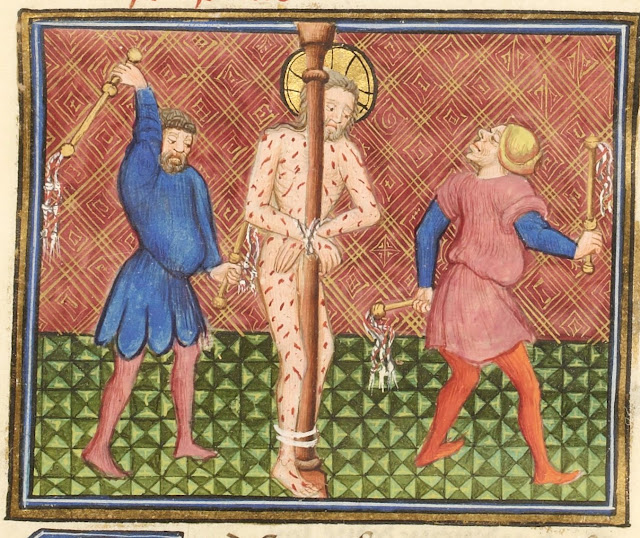 | The Scourging at the Pillar
From the Pelerinage de Jesus-Christ by Guillaume de Digulleville
France (Rennes), c. 1425-1450
Paris, Bibliotheque nationale de France
MS Francais 376, fol.216 |
 | The Scourging at the Pillar
English, c. 1440-1460
London, Victoria and Albert Museum |
 | Masters of the Gold Scrolls, The Scourging at the Pillar
From a Book of Hours
Flemish, c. 1450
The Hague, Meermano Museum
MS RMMW 10 E 2, fol. 75v |
,%201452_Paris,%20BNF_MS%20NAL%203244,%20fol.%20252r_2.jpg) | Master of Jouvenal des Ursins and Workshop, The Scourging at the Pillar
From a Book of Hours
French (Angers), 1452
Paris, Bibliotheque nationale de France
MS NAL 3244, fol. 252r |
 | Piero della Francesca, The Scourging at the Pillar
Italian, ca. 1455
Urbino, Galleria Nazionale delle Marche
|
|
Increasing Violence
However, starting around 1450, the levels of violence and cruelty depicted gradually increased, even though the composition of the figures remained basically unchanged.
,%201463_Paris,%20BNF_MS%20Francais%2050,%20fol.%20230r%20(2).jpg) |
Master Francois and Workshop, The Scourging at the Pillar
From Speculum historiale by Vincent of Beauvais
French (Paris), 1463
Paris, Bibliotheque nationale de France
MS Francais 50, fol. 230r
|
,%20c.%201475_Paris,%20BNF_MS%20Francais%20179,%20fol.%2093r.jpg) |
Jean Colombe, The Scourging at the Pillar
From a Vita Jesu Christi by Ludolph of Saxony
French (Bourges), c. 1475
Paris, Bibliotheque nationale de France
MS Francais 179, fol. 93r |
 |
The Scourging at the Pillar
German, c. 1480-1490
New York, Metropolitan Museum of Art, the Cloisters Collection |
,%20c.%201485_Paris,%20BNF_Ms%20Francais%206275,%20fol.%2021v.jpg) |
Master of Edward IV, The Scourging at the Pillar
From a Speculum humanae salvationis
Flemish (Bruges), c. 1485
Paris, Bibliotheque nationale de France
Ms Francais 6275, fol. 21v |
,%20End%20of%20the%2015th%20Century_Paris,%20BNF_MS%20Espagnol%20544,%20fol.%2028v.jpeg) |
The Scourging at the Pillar, on the Back
From a Speculum animae
Spanish (Catalan), End of the 15th Century
Paris, Bibliotheque nataionale de France
MS Espagnol 544, fol. 28v |
,%20End%20of%20the%2015th%20Century_Paris,%20BNF_MS%20Espagnol%20544,%20fol.%2029r.jpeg) |
The Scourging at the Pillar, on the Front
From a Speculum animae
Spanish (Catalan), End of the 15th Century
Paris, Bibliotheque nataionale de France
MS Espagnol 544, fol. 29r |
 |
Michael Pacher, Fragment of a Scourging at the Pillar
German, c. 1497-1498
Vienna, Belvedere Museum |
 |
Anton Woensam, The Scourging at the Pillar
German, 16th Century
Chambery, Musée des Beaux-Arts |
,%20c.%20150-1510_Paris,%20BNF_MS%20Latin%20923,%20fol.%2014r.jpeg) |
Workshop of Jean Pichore, The Scourging at the Pillar
From a Book of Hours
French (Paris), c. 150-1510
Paris, Bibliotheque nationale de France
MS Latin 923, fol. 14r |
 |
Luca Signorelli, The Scourging at the Pillar
Italian, 1502
Cortona, Museo Diocesano |
 |
Bacchiacca, The Scourging at the Pillar
Italian, c. 1512-1515
Washington, National Gallery of Art |
 |
Sebastiano del Piombo, The Scourging at the Pillar
Italian, c. 1516-1524
Rome, Church of San Pietro in Montorio
|
 |
Albrecht Altdorfer, The Scourging at the Pillar
German, 1518
Sankt Florian bei Linz, Augustinian Abbey |
 |
Joerg Ratgeb, The Scourging at the Pillar
German, c. 1518-1519
Stuttgart, Staatsgalerie
Although the central image is the Scourging, this picture includes multiple scenes from the Passion |
 |
Jean Penicaud the Elder, The Scourging at the Pillar
French, c. 1525
London, Victoria and Albert Museum |
 |
Lucas Cranach the Elder, The Scourging at the Pillar
German, 1538
Vienna, Kunsthistorisches Museum |
,%20c.%201540-1560_Paris,%20Musee%20du%20Louvre,%20D%C3%A9partement%20des%20Sculptures%20du%20Moyen%20Age,%20de%20la%20Renaissance%20et%20des%20temps%20modernes.JPG) |
The Scourging at the Pillar
French (Saint Denis), c. 1540-1560
Paris, Musée
du Louvre, Département des Sculptures du Moyen Age, de la Renaissance et des temps modernes |
 |
Federico Zuccaro, The Scourging at the Pillar
Italian, 1573
Rome, Oratorio del Gonfalone |
The Violence Increases
Following on from the work of the Venetian painter, Titian, the violence reached a crescendo with the work of Caravaggio (another north Italian) and his followers at the beginning of the 17th century. The tormentors in these paintings really get into their work.
 |
Titian, The Scourging at the Pillar
Italian, c. 1560
Rome, Borghese Gallery |
 |
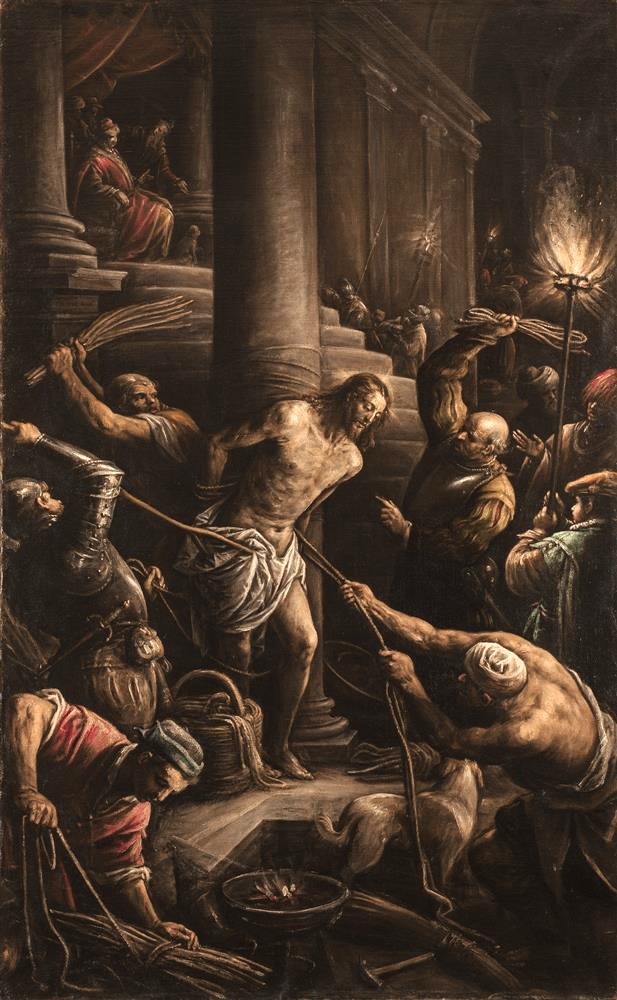
Leandro Bassano, The Scourging at the Pillar
Italian, c. 1585
Hartford, Wadsworth Atheneum |
 |
Franz Fallenter, The Scourging at the Pillar
Swiss, 1598
New York, Metropolitan Museum of Art |
 |
Caravaggio, The Scourging at the Pillar
Italian, 1605
Rouen, Musée des Beaux-Arts |
 |
Caravaggio, The Scourging at the Pillar
Italian, c. 1607
Naples, Museo Nazionale di Capodimonte |
 |
Pier Francesco Mazzucchelli, The Scourging of Jesus
Italian, c. 1615-1620
Madrid, Museo Nacional del Prado |
 |
Peter Paul Rubens, The Scourging at the Pillar
Flemish, 1617
Ghent, Museum voor Schone Kunsten |
 |
Jacques Blanchard, The Scourging at the Pillar
French, c. 1630
Rennes, Musée des Beaux-Arts |
 |
David Teniers, The Scourging at the Pillar
Flemish, Middle of the 17th Century
Madrid, Museo Nacional del Prado
|
 |
Guercino, The Scourging at the Pillar
Italian, 1657
Rome, Galleria Nazionale d'Arte Antica, Barbarini-Cornsini Galleries |
 |
Nicola Grassi, The Scourging at the Pillar
Italian, c. 1720
Budapest, Szépmûvészeti Múzeum |
 |
Pierre Subleyras, The Scourging at the Pillar
French, Before 1749
Montauban, Musée Ingres |
 |
Corrado Giaquinto, The Scourging at the Pillar
Italian, c. 1754
Madrid, Museo Nacional del Prado |
 |
Andrea Pozzi, The Scourgin at the Pillar
Italian, c. 1775-1800
Madrid, Museo Nacional del Prado |
 |
James Tissot, The Scourging on the Front
French, c. 1886-1894
New York, Brooklyn Museum |
 |
James Tissot, The Scourging on the Back
French, c, 1886-1894
New York, Brooklyn Museum |
Devotional Images
There was another way of depicting the Scourging, found in the realm of devotional iconography. These images begin to appear in the North, where devotional images often originate. They present the figure of the bleeding, wounded Jesus to the viewer for prayer and adoration.
,%20c.%201420-1440_Washington,%20Library%20of%20Congress_MS%20213,%20fol.%2044v.jpg) |
Follower of the master of the Gold Scrolls, Angels Adore the Wounded Christ
From a Book of Hours
Flemish (Bruges), c. 1420-1440
Washington, Library of Congress
MS 213, fol. 44v |
,%20c.%201485_Paris,%20BNF_Ms%20Francais%206275,%20fol.%2045v.jpg) |
Master of Edward IV, A Donor Prays Before a Vision of the Scourging at the Pillar
From a Speculum humanae salvationis
Flemish (Bruges), c. 1485
Paris, Bibliotheque nationale de France
MS Francais 6275, fol. 45v |
 |
Hans Memling, Christ at the Column
Flemish, c. 1485-1490
Barcelona, Coleccion Mateu |
 |
Christ at the Column
Spanish, Early 16th Century
Madrid, Museo Nacional del Prado |
Artists also imagined the exhausted, wounded Christ painfully retrieving his garments or simply exhausted after the scourging. Frequently the Christ in this kind of image is shown as a focus for prayerful, sympathetic contemplation by both angels and humans. This type of image became popular in the seventeenth century, especially in Spain.
 |
Diego Velazquez, Christ Contemplated by the Christian Soul
Spanish, c. 1628-1629
London, National Gallery |
 |
Alonso Cano, Christ Recovering His Garments after the Scourging
Spanish, c. 1645-1650
Madrid, Museo Nacional del Prado |
 |
Bartolome Esteban Murillo, Christ After the Scourging
Spanish, After 1665
Boston, Museum of Fine Arts |
 |
Bartolome Esteban Murillo, Christ at the Column with Saint Peter
Spanish, c. 1670
Paris, Musée du Louvre |
 |
Anonymous, Christ After the Scourging
German, c. 1725-1730
Ettal, Abbey Church of the Assumption, Sacristy |
According to art historian, John F. Mofitt, this unusual series of depictions of the aftermath of the Scourging derives from a number of works of advice on Christian prayer, stretching from the thirteenth-century Meditationies Vitae Christi by the Pseudo-Bonaventure to the sixteenth-century Spiritual Exercises of Saint Ignatius Loyola to the early seventeenth-century Introduction to the Devout Life of Saint Francis de Sales. All of these works proposed contemplation of the sufferings of Christ and the last, in particular, encouraged contemplation of the moments after the end of the Scourging.1
© M.
Duffy, 2013. Additional images added 2023. Images updated and new material added 2024.
1. Moffitt, John F. "The Meaning of 'Christ After the Flagellation' in Siglo de Oro Sevillian Painting", Wallraf-Richartz-Jahrbuch , 1992, Vol. 53 (1992), pp. 139-154.
Excerpts
from the Lectionary for Mass for Use in the Dioceses of
the United States of America, second typical edition © 2001,
1998, 1997, 1986, 1970 Confraternity of Christian Doctrine, Inc., Washington,
DC. Used with permission. All rights reserved. No portion of this text may be
reproduced by any means without permission in writing from the copyright owner.


2.jpg)


,%20c.%201200-1225_Paris,%20BNF_MS%20NAL%201392,%20fol.%2010v.jpg)

,%20c.%201250_Paris,%20BNF_MS%20Latin%2010434,%20fol.%2015v.jpg)
,%20c.%201250-1300_Paris,%20BNF_MS%20Smith-Lesou%C3%ABf%2020,%20fol.%2073r.jpg)
,%20c.%201275-1300_Paris,%20Bibliotheque%20nationale%20de%20France_MS%20Nouvelle%20acquisition%20francaise%2016251,%20fol.%2036r.jpeg)

,%20c.%201300_Oxford,%20Bodleian%20Library_MS%20Gough%20Liturg-8,%20fol.%2049r.jpg)


,%20c.%201325-1350_Paris,%20BNF_MS%20Francais%20185,%20fol.%2010v.jpg)


,%20c.%201350_Paris,%20BNF_MS%20Francais%209561,%20fol.%20171v+2.jpeg)


,%20c.%201371-1372_The%20Hague,%20Meermano%20Museum_%20MS%20RMMW%2010%20B%2023,%20fol.%20522r.jpg)

,%20c.%201380_Paris,%20BNF_MS%20Latin%2014033,%20fol.%2047r.jpeg)
,%20c.%201385-1390_Paris,%20BNF_MS%20Latin%2018014,%20fol.%2093v.jpg)
,%20c.%201385-1390_Paris,%20BNF_MS%20Latin%20757m%20fol.%20254v.jpg)


,%201452_Paris,%20BNF_MS%20NAL%203244,%20fol.%20252r_2.jpg)

,%201463_Paris,%20BNF_MS%20Francais%2050,%20fol.%20230r%20(2).jpg)
,%20c.%201475_Paris,%20BNF_MS%20Francais%20179,%20fol.%2093r.jpg)

,%20c.%201485_Paris,%20BNF_Ms%20Francais%206275,%20fol.%2021v.jpg)
,%20End%20of%20the%2015th%20Century_Paris,%20BNF_MS%20Espagnol%20544,%20fol.%2028v.jpeg)
,%20End%20of%20the%2015th%20Century_Paris,%20BNF_MS%20Espagnol%20544,%20fol.%2029r.jpeg)


,%20c.%20150-1510_Paris,%20BNF_MS%20Latin%20923,%20fol.%2014r.jpeg)


,%20c.%201540-1560_Paris,%20Musee%20du%20Louvre,%20D%C3%A9partement%20des%20Sculptures%20du%20Moyen%20Age,%20de%20la%20Renaissance%20et%20des%20temps%20modernes.JPG)




,%20c.%201420-1440_Washington,%20Library%20of%20Congress_MS%20213,%20fol.%2044v.jpg)
,%20c.%201485_Paris,%20BNF_Ms%20Francais%206275,%20fol.%2045v.jpg)


