Sunday, July 17, 2022

Much More Than Meets the Eye


For several hundred years European and American sensibilities have been influenced by an error.  


Virtually all the civil and religious sculpture that was produced between the mid-15th century and the mid-20th century has been monochrome.  It has been either white marble or bronze.  Any visitor to the grand edifices built in those years in London or Paris or New York or Washington and any visit to the parks and plazas of those same cities (and countless others) knows this to be true.  

Even statues of contemporaries or near contemporaries have been like this.  Think of the statue of Queen Anne in front of London’s Saint Paul’s, of Louis XIV in the Place Vendome, of Queen Victoria in front of Buckingham Palace or of the monuments to Presidents Lincoln or Jefferson.  The whiteness of the marble or the tone of the bronze have come to signify their greatness, their eternal fame and our own sense of memory.  


This sensibility was handed down to our ancestors by their ancestors, going all the way back to the Renaissance, when the first archaeological excavations unearthed survivors of the classical Greek and Roman past and those survivors were white or bronze.  Or were they?


Pheidias, Procession of women from the Parthenon Frieze, Athens
Greek, c. 438-432 BC
London, Trustees of the British Museum
This has for long been the accepted standard of classical sculpture.

Since most of the unearthed marble statues from antiquity were made of marble from the island of Paros, they came to be known as Parian marble.1   Looking back through the years the word “parian” has always conveyed an impression of gleaming but remote and perfect whiteness.  Much effort was made in the 19th century to recreate this exquisite material in cheaper, more abundant materials, perfect for the diffusion of classical taste to the wider public.  This was achieved by the discovery in Europe of the process of making hard paste porcelain, first in France, with the glorious Sevres porcelain, but later in England and Ireland.  Josiah Wedgwood became famous and rich for producing pottery distinguished by pure white figures fired onto vessels of various colors, especially the light “Wedgwood” blue which he made famous.  The Beleek company in Northern Ireland has always been proud of the pure white “Parian ware” produced from its kilns.2   In other words, “parian” represented an imagined, ideal classical past.

Josiah Wedgwood and Sons, Vase
English, c. 1790
London, Victoria and Albert Museum

However, while this may be the impression that is shared by the general public, art historians know that this has almost always been an illusion, that the classical past was as colorful, perhaps even more colorful, than the present.  We knew that many ancient statues showed traces of eroded pigments, often held in protected areas like folds, but occasionally easily visible to the naked eye.  We knew that medieval artists continued using color on statues, both in stone and in wooden statues.  We could see it, sometimes blatantly obvious, sometimes more hidden.  If one looked closely enough, it was there to be seen.  But this has remained an “insider” view, not one shared by the general population.  Until now. 

In the last few years, a traveling exhibition that set out to change that general opinion has been visiting major museums around the world and it is now the turn of the Metropolitan.  Indeed, the Met itself has been a major participant in producing this particular show, using its extensive collection and the advanced techniques for analyzing the remains of ancient pigments that its conservation department affords.  Since the exhibition, called “Chroma: Ancient Sculpture in Color”, was first announced I have been itching with anticipation to see it.   A couple of days ago I did, and it was a very satisfying experience, which will have to be repeated multiple times. 

Gallery view showing the reconstructed figure of an Archer from the Temple of Aphaia at Aegina (in the spotlight) among objects from the Metropolitan's own collection

At first, I was a bit taken aback by the way in which the exhibition is organized.  I had expected to find the objects in question in one of the special exhibition galleries, all in one place, as is usual.  However, they are not arranged in this way.  In keeping with a recent philosophical change regarding exhibitions, the objects in this exhibition are scattered throughout the Greek and Roman galleries, turning the act of viewing them into something of a treasure hunt.  But, in most cases, they aren’t hard to find.  Unfortunately, I had slept badly the night before and so was very tired, causing my ailing back and shoulder to be more painful than usual.  So, this limited the energy and the patience I had available for a hunt.  I will have to return (probably several times) to see it all. 

As you might suspect from the title of this essay and from this preamble, the subject of this exhibition is a little unusual.  It is an exploration of the use of color in antiquity.  Much to the surprise of the multitudes who have assumed for centuries that “classical” Greek statues were carved and displayed in a kind of pure, pearly white, state, indicative of a society that was idealizing, calm and unflappable, these statues were originally highly, even (to our eyes) garishly, colored.  Thus, the “ideal” marble statues of the Renaissance and later, from Michelangelo’s David through Bernini’s Apollo and Daphne to Canova’s Perseus to the Lincoln Memorial, are based on a misunderstanding of the evidence from antiquity.  Instead, the ancient Greeks and Romans used lifelike color and gilding to create works that, at the time looked astonishingly lifelike.3   If the crowds gathered around these works are any indication, some of them are catching modern people up short. 

The exhibition includes works from the Archaic Greek period through the Roman period, or roughly for about 700 years.  Colored reconstructions of ancient works from the Met’s collection are displayed alongside the originals throughout the Greek and Roman galleries. Some of the colorized works represent originals not from the Met’s own collection, but these are displayed beside related items that do belong to the museum. The coloration of the reproduced works is based on careful, scientific analysis of the traces of pigment that can still be found on them.  The work of analysis has largely been driven by Dr. Vincenz Brinkmann, a professor of Archaeology and curator of the Collections of Antiquities and Asia at the Liebighaus Museum of Sculpture in Frankfut-am-Main, with the help of scientists and conservation professionals in many museums and universities. The work of applying the colors has been accomplished by his wife, Ulrike Koch-Brinckmann, who is an art historian specializing in antiquity.  

Gallery view showing the original funeral stele against the wall, the original Sphinx finial on the right and the reconstructed, painted Sphinx on the left.

Seeing these surprisingly colorful images, next to the original or closely related original works, is astonishing.  Suddenly, those fragile, nearly hidden colors become bold and alive!  Among the most striking of the objects I saw was the image of a sphinx, directly modeled from a well-known Met original, the finial atop the funerary stele of a young man from the mid-fifth century BC.  

Marble Capital and Finial in the Form of a Sphinx
Greek, c. 530 BC
New York, Metropolitan Museum of Art
One can see the remains of paint on the marble original with the naked eye.

The colorized sphinx is set up next to the original, and behind it one can see the stele that the original once adorned (the crowning sphinx finial now replaced with a molded copy). They make a startling grouping.  And, now that color is being underscored, one can see that the stele itself was once highly colored.  The upper area, including the young man’s head and the background behind it, were once highly colored.  Traces of pigment are clearly visible in his hair, eyebrows, eyes and the background surrounding his upper torso.

Marble Stele with a Youth and Little Girl
Greek, c. 530 BC
New York, Metropolitan Museum of Art


Similarly, on the mezzanine level of the Greek and Roman galleries, usually a very lightly visited area, a group of people were transfixed by a video describing how the process of unraveling the colors and recreating the past was accomplished, while standing next to a stele dedicated to a Hoplite (foot soldier) and a copy of a similar stele that has been colorized.  

Gallery View Showing Visitors Standing Beside the Met's Image of a Hoplite and the Reconstruction of a Similar Image while watching an explanatory video.  You can view the same video at Chasing Color

That upper area also included some other gems.  There is a comparison of a colorized statuette of a Kore (young woman), next to a full sized original from the Met’s collection and a case filled with small works from the Met’s collection that contain significant traces of paint. 

Gallery View showing an original Greek Kore from the late 6th Century BC in the collection of the Metropolitan Museum on the left and a reconstruction of the Chios Kore from c. 510 BC from the collection of the Acropolis Museum in Athens on the right.

Case containing smaller items in terracotta from the Hellenistic and Roman periods.  All have retained vestiges of their original color.

Terracotta Statuette of a Woman
Greek-South Italian, Late 3rd Century BC
New York, Metropolitan Museum of Art 
This is the statuette that is farthest to the left in the picture above.


At the very entrance of the Greek and Roman galleries stands the funerary statue of a Kore (young woman).  She looks like many of the Kore that are included in collections from around the world, but she is painted and gilded.  From her astonishingly patterned red dress to her black hair, from her gold-tinged sandals, belt, necklace and bracelets to the bud she holds in her left hand to the crown of similar buds on her head, she is a presence, an individuated presence. 

Reconstruction of the Kore from the funerary Stele of Phrasikleia
Greek, c. 540 BC,
Athens, National Archaeological Museum
Colorized reproduction © Vincenz Brinckmann, 2010

Farther along the main Greek and Roman sculpture gallery stands another woman who might almost be one of us.  Indeed, as I approached her, a woman wearing a sari passed her by and I was struck by how similar the clothing was, in a way I would never have imagined if that sari clad woman had passed by a typical looking Roman statue.  It simply would not have occurred to me that the folds of the two dresses from different parts of the globe and from a distance of almost two thousand years fell in the same ways.  This statue is also set next to an original from the Met collection.  

Reconstruction of a Marble Statue, so-called Small Herculaneum Woman
Greek, Second Century AD
Athens, National Archaeological Museum
Colorized reproduction © Vincenz Brinckmann, 2019

I found this statue a bit unnerving.  Some of the others are done in very strong colors, but the research on this one has shown that the colors used were softer and more subtle.  Therefore, she has a more contemporary feel and a truly eery lifelikeness that was a bit unnerving.  She certainly attracted many visitors. 


There are quite a few objects in this exhibition, including portrait busts, bronze warriors, reconstructions of works from temple pediments and other items.  It was more than I could encompass in a few hours with little sleep and in a good deal of pain.  I will be getting back there soon and will continue to edit this article as I do.  I thought about waiting to publish this until I had seen more of it, but decided that this approach is better.  I urge anyone who can get there between now and next March to do so.  The exhibition will be in place until March 26, 2023.  

© M. Duffy, 2022

1)      Merriam-Webster definition:

1.      a porcelain composed essentially of kaolin and feldspar and usually used unglazed in ornamental articles 

2.      of or relating to the island of Paros noted for its marble used extensively for sculpture in ancient times

“Parian.” Merriam-Webster.com Dictionary, Merriam-Webster,https://www.merriam-webster.com. Accessed 16 Jul. 2022.

Parian Ware:

2)     Parian ware, porcelain introduced about 1840 by the English firm of Copeland & Garrett, in imitation of Sèvres biscuit (fired but unglazed porcelain). Its name is derived from its resemblance to Parian marble.

"Parian ware". From Encyclopedia Britannica, 14 Mar. 2008, https://www.britannica.com/art/Parian-ware. Accessed 16 July 2022.

3)     A good discussion of this issue is found at https://buntegoetter.liebieghaus.de/en/


Tuesday, June 21, 2022

A Time of Change


Master of Jouvenel des Ursins and Workshop, Saints Hildegarde of Bingen
and Bernard of Clairvaux
From Mare historiarum by John of Cologne
French (Anjou), c. 1447-1455
Paris, Bibliotheque nationale de France
MS Latin 4915, fol. 369v

For some time I have been pondering whether I should say something about the changes that have taken place in the work I am doing on this blog.  It is possible that you may have noticed that new reports are posted less frequently than they used to be.  Some of this is on account of personal reasons, chiefly the collapse of two additional disks in my lumbar spine last summer, plus a broken leg last autumn.  The leg has healed and even the disks seem to be improving with time.  But they still present a barrier to long sessions at the computer desk. In addition, the crash of one computer in mid-January has left me bereft of thousands of images collected over the last five years.  I know I should have had back up, but hindsight is 20/20, foresight is not.

However, these personal problems are not the most serious reason that essays are less frequent than they once were.  The true cause is the tremendous explosion of material that has become available in the last few years and, most especially, in the last two years.  

When I began doing this blog, way back in 2008, there was very little available.  Many websites from museums and galleries carried some pictures of the works in their collections, but these were frequently in very low resolution and quite often merely thumbnails.  They were better than absolutely nothing, but they were hardly ideal.  Therefore, I restricted myself mostly to the few sources that carried some pictures that were better quality.  This scarcely amounted to a thorough survey of the multivariant sweep of the iconography of Western Christian art.  Its greatest virtue was probably the fact that I could complete a survey of what was available in just a few hours and work it up into a post.  Since I was still working a full-time job this was a blessing in its own way.

My retirement in 2010 didn't change things much, except that I now had a greater amount of time to spend on work collecting and researching images.  And this continued in pretty much the same way for several years.  But, toward the end of the 2010 decade, the quantity of available images began to increase as more and more museums responded to calls for opening up their image resources to the broader public.  Especially helpful was the work of the Creative Commons, an organization founded in 2001 to open digital resources to all.  American museums were among the first to open their resources of non-copyright images, and these were chiefly where my earlier essays were sourced.  European museums, with a few notable exceptions, such as the Rijksmuseum and London's National Gallery, were very slow to join in this effort and what was available remained difficult to use and of spotty quality for many years.  

The COVID pandemic has made a huge difference.  Suddenly, the entire world found itself in quarantine.  Museums and libraries were shut, exhibitions and programs were cancelled, tourists were gone, staff were working from home.  It was grim.  However, with true human ingenuity, many of the laggard institutions recognized the value of the digital world and began to make up for lost time.  There has been an explosion of available sources, and the quality of the digital material available has also increased dramatically.  Indeed it literally increases and improves daily!  

It is this, even more than my ability to sit at the computer for long periods, that has often caused me to run out of time in researching a topic.  Several projects have been abandoned because I could not complete the survey of sources in time to make the post timely.  In addition, the closure of libraries meant that a particular book needed to make sense of the visual material was unavailable.  One or two essays have been posted after the event they were intended to accompany had already passed.  Rather than to delay those that were nearly finished yet again, I posted them anyway.  After all, neither the realm of faith nor the representation of events in the history of art will change much in another year.  

Where it is feasible, I have also been updating the images in my older essays with new or  higher quality material as I go.  This also slows down the work on new essays.  But I think that the sacrifice is worth it.  I keep track of page views by the viewers and think that I owe it to people to give them the best material I can find. 

Older posts are often highlighted by being listed in the right hand column of the webpage.  The group of essays listed there changes constantly in keeping with the liturgical cycle for the year, focusing on the Sunday Scripture readings, feast days and seasons.  Every time one of these older items is listed, I review it and try to update any images that can be updated.  I find myself astonished to realize that to date I have completed over 400 of these essays!  

I am thrilled that so much more visual material is now available and also thrilled with the constantly improving quality of both this new material and updates to old material that museums and libraries are constantly providing.  However, research that once could take a week or two now stretches to more than a month, sometimes more than one month.

I hope this will explain why new articles are coming more slowly than they once did. 

© M. Duffy, 2022


Sunday, March 20, 2022

Picturing the Parables—The Parable of the Barren Fig Tree and the Gardener


Jean Colombe, The Landowner, the Gardener and the Barren Fig Tree
From Vita Jesu Christi by Ludolph of Saxony
French (Bourges), c. 1475-1500
Paris, Bibliotheque nationale de France
MS Francais 177, fol. 338r


“Some people told Jesus about the Galileans
whose blood Pilate had mingled with the blood of their sacrifices.
Jesus said to them in reply,
“Do you think that because these Galileans suffered in this way
they were greater sinners than all other Galileans?
By no means!
But I tell you, if you do not repent,
you will all perish as they did!
Or those eighteen people who were killed
when the tower at Siloam fell on them—

do you think they were more guilty
than everyone else who lived in Jerusalem?
By no means!
But I tell you, if you do not repent,
you will all perish as they did!”

And he told them this parable:
“There once was a person who had a fig tree planted in his orchard,
and when he came in search of fruit on it but found none,
he said to the gardener,
‘For three years now I have come in search of fruit on this fig tree
but have found none.
So cut it down.
Why should it exhaust the soil?’
He said to him in reply,
‘Sir, leave it for this year also,
and I shall cultivate the ground around it and fertilize it;
it may bear fruit in the future
If not you can cut it down.’”

Luke 13:1-9, Gospel for the Third Sunday in Lent, Year C


In the Gospel chosen for the Third Sunday of Lent in the yearly cycle for Year C, we are presented with two instances in which Jesus sets out examples of how God deals with our sins.  First, he relates two recent disasters that may have made people wonder, even as we ourselves often wonder following the disasters of our own time, both natural and manmade.  In the first event, Pilate, the Roman governor, had ordered that his troops mingle the blood of many Galileans with the blood of their sacrificed animals. Presumably, this resulted in their deaths, as the passage clearly implies.  This is a manufactured tragedy, an atrocity caused by tyranny.  In the second event, a tower fell on people in the Siloam area of Jerusalem.  One supposes that this is a natural disaster, due to unsteady foundations or perhaps to an earthquake.  In both cases Jesus reprimands his listeners for making a judgment on the people affected by assuming that their unpleasant deaths marked them as great sinners.  He reminds them, however, that because death can be sudden and violent, the need for repentance is absolute and immediate at every moment of life.  Our sense of wounded justice and our self-deception are not what God sees.  God does not use the disasters of life to punish us. 

Sycamore Fig Tree
From De Materia Medica by Dioscorides Pedanius of Anazarbos
Byzantine (Constantinople), c. 940-960
New York, Pierpont Morgan Library
MS M 652, fol. 266r

He also adds a parable to drive home the point that repentance is important, and that God is merciful.  He tells us of a landowner (God), who comes to a fig tree in his garden and finds that it is barren for the third year.  He requests that his gardener cut it down, since it is producing nothing and eating up the nutrients in the soil.  However, the gardener (also a personification of God) urges him to be merciful and to give the tree another chance.  If it is carefully nurtured for another year, it may become fruitful once again.  If not, it can be destroyed.

Parable of the Barren Fig Tree in the Vineyard
Austrian, c. 1349-1351
Lilienfeld, Stiftsbibliothek
Institut für Realienkunde, Austria
CCBYNCD BYNCD
httpswww.europeana.eu


Both the stories from the recent European news and the parable emphasize how God deals with us and our world.  He will give us time to repent in the hope that, if our souls are lovingly tended and ready to accept the care, we will be able to produce good fruit, no matter how barren our previous years may have been.  Further, God does not use disasters, whether earthquakes, plagues, or wars, to exact punishment on the guilty.  But it is up to us to receive his grace and to act on it. 

This hopeful story has much in common with some of the other Lenten gospels we have looked at over the years.  It resonates, for example, with the story of the Prodigal Son and the Woman at the Well.  However, unlike them it has not had much iconographic life.  I was surprised with how few images I was able to find, although it is possible that more exist.   The number of sites that carry iconographic materials have expanded enormously since I began writing this blog, which makes it even more surprising that so few images seem to be available. 

Parable of the Fig Tree in the Vineyard
Austrian, c. 1425-1435
Vienna, Ã–sterreichische Nationalsbibliothek
Institut für Realienkunde, Austria
 CC BY-NC-ND
httpswww.europeana.euenitem15501005185


Ludovico Mazzolino, Parable of the Barren Fig Tree
Italian, c. 1525-1530
Amsterdam, Rijksmuseum

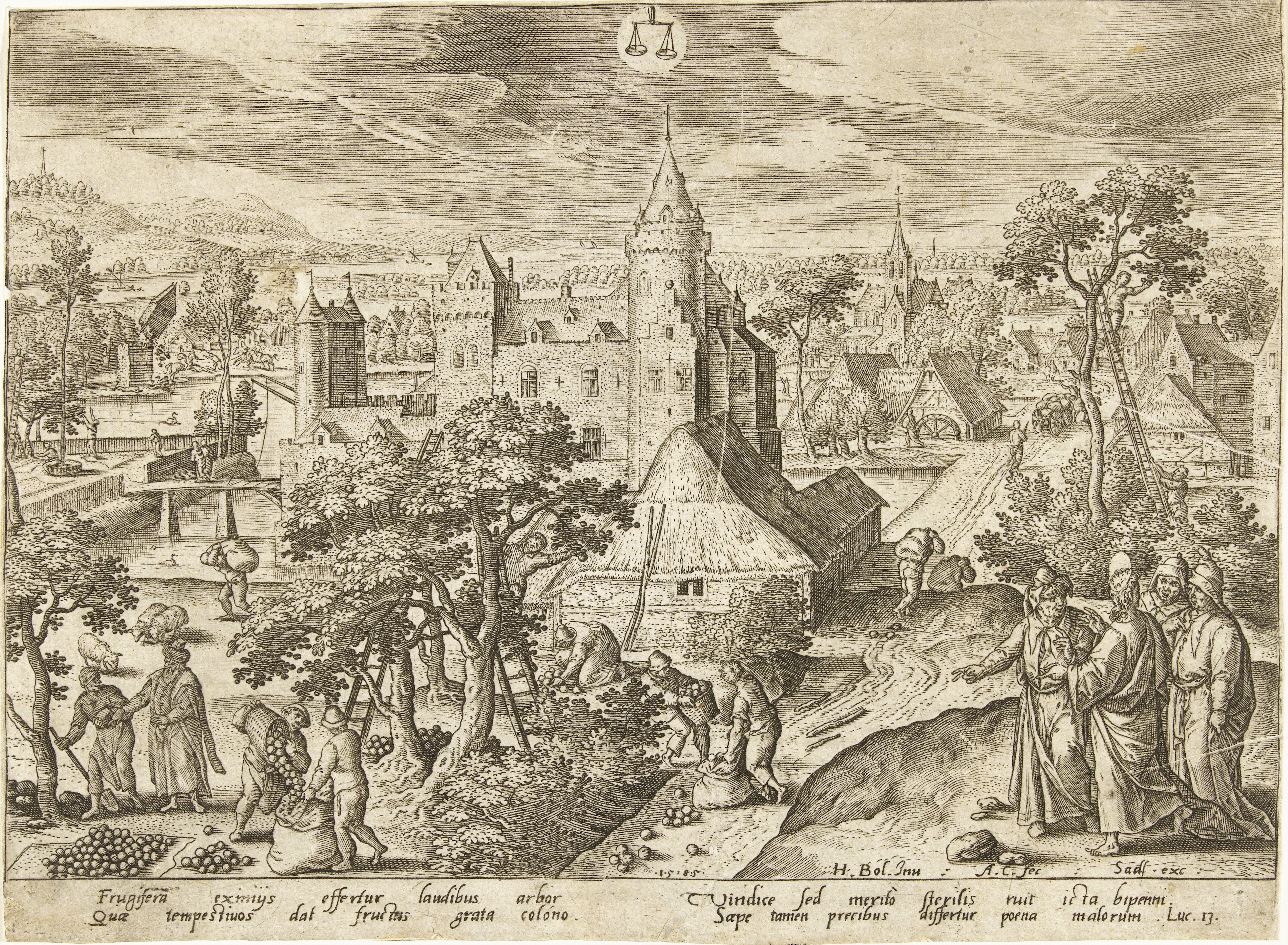
One particular print image is widely held, however (I located seven in a brief survey of museum collections on the internet).  This is a late sixteenth-century printed image made by Adriaen Collaert, following a design by Hans Bol.  It comes from a series of the twelve months produced by the same team.  This format seems to have been quite a popular item in the late sixteenth- and seventeenth centuries in the Low Countries (today's Holland and Belgium).  It harkens back to the labors of the months from the calendar pages found in medieval prayer books.  But in these examples, the labors of the months relate to biblical passages.  

Adriaen Collaert after Hans Bol, Parable of the Barren Fig Tree
From Emblemata Evangelica ad XII Signa Coelestia Sive
Flemish, 1585
Amsterdam, Rijksmuseum

So, for instance, the harvest and preparation for the coming year are associated with the story of the landowner and his gardener, who stand at the left of the image.  Meanwhile, all around them the other farm workers are collecting the abundant harvest of the other trees, filling bags with the crop and carrying them off.  Sheep are seen grazing peacefully and all seems at peace in the background.  That is until one notices that in the deep background, straight above the figures of the owner and the gardener as they confer over the barren tree, is a scene of warfare in which riders on horseback are shown with lances directed at figures who flee from them, while other figures, presumably dead or wounded lie around the base of a tower which is shown at the instant of collapse.  

Adriaen Collaert after Hans Bol, Parable of the Barren Fig Tree
Detail - Upper Left 
From Emblemata Evangelica ad XII Signa Coelestia Sive
Flemish, 1585
Amsterdam, Rijksmuseum

 Jesus stands at the far-left side of the page discussing with the Pharisees as he tells them these two stories. 

Adriaen Collaert after Hans Bol, Parable of the Barren Fig Tree
Detail - Lower Right
From Emblemata Evangelica ad XII Signa Coelestia Sive
Flemish, 1585
Amsterdam, Rijksmuseum

Below the engraving is a Latin commentary on this Gospel passage from Luke (Luke 13, above) which reads in translation:

“The super-fruitful tree which in season yields fruit pleasing to the farmer is praised; the barren tree is deservedly cut down with an ax to be sold; but often the punishment of evil men may be deferred by prayers.” (My translation)


Other visualizations of this Gospel passage do exist, though none is as complete and defined as this one.  Some, like the Collaert engraving include parts of the Gospel of Luke that are described in the same chapter 13, such as the falling tower or the healing of the bent woman.  

Jean Bondol and Others, The Blood of the Galileeans is Mingled with that of Their Sacrifices and the Owner Discusses the Fig Tree with the Gardener
From Grande Bible Historiale Completé
French (Paris), c. 1371-1372
The Hague, Meermano Museum
MS MMW 10 B 23, fol. 502v


Claes Brouwer and Others, Miracle of the Woman Bent Over and Parable of the Barren Fig Tree
From a History Bible
Dutch (Utrecht), c. 1430
The Hague, Koninklijk Bibliotheek
MS KB 78 D 38,II, fol. 170r


Master of Edward IV, Jesus Describing the Parable of the Fig Tree to the Pharisees and the Disciples
From Vita Christi by Ludolf of Saxony
Flemish (Bruges), c. 1487-1490
New York, Pierpont Morgan Library
MS M 894, fol. 219v
Here the parable itself is relegated to a small vignette just above the outstretched arm of Jesus.  The foreground and sides are filled with the Pharisees and the Disciples to whom Jesus is telling the story.


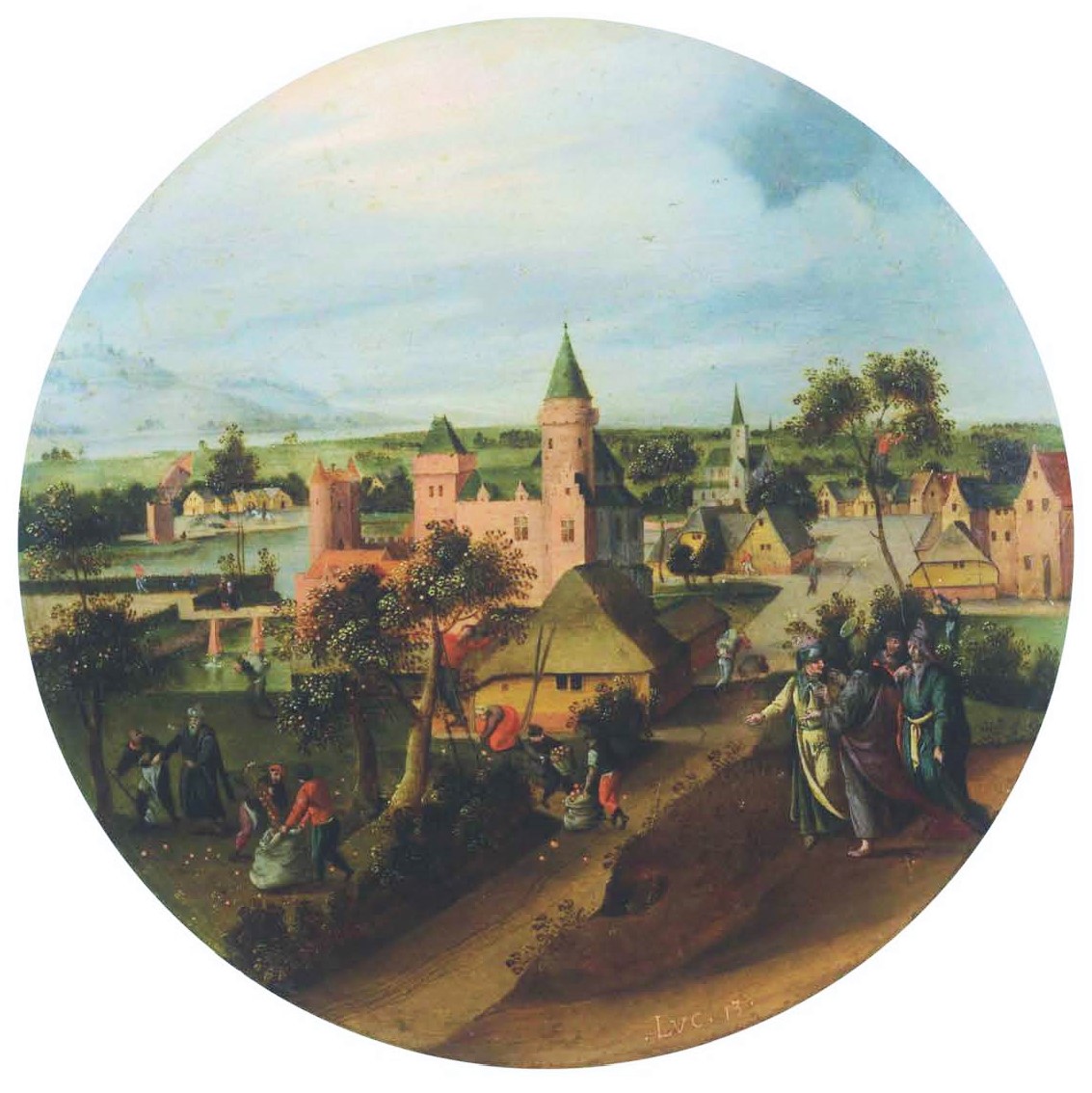
Some, like the two paintings by Abel Grimmer shown below, are modeled on the widely circulated Adriaen Collaert print already discussed.  Grimmer apparently copied in paint the series of twelve months and did it several times over.

Abel Grimmer, September, The Parable of the Sterile Fig Tree
Flemish, c. 1600
Private Collection


Abel Grimmer, September with the Parable of the Barren Fig Tree
Flemish, 1611
Private Collection


The seventeenth century Flemish engraver Nicolas Cochin also borrowed the composition of the Collaert/Bols print for his own, simplified, version.  His debt to the Collaert/Bols print is obvious, although he did not include the details of the falling tower and slaughtered people.  


Nicolas Cochin, Parable of the Fig Tree
From a Set of Twelve Parables
Flemish, 1672
Nancy, Museum of Fine Arts


In addition, the text on his print is a direct quotation of the words of the landowner from the Vulgate Gospel of Luke.  It reads:  "Ecce anni tres sunt ex quo venio quarens fructum in ficoluca hac, et non invenio, succide ergo illam, ut quid exiam terram occupat." Or in English "Behold, for three years I have come seeking fruit on this fig tree and I find none. Cut it down therefore. Why should it encumber the ground?" (Luke 13:7) (Slightly modernized quotation from the Douai-Reims Bible.) 1

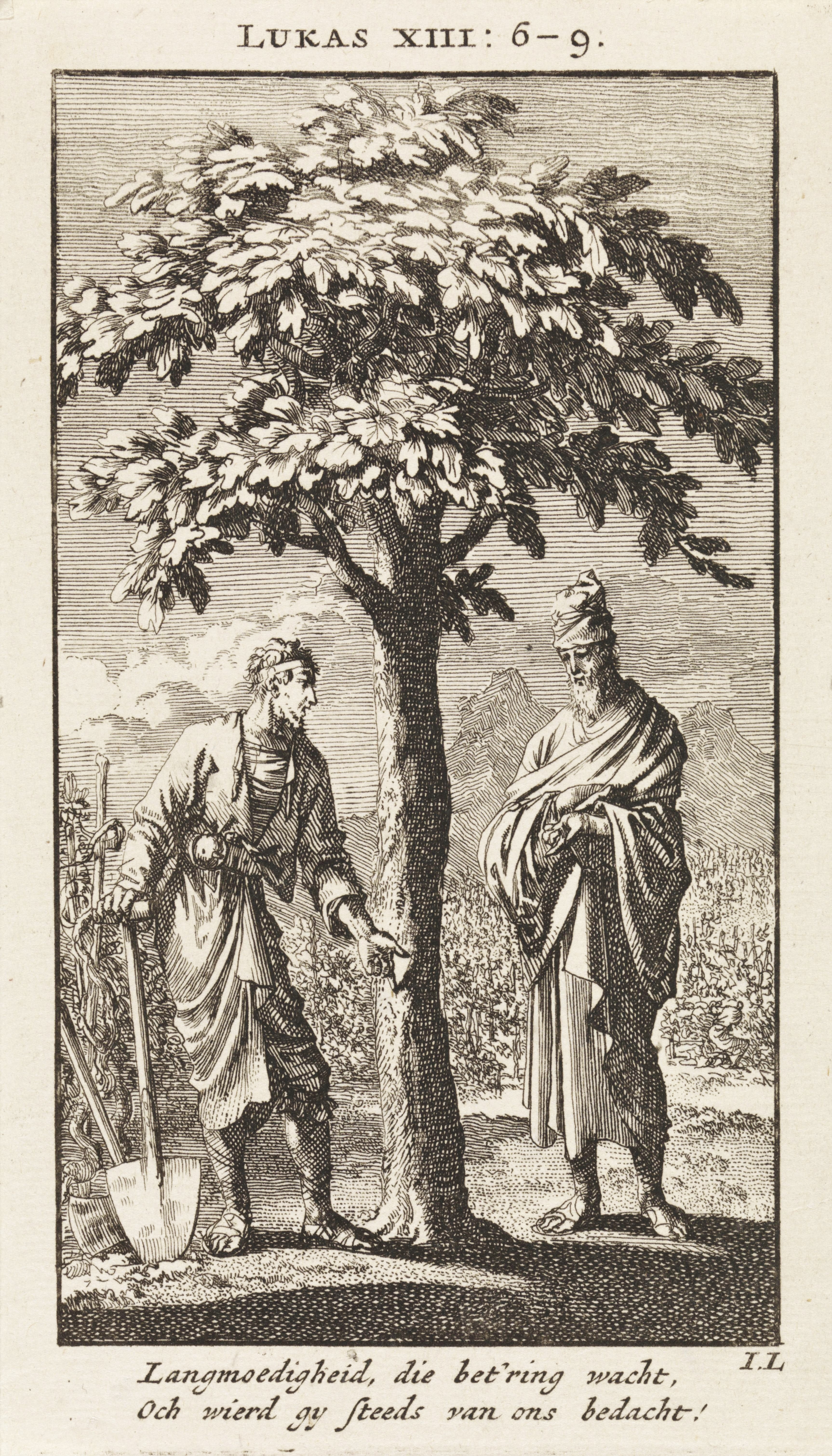
Others, especially those dating from the eighteenth century and later, reduce the field of vision only to the parable of the landowner and the gardener.   See especially the early eighteenth century prints of the Dutch engraver, Jan Luyken, all done within a handful of years and, although obviously related, subtly different from each other. 

Jan Luyken, Parable of the Barren Fig Tree
From Historiae Celebriores Veteris Testamenti by Christoph Weigel
Dutch, 1708
Amsterdam, Rijksmuseum


Jan Luyken, Parable of the Barren Fig Tree
From a Bible
Dutch, 1712
Amsterdam, Rijksmuseum
This print includes a highly colloquial verse.  The meaning  can be translated very roughly as "You wait patiently for us to improve.  O, that we remembered you!" "You" being, of course, God.

Jan Luyken, Parable of the Barren Fig Tree
From The Scriptural Histories and Parables of the Old and New Covenants
Dutch, 1712
Amsterdam, Rijksmuseum


These appear in increasingly naturalistic surroundings until, by the end of the nineteenth century, they are totally realistic. 

Carl Rahl, The Parable of the Barren Fig Tree
Austrian, c. 1850
Vienna, Belvedere Museum


James Tissot, The Vine Dresser and the Fig Tree
French, c. 1886-1894
New York, Brooklyn Museum


Until at the beginning of the twentieth century abstraction again entered the world of narrative art.  

The Parable of the Barren Fig Tree
Irish, 20th century
Dungarvan, Waterford, Ireland

© M. Duffy, 2022

1. Translation from the Douay-Rheims Latin Vulgate Bible found at https://vulgate.org/douay-rheims.htm


Lectionary for Mass for Use in the Dioceses of the United States, second typical edition, Copyright © 2001, 1998, 1997, 1986, 1970 Confraternity of Christian Doctrine. All rights reserved.