Showing posts with label Assisi. Show all posts

Tuesday, October 4, 2011

St. Francis of Assisi

Giotto ?, Sermon to the Birds
Italian, 1297-1300
Assisi, Basilica of St. Francis, Upper Level
A bout of something very much resembling the flu has prevented me from doing the research for the full-length essay on the iconography of St. Francis, which I had planned. But St. Francis is such an important and beloved saint that I can’t let his feast day pass without some acknowledgment. So, I will just point you to the extensive series of frescoes painted, shortly after his death, in the upper church of the basilica in his honor at Assisi.

The story of St. Francis is relatively well known. Perhaps no saint in the history of the Christian Church in the West has been so influential, so beloved, so misunderstood. From his own time to the present he has been made the subject of legends and stories. He has even been the subject of several movies. He is the goofy saint who talks to animals, the holy fool, the proto-hippie, sometimes seen as slightly mad. Yet, in reality his story and his joyful attempt to imitate Christ by a life of poverty, humility and service to the poor, is the spark that has ignited many souls to search for God and spend their own lives in serving the poor.

The Young Francis Receives a Vision While Praying
Italian, 1297-1300
Assisi, Basilica of St. Francis, Upper Level
The outlines of his real life story are fairly well known. Francesco Bernadone was born in the Umbrian town of Assisi in 1182 into a family of merchants. As a youth he had a fairly privileged and sheltered life. During a period of illness in 1205 he underwent the beginnings of a conversion to a more spiritual life and began to try to serve the poor.

Following his understanding of the message he had received in a vision, Francis sold some of his father’s stock of cloth to begin the task of rebuilding a ruined church on the outskirts of their town. His father was, understandably, angry about this and the ensuing battle of wills led Francis to renounce all worldly possessions and attachments, even the clothing he wore.


Francis Renounces Worldly Possessions
Italian, 1297-1300
Assisi, Basilica of St. Francis, Upper Level
 Attired in garments he acquired by begging, Francis began his life of total poverty, begging his clothing, food and the building materials with which he repaired various local churches. He also began to preach the joy of poverty and service in imitation of Christ and to attract other men to follow him.

In 1209 he drew up a simple rule for his “friars” and requested Papal approval. Pope Innocent III eventually agreed and in 1210 the Franciscan Order of Friars Minor was recognized by the Church.

The Rule is Confirmed by Pope Innocent III
Italian, 1297-1300
Assisi, Basilica of St. Francis, Upper Level

With St. Clare of Assisi he also founded the order of women that became known as the Poor Clares. Later, for those who wanted to associate themselves with him and his ideas he founded the Third Order for ordinary people not able or willing to leave their secular lives. All three orders still exist to this day. They have also sprouted a sometimes bewildering group of branches as well. In addition to several different Catholic sets of Franciscan friars and sisters there are Anglican and other Protestant Franciscans.

Giotto ?, St. Francis Receives the Stigmata,
Italian, 1297-1300
Assisi, Basilica of St. Francis, Upper Level
Francis is the first known person to receive the Stigmata, the visible wounds of Christ. He died on October 3, 1226 and was formally canonized two years later.

 That same year, 1228, a magnificent two-level basilica in his honor was begun in his hometown of Assisi. It was consecrated in 1253.

Near the end of the century the upper church was decorated with frescoes depicting the life of Francis and some of the legends that had already arisen in the 70 years since his death.


St. Francis Prepares the First Christmas Crib at Greccio
Italian, 1297-1300
Assisi, Basilica of St. Francis, Upper Level
 A number of artists were engaged in the decoration, including the Roman Jacopo Torriti and the Florentine Cimabue and his pupil, Giotto. Attribution of the frescoes is disputed, but many have seen in them the first works of Giotto.

Although severely damaged in an earthquake in 1997 (when four people were killed during an aftershock), the basilica and the frescoes have been repaired and the basilica was designated a UNESCO World Heritage Site in 2000 (http://whc.unesco.org/en/list/990/).

Francis’ greatest legacy, of course, is not the building in Assisi nor the frescoes that decorate it nor the other works of art inspired by his story, but the good done by the countless men and women who, over the last 800 years, have followed in his footsteps.

Father,
you helped Saint Francis to reflect the image of Christ
through a life of poverty and humility.
May we follow your Son
by walking in the footsteps of Francis of Assisi,
and by imitating his joyful love.
Grant this through our Lord Jesus Christ, your Son,
who lives and reigns with you and the Holy Spirit,
one God, for ever and ever. Amen.
(Memorial Prayer from Morning Prayer in the Liturgy of the Hours for Feast of St. Francis of Assisi, October 4)

© M. Duffy, 2011

Tuesday, June 14, 2011

Living on a layer cake

Largo Argentina, Rome
One of the things I love best about long occupied cities is the thought that one is walking around on top of a human layer cake. Unseen under your feet are the remains of other humans and earlier civilizations. I was reminded about this again with the arrival of an e-mail from the Archaeological Institute of America, which included an article on a recently discovered Roman villa under a building at Assisi.
Read it here Assisi's Roman Villa - Archaeology Magazine
Largo Argentina, Rome (alternate view)


One of my favorite places in Rome is a small excavated area at Largo Argentina, where while waiting for the bus you can look down on Roman remains. There are four Roman temples and part of Pompey's Theatre down just a few feet below contemporary ground level. 


Although lower Manhattan does have underground remains, some of which were recently exposed when an 18th century ship was uncovered, one doesn't usually see them and they most definitely are not as impressive. 


Diagram showing relationship of (from bottom to top)
the Circus of Nero, Old St. Peter's Basilica and
the current basilica.  The boundary wall shown at the top
of the Circus, was the boundary wall of the cemetery
containing the grave on which both basilicas were built.
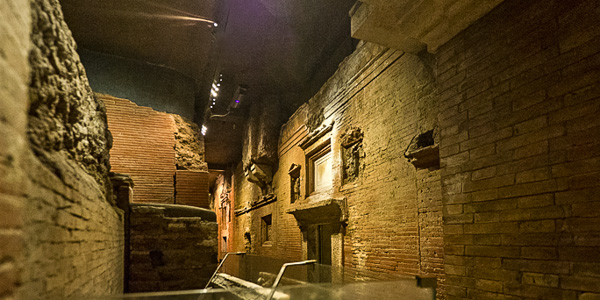
And, one of the most interesting elements in Rome are the layer cake churches.  St. Peter's is probably the most famous.  It sits on top of the remains of the original basilica, built on the orders of Constantine in the 4th century and incorporated into the "new" St. Peter's, built in the 16th century.  Constantine's building, in turn, sits on top of a Roman cemetery dating to the 1st century, which contains the remains of both pagan Roman and early Christian burials, including that of St. Peter. 

When walking in that cemetery (which is rather like walking through the mausoleum section of a modern cemetery) it is astonishing to think that above you are two large churches, and that the top of the two is the largest church in the world.
Portion of the necropolis underneath St. Peter's basilica

Rome has other churches similarly layered, among them:  San Clemente, Santa Cecilia in Trastevere, San Crisogono.  All are built over early Christian places of note.
Life of St. Clement
Italian, 12th century
Rome, San Clemente
Fresco from underground portion of
San Clemente


All are well worth a visit.  And they are eloquent reminders of the continuity and survival of the Catholic faith from the first century to the 21st.   They remind us of the history that has come and gone in that time and the often hostile events the Church has endured:  the Roman Empire, the Barbarian Invasions, hostile medieval kings and emperors, the Avignon years, the Great Schism, the Reformation, the Enlightenment, the Industrial Revolution, Fascism, Communism.  As Jesus promised, the gates of hell have not prevailed, nor will they, for He is with us till the end of the world.