A Happy and Blessed Easter season to all! The Lord is Risen!
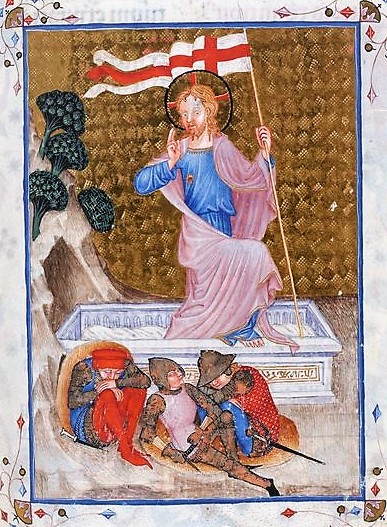
This will be an interruption to my series of postings on the issue of the identification of the figure seated to the Jesus' left in the DaVinci Last Supper. But I just couldn't resist an image I recently found of the Resurrection. It definitely caused me to smile when I found it and I would like to share it with you.
Several years ago I wrote a series of essays for this blog regarding the iconography of the Resurrection. (See postings for April and May 2011 in the panel at the right of this web page.) One of the essays was entitled Climbing From the Tomb. In it I described one of the earliest depictions of the actual event of the Resurrection. In this somewhat awkward and static treatment of the subject artists showed Jesus literally climbing from the grave. It was superseded as time went on my more dynamic images as Jesus first hovered over, then finally burst from, the tomb.
This year, while trawling the growing body of images available on the internet from institutions around the world, I came across an image in a manuscript preserved here in New York at the Morgan Library. It is a curious composition, more awkward than any that formed part of my original group of images of climbing.
The manuscript is a Book of Hours, a medieval prayer book used mostly by the laity and often illustrated lavishly. This particular book was painted in Paris in the last few decades of the fifteenth century.
The image in question clearly derives from the image of the Man of Sorrows (about which I also wrote in 2012). The artist has modified a fairly standard image of the Man of Sorrows, that is Jesus shown in a state, sometimes dead and sometimes half awake, emerging half way from the tomb to display His wounds. He has modified the gesture of Jesus toward the wound in His side into a gesture of blessing and covered the other hand in drapery. The amusement enters when we see how he has introduced the "climbing" element. He has added a curiously disembodied leg to the outside of the tomb. It has no real relationship to the body of Jesus, except that provided by a swirl of drapery. Its position is not one that is realistic in any sense of the word. It's merely a sort of pasted on addition to an already familiar pose. Seeing it shows that the painters of the other images I wrote about in 2011 were obviously more advanced in their ability to present a believable figure than the illuminator who prepared this book.
The derivation of this particular image in the Morgan Book of Hours is not surprising when you notice that this book (available for viewing on the Morgan website (here) has more images of the Man of Sorrows than I have ever seen. Obviously, the illuminator was comfortable with this particular image and it colored every image where it could be used. Indeed, even his many images of Christ in other situations are basically modifications of the same pose. He appears to have had one basic image that he used over and over and over in this Book of Hours.
This will be an interruption to my series of postings on the issue of the identification of the figure seated to the Jesus' left in the DaVinci Last Supper. But I just couldn't resist an image I recently found of the Resurrection. It definitely caused me to smile when I found it and I would like to share it with you.
Several years ago I wrote a series of essays for this blog regarding the iconography of the Resurrection. (See postings for April and May 2011 in the panel at the right of this web page.) One of the essays was entitled Climbing From the Tomb. In it I described one of the earliest depictions of the actual event of the Resurrection. In this somewhat awkward and static treatment of the subject artists showed Jesus literally climbing from the grave. It was superseded as time went on my more dynamic images as Jesus first hovered over, then finally burst from, the tomb.
This year, while trawling the growing body of images available on the internet from institutions around the world, I came across an image in a manuscript preserved here in New York at the Morgan Library. It is a curious composition, more awkward than any that formed part of my original group of images of climbing.
_1485-1496_Morgan_H3_199r.jpg) |
| Resurrection of Jesus from Book of Hours French (Paris), 1485-1495 New York, Morgan Library MS H3, fol. 199r |
The image in question clearly derives from the image of the Man of Sorrows (about which I also wrote in 2012). The artist has modified a fairly standard image of the Man of Sorrows, that is Jesus shown in a state, sometimes dead and sometimes half awake, emerging half way from the tomb to display His wounds. He has modified the gesture of Jesus toward the wound in His side into a gesture of blessing and covered the other hand in drapery. The amusement enters when we see how he has introduced the "climbing" element. He has added a curiously disembodied leg to the outside of the tomb. It has no real relationship to the body of Jesus, except that provided by a swirl of drapery. Its position is not one that is realistic in any sense of the word. It's merely a sort of pasted on addition to an already familiar pose. Seeing it shows that the painters of the other images I wrote about in 2011 were obviously more advanced in their ability to present a believable figure than the illuminator who prepared this book.
The derivation of this particular image in the Morgan Book of Hours is not surprising when you notice that this book (available for viewing on the Morgan website (here) has more images of the Man of Sorrows than I have ever seen. Obviously, the illuminator was comfortable with this particular image and it colored every image where it could be used. Indeed, even his many images of Christ in other situations are basically modifications of the same pose. He appears to have had one basic image that he used over and over and over in this Book of Hours.