Saturday, January 14, 2017

The Flight into Egypt -- The Holy Refugees, The "Simple" Images (Part I of a Series)

Giotto, The Flight into Egypt
Italian, c. 1304-1306
Padua, Arena/Scrovegni Chapel

I recently wrote an essay on the iconography of the Massacre of the Innocents,1 a now neglected portion of the Christmas story, which follows directly after the passage below concerning the Magi or Wise Men and the warnings God sent by way of dreams to them and to Saint Joseph:

“… the star that they had seen at its rising preceded them, until it came and stopped over the place where the child was.

They were overjoyed at seeing the star, and on entering the house they saw the child with Mary his mother.

They prostrated themselves and did him homage. Then they opened their treasures and offered him gifts of gold, frankincense, and myrrh.  

And having been warned in a dream not to return to Herod, they departed for their country by another way.

When they had departed, behold, the angel of the Lord appeared to Joseph in a dream and said, “Rise, take the child and his mother, flee to Egypt, and stay there until I tell you. Herod is going to search for the child to destroy him.”

Joseph rose and took the child and his mother by night and departed for Egypt.
He stayed there until the death of Herod, that what the Lord had said through the prophet might be fulfilled, “Out of Egypt I called my son.”

Matthew 2:9-15


This portion of the Christmas story has also been subject to a kind of general amnesia.  We tend to stop with the Magi offering their gifts to the Child and forget to mention the warnings and the journeys they provoked.  The Wise Men receive a warning and return to their own country “by another way”.  Joseph gets up in the middle of the night and bundles Mary and Jesus up to flee to Egypt.


The Dream of the Magi
From a Psalter
English (Oxford), 1st quarter of 13th Century
London, British Library
MS Royal 1 D X, fol. 2v
 

These lines should have particular resonance in our own day, when sudden changes to travel plans can be caused by troubles in the places to which we had intended going and when millions of the world’s people have become refugees, fleeing war and threats to their lives, bringing with them little but the clothing on their backs and on those of their innocent, bewildered children. 

The Biblical amnesia that affects this episode of the Infancy of Jesus is now pretty well established, but it wasn’t always like this.  Images of the warnings to the Magi and to Joseph and of the Holy Family as refugees pervade the history of western art.   In fact, there are so many images of the “Flight into Egypt” and of the related subject of the “Rest on the Flight into Egypt” that it amused me when I was a student.  It seemed that every other slide discussed in my classes on Renaissance and Baroque arts was of one of the two subjects. 

 The Flight into Egypt began to appear in western art during the Middle Ages.  One of the earliest images I have found comes from the Moone High Cross, originally from the monastery founded there in the 6th century by Saint Colmcille.


The Flight into Egypt
From the Moone High Cross
Irish, 8th Century
Moone, Co. Kildare


The image is simple and direct.  It may derive from images seen in manuscripts imported into Ireland from Byzantium and North Africa (more recent history has obscured the fact that Ireland, in its position on the main north/south sea route along the western edge of Europe, was not as isolated in antiquity and the middle ages as it later became and had trading links with the far reaches of the Mediterranean, as well as with its nearer Atlantic neighbors, France, Spain and Scandinavia). 

In general, the images associated with the Flight into Egypt fall into several distinct categories.  I’ve broken them down below.


The “Simple” Image of the Flight
In the main, the iconography of the Flight into Egypt remained remarkably consistent throughout history.   The primary image is of Mary, carrying Jesus, sitting on a donkey, usually led by Saint Joseph.  Occasionally, Mary may be seen as walking instead of riding.  Very occasionally Joseph may carry the Child.  Additional variations occur through the introduction of one or more angels who assist in guiding the family, sometimes leading the donkey instead of Joseph, who then usually follows.  Occasionally, additional human figures appear, either as fellow travelers or as onlookers.

These “simple” images form the major part of the iconography.

The Flight into Egypt
Italian Ivory, End 11th-Beginning 12th Centuries
Salerno, Diocesan Museum


The Flight into Egypt
Swiss, 12th Century
Zillis, Church of St. Martin


Gislebertus, The Flight into Egypt
French, c. 1120s
Autun, Cathedral of St. Lazare


The Flight into Egypt
Originally from the basilica of Saint Denis
French, c.1145
Bryn Athyn, PA, Glencairn Museum


Attributed to Theodore Apsevdis, The Flight into Egypt
Byzantine, c. 1183
Cyprus Monastery Church of St. Neophytos


Bonanno Pisano, The Flight into Egypt
Italian, after 1187
Pisa, Museo dell'Opera del Duomo


The Flight into Egypt
From a Vita Christi
English (York), c.1190
Los Angeles, J. Paul Getty Museum
MS 101, fol. 44v


The Flight into Egypt
Italian (Apulia), c. 1196-1205
San Vito dei Normanni, Church of San Biagio


Nicolas of Verdun, The Flight into Egypt
From the Shrine of the Virgin
Mosan, 1205
Tournai. Cathedral Treasury


The Flight into Egypt
French, c.1240
Beauvais, Cathedral


The Flight into Egypt
From a Psalter-Book of Hours
Belgian (Liege), c.1250-1300
The Hague, Koninklijk Bibliotheek
MS KB 76 17, fol. 32v


The Flight into Egypt
 from the Liber de ortu beatae mariae et infantia salvatoris
Italian (Rome), c.1275-1300
Paris, Bibliotheque nationale de France
MS Latin 2688, fol. 4r


The Flight into Egypt
Central Leaf from a Polyptych
French, 14th Century
New York, Metropolitan Museum of Art
Very interesting in this ivory are the remains of the colors that were once applied to it  There are touches of red in the cross of the nimbus around the head of the infant Jesus and in the reins of the donkey held by Saint Joseph and rose on the lips of Mary and Joseph.  There are also traces of green in the incised marks that have retained some of the color that once adorned the landscape, remains of deep blue pigment under Mary's chin and touches of gold throughout.  These traces suggest that the ivory was once highly colored.


Duccio, The Flight into Egypt
Italian, c. 1308-1311
Siena, Museo dell'Opera del Duomo


Giotto and Assistants, The Flight into Egypt
Italian, c. 1315-1320
Assisi, Basilica of San Francesco, Lower Church


The Flight into Egypt
One of 27 Scenes from the Altarpiece of the Life of Christ  from the Monastery of St. Clare
 German (Cologne), c.1370-1380
Cologne, Wallraf-Richartz-Museum & Fondation Corboud


Master of the Coronation of the Virgin, The Flight into Egypt
From a Book of Hours Fragment
French (Paris), c. 1395-1415
New York, Pierpont Morgan Library
MS M1068, fol. 6r


Boucicaut Master, The Flight into Egypt
from the Hours of Jeanne Bessonnelle
French (Paris), c.1400-1425
Paris, Bibliotheque nationale de France
MS Latin 1161, fol. 87r


Conrad von Soest, The Flight into Egypt
German, c.1400
Paderborn, Episcopal Diocesan Museum and Cathedral Treasury


Lorenzo Monaco, The Flight into Egypt
Italian, c. 1405-1410
Altenburg, Lindenau-Museum


Paolo Schiavo, The Flight into Egypt
Italian, Late 1420s-Early 1430s
Philadelphia, Museum of Art


Masters of the Delft Grisailles, The Flight into Egypt
From a Book of Hours
Dutch (Delft), c.1440
The Hague, Koninklijk Bibliotheek
MS KB 135 E 23, fol. 60v


Hans Strigel The Elder, The Flight into Egypt
German, c.1450
Zell, Catholic Church of St. Bartholomew


Fra Angelico, The Flight into Egypt
Panel from the Armadio degli Argenti
Italian, c. 1451-1452
Florence, Museo di San Marco


Cosimo Tura, The Flight into Egypt
Italian, c.1470s
New York, Metropolitan Museum of Art


Glass Roundel with The Flight into Egypt
German (Upper Rhineland), 1480-1490
New York, Metropolitan Museum of Art, The Cloisters Collection


Bernardino Butinone, The Flight into Egypt
Italian, 1485
Chicago, Art Institute


Jean Bourdichon, The Flight into Egypt
From the Hours of Frederic of Aragon
French (Tours), c. 1501-1504
Paris, Bibliotheque nationale de France
MS Latin 10532, fol. 158


Jan de Beer, The Flight into Egypt
Dutch, c. 1519-1527
Dublin, National Gallery of Ireland


Wolfgang Huber, The Flight into Egypt
 German, c. 1525-1530
Berlin, Gemaeldegalerie der Staatliche Museen zu Berlin


El Greco, The Flight into Egypt
Greco-Spanish, c.1570
Madrid, Museo del Prado


Bartolome Carducho, The Flight into Egypt
Spanish, c. 1600-1603
St. Petersburg, State Hermitage Museum


Giovanni Andrea Ansaldo, The Flight into Egypt
Italian, c. 1620s
Rome, Galleria Nazionale d'Arte Antica


Guido Reni, The Flight into Egypt
Italian, 1620
Bradford UK, Bradford Museums and Galleries


Alessandro Turchi, The Flight into Egypt
Italian, c. 1630-1633
Madrid, Museo Nacional del Prado


Francisco de Zurbarán, The Flight into Egypt
Spanish, Late 1630s
Seattle, Art Museum


Jean Tassel, The Flight into Egypt
French, c. 1640-1650
Rennes, Musee des Beaux-Arts


Sebastien Bourdon, The Flight into Egypt
French, c.1644
Paris, Musee du Louvre


Philippe de Champaigne, The Flight into Egypt
French, c.1650-1660
Senlis, Musee d'Art et d'Archeologie


Carlo Maratta, The Flight into Egypt
Italian, 1652
Stourhead, National Trust


Nicolas Poussin, The Flight into Egypt
French, c. 1657-1658
Lyon, Musée des Beaux-Arts 


Johann Hiebel, The Flight into Egypt
German, c. 1727-1731
Leitmeritz (CZ), Jesuit Church of the Annunciation


Noel Halle, The Flight into Egypt
French, 1759
Paris, Musée du Louvre


Josef Bayer, The Flight into Egypt
Austrian, 1830
Vienna, Belvedere Museum


Escape by Water

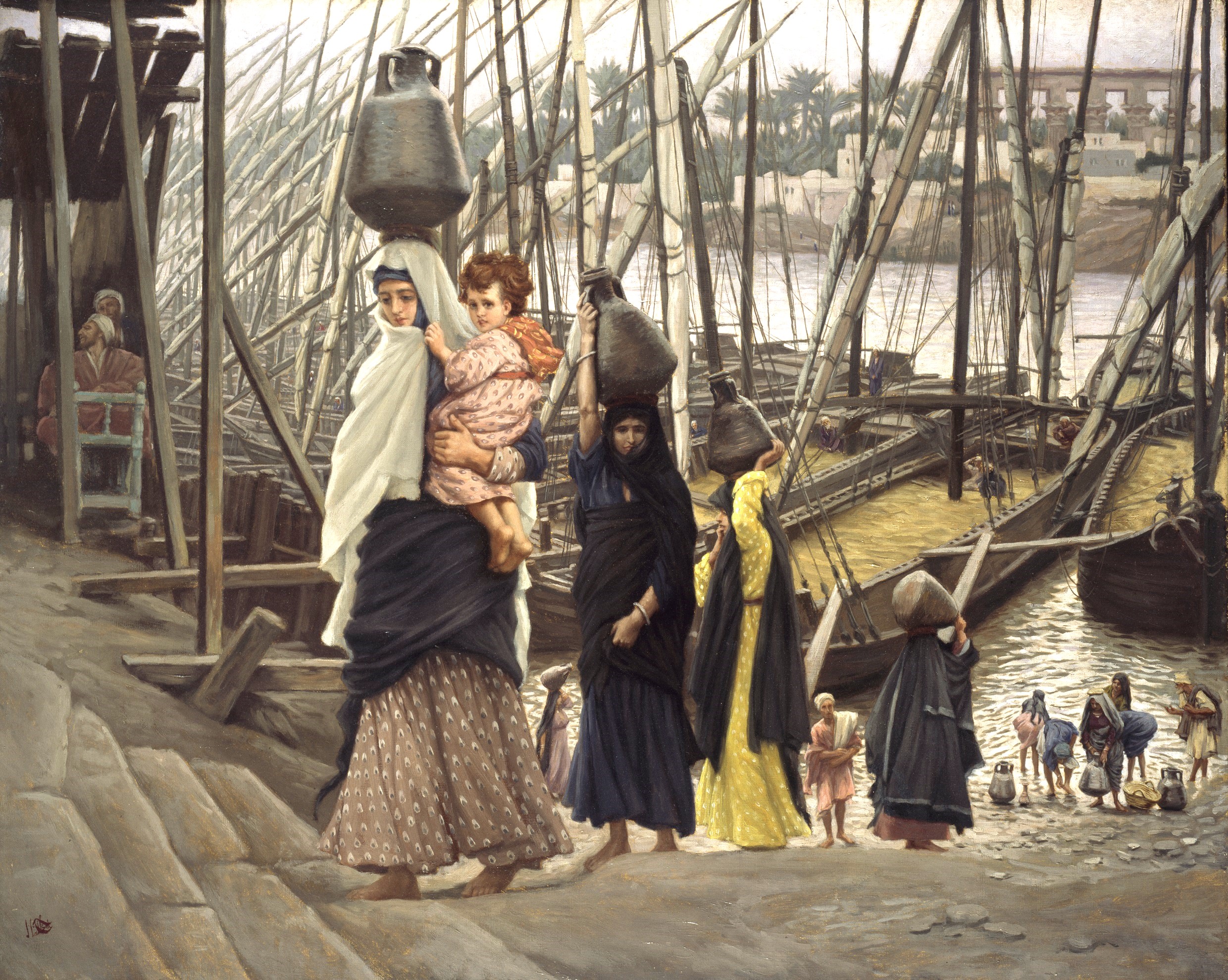
Virtually all the images of the flight into Egypt depict the Holy Family traveling by land, either on foot or with the aid of their trusty donkey.  However, a handful of images depict them making at least part of the journey by boat.  Presumably the body of water they are crossing by boat is the Red Sea or the River Nile.  In either case, this may be a subtle reference to the crossing of these bodies by the ancient Israelites in their Exodus.  It would be an appropriate reference for the infant Jesus, who is the promised Savior, born to complete salvation history, the beginnings of which include the events of the Old Testament.


Luca Giordano, The Flight into Egypt
Italian, 1701
New York, Metropolitan Museum of Art


Follower of Giovanni Battista Tiepolo, The Flight into Egypt
Italian, c. 1750-1810
Amsterdam, Rijksmuseum


James Tissot, The Sojourn in Egypt
French, c. 1886-1894
Dublin, National Gallery of Ireland


To Continue the Story of the Iconography of the Flight into Egypt see

The Flight Into Egypt -- The Variations

 .
© M. Duffy, 2017, images updated 2024

  1. Massacre of the Innocents at http://imaginemdei.blogspot.com/2016/12/the-holy-innocents-nearly-forgotten.html

Scripture texts in this work are taken from the New American Bible, revised edition © 2010, 1991, 1986, 1970 Confraternity of Christian Doctrine, Washington, D.C. and are used by permission of the copyright owner. All Rights Reserved. No part of the New American Bible may be reproduced in any form without permission in writing from the copyright owner.


Tuesday, January 3, 2017

The Holy Name of Jesus

El Greco, Adoration of the Holy Name of Jesus
Greco-Spanish, Late 1570s
London, National Gallery
This is either a preparatory sketch or a reduced
copy of the painting which was commissioned by
Philip II for the Escorial.  It shows the Name of 
Jesus adored by the angels in heaven, the faithful
on earth, the souls in Purgatory and those in Hell.  
It may also refer to the Holy League of Spain, 
Venice and the Papal States, which defeated the
Turkish Fleet at Lepanto in 1571.  


In his letter to the Philippians Saint Paul includes what is generally accepted to be a very early Christian hymn in praise of Jesus:

“Who, though he was in the form of God,
did not regard equality with God something to be grasped.
Rather, he emptied himself,
taking the form of a slave,
coming in human likeness;
and found human in appearance,
he humbled himself,
becoming obedient to death, even death on a cross.

Because of this, God greatly exalted him
and bestowed on him the name
that is above every name,
that at the name of Jesus
every knee should bend,
of those in heaven and on earth and under the earth,
and every tongue confess that
Jesus Christ is Lord,
to the glory of God the Father.”

Philippians 2:6-11

In this hymn we are given an insight into what the earliest Christians, those who became Christians within the first 20-30 years following the Resurrection, believed about Jesus.  For His humility in accepting human form and human suffering in dying on the cross He was given “the name that is above every name” and on hearing this name the proper response of every knee “of those in heaven and on earth and under the earth” shall bend in homage.


That the name of Jesus is holy is, therefore, one of the very earliest Christian concepts.  Once upon a time, not so long ago, Catholics would quickly bow their heads when they heard the name of Jesus.  That little bit of reverence was blown away by the winds of change that hit the church following Vatican Council II and scarcely anyone does this anymore, not even among the older folks.


Looking at the artistic record, it seems that, in spite of the hymn quoted by Paul, it was not the name “Jesus” that first appeared in art, but symbolic representations of it.  The first, and probably best known, was the fish, since the first letters of the Greek word for fish are the same as the initials for the words “Jesus Christ”. 

Tombstone with Fish and Anchor Symbols
Stele of Licinia Amias
Roman Early Christian, 3rd Century
Rome, Epigraphical Museum. Terme di Diocleziano

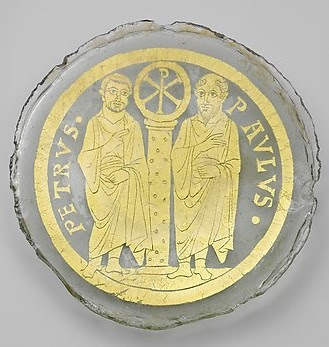
The second seems to have been the Chi Rho, a combination of the first two letters of the word “Christ” and, presumably, the sign which Constantine appears to have seen in his dream the night before his climactic battle with Maxentius.  It is often referred to as the “Christogram” and has had a very long run in Christian iconography, being still much used in church decoration.

Chi Rho
Central Panel of Sarcophgus of Anastasis
Roman Early Christian, c.350
Vatican City, Pio-Christiano Museum

Bowl Base with Saints Peter and Paul Flanking a Column with the Cristogram
Early Byzantine, Late 4th Century
New York, Metropolitan Museum of Art


Chi Rho, Fragment of a Lintel
Possibly Syrian, c. 400-550
New York, Metropolitan Museum of Art


Paten with Christogram and Repousse Border
Byzantine, c. 550
Washington, Dumbarton Oaks Research Library and Collection


However, there is another symbol which is more specifically related to the name “Jesus”, this sign also combined the first letter of the name with the first and last of the title “Christ” or Iesous Christos.  It could be written as IHC or IHS.  This is often called the Monogram of Jesus.  Over time the spelling IHS began to be more frequently used than the (probably) more correct IHC.  Frequently, a cross stroke was added to the up stroke of the letter "h" or the crossbar of the letter "H", depending on which form of the letter was used.

Monogram of Jesus
from Commentary and Prose Paraphrase on the Metamorphoses of Ovid
Italian (Milan), 1446
New York, Pierpont Morgan Library
MS M 938, fol.177r

Monogram of Jesus
from a Prayer Roll
English (Northwest), c. 1475-1499
New York, Pierpont Morgan Library
MS M 486, recto section 2


Giovanni di Paolo di Grazia, Saint Bernardino of Siena
Italian, c.1450
Trequanda, Confraternity of the Holy Trinity and Saint Bernardino


Its popularity began to increase, especially among the general European population in the latter years of the Middle Ages, especially through the preaching of the Franciscan friar, Saint Bernardino of Siena.  1

Saint Bernardino, who died in 1444 and was canonized in 1450, preached using an image of the monogram of the holy name surrounded by rays of light, as though the monogram is the sun, with the intention of promoting devotion to the Holy Name.  Suspicious of this seemingly new devotion and image, Bernardino was investigated by the Vatican.  After the examination not only was his preaching declared to be orthodox, but the pope, Pope Martin V, invited Bernardino to preach about this new devotion in Rome.   


Sano di Pietro, Saint Bernardino of Siena
Italian, c. 1450-1460
New York, Metropolitan Museum of Art, Lehman Collection


Andrea Mantegna, Monogram of Christ with Saints Anthony of Padua and Bernardino of Siena
Italian, 1452
Padua, Museo Antoniano
The inscription surrounding the Monogram of the Name of Jesus is the text from St. Paul "At the name of Jesus every knee should bow, in heaven, on earth and under the earth".

The devotion to the name of Jesus became very popular all over Europe and the image promoted by Saint Bernardino became very popular as decoration.  It was used in all sorts of ways, even to the extent of decorating pottery and making jewelry. 

Dish with IHS Monogram and Floral Pattern
Spanish (Valencia), c. 1430-1440
New  York, Metropolitan Museum of Art, the Cloisters Collection

Dish with IHS Monogram
Italian, (Faenza). c.1500
London, Victoria and Albert Museum


Raphael, Faith from a series of pictures of the Theological Virtues
Italian, 1507
Vatican City, Pinacoteca
The Monogram is held by the angel at the right.


Simon Bening, Border with Adoration of the Name of Jesus
from Prayer Book of Cardinal Albrecht of Brandenburg
Flemish (Bruges), c. 1525-1530
Los Angeles, J. Paul Getty Museum
MS Ludwig IX 19, fol. 32
This image shows the Monogram being venerated by the three divisions of the world mentioned by St. Paul; "in heaven and on earth and under the earth".


Philippe Galle, Adoration of the Name of Jesus
Belgian, c. 1557-1612
Madrid, Biblioteca Nacional de Espana
This engraving also shows the three divisions of the world offering adoration to the Holy Name.  It also includes the words from St. Paul's Letter.


Pendant with Monogram of Jesus
South German, Late 16th Century
Vienna, Kunsthistorisches Museum


Daniel Mytens, Aletheia Talbot, Countess of Arundel
Anglo-Dutch, c. 1618
London, National Portrait Gallery

I've included this portrait to show how such a jewel as the pendant above might be worn.  The Countess is wearing a diamond studded pendant in the form of the Monogram just below the pendant cross she wears.  

The Countess of Arundel and her husband the Earl of Arundel were recusant English Catholics at the time of King James I (that's the King James who authorized the most famous Protestant English translation of the Bible).  That the Countess wore a jewel with the Monogram of the Name of Jesus is a demonstration of her Catholic faith in the midst of a Protestant country.


El Greco, Adoration of the Name of Jesus
Greco-Spanish, c. 1578-1579
El Escorial, Monastery of San Lorenzo, Chapter House
Here, as in the smaller version which begins this essay, El Greco maintains adherence to the text of St. Paul's Epistle by including the three states of being which kneel to do homage to the name of Jesus:  those "in heaven and on earth and under the earth".  We see the Monogram of the Name of Jesus adored by the angels in heaven, by the Pope, the Doge of Venice and King Philip of Spain and other of the faithful on earth, by the souls in Purgatory, seen in the middle background on the right and by those held in the open mouth of Hell at the right. Some scholars see in this painting, both the Adoration of the Holy Name and a celebration of the victory of the Holy League formed by Spain, Venice and the Holy See over the Turks at Lepanto a few years before this was painted.

One hundred years later Saint Ignatius Loyola chose this image as the base for the symbol of his newly founded religious order, the Company of Jesus or Jesuits.  He added the three nails from the Crucifixion below the symbol, but it is basically the same monogram of the Holy Name that was preached by Saint Bernardino of Siena.  2

Juan Valdes de Leal, St. Ignatius Loyola Receiving
the Name of Jesus
Spanish, 1676
Seville, Museo de Bellas Artes


Juan de las Roelas, Adoration of the Name of Jesus
Spanish, c. 1604-1605
Seville, University Chapel
This visionary painting combines the Monogram with the Biblical event of the Circumcision, when Jesus officially received His name, with the Adoration of the angels and saints.


Guido Reni, Four Saints and Six Angels Adoring the Name of Jesus
Italian, 1st quarter of 17th Century
Paris, Musédu Louvre


Antoine Sallaert, Glorification of the Name of Jesus
Flemish, c. 1650
Private Collection


Baciccio, Adoration of the Name of Jesus
Italian, c. 1676-1679
Rome, Church of Il Gesu
Perhaps the grandest presentation of the Adoration of the Name of Jesus ever painted.  Done for the mother church of the Jesuit order.

Also included in this particular image of the Holy Name is often a reference to the Eucharist, the true Body of Christ under the form of bread that is the center of every Catholic Mass.  Because Saint Bernardino’s image of the Holy Name is similar to an image of the Holy Eucharist when exposed in a monstrance for Benediction or Eucharistic Adoration, the Hosts prepared for the celebration of the Eucharist and the altars on which the Hosts are offered are often also marked with the image of the Holy Name.  

Giovanni Maria Morlaiter, Altar with Adoration of the Holy Name of Jesus
Italian, 1735
Fratta Polesine (Veneto), Church of Saints Peter and Paul

A popular image from the end of the nineteenth century makes this relationship explicit.

Anonymous, Adoration of the Most Blessed Sacrament
 Printed by Pellerin & Cie. Printers, Paris
French, Fourth Quarter of 19th Century
Epinal, Muséde l'Image

The feast of the Holy Name of Jesus is celebrated on January 3rd by the Roman Catholic Church, and on other dates in early January by other Christian groups.

© M. Duffy, 2017
___________________________________________________________
  1. Maere, René. "IHS." The Catholic Encyclopedia. Vol. 7. New York: Robert Appleton Company, 1910. 2 Jan. 2017 .
  2. Pollen, John Hungerford. "St. Ignatius Loyola." The Catholic Encyclopedia. Vol. 7. New York: Robert Appleton Company, 1910. 2 Jan. 2017 .

Scripture texts in this work are taken from the New American Bible, revised edition © 2010, 1991, 1986, 1970 Confraternity of Christian Doctrine, Washington, D.C. and are used by permission of the copyright owner. All Rights Reserved. No part of the New American Bible may be reproduced in any form without permission in writing from the copyright owner.