,%20c.%201515-1525_Paris,%20BNF_MS%20NAL%2083,%20fol.%2018v.jpg) |
| Master of the Ango Hours, Saints Anne and Joachim with a Donor From a Prayer Book French (Rouen), c. 1515-1525 Paris, Bibliotheque nationale de France MS Nouvelle acquisition latine 83, fol. 18v |
Each year I have continued to add to the collection of images available through this blog as new ones become accessible. I link these images with the essays about their iconological type which I did in 2011. Just click on the section headings to be linked to the essays.
In addition, in the last several years I have identified new subjects within the general "Saints Anne and Joachim" theme. For example, five years ago I came across several images that fit into a new category that I called "Parental Love". Like pictures that imagine the life of Jesus as a boy in His home in Nazareth, these images imagine the relationship between Mary, as a little girl, and her parents.
This year I am adding two new categories. I call one, "The Story of Salvation" because it consists of all the apochryphal stories about Mary's birth and childhood as small images set around an image of the Annunciation. The other I call "The Death of Saint Anne" because that is what the images depict.
For the third year in a row I have found so many new images that I am overwhelmed. Consequently, I have chosen to include only a selection of these "new" images and will save the remainder for future years.
So, now I present the 2022 additions to the iconography of Saint Anne. Each section heading is also a link to the original article which explains the iconography. Click on the section headings to learn more.
So, now I present the 2022 additions to the iconography of Saint Anne. Each section heading is also a link to the original article which explains the iconography. Click on the section headings to learn more.
Please note that, due to personal health issues, there was no 2021 update.
Annunciation of Mary's Birth
,%20c.%201350+Paris,%20BNF_MS%20Francais%209561,%20fol.%20115.jpg) |
| Annunciation of the Birth of Mary to Saint Anne From Vies de la Vierge et du Christ Italian (Naples), c. 1350 Paris, Bibliotheque nationale de France MS Francais 9561, fol. 115r |
,%20c.%201350+Paris,%20BNF_MS%20Francais%209561,%20fol.%20116v.jpg) |
| Annunciation of the Birth of Mary to Saint Joachim From Vies de la Vierge et du Christ Italian (Naples), c. 1350 Paris, Bibliotheque nationale de France MS Francais 9561, fol. 116v |
,%20c.%201370-1380_Paris,%20BNF_MS%20NAF%2015940,%20fol.%2018v.jpg) |
| Master of the Livre du Sacre of Charles V and Workshop, Annunciation of the Birth of Mary to Saints Anne and Joachim From Speculum humanae salvationis French (Paris), c. 1370-1380 Paris, Bibliotheque nationale de France MS Nouvelle acquisition francaise 15940, fol. 18v |
,%201409_Paris,%20BNF_MS%20Latin%20919,%20fol.%2018r.jpg) |
| Jacquemart de Hesdin and Workshop, Annunciation of the Birth of Mary to Saints Joachim and Anne From Grandes heures de Jean de Berry French (Paris), 1409 Paris, Bibliotheque nationale de France MS Latin 919, fol. 18r |
,%201409_Paris,%20BNF_MS%20Latin%20919,%20fol.%208r.jpg) |
| Jacquemart de Hesdin and Workshop, Joachim's Offering Refused From Grandes heures de Jean de Berry French (Paris), 1409 Paris, Bibliotheque nationale de France MS Latin 919, fol. 8r |
,%20c.%201450+The%20Hague,%20Meermano%20Museum_MS%20RMMW%2010%20B%2034,%20fol.%203v.jpg) |
| Annunciation of the Birth of Mary to Saints Anne and Joachim From Speculum humanae salvationis German (Cologne), c. 1450 The Hague, Meermano Museum MS RMMW 10 B 34, fol. 3v |
,%201456_Par,%20BNF_MS%20Fran%209198,%20f%203v.jpg) |
| Jean le Tavernier, Annunciation of the Birth of Mary to Saint Joachim and Meeting at the Golden Gate From Miracles de Notre Dame by Jean Mielot Flemish (Oudenarde), 1456 Paris, Bibliotheque nationale de France MS Francais 9198, fol. 3v |
Meeting at the Golden Gate
,%20c.%201285-1290_Paris,%20BNF_NAF%2016251,%20fol.%2018v.jpg) |
| Master Henri, Saints Anne and Joachim From Livre d'Images de Madame Marie Flemish (Hainault), c. 1285-1290 Paris, Bibliotheque nationale de France MS Nouvelle acquisition francaise 16251, fol. 18v |
,%20c.%201350+Paris,%20BNF_MS%20Francais%209561,%20fol.jpg) |
| Meeting at the Golden Gate From Vies de la Vierge et du Christ Italian (Naples), c. 1350 Paris, BNF MS Francais 9561, fol. 117r |
,%201409_Paris,%20BNF_MS%20Latin%20919,%20fol.%2024r.jpg) |
| Jacquemart de Hesdin and Workshop, Meeting at the Golden Gate From Grandes heures de Jean de Berry French (Paris), 1409 Paris, Bibliotheque nationale de France MS Latin 919, fol. 24r |
 |
| Jean Dreux and Others, Meeting at the Golden Gate (with the Annunciation of Mary's Birth to Saint Joachim in the background) From Compendium historiae universalis Flemish, c. 1450-1460 The Hague, Meermano Museum MS MMW 10 A 21, fol. 66r |
,%20c.%201490_The%20Hague,%20KB_MS%20KB%2076%20F%2017,%20fol.%20111r.jpg) |
| Saints Joachim and Anne Meeting at the Golden Gate From a Book of Hours French (Paris), c. 1490 The Hague, Koninklijk Bibliotheek MS KB 76 F 17, fol. 111r |
The Birth of Mary
,%201323_The%20Hague,%20KB_MS%20KB%2078%20D%2040,%20fol.%20109r.jpg) |
| Petrus de Raimbaucourt, Infant Mary From a Missal French (Amiens), 1323 The Hague, Koninklijk Bibliotheek MS KB 78 D 40, fol. 109r |
,%20c.%201350+Paris,%20BNF_MS%20Francais%209561,%20fol.%20118v.jpg) |
| Birth of Mary From Vies de la Vierge et du Christ Italian (Naples), c. 1350 Paris, Bibliotheque nationale de France MS Francais 9561, fol. 118v |
,%20c.%201370-1380_Paris,%20BNF_MS%20NAF%2015940,%20fol.%2018v.jpg) |
| Master of the Livre du Sacre of Charles V and Workshop, Birth and Presentation of Mary From Speculum humanae salvationis French (Paris), c. 1370-1380 Paris, Bibliotheque nationale de France MS Nouvelle acquisition francaise 15940, fol. 18v |
,%201409_Paris,%20BNF_MS%20Latin%20919,%20fol.%2028.jpg) |
| Jacquemart de Hesdin and Workshop, Birth of the Virgin From Grandes heures de Jean de Berry French (Paris), 1409 Paris, Bibliotheque nationale de France MS Latin 919, fol. 28 |
,%20c.%201450_The%20Hague,%20Meermano%20Museum_MS%20RMMW%2010%20B%2034,%20fol.%204v.jpg) |
| Birth of the Virgin From Speculum humanae salvationis German (Cologne), c. 1450 The Hague, Meermano Museum MS RMMW 10 B 34, fol. 4v |
,%20c.%201485_Paris,%20BNF_MS%20Francais%206275,%20fol.%205v.jpg) |
| Master of Edward IV, Birth of the Virgin From Speculum humanae salvationis Flemish (Bruges), c. 1485 Paris, Bibliotheque nationale de France MS Francais 6275, fol. 5v |
.%20c.%201525_The%20Hague,%20Meermano%20Museum_MS%20RMMW%2010%20E%204,%20fol.%2085r.jpg) |
| Birth of Mary From a Prayer Book Flemish (Antwerp). c. 1525 The Hague, Meermano Museum MS RMMW 10 E 4, fol. 85r |
Presentation of Mary in the Temple
,%20c.%201350+Paris,%20BNF_MS%20Francais%209561,%20fol.%20119.jpg) |
| Presentation of the Virgin From Vies de la Vierge et du Christ Italian (Naples), c. 1350 Paris, Bibliotheque nationale de France MS Francais 9561, fol. 119 |
 |
| Master of the Livre du Sacre of Charles V and Workshop, Birth and Presentation of Mary From Speculum humanae salvationis French (Paris), c. 1370-1380 Paris, Bibliotheque nationale de France MS Nouvelle acquisition francaise 15940, fol. 18v |
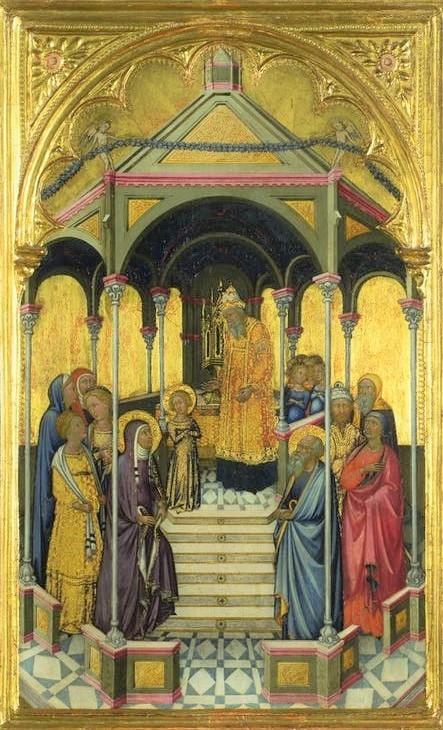 |
| Niccolo di Buonaccorso, Presentation of the Virgin Italian, 1380 Florence, Gallerie degli Uffizi |
,%20c.%201385-1390_Paris,%20BNF_MS%20Latin%2018014,%20fol.%20142v.jpg) |
| Pseudo-Jacquemart, Presentation of the Virgin From the Petites heures of Jean de Berry French (Bourges), c. 1385-1390 Paris, Bibliotheque nationale de France MS Latin 18014, fol. 142v |
,%20c.%201398-1430_Paris,%20BNF_MS%20Rothschild%202529,%20fol.%20312r.jpg) |
| Presentation of the Virgin From the Breviary of Martin of Aragon Spanish (Catalan), c. 1398-1430 Paris, Bibliotheque national de France MS Rothschild 2529, fol. 312r |
,%201409_Paris,%20BNF_MS%20Latin%20919,%20fol.%2031r.jpg) |
| Jacquemart de Hesdin and Workshop, Presentation of the Virgin From Grandes heures de Jean de Berry French (Paris), 1409 Paris, Bibliotheque nationale de France MS Latin 919, fol. 31r |
,%20c.%201485_Paris,%20BNF_MS%20Francais%206275,%20fol.%206v.jpg) |
| Master of Edward IV, Presentation of the Virgin From Speculum humanae salvationis Flemish (Bruges), c. 1485 Paris, Bibliotheque nationale de France MS Francais 6275, fol. 6v |
Saint Anne as Teacher, the Education of the Virgin
 |
| The Education of the Virgin From a Book of Litanies English, c. 1350-1400 Paris, Bibliotheque nationale de France MS Francais 400, fol. 38v |
,%2015th%20Century_Paris,%20BNF_MS%20NAL%203115,%20fol.%20187r.jpg) |
| The Education of the Virgin From a Book of Hours French (Paris), 15th Century Paris, Bibliotheque nationale de France MS NAL 3115, fol. 187r |
 |
| Workshop of the Bedford Master, Saint Anne and the Virgin as a Child From a Book of Hours French (Paris)m c, 1440-1450 Los Angeles, J. Paul Getty Museum MS Ludwig IX 6, fol. 223v |
 |
| Anonymous Bolognese Artist, The Education of the Virgin Italian, 17th Century London, Royal Collection Trust |
 |
| Jacques Callot, The Education of the Virgin, July 26 From Les Images de Tous les Saincts et Saintes de l'Annee French, 1636 New York, Metropolitan Museum of Art |
Saint Anne, the Root of the Tree of Salvation, Anna Selbdritt
,%20c.%201445-1460_Paris,%20BNF_MS%20Latin%209473,%20fol.%20182v.jpg) |
| Anna Selbdritt From Hours of Louis of Savoy French (Savoy), c. 1445-1460 Paris, Bibliotheque nationale de France MS Latin 9473, fol. 182v |
 |
| Anna Selbdritt German, c. 1475-1500 New York, Metropolitan Museum of Art |
 |
| Glass Roundel of Saint Anne with the Virgin and Child Flemish, c. 1480-1500 New York, Metropolitan Museum of Art, The Cloisters Collection |
 |
| Saint Anne with the Virgin and Child German, c. 1520 New York, Metropolitan Museum of Art |
 |
| Marcantonio Raimondi, Anna Selbdritt Italian, c. 1520 New York, Metropolitan Museum of Art |
 |
| Lorenzo Lotto, Holy Family with Saint Jerome Italian, 1534 Florence, Gallerie degli Uffizi |
 |
| Glass panel with the Arms of Pierre Babenberg with Anna Selbdritt amd Saint Joachim German, 1540 Paris, Musée du Louvre, Département des Objets d'art du Moyen Age, de la Renaissance et des temps modernes |
 |
| Attributed to Santi Bugioni, Anna Selbdritt with Saints Anthony Abbot and Anthony of Padua Italian, c. 1550 Paris, Musée du Louvre, Département des Sculptures du Moyen Age, de la Renaissance et des temps modernes |
 |
| Godfried Schalken, Holy Family with Saint Anne and an Angel Dutch, c. 1680-1685 Paris, Musée du Louvre |
Saint Anne as a Grandmother
 |
| Lucas Cranach the Elder, Saint Anne with the Virgin and Child German, Early 16th Century New York, Metropolitan Museum of Art |
 |
| Albrecht Duerer, Saint Anne with the Virgin and the Infant Christ German, c. 1500 New York, Metropolitan Museum of Art |
 |
| Lucas van Leyden, Madonna and Child with Saint Anne Dutch, 1516 New York, Metropolitan Museum of Art |
 |
| Workshop of Albert Cornelis, Virgin and Child with Saint Anne Flemish, c. 1520 London, National Gallery |
 |
| Shrine of Saint Anne and the Holy Kinship Flemish, Late 15th Century New York, Metropolitan Museum of Art, The Cloisters Collection |
 |
| Israhel van Mechkenem, Holy Family with Saints Anne and Joachim German, Late 15th Century New York, Metropolitan Museum of Art |
Parental Love
,%201409_Paris,%20BNF_MS%20Latin%20919,%20fol.%2037r.jpg) |
| Jacquemart de Hesdin and Workshop, The Young Mary with her Parents From Grandes heures de Jean de Berry French (Paris), 1409 Paris, Bibliotheque nationale de France MS Latin 919, fol. 37r |
 |
| Giuliano Traballesi, The Young Virgin Mary with Her Parents, Saints Anne and Joachim Italian, c. 1760-1800 New York, Metropolitan Museum of Art |
The Story of Salvation
This subject is included for the first time this year. These images all focus on the subject of the Annunciation of the potential birth of Jesus made by Gabriel to the Virgin Mary, which will be accomplished by her consent. This act constitutes the Incarnation, the first action in the salvation of the world. Thus it is part of the history of Jesus, as well as part of the history of Mary, his mother. It is the cause for which Mary is exalted, the beginning of theological speculation about her antecedents, that culminates in the later Marian dogmas of the Immaculate Conception and Assumption and goes far beyond the fanciful speculations of the Proto Evangelion that gave us the charming stories and vignettes associated with Saints Anne and Joachim. It forms a sort of bridging moment between those tales and the words of the New Testament.
The images I found this year that acknowledge this bridge all center on the moment of the Annunciation, but they include, as a sort of frame, smaller images taken from the Proto-Evangelion. I am including three here. Of these, all three include the image of the Presentation of the Virgin in the Temple and the Marriage of the Virgin (a story from the Proto-Evangelion that does not include Saint Anne), two include the story of the birth of Mary, two include the Meeting at the Golden Gate and one squeezes in the Annunciation of the Birth of the Virgin to Saint Joachim.
,%20c.%201450-1475_Paris,%20BNF_MS%20Latin%201175,%20fol.%2021.jpg) |
| Annunciation with Scenes from the Lives of Saints Anne and Joachim From a Book of Hours French (Paris), c. 1450-1475 Paris, Bibliotheque nationale de France MS Latin 1175, fol. 21 |
,%20c.%201450-1500_Paris,%20BNF_MS%20NAL%203134,%20fol.%2025r.jpg) |
| Annunciation with Scenes from the Lives of Saints Anne and Joachim From a Book of Hours French (Rouen), c. 1450-1500 Paris, Bibliotheque nationale de France MS Nouvelle acquisition latine 3134, fol. 25r |
,%20c.%201490-1500_The%20Hague,%20KB_MS%20KB%2076%20F%2014,%20fol.%2019r.jpg) |
| Annunciation with a Donor with Scenes from the Lives of Saints Anne and Joachim From a Book of Hours French (Paris Probably), c. 1490-1500 The Hague, Koninklijk Bibliotheek MS KB 76 F 14, fol. 19r |
The Death of Saint Anne
This subject is one I discovered for the first time this year. It depicts Saint Anne, in old age and on her deathbed, being visited by her daughter who has brought the infant Jesus, while heavenly visions swirl overhead. Both examples come from the Baroque period. It is too early in my research to determine if this is a particularly Baroque invention, but it may be. In addition, both are in the form of drawings and, so far, I know of no painted versions of this iconography. But it is an intriguing clue that more such images may exist.
 |
| Cesare Fantetti, Death of Saint Anne Surrounded by Her Family Italian, c. 1670-1680 New York, Metropolitan Museum of Art |
 |
| Andrea Scacciati, The Death of Saint Anne Italian, 1766 New York, Metropolitan Museum of Art |
Novena Prayer to Saint Anne
"O glorious St. Ann, you are filled with compassion for those who invoke you and with love for those who suffer! Heavily burdened with the weight of my troubles, I cast myself at your feet and humbly beg of you to take the present intention which I recommend to you in your special care.
Please recommend it to your daughter, the Blessed Virgin Mary, and place it before the throne of Jesus, so that He may bring it to a happy issue. Continue to intercede for me until my request is granted. But, above all, obtain for me the grace one day to see my God face to face, and with you and Mary and all the saints to praise and bless Him for all eternity. Amen."
Note: The original 2011 iconographic explanations are linked to the headings in each of the sections above.
In addition, prior years updates can be linked to below or can be located in the Blog Archive on the right side of the page, by year for the month of July.


.jpg)


