 |
The Limbourg Brothers, January
From the Tres Riches Heures of Jean, Duke de Berry
Flemish, c. 1412-1416
Chantilly, Musée Condé
MS 65, fol. 1v |
NOTE: I first published this essay a number of years ago and revised it thoroughly in 2018. In the years since then I have replaced many of the pictures with more recent editions that are clearer and that have better coloring, without making any revisions to the written words. Once again I am publishing it without any rewrites except to update the name of one library. However, as this winter seems to already be particularly abominable in many places, I thought this might be a good moment to send it out once again as a reminder how much has changed and how much has not!
January and February are frequently difficult months to live
through, even with all our modern technology.
Depending on the year and the location we can be subjected to fierce
blizzards and brutal cold in the northern latitudes. In other years we may have deceptive patches
of warmer days that turn our minds to spring, only to plunge once more into
deep winter. In addition, especially in
January, the days are short and, although the turn of the northern hemisphere
back toward the sun has begun with the winter solstice in late December,
darkness seems to reign interminably.
The lack of sunlight can contribute to depression, both physical and
mental, and the closing in of life to the indoors contributes to the spread of
infections such as influenza and the common cold.
This situation is, of course, nothing new. The earth has tilted on its axis for many
millennia, bringing winter and darkness alternately to both lateral hemispheres
of the planet. Only the regions near the
center of the earth have a relatively stable year-round relationship with the
sun.
Since this is so, how did our ancestors in the northern
latitudes deal with winter? Is there any
way we can find to relate their experience to ours? The answer is yes, at least for Western
Europe. We can actually see what they
did through the calendar pages of medieval prayer books.
 |
Follower of Jean Pichore, January and February
From a Book of Hours
French (Paris), c. 1490-1500
New York, The Morgan Library and Museum
MS M7, fol. 1v |
Calendar pages usually formed the first group of pages in
missals, books of hours or other prayer books.
Their initial purpose was to record the calendar of feast days for each
month of the year. By the start of the middle
ages the Church already had a well-defined calendar of feasts. There are two kinds of feasts, moveable and
fixed. The moveable feasts are those
without a specific calendar date, such as Easter, which is set each year by the
relationship between the movements of the sun and the movements of the moon
(being celebrated on the first Sunday after the first full moon which follows
the spring equinox). Fixed feasts have a
specific calendar date (for example Christmas, which is celebrated on December
25 every year). Saints feast days are
the most prevalent form of fixed feast, being usually celebrated on the date of
the death of the saint.
|
|
January Calendar Page
From Hours of Marguerite of Orleans
French (Rennes), c. 1426
Paris, Bibliotheque nationale de France
MS Latin 1156 B, fol. 1
|
The books contained lists of both types of feasts, with the
moveable ones being calculated for several years in the future at the time the
book was created. However, it is the
pages with the fixed feast days that received the most decoration, since they
are used year after year. The fixed
feasts include important festivals celebrating events in the life of the Virgin
Mary (such as the Purification on February 2 or the Nativity of Mary on
September 8) as well as the feast days assigned to particular saints (such as
Saint Blaise on February 3 or Saint Augustine on August 28).
Calendar pages started out as simple lists of dates and names,
just as they appear today in prayer books.
Fairly soon, however, small pictures were inserted into the page to
enliven them. And these small pictures
grew in size to become, by the late middle ages, full page pictures of the
natural world and human activity within it.
The Renaissance broadened this still further.
The Middle Ages (1100-1500)
January
At the start the images were small and often focused on two
things: the sign of the zodiac
associated with the month and an easily recognizable activity associated with
it.
 |
January
From the Fulda Sacramentary
French (Corvey), c. 960-1000
Munich, Bayerisches Staatsbibliothek
MS Clm 10077, fol. 219
|
 |
January
From the Munich Golden Psalter
English (Oxford), c. 1200-1225
Munich, Bayerisches Staatsbibliothek
MS Clm 835, fol. 1
|
The activity associated with the month of January should
come as no surprise. It is
feasting. In the twenty-first century we
still practice this, but we have displaced the feasting from its correct place
in the calendar. In the middle ages, the
celebration of Christmas took about the same amount of time as it does now. However, they began their celebration on
Christmas Eve and carried it through to the feast of the Purification on
February 2, giving them roughly six weeks of celebration. Today, especially in the United States, with
its unique, secular Thanksgiving feast at the end of November, we begin the
celebration in late November and end it (more or less) with New Year’s Day on
January 1. This is also roughly six
weeks of celebration, just displaced.
Or, put differently, we celebrate going into the winter solstice and
Christmas, they celebrated coming out of these days.
January also carried another charge, more obvious to them than it may be to us. The name of the month itself derives from the name of the Roman god, Janus. Janus is the two-headed god, who looks both ahead and behind and was the god of beginnings and endings and of transitions. Therefore, some of the early images associated with the January calendar pages depicted the two-headed Janus feasting, with both heads. Into one mouth he is putting food and into the other mouth drink.
 |
January Stained Glass Window Panel
Swiss, c. 1170
Lausanne, Cathedral
|
 |
Ham of Fecamp, January
From a Psalter
French, c. 1180
The Hague, Koninklijk Bibliotheek
MS 76 F 13, fol.1v
|
 |
Tweede Groep, January
From a Psalter
Flemish (Ghent), c. 1270-1280
New York, The Morgan Library and Museum
MS M 72, fol. 1r
|
 |
January
From a Book of Hours
French, c. 1425-1435
New York, The Morgan Library and Museum
MS M 64, fol. 1r |
However, artists soon dropped this sometimes challenging
image in favor of showing a man (with a single head and mouth) eating in front
of a good fire.
 |
January
From a Church Calendar Leaves Album
Flemish (Liege), c. 1245-1255
New York, The Morgan Library and Museum
MS M 908.1, fol. 1v
|
 |
January
From a Psalter
English (Winchester), c. 1295-1305
New York, The Morgan Library and Museum
MS G 19, fol. 1r
|
 |
January
From a Book of Hours
French (Rouen), c. 1475-1500
New York, The Morgan Library and Museum
MS G 4, fol. 2r
|
 |
Jean Colombe, January
From a Book of Hours
French (Bourges), c. 1465-1470
New York, The Morgan Library and Museum
MS M 248, fol. 1r |
Other images began to appear as well. One that is especially easy for those of us
who live in the northern climate to appreciate is the motif of the man seated
before the fire warming his cold feet.
In these little pictures showing him removing his boots and stretching
out his cold feet and hands we can find a good deal of resonance as we cozy up
to our own radiators and heaters or wrap our hands around a warm mug of coffee, tea or cocoa.
 |
January
From a Psalter
French (Therouanne), c. 1260-1270
New York, The Morgan Library and Museum
MS M 97, fol. 1r |
 |
Egerton Master, January
From a Book of Hours
French (Paris), c. 1410-1425
New York, The Morgan Library and Museum
MS M 919, fol. 1r
|
Initially, the man was depicted alone by the fire. Over time, however, other figures began to be
added to the scene. Servants were shown
bringing food or drink or extra logs for the fire.
 |
January
From a Book of Hours
French (Paris), c. 1470-1480
New York, The Morgan Library and Museum
MS S 5, fol. 2r
|
 |
Master of the Morgan 366, January
From a Book of Hours
French (Tours), c. 1465-1475
New York, The Morgan Library and Museum
MS M 366, fol. 5r
|
 |
Master of the Rouen Echevinage, January
From a Book of Hours
French (Rouen), c. 1470-1480
New York, The Morgan Library and Museum
MS M 312, fol. 1r
|
 |
January
From a Book of Hours
French (Rouen),. c. 1485-1495
New York, The Morgan Library and Museum
MS M 202, fol. 1e |
Friends shared the table.
 |
Master of the Rouen Echevinage, January
From a Book of Hours
French (Rouen), c. 1475-1485
New York, The Morgan Library and Museum
MS M 131, fol. 1r |
Eventually, by the end of the fifteenth century women
began to appear both as servants and as family members.
 |
Jean Colombe and Workshop, January
From the Hours of Anne of France
French (Bourges), c. 1470-1480
New York, The Morgan Library and Museum
MS M 677, fol. 1r
|
 |
Georges Trubert, January
From a Book of Hours
French (Avignon), c. 1480-1495
New York, The Morgan Library and Museum
MS M 348, fol. 94 |
 |
January
From a Book of Hours
Flemish, c. 1485-1495
New York, The Morgan Library and Museum
MS S 7, fol. 1r
|
 |
Master of Spencer 6, January
From a Book of Hours
French (Langres), c. 1495-1505
New York, The Morgan Library and Museum
MS M 271, fol. 1r
|
 |
January
From a Breviary
French, c. 1506-1516
New York, The Morgan Library and Museum
MS M 8, fol. 1r |
By the early sixteenth century the entire family
has assembled, including the dog and the cat.
 |
Gerard Horenbout, January
From the Grimani Breviary
Flemish, c. 1510-1520
Venice, Biblioteca Nazionale Marciana
MS Lat I 99 |
 |
Simon Bening, January
From the Da Costa Hours
Flemish (Bruges), c. 1510-1520
New York, The Morgan Library and Museum
MS M 399, fol. 2v
|
 |
Follower of the Master of Petrarch's Triumphs, January
From a Book of Hours
French (Paris), c. 1515-1525
New York, The Morgan Library and Museum
MS M 632, fol. 1r
|
 |
Simon Bening, January
From a Book of Hours
Flemish (Bruges), c. 1515-1525
New York, The Morgan Library and Museum
MS M 307, fol. 1v |
Also, toward the end of the fifteenth century, these
interior scenes begin to share space with glimpses of the world outside the
house and of the activities associated with it.
For January, the principle outdoor activity is directed toward the goal
of keeping the interior warm, for example chopping wood and carrying it home.
 |
January
From a Book of Hours
Flemish, c. 1485-1495
New York, The Morgan Library and Museum
MS S7, fol. 1v
|
 |
Master of James IV of Scotland, January
From the Breviary of Eleanor of Portugal
Flemish (Bruges), c. 1495-1505
New York, The Morgan Library and Museum
MS M 52, fol. 2r
|
 |
Jean Poyer, January
From the Hours of Henry VIII
French (Tours), c. 1495-1505
New York, The Morgan Library and Museum
MS H8, fol. 1r |
February
Especially at the beginning of the medieval period February has a similar iconography, but with a slightly different pitch. The feasting that was so prominent in January
has been replaced by two images in the early calendars.
The first is of the feast of the Purification
or Candlemas, which is celebrated on February 2. It commemorates the double event of the
presentation of Jesus in the Temple and the purification of Mary, the ritual
cleansing rite that Jewish women were required to undergo after
childbirth. By tradition candles are
brought to church and blessed by the priests.
And many of the calendar pages feature small images of women holding one
or more candles. Later men also appear
with candles.
 |
February
From a Psalter
Flemish (Bruges), c. 1250-1300
London, The British Library
MS Royal 2 B III, fol. 2v
|
 |
Eerste Groep, February
From a Psalter
Flemish (Bruges), c. 1255-1256
New York, The Morgan Library and Museum
MS M 106, fol. 1v
|
 |
Tweede Groep, February
From a Psalter
Flemish (Ghent), c. 1270-1280
New York, The Morgan Library and Museum
MS M 72, fol. 1v |
 |
February
From a Psalter and Book of Hours
French (St. Omer), 1276
London, The British Library
MS Yates Thompson 43, fol. 2v |
 |
Laurentius, February
From a Missal
Flemish (Antwerp), c. 1350-1366
The Hague,The Meermano Museum
MS MMW 10 A 14, 1v |
 |
February
From the Egmont Breviary
Dutch (Utrecht), c. 1435-1445
New York, The Morgan Library and Museum
MS M 87, fol. 5v |
But, by far, the greater number of images of February are of
people, first men, and later men and women, keeping warm by the fireside. They hold out their cold feet and hands to
the fire and lift up the skirts of their gowns to draw the heat up the entire
span of their legs.
 |
February
From a Psalter
English (Reading), c. 1245-1255
New York, The Morgan Library and Museum
MS M103, fol. 4v
Interesting proof that the stirrup pant is not a modern invention! |
 |
February
From a Psalter
English (Winchester), c. 1295-1305
New York, The Morgan Library and Museum
MS G 19, fol. 1v
Note the depiction of the right foot outside the pictorial space. Rather than accept the limitations of the frame this artist depicts it as superimposed on the scene. It is not a window into reality, but an imposition upon it.
|
 |
February
From the Queen Mary Psalter
English (London), c. 1310-1320
London, The British Library
MS Royal 2 B VII, fol. 72v
This rather unusual scene of a lord being assisted in dressing before a fire offers an intimate glimpse into the lives of fourteenth-century people. And, anyone who has ever had to get dressed in a cold room can appreciate the need for the blazing fire.
|
 |
Master of Morgan 453, February
From a Book of Hours
French (Paris), c. 1420-1435
New York, The Morgan Library and Museum
MS M 453, fol. 2v
|
 |
February
From a Book of Hours
French, c. 1425-1435
New York, The Morgan Library and Museum
MS M 64, fol. 2r |
 |
February
From a Book of Hours
French (Anjou), c. 1435-1445
New York, The Morgan Library and Museum
MS M 157, fol. 3r
|
 |
Courting Scene, February
From a Book of Hours
French (Paris), c. 1470-1480
NY, The Morgan Library and Museum
MS S 5, fol. .3r
This courting scene used as an activity for the month of February reminds us that it is around this time that February 14, the feast of St. Valentine, became associated with courtship and love.
|
 |
February
English (Norwich), c. 1500-1520
London, The Victoria and Albert Museum
|
 |
Georges Trubert, February
From a Book of Hours
French (Avignon), c. 1480-1495
New York, The Morgan Library and Museum
MS M 348, fol. 10v |
 |
Jean Poyer, February
From the Hours of Henry VIII
French (Tours), c. 1495-1505
New York, The Morgan Library and Museum
MS H 8, fol. 1v
|
 |
February
From Meditations and Church Services
German, 1507
London, The British Library
MS Egerton 2076, fol. 2
|
Toward the beginning of the fifteenth century one of the
most extraordinary images of February appeared in the great calendar page from
the Tres Riches Heures of the Duke de Berry, painted by the Limbourg
Brothers. This image shows us not only
the folks by the fire, but the outdoor activity of a manor in a snowy corner of
France. We see the distant town toward
which a man is driving a donkey struggling under a load of wood. In the middle ground another man is busy
chopping down saplings for additional fuel.
In the farmyard, the sheep are safely pinned and under cover, the
beehives are heaped up with snow, the pigeons and other native birds feast on
some scattered grain and a dairy maid blows on her shawled hands as she plods
through the snow in very practical boots.
We find ourselves looking at a world that is startlingly like our own.
 |
The Limbourg Brothers, February
From the Tres Riches Heures of Jean, Duke de Berry
Flemish, c. 1412-1416
Chantilly, Musée Condé
MS 65, fol. 2v
|
This had a huge effect on some of the miniature painters who
followed the Limbourgs. Prior to their
work hardly any images had shown any winter activities outside the house. A few images did exist, primarily as sculptural decorations on church doors or occasionally in manuscripts. Generically called "the Labors of the Months" they showed figures participating in whatever agricultural activity suited that month.
 |
January
Italian, c. 1250
Venice, Basilica of St. Mark |
 |
February
Italian, c. 1250
Venice, Basilica of St. Mark |
 |
February
From the Psalter of Lambert le Begue
Flemish (Liege), c. 1255-1265
London, The British Library
MS Additional 21114, fol. 1v
|
 |
February
From a Breviary
French (Cambrai), c. 1275-1300
The Hague, Koninklijk Bibliotheek
MS KB 76 J 18, fol. 210v
In this image, the artist shows us not only a "Labor of the Month", but also a clever reference to the zodiacal sign for February, the twin fish of Pisces.
|
|
|
Luca della Robbia, January
Italian, c. 1450-1456
London, Victoria and Albert Museum
|
 |
Luca della Robbia, February
Italian, c. 1450-1460
London, The Victoria and Albert Museum
|
 |
Fishing in February
From The Queen Mary Psalter
English (London), c. 1310-1320
London, The British Library
MS Royal 2 B VII, fol. 73
Not only is this a reference to winter fishing, but the fish are actually the symbol of Pisces, February's sign of the zodiac.
. |
After the work of the Limbourgs this kind of image became much more frequent. The fireside only scenes continued, of course, but they were joined by many more showing such scenes as workers pruning trees, preparing the ground for sowing, cutting and hauling wood. Occasionally, the two motifs are combined, with scenes of people warming themselves by the fire outdoors.
 |
February
From a Book of Hours
French (Paris), c. 1415-1425
New York, The Morgan Library and Museum
MS M 1000, fol. 2r |
 |
February
From the Hours of Charlotte of Savoy
French (Paris), c. 1415-1430
New York, The Morgan Library and Museum
MS M 1004, fol. 1v |
 |
February
From the Dunois Hours
French (Paris), c. 1440-1450
London, The British Library
MS Yates Thompson 3, fol. 2
,%20c.%201450-1455_Los%20Angeles,%20J.%20Paul%20Getty%20Museum_MS%202.%20fol.%202%20r.jpg) | The Master of the Lee Hours, February
From a Book of Hours
Flemish (Ghent), c. 1450-1455
Los Angeles, The J. Paul Getty Museum
MS 2, fol. 2 r |
|
 |
February
From a Book of Hours
Flemish (Bruges), c. 1465-1475
New York, The Morgan Library and Museum
MS M 285, fol. 2r
|
 |
Jean Colombe and Workshop, February
From a Book of Hours
French (Bourges), c. 1465-1470
New York, The Morgan Library and Museum
MS M 248, fol. 2r
|
 |
February
From a Book of Hours
French (Rouen), c. 1475-1500
New York, The Morgan Library and Museum
MS G 4, fol. 3r
|
 |
February, Cutting Firewood
From a Book of Hours
Flemish, c. 1485-1495
New York, The Morgan Library and Museum
MS S 7, fol. 2r
The action in this picture is continued on the next leaf (below).
|
 |
February, Bringing the Cut Wood Home
From a Book of Hours
Flemish, c. 1485-1495
New York, The Morgan Library and Museum
MS S 7, fol. 3r |
 |
February
From a Book of Hours
Flemish, c. 1500
London, The British Library
MS King's 9, fol. 3v-4
This Book of Hours contains inscriptions by Anne Boleyn and Henry VIII. |
,%20c.%20Early%2016th%20Century_%20Los%20Angeles,%20J.%20Paul%20Getty%20Museum_MS%20Ludwig%20IX%2016,%20fol.%202r.jpg) |
February
From a Book of Hours
German (Strasbourg), Early 16th Century
Los Angeles, J. Paul Getty Museum
MS Ludwig IX 16, fol. 2r |
The Renaissance and Baroque (1500-1800)
January
For whatever reason, the sixteenth century was a time of
change for the depiction of the months.
No longer was the focus for the month of January solely feasting by the fire, although such pictures did continue to be created. Instead, artists began to study and depict
the wintry landscape, with its snow and leafless trees, and the human actors
moving within it. Initially glimpsed as
a landscape outside the house in the manner of the Limbourg Brothers, the
landscape itself soon became the dominant subject of the painting. And, while the Labors of the Months continued
to hold some place, some of the “labors” became more akin to what we would call
pastimes, such as ice skating. Such activities were probably not depicted until now because they were not considered worthy of recording.
 |
Pieter Bruegel the Elder, Hunters in the Snow (January)
Flemish, 1565
Vienna, Kunsthistorisches Museum
|
 |
Etienne Delaune, January
French, c. 1570
Paris, Musée du Louvre
|
 |
Leandro Bassano, January
Italian, c. 1595-1600
Vienna, Kunsthistorisches Museum
In spite of the modernity of this image, it still retains a reference to the older tradition by placing the zodiacal symbol for January, Aquarius, in the sky.
|
Some of these winter landscapes make reference to a Biblical event associated with the month, the Flight into Egypt.
 |
Abel Grimmer, January, Landscape with the Flight into Egypt
Flemish, c. 1600
Private Collection
|
 |
Joos de Momper, Winter Landscape with the Flight into Egypt
Flemish, c.1620-1630
Private Collection
|
 |
Jan Gerritsz Swelinck, January with Flight into Egypt
Dutch, c. 1624-1645
Amsterdam, Rijksmuseum |
But the majority, growing ever less religious, concentrated attention on the effects of the cold weather on the natural and human worlds.
 |
Sebastian Vrancx, January
Flemish, c. 1620-1630
Budapest, Szépmûvészeti Múzeum
|
 |
Joos de Momper, Winter Landscape
Flemish, c.1620-1630
Private Collection
|
 |
Pierre Antoine Patel, January, Snow Effect
French, c. 1680-1700
Paris, Musée du Louvre |
 |
Cornelis Dusart, January, Twelfth Night
Dutch, c. 1675-1704
London, The British Museum
|
 |
Caspar Luyken, January
Dutch, c. 1698-1702
Amsterdam, Rijksmuseum |
February
February followed a similar pattern. However, because by late February winter
begins to abate, the medieval Labors often included scenes such as pruning and
digging, the difference is not quite so stark. In the Renaissance and Baroque
periods February also included some of the more lighthearted activities such as
skating, but the focus was more weighted toward the agricultural activities
that had medieval precedents.
 |
Master of James IV of Scotland, February
From the Breviary of Eleanor of Portugal
Flemish (Bruges), c. 1495-1515
New York, The Morgan Library and Museum
MS M 52, fol. 2v
|
 |
February
From a Book of Hours
Dutch, c. 1500-1525
The Hague, Koninklijk Bibliotheek
MS KB 133 D 11, fol. 3r
|
 |
Gerard Horenbout, February
From the Grimani Breviary
Flemish, c. 1510-1520
Venice, Biblioteca Nazionale Marciana
Horenbout's debt to the Limbourg Brothers is obvious.
|
 |
Simon Bening, February
From the Da Costa Hours
Flemish (Bruges), c. 1510-1520
New York, The Morgan Library and Museum
MS M 399, fol. 3v
|
 |
Simon Bening, February
From a Book of Hours
Flemish (Bruges), c. 1515-1525
New York, Pierpont Morgan Library
MS M 307, fol. 2r
|
 |
Master of the Getty Epistles, February
From a Book of Hours
French (Tours), c. 1525-1540
New York, The Morgan Library and Museum
MS M 452, fol. 3r
|
 |
Pieter Bruegel the Elder, A Gloomy Day (February)
Flemish, 1565
Vienna, Kunsthistorisches Museum
|
 |
Etienne Delaune, February
French, After 1568
Philadelphia, Museum of Art
|
 |
February
French, Late 16th Century
Philadelphia, Museum of Art
|
 |
February
Italian (Venetian), c. 1580
London, The National Gallery
|
 |
Lucas van Valckenborch the Elder, Winter Landscape in a Snowstorm
Dutch, 1586
Vienna, Kunsthistorisches Museum
|
 |
Joos de Momper, Dorf in Winter
Flemish, c. 1600
Hamburg, Kunsthalle
|
 |
Leaonard Gaultier, February
French, c. 1600
Philadelphia, Museum of Art
|
 |
Abel Grimmer, Month of February or Winter
Flemish, c 1604-1606
Private Collection
|
 |
Jan van de Velde the Younger, February
From a series of The Months
Dutch, 1616
Boston, Museum of Fine Arts
|
February has the additional connotation of being the usual start for the season of Lent. Thus, the theme of carnival, the time of frivolity in the days leading up to Ash Wednesday, the beginning of Lent, that was common in Catholic countries plays a role in some of the landscapes.
 |
Leandro Bassano, Februry
Italian, c. 1595-1600
Vienna, Kunsthistorisches Museum
|
 |
Antonio Tempesta, February, A Carnival Tournament
Italian, 1599
Philadelphia, Museum of Art
|
 |
Joos de Momper_February
Flemish, c. 1600
Amsterdam, Rijksmuseum
|
 |
Aegidius Sadeler the Younger After Pieter Stevens, February-Carnival
Flemish, 1607
Philadelphia, Museum of Art
|
 |
Cornelis Dusart, February
From the 12 Months of the Year
Dutch, c. 1680-1690
Boston, Museum of Fine Arts |
Nor was the theme of romantic love, associated with the feast of St. Valentine on February 14 by the fourteenth century, neglected.
 |
February Torch Dance
Flemish, c. 1650
Vienna, Kunsthistorisches Museum
|
 |
Francois Boucher, The Four Seasons: Winter
French, 1755
New York, Frick Collection |
And, our old friends from January, eating and keeping warm, were not entirely neglected either.
 |
Francisco Barrera, February, Winter Still Life
Spanish, 1640
Madrid, Museo Nacional del Prado
|
 |
Hendrick Bloemaert, Old Man Warming His Hands
Flemish, 1631
Private Collection
|
 |
Joachim von Sandrart, February
German, 1642
Schleissheim, Staatsgalerie
|
Gradually, the distinction between the two winter months faded into an almost generic depiction of "Winter". These paintings of the Baroque and later periods depict mainly landscapes and winter
sports and have abandoned the old tie to the liturgical calendar for a new seasonal
approach to nature.
 |
Hendrick Avercamp, Skating on a Frozen River
Dutch, c. 1608
Amsterdam, Rijksmuseum
|
 |
Klaes Molenaer, Winter
Dutch, c. 1660-1670
Private Collection
|
 |
Aert van der Neer, Sports on a Frozen River
Dutch, c. 1660
New York, Metropolitan Museum of Art
|
 |
Jacques de la Joue the Younger, Allegory of Winter
French, c. 1730-1740
New York, Metropolitan Museum of Art |
"Winter": The Post-Baroque (1800-2018)
In the period from the mid-eighteenth century to the present
the seasonal landscape has dominated. The mysterious effects of snow and ice have continued to intrigue painters.
 |
Caspar David Friedrich, Winter
German, 1811
London, National Gallery
|
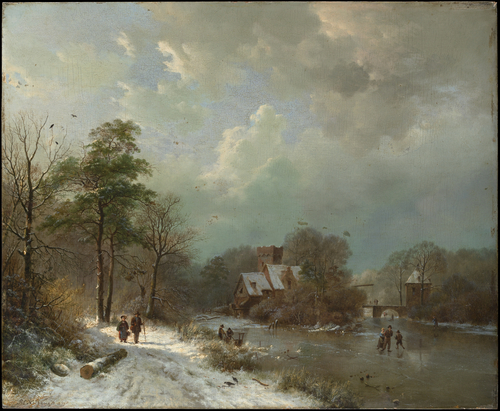 |
Barend Cornelis Koekkoek, Winter Landscape, Holland
Dutch, 1833
New York, Metropolitan Museum of Art
|
 |
Henry Farrer, Winter Scene in Moonlight
American, 1869
New York, Metropolitan Museum of Art
|
 |
Claude Monet, Boulevard Saint-Denis, Argenteuil, in Winter
French, 1875
Boston, Museum of Fine Arts
|
 |
Leon-Germain Pelouse, January:Cernay, near Rambouillet
French, c. 1887
New York, Metropolitan Museum of Art
|
 |
Alfred Sisley, Rue Eugene Moussoir at Moret: Winter
English, 1891
New York, Metropolitan Museum of Art
|
 |
Claude Monet, Ice Floes
French, 1893
New York, Metropolitan Museum of Art
|
 |
George Bellows, Blue Snow, the Battery
American, 1910
Columbus (OH), Museum of Art
|
 |
Ernest Lawson, Winter
American, 1914
New York, Metropolitan Museum of Art
|
It would appear that almost all ties to the old calendar pages have been obliterated, except, of course, that nature has not changed. Winter is still winter and during the season we still do the same things that
our ancestors did. We sit at home in the
warmth, we perhaps overindulge in food and drink, we do what chores are
required of us in the outside world (though these may no longer involve tillage
and pruning).
 |
George Henry Durrie, Red School House
American, 1858
New York, Metropolitan Museum of Art
|
 |
Camille Bernier, Janvier, Bretagne
French, c. 1872
Paris, Musée d'Orsay
|
 |
Childe Hassam, Winter in Union Square
American, c.1889-1890
New York, Metropolitan Museum of Art
|
When we can, if we can, we also participate in outdoor sports.
 |
Currier and Ives After Charles Parsons, Central Park, Winter-The Skating Pond
American, 1862
New York, Metropolitan Museum of Art
|
 |
Currier and Ives, Central Park in Winter
American, c. 1877-1894
New York, Metropolitan Museum of Art
|
 |
William James Glackens, Central Park, Winter
American, c. 1905
New York, Metropolitan Museum of Art
|
 |
George Bellows, Love of Winter
American, 1914
Chicago, Art Institute
|
Some take their interest in winter sports to
great lengths and, every four years, the winter athletes of the world
participate in one of the grandest winter spectacles of all, the Winter
Olympics. This competitive seeking of
excellence in outdoor activities may be the greatest difference between our day
and the days of our ancestors.
Of course, for the rest of us, we sit at home keeping warm
and watch, not the dancing flames of the fire, but the performance of these
hardy men and women on our screens.
Or, instead of watching the screen, we may read a book, peruse a magazine or write a letter, in the company of our dog or cat.
 |
Joseph J. Gould, February
American, 1896
New York, Metropolitan Museum of Art
(Notice that the wallpaper is sprinkled with hearts for Valentine's Day)
|
 |
Edward Penfield, February
American, 1898
New York, Metropolitan Museum of Art |
So perhaps
things aren’t really so different for most of us after all.
 |
Wharton H. Esherick, Trudging in the Snow (January)
American ,1922
Philadelphia, Museum of Art
|
© M. Duffy, 2018
_Hours%20of%20Rene%20of%20Anjou_France_Paris)_1410_BL_Egerton%201070,%20fol.15v%20det.jpg)


,%20c.%201450-1455_Los%20Angeles,%20J.%20Paul%20Getty%20Museum_MS%202.%20fol.%202%20r.jpg)


,%20c.%20Early%2016th%20Century_%20Los%20Angeles,%20J.%20Paul%20Getty%20Museum_MS%20Ludwig%20IX%2016,%20fol.%202r.jpg)


