|
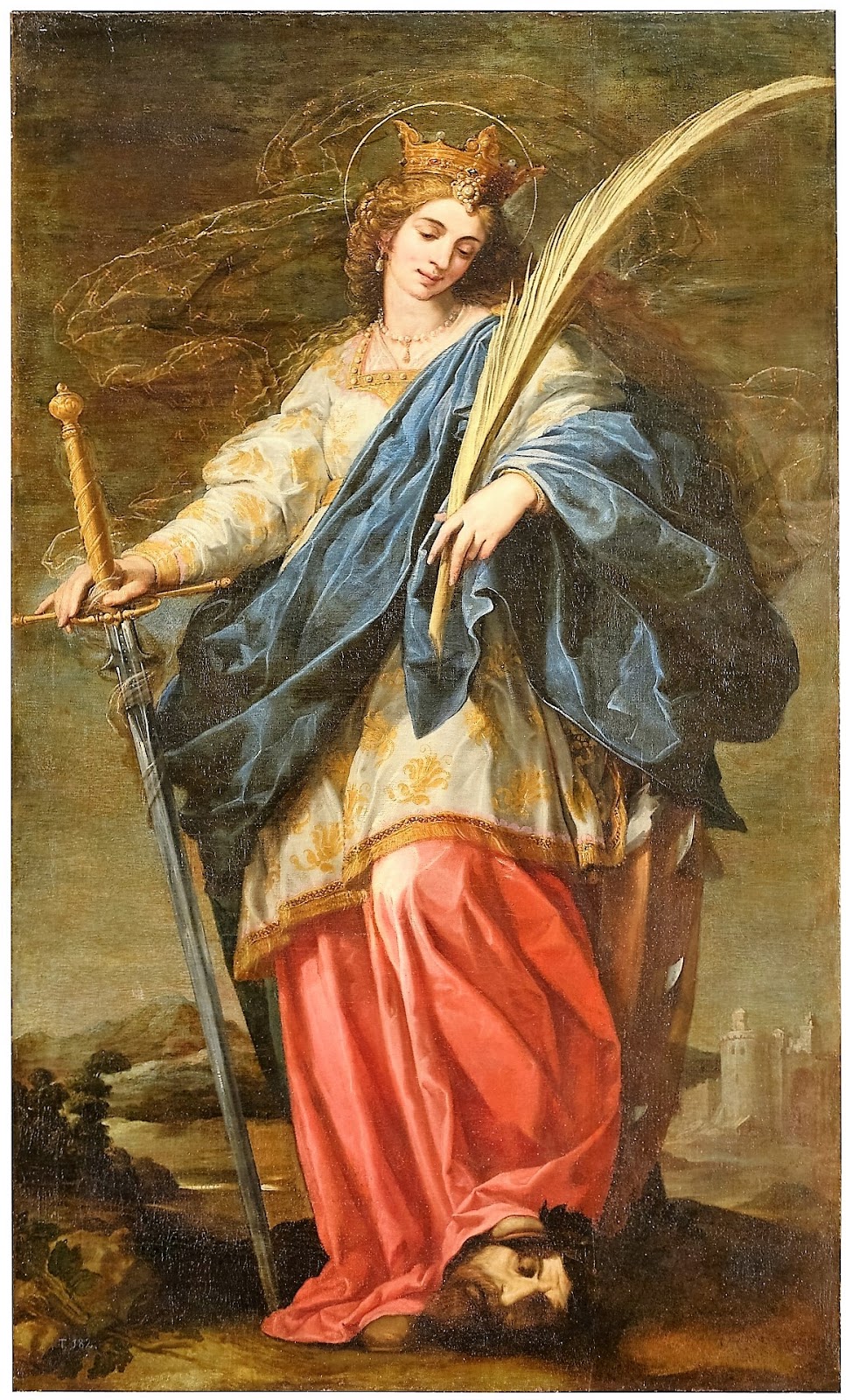
Vicente Carducho, Saint Catherine of Alexandria
Spanish, End of 16th-First Third of 17th Century
Madrid, Museo Nacional del Prado
This image has nearly all of Catherine's attributes. She wears a crown,carries a martyr's palm and a sword, At her left side is the broken wheel and at her feet, the head of Emperor Maximian. Missing is the book.
|
Anyone who has had any exposure to European art of the
middle ages through the Baroque period has probably encountered pictures or
statues of Saint Catherine of Alexandria.
She was one of the most popular saints during those periods. Images of her life, both those that are
likely to have been real and those that are likely to have been invented,
abound in every country of Christian Western Europe as well as from the
Byzantine Empire. There is so much
material to work with that I find I must spread these blog reports over several
days in order to do a half-way decent job of explaining her iconography, which
is fascinating.
The “facts” of Catherine’s life have been disputed. Some scholars claim that she never existed at
all and that her entire story is an invention.
Other scholars claim that the life and death of a real woman lies at the
base of the story. Still others suggest
that her “life” is actually a pastiche of several remembered lives.
My personal belief is that there is probably
a kernel of truth at the base of her story and that it is indeed the memory of
one extraordinary woman martyr that forms that kernel. As one scholar suggests:
“There seems every likelihood, …, that a real woman
connected with Alexandria, whose name may have been Katharine, made some
gesture during the period of the martyrdoms which caught the folk imagination
and lived orally among Greek-speaking Christian congregations in the Near East
and Southern Italy, her story taking on more and more the "einfache
Form" of Legende toward the eighth century.”1
Traditionally, Catherine (or Katherine) is believed to have
been killed during the persecution of Diocletian in 305. According to the tradition as it finally
developed, she was a princess, daughter of a “king” at Alexandria named, Custas
or Custos and his wife, Sabinelle. She
had been born a pagan, had been well educated by her father and mother and was,
in addition, very beautiful. She had
been converted and baptized as a teenager by a hermit named Adrian.
 |
Master of the Beatus of San Andres de Arroyo, Saint Catherine of Alexandria
Detached page from the Legenda aurea of Jacob de Voragine
Spanish, c. 1265-1300
Paris, Musée de Cluny, Musée national du Moyen Age
MS Cl. |
Shortly after her baptism she had a vision in which the
Blessed Virgin offered her a choice of male saints as spouses. On Catherine’s rejection of them as not
worthy of her hand, Christ Himself appeared and placed a ring on her finger,
wedding her as his virgin bride.
 |
Bust of Saint Catherine
East Tyrol, c. 1265-1270
Matrei, Church of St. Nicholas |
Shortly
thereafter she was lustfully sought after by the Emperor Maximian (co-emperor
with Diocletian and father of Constantine’s eventual rival, Maxentius, with
whom he is sometimes confused). In some versions of the story he seeks her for himself. In other versions he seeks her for his son, Maxentius. Having
decided on a life of Christian virtue with her virginity dedicated to Christ as
her husband, Catherine resisted.
Maximian
then brought her before fifty pagan philosophers whose task was to persuade her
to abandon Christianity and offer sacrifice to the Roman gods. The brilliantly
well-educated and inspired Catherine stood her ground and was unpersuaded,
throwing the philosophers into a quandary.
 |
Ivory Diptych with Scenes From the Life of Saint Catherine
French, Third Quarter of the 14th Century
Paris, Musée du Louvre |
Then Maximian threw her into prison.
But, while there, she continued her discussions with the pagan
philosophers, eventually converting all of them, plus the Emperor’s wife and Porphirius,
the captain of the guard. Maximian was
so angry that he ordered all her converts to be killed, including his
wife.
One of Maximian’s executioners then suggested a peculiarly
dreadful torment for killing Catherine.
This was a contraption made of wheels into which sharpened knives or
spikes had been driven. The idea was to
roll this over Catherine multiple times, inflicting many wounds.
 |
Metal Pilgrim Badge, Saint Catherine's Wheel
French, c. 1400-1450
London, British Museum
|
The device was constructed and Catherine was
brought out to suffer. But angels
prevented the ordeal by sending a storm that showered rocks and lightening on
the wheels, breaking them into pieces and killing many of the executioners and
bystanders in the process.
 |
Master of Morgan 366, Martyrdom of Saint Catherine, Saint Catherine Saved by Angels
From a Book of Hours
French (Tours), c. 1465-1475
New York, Pierpont Morgan Library
MS M 366, fol. 149v |
Eventually,
as with others among the early martyrs, Catherine was killed by
decapitation. Instead of blood milk poured out of her
severed neck.
 |
Romanesque Wall Painting, Saint Catherine of Alexandria
German, c.1300 |
A further wrinkle in the story of Saint Catherine is that
her last words were a statement that God would come to the assistance of anyone
who asked for her prayers and that she wished for her body to be hidden away so
as not to attract attention. According
to the legend, God answered her last wish by sending angels to collect her body
and bring it to Mount Sinai for burial.
 |
Saint Catherine of Alexandria
French, Early 15th Century
New York, Metropolitan Museum of Art |
Alexandria, with its famous library, which was still
reasonably intact at the beginning of the fourth century, and its long
tradition of scholarship would indeed have been a place in which a woman could
attain a high degree of education.
Egyptian society, remembering that women had once held significant power
in the past, was less restrictive than would have been the norm in European
parts of the Empire. About a hundred
years later, the pagan scholar Hypatia, a woman who embodied the last strands
of the old pagan world, was killed in an anti-pagan riot (415). Thus, it is highly likely that the woman on
whose life the story of Catherine is based (and who may even have been called
Catherine) had an impressive education.
In addition, she was fearless in proclaiming Christianity. While the former makes her stand out, it is
the latter quality that caused her martyrdom.
 |
The Gold Scrolls Group, Saint Catherine of Alexandria
From a Book of Hours
Flemish (Bruges), c. 1435-1445
New York, Pierpont Morgan Library
MS W3, fol. 198v |
Memories of her ordeal were probably cherished by her Christian contemporaries and within a generation of her death some version of it appears to have reached the ears of Constantine’s advisor, Eusebius, who describes in his Church History (340)
“And the women were not less
manly than the men in behalf of the teaching of the Divine Word, as
they endured conflicts with the men, and bore away equal prizes of virtue. And when they were
dragged away for corrupt purposes, they surrendered their lives to death rather
than their bodies to impurity.
One only of those who were seized for adulterous purposes by
the tyrant, a most distinguished and illustrious Christian woman in Alexandria, conquered the
passionate and intemperate soul of Maximian by most heroic firmness. Honorable on account of wealth and family and education,
she esteemed all of these inferior to chastity. He urged her
many times, but although she was ready to die, he could not put her to death,
for his desire was stronger than his anger.” 2
Memories of Catherine’s bravery earned her a place in the
liturgy of the Greek-speaking Church and eventually worked into the Latin-speaking
Church as well. Much has been lost, of
course, during the confusion and destruction which followed the Barbarian
invasions of the fifth century and the Arab Muslim invasions of the seventh and
later centuries. Indeed, it is
remarkable that anything survived. The
earliest existing liturgical reference to her that has so far been identified comes
from the seventh century. The next two
centuries saw a gradual increase in references until by the early tenth century
there was a popular account of her martyrdom, the Passio of St. Catherine, a feast day already set as November
25, with hymns and prayers already in circulation and with the beginnings of an
iconographic tradition already established.
 |
Byzantine Illuminator, Martyrdom of Saint Catherine of Alexandria and the Philosophers From a Menologium Basilianum
Constantinople, c. 1000
Vatican City, Biblioteca Apostolica Vaticana
MS Vat.gr.1613, Fol. 207 |
One of the earliest images we have is that found in the book titled Menologium Basilianum, a book of
prayers composed for the Byzantine Emperor Basil II, written and illuminated around
the year 1000. The image shows
Catherine, wearing Byzantine court dress and a crown, about to be decapitated. To the left the newly converted philosophers
suffer martyrdom by fire for their conversion, while above their heads appears
the hand of God.
 |
Lieven van Lathem, Saint Catherine of Alexandria
From the Warburg Hours
Belgian (Antwerp), c. 1460-1470
New York, Pierpont Morgan Library
MS M1178, fol. 101v |
Interest turned to Mount Sinai, where her body was reputed
to have been buried by angels who had carried it from Alexandria. The Greek monks from the monastery founded by
Justinian in the seventh century at the foot of the mountain traditionally
believed to be Mount Sinai, and dedicated to the Virgin Mary under the title of
Theotokos, set out to locate it. During
the tenth century bones were located on a nearby hill and a chapel was built to
house them. The hill became known as
Jebel Katrin. The bones were said to
exude a healing oil. Pilgrimages
began.
Eventually, sometime in the
twelfth century, the bones were removed from the chapel and brought into the main
monastery. Over time the presence of the
relics began to effect a conflation between the saint and the monastery and the
dedication of the monastery changed to that of St. Catherine. Even today, the Sinai monastery, which still
exists, is known to the world as St. Catherine’s. 3
One of the twelfth-century pilgrims to the Sinai monastery
came away with several small finger bones which he brought back to Europe and
deposited in the recently founded monastery of Sainte-Trinité-du-
mont-de-Rouen in Normandy. 4 Owing to the
deposit of these relics and the ongoing Crusades, which brought people from
Europe into the Orthodox East and even as far as Mount Sinai and Jerusalem,
devotion to Saint Catherine spread throughout Western Europe from Rome to Spain
and from England to Sweden.
 |
Workshop of Nichlaus Gerhaert von Leyden, Reliquary Bust of Saint Catherine of Alexandria
German, c.1465
New York, Metropolitan Museum of Art |
By the fourteenth century Saint Catherine of Alexandria had
become one of the most popular saints in Europe. And, in 1347, a baby girl, born in the
Italian town of Siena, was baptized with her name. The Siennese Catherine would identify with
her namesake saint in many ways and would become, in her turn, a saint as well,
Saint Catherine of Siena. From that
point on there is sometimes some confusion between the two, which I will deal
with in another article.
 |
Carlo Crivelli, Saint Catherine of Alexandria
Italian, c.1491-1494
London, National Gallery
|
Catherine of Alexandria remained one of the major saints of
Europe, one of fourteen known as the “Holy Helpers”, to whom people appealed
for their powerful intercession before the throne of God. She is known by her attributes, which are a
crown, the spiked wheel of her attempted martyrdom, the sword by which she was
finally killed, a book which is symbolic of her intellectual achievements and
the palm of martyrdom. Frequently there
is a small male figure shown at her feet.
This is the Emperor Maximian, whose efforts to subdue and pervert her
she defeated. She is patron saint of
wheel wrights, of students, in particular female students, of unmarried women, of
philosophers and theologians. (Text continues below the pictures.)
 |
Stained Glass Roundel with Saint Catherine of Alexandria
South Netherlandish, c.1500
New York, Metropolitan Museum of Art, the Cloisters |
 |
Jean Bourdichon, Saint Catherine of Alexandria
From the Grandes heures d'Anne de Bretagne
French (Tours), c.1503-1508
Paris, Bibliotheque nationale de France
MS Latin 9474, fol. 203v |
 |
Raphael, Saint Catherine of Alexandria
Italian, c.1507
London, National Gallery |
 |
Fernando Yanyez de la Almedina, Saint Catherine of Alexandria
Spanish, c.1510
Madrid, Museo Nacional del Prado
|
 |
Frankfort Master, Saint Catherine of Alexandria
Panel from the Holy Family with Angel Musicians, Saints Catherine and Barbara
German, c.1510-1520
Madrid, Museo Nacional del Prado |
 |
Cristoforo Solari, Saint Catherine of Alexandria
Italian, c. 1514-1524
New York, Metropolitan Museum of Art |
 |
Saint Catherine of Alexandria
German, c.1530
New York, Metropolitan Museum of Art |
 |
Titian, Saint Catherine of Alexandria
Italian, c.1560
Madrid, Museo Nacional del Prado
|
 |
Paolo Veronese, Saint Catherine of Alexandria
Italian, c.1580-1585
New York, Metropolitan Museum of Art |
 |
Federico Barocci, Saint Catherine of Alexandria
Italian, c. 1600
Chambery, Musée des Beaux-Arts |
 |
Bernardo Strozzi, Saint Catherine of Alexandria
Italian, c.1615
Hartford, Wadsworth Atheneum |
 |
Angelo Caroselli, Saint Catherine of Alexandria
Italian, 17th Century (Before 1652)
Nantes, Musée des Beaux-Arts |
 |
Anonymous, Saint Catherine of Alexandria
French (?), 17th Century
Rennes, Musée des Beaux-Arts
|
Like many of the early saints, whose real lives became
overgrown with legends, Catherine of Alexandria was “demoted” by the Catholic
Church after the Second Vatican Council.
Her feast day was removed from the calendar of the universal Church in
the pruning of multiple saints’ days that followed the Second Vatican Council.
Removal from the calendar does not mean, as I have seen it asserted, that the
Church has decided that the saint never existed. It means that a deliberate choice has been
made about which saints’ days should be celebrated universally, rather than in
individual countries or dioceses. 5
There are thousands of Catholic saints and not all of them can be
celebrated all over the world. Saints,
especially those from the time of the early centuries of the Church, may have
few documentary sources to prove that they existed and, clearly, some of the
stories of their sufferings may have been embroidered over time, but if does
not follow that they did not live. It was not until much later in history that
an elaborate procedure for canonizing individuals as saints was developed.
 |
Michelino de' Molinari da Besozzo, Saint Catherine of Alexandria From a Prayer Book Italian (Milan), c. 1425-1435 New York, Pierpont Morgan Library MS M 944, fol. 83v
|
In the case of Catherine of Alexandria, this removal was
reversed in 2002 in the last revision of the Roman Missal, announced on March
18, 2002, when her feast was reinstated as an optional memorial on November 25. 6
©
M. Duffy, 2016
___________________________________________
- Beatie,
Bruce A. “Saint Katharine of Alexandria:
Traditional Themes and the Development of a Medieval German Hagiographic
Narrative”, Speculum, Vol. 52, No. 4 (Oct., 1977), p. 798.
- Eusebius of Cesarea. Church History, Volume 8, Chapter 14,
¶ 14-15. Translated by Arthur Cushman
McGiffert. From Nicene and Post-Nicene Fathers, Second Series, Vol.
1. Edited by Philip Schaff and Henry Wace. (Buffalo, NY: Christian
Literature Publishing Co., 1890.) Revised and edited for New Advent
by Kevin Knight.
- Walsh, Christine. The
Cult of St Katherine of Alexandria in Early Medieval Europe, Ashgate Publishing Company, Burlington, VT, 2007, p.40.
- Jenkins, Jacqueline and Lewis, Katherine J.,
eds. St. Katherine of Alexandria:
Texts and Contexts in Western Medieval Europe, Brepols Publishers,
Turnhout, Belgium, 2003, p.8.
- Constitution on the Sacred Liturgy, Sacrosanctum Concilium, Solemnly Promulgated by His Holiness Pope Paul VI on December 4, 1963, Chapter IV, article 111. “The saints have been traditionally honored in
the Church and their authentic relics and images held in veneration. For the
feasts of the saints proclaim the wonderful works of Christ in His servants,
and display to the faithful fitting examples for their imitation. Lest the feasts of the saints should
take precedence over the feasts which commemorate the very mysteries of
salvation, many of them should be left to be celebrated by a particular Church
or nation or family of religious; only those should be extended to the
universal Church which commemorate saints who are truly of universal
importance.” http://www.vatican.va/archive/hist_councils/ii_vatican_council/documents/vat-ii_const_19631204_sacrosanctum-concilium_en.html. See also, the Motu Proprio, Mysterii Paschalis (The Paschal Mystery) of Pope Paul
VI, dated February 14, 1969, which implemented the changes, specifically Part
II, paragraph 3. http://w2.vatican.va/content/paul-vi/en/motu_proprio/documents/hf_p-vi_motu-proprio_19690214_mysterii-paschalis.html
- Press Release from the Congregation for Divine
Worship and the Discipline of the Sacraments on the New Roman Missal,
Intervention of Cardinal Jorge Arturo Medina Estevez http://www.vatican.va/roman_curia/congregations/ccdds/documents/rc_con_ccdds_doc_20020327_card-medina-estevez_it.html