Showing posts with label Jesse Tree. Show all posts

Thursday, December 19, 2024

O Flower of Jesse's Stem!

The Tree of Jesse
Cutting from an Antiphonary
German, c. 1115-1125
Cleveland, Museum of Art
Jesse sits at the bottom of this image, with two branches 
emerging from his chest. These branches coil around to 
envelope some of his descendants.  However, straight 
above his head is his most important lineage, that of David.
Directly above him is David himself, then above him is the
Virgin Mary. Above Mary is Jesus, in whom the branches 
of Jesse's lineage converge and flower.

The third of the "O Antiphons", for December 19th reads:  
"O Flower of Jesse’s stem, you have been raised up as a sign for all peoples; kings stand silent in your presence; the nations bow down in worship before you. Come, let nothing keep you from coming to our aid."  
This title "Flower of Jesse's stem" derives from the lineage of Jesus.  He is a descendant of Jesse, father of King David, and the presumed subject of the prophecy of Isaiah (read on the Second Sunday of Advent in Year A), which reads:

"But a shoot shall sprout from the stump of Jesse,
and from his roots a bud shall blossom.
The spirit of the LORD shall rest upon him:
a spirit of wisdom and of understanding,
A spirit of counsel and of strength,
a spirit of knowledge and of fear of the LORD,
and his delight shall be the fear of the LORD.
Not by appearance shall he judge,
nor by hearsay shall he decide,
But he shall judge the poor with justice,
and decide fairly for the land’s afflicted.
He shall strike the ruthless with the rod of his mouth,
and with the breath of his lips he shall slay the wicked.
Justice shall be the band around his waist,
and faithfulness a belt upon his hips.
Then the wolf shall be a guest of the lamb,
and the leopard shall lie down with the young goat;
The calf and the young lion shall browse together,
with a little child to guide them.
The cow and the bear shall graze,
together their young shall lie down;
the lion shall eat hay like the ox.
The baby shall play by the viper’s den,
and the child lay his hand on the adder’s lair.
They shall not harm or destroy on all my holy mountain;
for the earth shall be filled with knowledge of the LORD,
as water covers the sea.

On that day,
The root of Jesse,
set up as a signal for the peoples—
Him the nations will seek out;
his dwelling shall be glorious.
(Isaiah 11:1-10)
 
This image, of Jesse as the root and Jesus as the flower (sometimes also translated as rod), resulted in one of the best known of medieval images, the Tree of Jesse.  This is not to be confused with the modern "Jesse tree" which is a sometimes charming Advent decoration, a kind of Advent calendar, especially in use in homes with children.  Instead, this is a serious didactic image, making visual the human ancestry of Jesus.

Although I have found some excellent images of the Tree of Jesse in twentieth-century church decorations, the majority of these images were done between the twelfth and the seventeenth centuries.  

Anton Mormann, Madonna and Child in a Jesse Tree Mandorla
German, 1928
Ölde, Catholic Parish Church of Saint John the Baptist

In most of the Jesse Tree images, we see Jesse, asleep, either lying down or sitting up.  Out of his body (generally, but not always from his mid-section, the location of his "loins") grows a tree or a vine, which branches as it grows.  The branches are occupied by his descendents, often shown in chronological order.  Most of the images choose to illustrate only a few of the descendents, although David is usually prominent.  Very rarely all the generations named in the beginning of Matthew's Gospel are shown.
 

Medieval Stained Glass

Among the best known of the medieval Jesse trees are two famous stained glass windows, dated to the middle decades of the 12th century, at the abbey of St. Denis outside Paris and at Chartres cathedral in Ile-de-France.  These two immensely important churches were the hatching grounds for the Gothic style in architecture and embellishment that would dominate most of Europe for the following 300 years.  Their influence was widespread. 
 
The Jesse Tree, Stained Glass
French, c. 1140-1144
St. Denis, Abbey of St. Denis


The Jesse Tree, Stained Glass
French, c. 1150-1170
Chartres, Cathedral


The Tree of Jesse Window
English, c. 1170-1180
Canterbury, Cathedral


The Jesse Tree, Stained Glass
German (Swabian), c. 1280-1300
New York, Metropolitan Museum of Art

 
Therefore, it is not surprising that the image of the tree of Jesse would appear in other forms of art during the remainder of the Gothic period.  It appears in particular in manuscripts painted all over Europe during these centuries.

Manuscript Illumination


The Tree of Jesse
From the Siegburg Lectionary
German, c. 1125-1150
London, British Library
MS Harley 2889, fol. 4r


The Tree of Jesse
From the Lambeth Bible
English, c. 1140-1150
London, Lambeth Palace


The Tree of Jesse
Single Leaf from a Psalter
English (Canterbury), c. 1155-1160
New York, Pierpont Morgan Library
MS M 724, fol. 1v


Master of Simon de Saint Albans and Workshop, The Tree of Jesse
From a Bible
French (Champagne), c. 1170-1180
Paris, Bibliotheque nationale de France
MS Latin 16746, fol. 7v


The Tree of Jesse
From a Gospel Book
French (Champagne), c. 1185-1195
Paris, Bibliotheque nationale de France
MS Latin 11534, fol. 207v


The Tree of Jesse
From a Bible
French (Troyes), c. 1190-1200
Paris, Bibliotheque nationale de France
MS Latin 8823, fol. 9v


Often the image of the branching vine or tree makes ingenious use of the shape of the page and takes advantage of the letter L, which is the initial letter of the opening of the Gospel of Matthew in the Latin Vulgate, "Liber generationis".  Jesse is shown lying in sleep as the horizontal bar of the letter, while his descendents occupy the vertical bar.

At other times it spreads out and occupies the entire space of the page, often with many branches.  

Master of the Ingeborg Psalter, The Tree of Jesse
From the Ingeborg Psalter
French, c. 1195
Chantilly, Musée Condé
MS 94695, fol. 14v


*The Tree of Jesse
From the Munich Golden Psalter
English (Oxford), c. 1201
Munich, Bayerische Staatsbibliothek
MS Clm 835, fol. 121r


Master of Blanche of Castille, The Jesse Tree
From the Psalter of St. Louis and Blanche of Castille
French (Paris), c. 1225
Paris, Bibliotheque nationale de France
MS Arsenal 1186, fol. 15v


The Jesse Tree
From the Windmill Psalter
English (London), c. 1280-1299
New York, Pierpont Morgan Library
MS M 102, fol.1v


Queen Mary Master, The Tree of Jesse
From the Queen Mary Psalter
English (London), c. 1310-1320
London, British Library
MS Royal 2 B VII, fol. 67v


*The Jesse Tree
From an Incomplete Bible
English (Anglo-Norman), c. 1366-1370
Paris, Bibliotheque nattionale de France
MS Francais 1, fol. 329r


The Jesse Tree
From a Book of Hours
French (Rouen). c. 1475-1500
The Hague, Koninklijk Bibliotheek
MS 133 D 17, fol. 24r


and south to Spain, where the lower section of the central pillar of the famed Portico de la Gloria at the great shrine of Santiago de Compostela is decorated with a Jesse tree:

Santiago de Compostela, Portico de la Gloria
Spanish, 12th century
Santiago de Compostela, Cathedral


and to Italy, where the influence of the still existing classical style, plus the ethereal style of the nearby Byzantine Empire, resulted in such beautiful works as the Bible of Pope Clement VII.

The Bible of Clement VII
Italian (Bologna), ca. 1267
Paris, Bibliotheque Nationale de France
MS Latin 22, fol. 346


The Bible of Clement VII, The Jesse Tree
detail view


The Jesse Tree
From a  Bible
Northern French, 1229
New York, Morgan Library
MS M 163, fol. 326r


Nearly all the images include Mary independently, in the level just below that of Jesus or she is shown holding the Infant Jesus. However, there are some variations.

Images from the 14th century on begin to focus on Mary herself.  She is shown at the center of the composition as the true, direct offshoot of Jesse himself.


The Jesse Tree
From a Bible historiale of Gerard des Moulins
French (St. Omer), c 14th Cemtury
Paris, Bibliotheque nationale de France
MS Francais 152, fol. 467v


The Jesse Tree
From the Heures de Louis de Savoie
France (Savoy), c. 1445-1460
Paris, Bibliotheque nationale de France
MS Latin 9473, fol. 102


Master of Cornelis Croesinck, The Jesse Tree
From the Croesinck Hours
Dutch, c. 1489-1499
New York, Pierpont Morgan Library and Museum
MS M 1078, fol. 112v


The Jesse Tree
From a Psalter
Flemish (Bruges), c. 1500
Paris, Irish Cultural Center
MS E.1, fol . 42 


The Jesse Tree
From a Psalter
German (Augsburg), c. 1230-1255
New York, Pierpont Morgan Library and Museum
MS M 280, fol. 2r
This image is unusual in that, instead of ancestors of Christ sitting on the boughs of the Tree, it is incidents from the New Testament depicting the Annunciation, Nativity, Presentation and Baptism of Jesus that appear.


In the years bracketing 1500, at the very end of the Middle Ages are images that directly link the Tree of Jesse with the Annunciation, as for example, this image attributed to the Master of the Older Prayer Book of Maximilian I.


Master of the Old Prayer Book of Maximilian I, The Annunciation surrounded by a Jesse Tree
From the Breviary of Eleanor of Portugal
Flemish, 1495-1515
New York, Morgan Library
MS M 52, fol. 388v


Finally, one image combines many themes.  In similar fashion to the Breviary of Eleanor of Portugal, it combines the image of the Annunciation with the Tree of Jesse.  But, it also includes an image of Adam and Eve, also ancestors of Jesus, as they are of all humans, just above the figures of Gabriel and Mary.  Not only are they part of the ancestry of Jesus, they are also the means through which sin and death entered the world.  It is their Fall that was healed by Christ, beginning at the Annunciation. 

The Annunciation Surrounded by a Jesse Tree 
From an Hours of the Virgin
French (Rouen), c. 1495-1505
New York, Pierpont Morgan Library and Museum
MS M 174, fol. 21r


The image of the Jesse Tree continued into the Renaissance period, although it waned in popularity.  This may be due to the impact of the Reformation on European art.  Such images, giving visual form to abstract ideas, were frowned on by the Protestant reformers.  many such images, which had served for centuries as a means of instructing the common people about some of the tenets of the Christian faith, were seen by them as idolatrous images, not visual aids to understanding.  many such images were destroyed all over Europe where Protestantism became established.   Some of this thinking eventually transferred to  Catholic authorities, especially with the efforts to implement the decrees of the reforming Council of Trent, which also swept away some older ways of approaching the faith, without destroying the works already in existence.  Consequently, the concept of the Jesse Tree seems to have faded away, to be revived in the modern era.

A rather wonderful, small, late Jesse Tree image, possibly by the painter Girolamo Genga, lives at the National Gallery in London.  In it, each of the ancestors of Christ is depicted as a fully developed individual personality.


*Possibly Girolamo Genga, The Tree of Jesse
Italian, c. 1535
London, National Gallery


Like most of the images in this essay it is a work of miniature painting on parchment.  However, it is not certain whether it was originally part of a book or if it was an independent miniature painting.  Whichever way it was planned, it is truly a small wonder, feeling as monumental as an image from the Sistine Chapel ceiling.  


© M. Duffy, 2011.  New material added 2024.
* Indicates new image


Wednesday, January 20, 2016

David and Goliath


David and Goliath
From Bible historiale by Guiard des Moulins
French (Paris), c. 1300-1325
Paris, Bibliotheque nationale de France
MS Francais 160, fol. 135r

David spoke to Saul:
“Let your majesty not lose courage.
I am at your service to go and fight this Philistine.”
But Saul answered David,
“You cannot go up against this Philistine and fight with him,
for you are only a youth, while he has been a warrior from his youth.”

David continued:
“The LORD, who delivered me from the claws of the lion and the bear,
will also keep me safe from the clutches of this Philistine.”
Saul answered David, “Go! the LORD will be with you.”

Then, staff in hand, David selected five smooth stones from the wadi
and put them in the pocket of his shepherd’s bag.
With his sling also ready to hand, he approached the Philistine.

With his shield bearer marching before him,
the Philistine also advanced closer and closer to David.
When he had sized David up,
and seen that he was youthful, and ruddy, and handsome in appearance,
the Philistine held David in contempt.
The Philistine said to David,
“Am I a dog that you come against me with a staff?”
Then the Philistine cursed David by his gods
and said to him, “Come here to me,
and I will leave your flesh for the birds of the air
and the beasts of the field.”
David answered him:
“You come against me with sword and spear and scimitar,
but I come against you in the name of the LORD of hosts,
the God of the armies of Israel that you have insulted.
Today the LORD shall deliver you into my hand;
I will strike you down and cut off your head.
This very day I will leave your corpse
and the corpses of the Philistine army for the birds of the air
and the beasts of the field;
thus the whole land shall learn that Israel has a God.
All this multitude, too,
shall learn that it is not by sword or spear that the LORD saves.
For the battle is the LORD’s and he shall deliver you into our hands.”

The Philistine then moved to meet David at close quarters,
while David ran quickly toward the battle line
in the direction of the Philistine.
David put his hand into the bag and took out a stone,
hurled it with the sling,
and struck the Philistine on the forehead.
The stone embedded itself in his brow,
and he fell prostrate on the ground.
Thus David overcame the Philistine with sling and stone;
he struck the Philistine mortally, and did it without a sword.
Then David ran and stood over him;
with the Philistine’s own sword which he drew from its sheath
he dispatched him and cut off his head.
1 Samuel 17: 32-33, 37, 40-51 (Gospel Reading for January 20, 2016)

Images of David have a long history in Christian art, and indeed even in Jewish art in the early Christian period.  They have continued to show many aspects of his story.  

We see him as:

David the young shepherd boy, chosen by Samuel as the successor to the dishonored King Saul;
David Anointed by Samuel
Syrian, c. 244-245
Dura Europos, Syria, Synagogue


David the King, musician and Psalmist, husband, sinner, father and ancestor of Jesus:

Kings saw David as a pattern of Christian kingship, so many of the images are of David as king, often combined with his role as musician and psalmist.

David as King and Musician
from Bible of Charles the Bald known as the Vivien Bible
French (Tours), c. 845-851
Paris, Bibliotheque nationale de France
MS Latin 1, fol. 215v


Master of the Roman de Fauvel and Workshop
From Bible historiale of Guiard des Moulins
French (Paris), c. 1320-1330
Paris, Bibliotheque nationale de France
MS Francais 8, fol. 212

Pseudo-Jacquemart, David Playing the Bells
 From Psalter of Jean de Berry
French (Bourges), ca.1386
Paris, Bibliotheque nationale de France
 MS Francais 13091, fol. 153
Here David has put down his harp and instead plays a series of bells. He is also sometimes shown playing a medieval organ.


David in his relationship to his wife, Michal;

David is saved by Mikal
From Bible historiale by Guiard des moulins
French (Paris), 1375-1400
Paris, Bibliotheque nationale de France
MS Francais 164, fol. 106


Atelier of Jean Pucelle, David Upbraided by Mikal for Dancing Before the Ark
From the Breviary of Belleville
French (Paris), 1323-1326
Paris, Bibliotheque nationale de France
MS Latin 10483, fol. 45v


David in relation to Saul;

David and Saul
From Bible historiale by Guiard des Moulins
French (Paris), c.1400
Paris, Bibliotheque nationale de France
MS Francais 3, fol. 266v


David the sinner, coveting Bathsheba and conniving to murder Uriah, her husband;

David Watching Bathsheba
From a Book of Hours
French, 15th Century
Paris, Bibliotheque nationale de France
MS Nouvelle acquistion latine 183, fol. 95


David Giving Uriah a Letter for Joab
From Fleur des histoires by Jean Mansel
French, 1475-1500
Paris,Bibliotheque nationale de France
MS Francais 55, fol. 62


David the repentant sinner, chastised by Nathan the prophet;

David Admonished by Nathan and Penitent David
From Psalter with Commentary
Constantinople, ca. 950
Paris, Bibliotheque nationale de France
MS Grec 139, fol. 136v

David Admonished by Nathan
From Bible historiale by Guiard des Moulins
French (Paris), 1400-1425
Paris, Bibliotheque nationale de France
MS Francais 3, fol.134v


David as the father of Absolom who betrayed him and Solomon who followed him as king

Death of Absolom
From Bible historiale by Guiard des Moulins
French (Paris), 14th-15th Century
Paris, Bibliotheque nationale de France
MS Francais 159, fol. 133


Master of the Roman de Fauvel and Collaborators, David and Salomon
From Bible historiale by Guiard des Moulins
French (Paris), 1320-1330
Paris, Bibliotheque nationale de France
MS Francais 8, fol. 148v


and
David, son of Jesse, as an ancestor of Jesus.

Master of Simon of St. Albans and Collaborators, Jesse Tree
From Capucin Bible
French (Champagne),1170-1180
Paris, Bibliotheque nationale de France
MS Latin 16746, fol. 7v


David and Goliath

But the majority of images I will discuss in this post are those that show him in his battle with the giant Philistine, Goliath, or in the aftermath of the battle.  These images begin fairly early.  One of the earliest images is actually a series of images chased into silver plates in seventh century Constantinople and currently on view at the Metropolitan Museum in New York, which show many scenes from the life of David.

Silver Plate with Battle of David and Goliath
Constantinople, 629-630
New York, Metropolitan Museum of Art


With the recovery of Western Europe following the cultural losses due to the barbarian invasions, beginning in the ninth century the number of images of David begins to skyrocket.  But the event that sealed David forever as the special favorite of God, his defeat of Goliath with a simple slingshot, was always the most prevalent image.  We can find it in wall paintings, but most especially in manuscript painting, in all regions of the Christian world.

Battle of David and Goliath
From Psalter with Commentary
Constantinople, ca. 950
Paris, Bibliotheque nationale de France
MS Grec 139, fol. 4v


Catalan Romanesque Painter, Battle of David and Goliath
Catalan, c.1123
Barcelona, Museu Nacional d'Art de Catalunya


Story of David
Page from the Winchester Bible
English (Winchester), 1160-1180
New York, Pierpont Morgan Library
MS M 619-v


Battle of David and Goliath
From the Psalter of St. Louis and Blanche de Castille
French (Paris), ca. 1225
Paris, Bibliotheque nationale de France
MS Arsenal 1186, fol. 77


Master Honore and Collaborators, Anointing of David and Battle of David and Goliath
From Breviary of Philippe le Bel
French (Paris), 1290-1295
Paris, Bibliotheque nationale de France
MS Latin 1023, fol. 7v

Masster of the Roman de Fauvel, Battle of David and Goliath
From Bible historiale by Guiard des Moulins
French (Paris), 1300-1325
Paris, Bibliotheque nationale de France
MS Francais 156, fol. 146


Battle of David and Goliath
From Bible historiale by Guiard des Moulins
French (Paris), ca. 1400
Paris, Bibliotheque nationale de France,
MS Francais 3, fol. 124v


Andrea del Castagno, Youthful David
Italian, ca. 1450
Washington, National Gallery of Art


Early and Medieval images of David and Goliath are dominated by images of action, in which David and Goliath face off, Goliath is hit and David severs his head. 

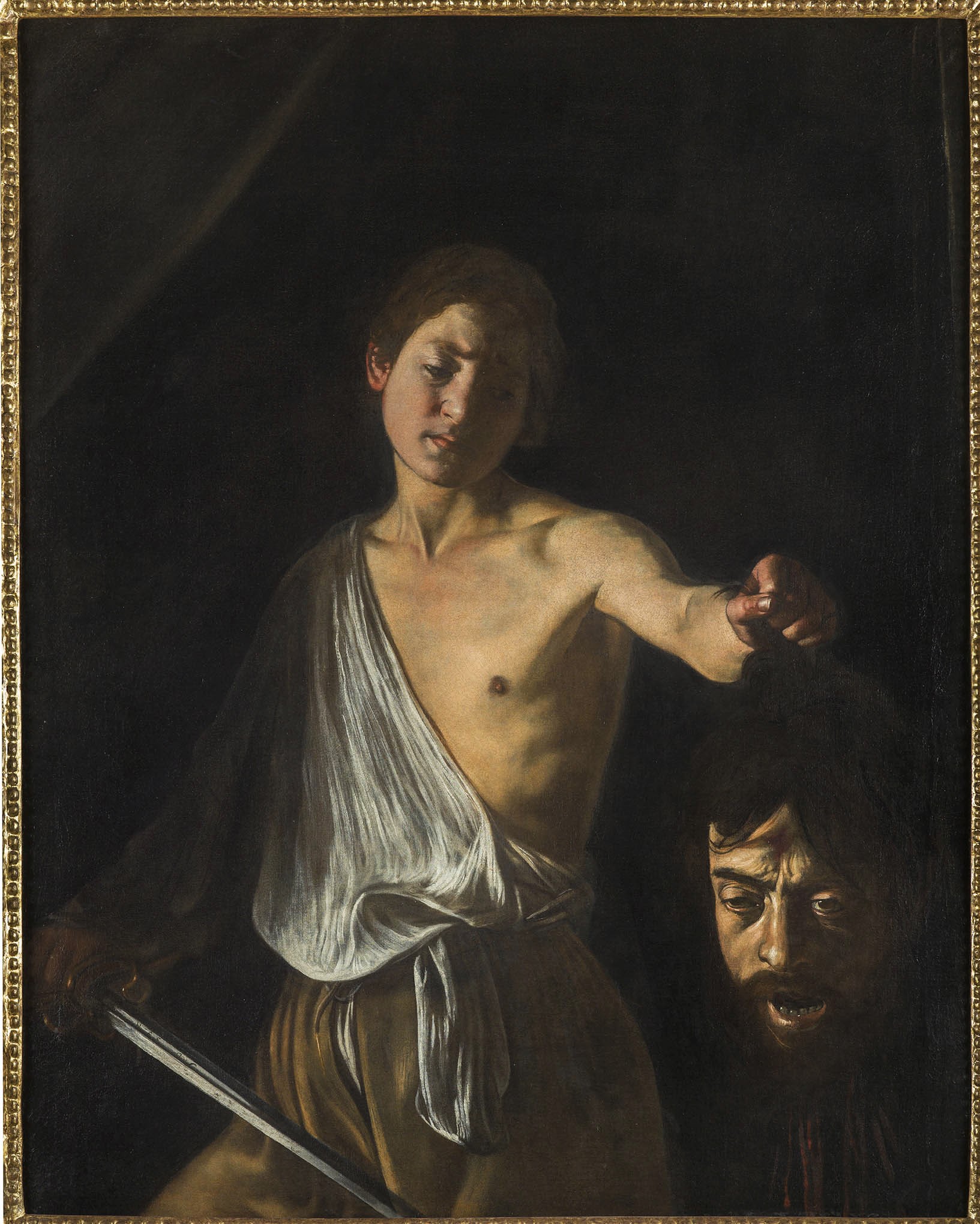
With the advent of the Renaissance in Italy, we also begin to find a somewhat different theme both in painting and in sculpture and it is in sculpture that the most memorable series of images of David were accomplished.   Picking up a theme already established in painting, that of the young David with the severed head of Goliath, and beginning with the work of Donatello we begin to see a newly distinct way of imagining the youthful shepherd boy.  


Taddeo Gaddi, David with the Head of Goliath
Italian, c.1330
Florence, Church of Santa Croce, Cappella Baroncelli


Donatello, David
Italian, 1409
Florence, Museo Nazionale del Bargello


The image is of the contemplative David, thoughtful and somewhat remote from action, either not yet in motion or pondering the effect his action has had on his enemy.1  These are the Davids of Donatello, Rossellino, Verocchio and, of course, of the great David of Michelangelo.  

Donatello, David
Italian, c. 1430-1440s
Florence, Museo Nazionale del Bargello


Bernardo Rossellino, David of the Casa Martelli
Italian, c.1461-1479
Washington, National Gallery of Art


Andrea del Verrocchio, David
Italian, c. 1473-1475
Florence, Museo Nazionale del Bargello


Michelangelo, David
Italian, 1504
Florence, Galleria dell'Accademia


These images set the pace for many of their followers and dominated the sculptural image from then on.


There were occasional reversions to the older, active image, culminating in the powerful, very active David of the young Gianlorenzo Bernini.  


Michelangelo, David and Goliath
Italian, 1509
Vatican City State, Capella Sistina
This is one of several images of David that Michelangelo included among the Ancestors of Christ in the ceiling of the Sistine Chapel.  This image appears in one of the spandrels of the curved ceiling, which accounts for the odd shape.


Titian, David and Goliath
Italian, c. 1542-1544
Venice, Church of Santa Maria della Salute


Daniele da Volterra, David Overcoming Goliath
Italian, c. 1550-1555
Paris, Musée du Louvre


Gianlorenzo Bernini, David
Italian, c. 1623-1624
Rome, Galleria Borghese

Bernini always aimed to engage the viewer in the sense of reality created by his works and he certainly does so in the David. 

But in the long run it was the contemplative image that remained the dominant one.  The seventeenth century saw a steady procession of paintings depicting handsome, mostly semi-nude young men contemplating the severed head of their adversary.  

Guido Reni, David with the Head of Goliath
Italian, c. 1604-1606
Paris, Musée du Louvre


Caravaggio, David with the Head of Goliath
Italian, c. 1609-1610
Rome, Galleria Borghese


Orazio Gentileschi, David with the Head of Goliath
Italian, ca.1610
Rome, Galleria Spada


Domenico Fetti, David with the Head of Goliath
Italian, ca. 1620
Hampton Court Palace, Royal Collections Trust


Valentin de Boulogne, David with the Head of Goliath Accompanied by Two Soldiers
French, c. 1620-1622
Madrid, Museo Thyssen-Bornemisza


Nicolas Poussin, Triumph of David
French, ca.1630
Madrid, Museo Nacional del Prado


Pier Francesco Mola, David with the Head of Goliath
Italian, 1660-1663
Private Collection


Only the Dutch seem to have been able to resist this trend.

Rembrandt, David Presenting the Head of Goliath to King Saul
Dutch, 1627
Basel, Kunstmuseum


Jacob van Oost the Elder, David with the Head of Goliath
Dutch, 1643
St. Petersburg, State Hermitage Museum


But the Donatello inspired image proved to be too strong, going on well into the nineteenth century.

Giovanni Marchiori, David with the Head of Goliath
Italian, 1744
Venice, Church of San Rocco


Antonin Mercie, David with the Head of Goliath
French, 1872
Paris, Musée d'Orsay


A great deal of ink has been spilled over the identity of these beautiful young men.  Are they to be construed as depicting David’s simplicity, are they homoerotic in nature or is their beauty to be construed as a sign of God’s favor?  Any and all of these theories have been proposed along with differing dates for the famous Donatello bronze that started the trend.2  Recent argument has tended to attempt to view them in the context of their times and has come to the conclusion that much has been made of little.   Whatever the truth of the matter many of the world's museums have a David to show, though since the 15th century Goliath has been present largely as a mere trophy. 
  
© M. Duffy, 2016


 1.  Andrew Butterfield, “New Evidence for the Iconography of David in Quattrocento Florence”, I Tatti Studies in the Italian Renaissance, Vol. 6 (1995), pp. 115-133.

2.  Robert Williams, "Virtus Perficitur": On the Meaning of Donatello’s Bronze "David", Mitteilungen des Kunsthistorischen Institutes in Florenz, 53. Bd., H. 2/3 (2009), pp. 217- 228.