Showing posts with label O Antiphons. Show all posts

Tuesday, December 16, 2025

The O Antiphons


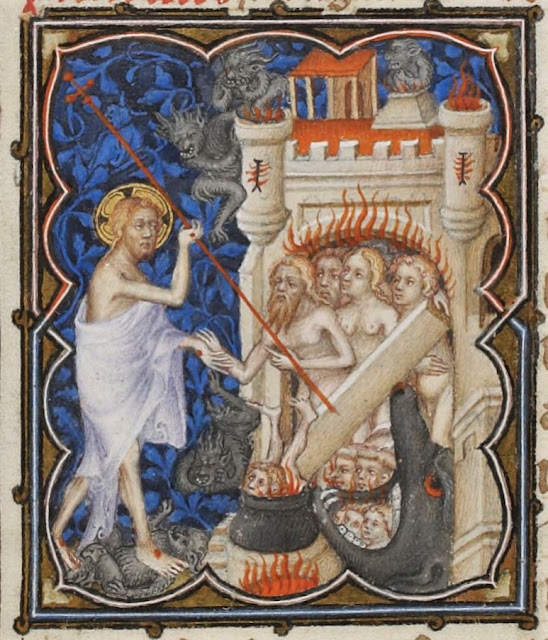
+Follower of the Coetivy Master, Initial O
From a Book of Hours
French (Loire Region), c. 1470-1480
New York, Pierpont Morgan Library
MS G1.II, fol. 232v


For the convenience of readers I am reposting this listing of the O Antiphons. 

In the week before Christmas, the Liturgy of the Hours (the official daily prayer of the Church) includes a series of special antiphons that precede the recitation of the Magnificat (Luke 1: 46-55) during Evening Prayer that are collectively called the O Antiphons.  In the English-speaking world most Christians are familiar with them as they are paraphrased in the verses of the well-known Advent hymn "O Come, O Come Emmanuel", which is a free translation of the medieval Latin text.


The O Antiphons refer to Christ under eight different titles.  These titles connect certain events or ideas from the Old Testament that are understood to forecast different aspects of Jesus and the salvation He came to give.

To see the images these titles reflect, click on the title of the antiphon below:

December 19 -- O Flower of Jesse's Stem!

In recent years a revival of lay interest in the Liturgy of the Hours has brought more awareness of these special texts.

Here is a video of Ely Cathedral Women's Choir singing the traditional English version of "Veni, Veni, Emmanuel".


© M. Duffy, 2017, 2024, 2025.
+ Image updated 2024.

Thursday, December 19, 2024

O Flower of Jesse's Stem!

The Tree of Jesse
Cutting from an Antiphonary
German, c. 1115-1125
Cleveland, Museum of Art
Jesse sits at the bottom of this image, with two branches 
emerging from his chest. These branches coil around to 
envelope some of his descendants.  However, straight 
above his head is his most important lineage, that of David.
Directly above him is David himself, then above him is the
Virgin Mary. Above Mary is Jesus, in whom the branches 
of Jesse's lineage converge and flower.

The third of the "O Antiphons", for December 19th reads:  
"O Flower of Jesse’s stem, you have been raised up as a sign for all peoples; kings stand silent in your presence; the nations bow down in worship before you. Come, let nothing keep you from coming to our aid."  
This title "Flower of Jesse's stem" derives from the lineage of Jesus.  He is a descendant of Jesse, father of King David, and the presumed subject of the prophecy of Isaiah (read on the Second Sunday of Advent in Year A), which reads:

"But a shoot shall sprout from the stump of Jesse,
and from his roots a bud shall blossom.
The spirit of the LORD shall rest upon him:
a spirit of wisdom and of understanding,
A spirit of counsel and of strength,
a spirit of knowledge and of fear of the LORD,
and his delight shall be the fear of the LORD.
Not by appearance shall he judge,
nor by hearsay shall he decide,
But he shall judge the poor with justice,
and decide fairly for the land’s afflicted.
He shall strike the ruthless with the rod of his mouth,
and with the breath of his lips he shall slay the wicked.
Justice shall be the band around his waist,
and faithfulness a belt upon his hips.
Then the wolf shall be a guest of the lamb,
and the leopard shall lie down with the young goat;
The calf and the young lion shall browse together,
with a little child to guide them.
The cow and the bear shall graze,
together their young shall lie down;
the lion shall eat hay like the ox.
The baby shall play by the viper’s den,
and the child lay his hand on the adder’s lair.
They shall not harm or destroy on all my holy mountain;
for the earth shall be filled with knowledge of the LORD,
as water covers the sea.

On that day,
The root of Jesse,
set up as a signal for the peoples—
Him the nations will seek out;
his dwelling shall be glorious.
(Isaiah 11:1-10)
 
This image, of Jesse as the root and Jesus as the flower (sometimes also translated as rod), resulted in one of the best known of medieval images, the Tree of Jesse.  This is not to be confused with the modern "Jesse tree" which is a sometimes charming Advent decoration, a kind of Advent calendar, especially in use in homes with children.  Instead, this is a serious didactic image, making visual the human ancestry of Jesus.

Although I have found some excellent images of the Tree of Jesse in twentieth-century church decorations, the majority of these images were done between the twelfth and the seventeenth centuries.  

Anton Mormann, Madonna and Child in a Jesse Tree Mandorla
German, 1928
Ölde, Catholic Parish Church of Saint John the Baptist

In most of the Jesse Tree images, we see Jesse, asleep, either lying down or sitting up.  Out of his body (generally, but not always from his mid-section, the location of his "loins") grows a tree or a vine, which branches as it grows.  The branches are occupied by his descendents, often shown in chronological order.  Most of the images choose to illustrate only a few of the descendents, although David is usually prominent.  Very rarely all the generations named in the beginning of Matthew's Gospel are shown.
 

Medieval Stained Glass

Among the best known of the medieval Jesse trees are two famous stained glass windows, dated to the middle decades of the 12th century, at the abbey of St. Denis outside Paris and at Chartres cathedral in Ile-de-France.  These two immensely important churches were the hatching grounds for the Gothic style in architecture and embellishment that would dominate most of Europe for the following 300 years.  Their influence was widespread. 
 
The Jesse Tree, Stained Glass
French, c. 1140-1144
St. Denis, Abbey of St. Denis


The Jesse Tree, Stained Glass
French, c. 1150-1170
Chartres, Cathedral


The Tree of Jesse Window
English, c. 1170-1180
Canterbury, Cathedral


The Jesse Tree, Stained Glass
German (Swabian), c. 1280-1300
New York, Metropolitan Museum of Art

 
Therefore, it is not surprising that the image of the tree of Jesse would appear in other forms of art during the remainder of the Gothic period.  It appears in particular in manuscripts painted all over Europe during these centuries.

Manuscript Illumination


The Tree of Jesse
From the Siegburg Lectionary
German, c. 1125-1150
London, British Library
MS Harley 2889, fol. 4r


The Tree of Jesse
From the Lambeth Bible
English, c. 1140-1150
London, Lambeth Palace


The Tree of Jesse
Single Leaf from a Psalter
English (Canterbury), c. 1155-1160
New York, Pierpont Morgan Library
MS M 724, fol. 1v


Master of Simon de Saint Albans and Workshop, The Tree of Jesse
From a Bible
French (Champagne), c. 1170-1180
Paris, Bibliotheque nationale de France
MS Latin 16746, fol. 7v


The Tree of Jesse
From a Gospel Book
French (Champagne), c. 1185-1195
Paris, Bibliotheque nationale de France
MS Latin 11534, fol. 207v


The Tree of Jesse
From a Bible
French (Troyes), c. 1190-1200
Paris, Bibliotheque nationale de France
MS Latin 8823, fol. 9v


Often the image of the branching vine or tree makes ingenious use of the shape of the page and takes advantage of the letter L, which is the initial letter of the opening of the Gospel of Matthew in the Latin Vulgate, "Liber generationis".  Jesse is shown lying in sleep as the horizontal bar of the letter, while his descendents occupy the vertical bar.

At other times it spreads out and occupies the entire space of the page, often with many branches.  

Master of the Ingeborg Psalter, The Tree of Jesse
From the Ingeborg Psalter
French, c. 1195
Chantilly, Musée Condé
MS 94695, fol. 14v


*The Tree of Jesse
From the Munich Golden Psalter
English (Oxford), c. 1201
Munich, Bayerische Staatsbibliothek
MS Clm 835, fol. 121r


Master of Blanche of Castille, The Jesse Tree
From the Psalter of St. Louis and Blanche of Castille
French (Paris), c. 1225
Paris, Bibliotheque nationale de France
MS Arsenal 1186, fol. 15v


The Jesse Tree
From the Windmill Psalter
English (London), c. 1280-1299
New York, Pierpont Morgan Library
MS M 102, fol.1v


Queen Mary Master, The Tree of Jesse
From the Queen Mary Psalter
English (London), c. 1310-1320
London, British Library
MS Royal 2 B VII, fol. 67v


*The Jesse Tree
From an Incomplete Bible
English (Anglo-Norman), c. 1366-1370
Paris, Bibliotheque nattionale de France
MS Francais 1, fol. 329r


The Jesse Tree
From a Book of Hours
French (Rouen). c. 1475-1500
The Hague, Koninklijk Bibliotheek
MS 133 D 17, fol. 24r


and south to Spain, where the lower section of the central pillar of the famed Portico de la Gloria at the great shrine of Santiago de Compostela is decorated with a Jesse tree:

Santiago de Compostela, Portico de la Gloria
Spanish, 12th century
Santiago de Compostela, Cathedral


and to Italy, where the influence of the still existing classical style, plus the ethereal style of the nearby Byzantine Empire, resulted in such beautiful works as the Bible of Pope Clement VII.

The Bible of Clement VII
Italian (Bologna), ca. 1267
Paris, Bibliotheque Nationale de France
MS Latin 22, fol. 346


The Bible of Clement VII, The Jesse Tree
detail view


The Jesse Tree
From a  Bible
Northern French, 1229
New York, Morgan Library
MS M 163, fol. 326r


Nearly all the images include Mary independently, in the level just below that of Jesus or she is shown holding the Infant Jesus. However, there are some variations.

Images from the 14th century on begin to focus on Mary herself.  She is shown at the center of the composition as the true, direct offshoot of Jesse himself.


The Jesse Tree
From a Bible historiale of Gerard des Moulins
French (St. Omer), c 14th Cemtury
Paris, Bibliotheque nationale de France
MS Francais 152, fol. 467v


The Jesse Tree
From the Heures de Louis de Savoie
France (Savoy), c. 1445-1460
Paris, Bibliotheque nationale de France
MS Latin 9473, fol. 102


Master of Cornelis Croesinck, The Jesse Tree
From the Croesinck Hours
Dutch, c. 1489-1499
New York, Pierpont Morgan Library and Museum
MS M 1078, fol. 112v


The Jesse Tree
From a Psalter
Flemish (Bruges), c. 1500
Paris, Irish Cultural Center
MS E.1, fol . 42 


The Jesse Tree
From a Psalter
German (Augsburg), c. 1230-1255
New York, Pierpont Morgan Library and Museum
MS M 280, fol. 2r
This image is unusual in that, instead of ancestors of Christ sitting on the boughs of the Tree, it is incidents from the New Testament depicting the Annunciation, Nativity, Presentation and Baptism of Jesus that appear.


In the years bracketing 1500, at the very end of the Middle Ages are images that directly link the Tree of Jesse with the Annunciation, as for example, this image attributed to the Master of the Older Prayer Book of Maximilian I.


Master of the Old Prayer Book of Maximilian I, The Annunciation surrounded by a Jesse Tree
From the Breviary of Eleanor of Portugal
Flemish, 1495-1515
New York, Morgan Library
MS M 52, fol. 388v


Finally, one image combines many themes.  In similar fashion to the Breviary of Eleanor of Portugal, it combines the image of the Annunciation with the Tree of Jesse.  But, it also includes an image of Adam and Eve, also ancestors of Jesus, as they are of all humans, just above the figures of Gabriel and Mary.  Not only are they part of the ancestry of Jesus, they are also the means through which sin and death entered the world.  It is their Fall that was healed by Christ, beginning at the Annunciation. 

The Annunciation Surrounded by a Jesse Tree 
From an Hours of the Virgin
French (Rouen), c. 1495-1505
New York, Pierpont Morgan Library and Museum
MS M 174, fol. 21r


The image of the Jesse Tree continued into the Renaissance period, although it waned in popularity.  This may be due to the impact of the Reformation on European art.  Such images, giving visual form to abstract ideas, were frowned on by the Protestant reformers.  many such images, which had served for centuries as a means of instructing the common people about some of the tenets of the Christian faith, were seen by them as idolatrous images, not visual aids to understanding.  many such images were destroyed all over Europe where Protestantism became established.   Some of this thinking eventually transferred to  Catholic authorities, especially with the efforts to implement the decrees of the reforming Council of Trent, which also swept away some older ways of approaching the faith, without destroying the works already in existence.  Consequently, the concept of the Jesse Tree seems to have faded away, to be revived in the modern era.

A rather wonderful, small, late Jesse Tree image, possibly by the painter Girolamo Genga, lives at the National Gallery in London.  In it, each of the ancestors of Christ is depicted as a fully developed individual personality.


*Possibly Girolamo Genga, The Tree of Jesse
Italian, c. 1535
London, National Gallery


Like most of the images in this essay it is a work of miniature painting on parchment.  However, it is not certain whether it was originally part of a book or if it was an independent miniature painting.  Whichever way it was planned, it is truly a small wonder, feeling as monumental as an image from the Sistine Chapel ceiling.  


© M. Duffy, 2011.  New material added 2024.
* Indicates new image


Saturday, April 8, 2023

Something Strange Is Happening Today -- The Lord Jesus Is Breaking Down the Gates of Hell

Pseudo-Jacquemart, The Harrowing of Hell
From the Petites Heures of Jean de Berry
French (Bourges), c. 1385-1390
Paris, Bibliotheque nationale de France
MS Latin 18014, fol. 166r


The Apostles Creed, prayed by virtually every Christian denomination that uses a creed, says of Jesus the "He descended into hell" following His death and before the Resurrection. 


The fact that this subject is found in the Apostles Creed testifies to its early appearance in Christian belief, as does the Ancient Homily for Holy Saturday, which is a reading from the Divine Office for Holy Saturday.  


This beautiful reading, part of the Office of Readings of the Liturgy of the Hours for Holy Saturday states:

"Something strange is happening—there is a great silence on earth today, a great silence and stillness. The whole earth keeps silence because the King is asleep. The earth trembled and is still because God has fallen asleep in the flesh and he has raised up all who have slept ever since the world began. God has died in the flesh and hell trembles with fear.

He has gone to search for our first parent, as for a lost sheep. Greatly desiring to visit those who live in darkness and in the shadow of death, he has gone to free from sorrow the captives Adam and Eve, he who is both God and the son of Eve. The Lord approached them bearing the cross, the weapon that had won him the victory. At the sight of him Adam, the first man he had created, struck his breast in terror and cried out to everyone: “My Lord be with you all.” Christ answered him: “And with your spirit.” He took him by the hand and raised him up, saying: “Awake, O sleeper, and rise from the dead, and Christ will give you light.”

I am your God, who for your sake have become your son. Out of love for you and for your descendants I now by my own authority command all who are held in bondage to come forth, all who are in darkness to be enlightened, all who are sleeping to arise. I order you, O sleeper, to awake. I did not create you to be held a prisoner in hell. Rise from the dead, for I am the life of the dead. Rise up, work of my hands, you who were created in my image. Rise, let us leave this place, for you are in me and I am in you; together we form only one person and we cannot be separated.

For your sake I, your God, became your son; I, the Lord, took the form of a slave; I, whose home is above the heavens, descended to the earth and beneath the earth. For your sake, for the sake of man, I became like a man without help, free among the dead. For the sake of you, who left a garden, I was betrayed to the Jews in a garden, and I was crucified in a garden.

See on my face the spittle I received in order to restore to you the life I once breathed into you. See there the marks of the blows I received in order to refashion your warped nature in my image. On my back see the marks of the scourging I endured to remove the burden of sin that weighs upon your back. See my hands, nailed firmly to a tree, for you who once wickedly stretched out your hand to a tree.

I slept on the cross and a sword pierced my side for you who slept in paradise and brought forth Eve from your side. My side has healed the pain in yours. My sleep will rouse you from your sleep in hell.

The sword that pierced me has sheathed the sword that was turned against you.

Rise, let us leave this place. The enemy led you out of the earthly paradise. I will not restore you to that paradise, but I will enthrone you in heaven. I forbade you the tree that was only a symbol of life, but see, I who am life itself am now one with you. I appointed cherubim to guard you as slaves are guarded, but now I make them worship you as God. The throne formed by cherubim awaits you, its bearers swift and eager. The bridal chamber is adorned, the banquet is ready, the eternal dwelling places are prepared, the treasure houses of all good things lie open. The kingdom of heaven has been prepared for you from all eternity."
1


This belief is that during the time between His death on the Cross and the Resurrection, Jesus descended to limbo to free the souls of the previously deceased just who were confined in waiting there.  Limbo is a place of darkness and peace, but not of the Presence of God, which had been lost through Original Sin.   Their souls were confined to limbo because they had been barred from entering heaven by Adam's sin, but they were set free by Christ's saving death.  For them He truly became the Key of David, breaking down the walls of death and leading the captives to freedom and joy.  

There is a long tradition of images in art illustrating this subject. 

In the East the tradition culminates in the dramatic and dynamic Anastasis of the church of Saint Saviour in Chora in Istanbul, in which Christ seems to drag Adam and Eve from their graves.  

Anastasis (The Harrowing of Hell)
Byzantine, c. 1316-1321
Istanbul, Church of Saint Saviour in Chora

In the West the image appears in the Klosterneuberg Altarpiece by Nicholas of Verdun, as well as in many paintings.

Nicholas of Verdun, Harrowing of Hell
Mosan (Meuse region), 1181
Klosterneuberg Austria, Klosterneuberg Priory

There are two distinct types of iconography that apply to most of these images. In one, Christ breaks down actual gates, which are often shown thrown to the ground or hanging off their hinges.  

The Harrowing of Hell
From the Psalter of Christina of Markyate_
English (St. Alban's), c. 1124-1145
Hildesheim, Dombibliothek
Page 49


Workshop of Duccio, The Harrowing of Hell
Italian, c. 1308-1311
Siena, Museo dell'Opera del Duomo


Giotto Workshop, The Harrowing of Hell
Italian, c. 1320-1325
Munich, Bayerische Staatsgemäldesammlungen, Alte Pinakothek


Fra Angelico, The Harrowing of Hell
Italian, c. 1437-1445
Florence, Museo di San Marco


Master of the Osservanza, The Harrowing of Hell
Italian, c. 1445
Cambridge (MA), Fogg Museum


In the other, Christ leads or sometimes drags the souls of the dead from the 'mouth of hell', shown as the jaws of a whale-like monster or from a cave that resembles an open mouth.

The Harrowing of Hell
From Miniatures of the Life of Christ
French (Northern), c. 1170-1180
New York, Pierpont Morgan Library
MS M 44, fol. 11v


Andrea da Firenze, The Harrowing of Hell
Italian, c. 1365-1368
Florence, Santa Maria Novella, Capella Spagnuolo


Alabaster Relief, The Harrowing of Hell
English, c. 1440-1470
London, Victoria and Albert Museum


Luca Penni, The Harrowing of Hell
Italian, c. 1547-1548
New York, Metropolitan Museum of Art


In both types He carries the staff, topped with a cross or with a pennant bearing a cross, that is His banner of victory over death.

Later images show Christ dragging the souls of the just from a more generalized image of a limbo jammed with just souls in waiting.  In these images the iconography of the gates or the mouth of hell is not as emphasized as in the earlier images.


The Harrowing of Hell
From a Book of Homilies
German (Lower Rhine), c. 1320-1350
Baltimore, The Walters Art Museum
MS W. 148, fol. 21r


Friedrich Pacher, The Harrowing of Hell
German, c. 1460s
Budapest, Museum of Fine Arts


Andrea Mantegna, The Harrowing of Hell
Italian, 1468
Private Collection 


Agnolo Bronzino, The Harrowing of Hell
Italian, 1552
Florence, Church of Santa Croce


Tintoretto, The Harrowing of Hell
Italian, 1568
Venice, Church of San Cassiano


© M. Duffy, 2023, 2024

1.  Office of Readings, Holy Saturday.  Source is:  Patrologiae cursus completus ...: Series graeca. Edited by Jacques Paul Migne, France, 1864, Volume 4, Section 43, "Seven Homilies", Paragraphs 440-463, "Sancto et magno Sabbato".