Showing posts with label 4th century mosaic. Show all posts

Friday, November 8, 2024

Dedication of the Lateran – Seventeen Hundred Years of Prayer


Basilica of Saint John Lateran
4th - 19th Centuries
Rome


The Catholic Church commemorates the dedication of the Lateran Basilica in Rome each year on November 9, remembering the day of its consecration as a church on November 9, 324.  November 9, 2024 is the 1,700th anniversary of that consecration.  Since the days of Constantine, the Lateran has served the city of Rome and the universal Church.  In honor of this remarkable anniversary, I am reissuing this post about that ancient and highly significant building.
 
Because of its immense size and prominence in the life of the Catholic Church most people probably think that Saint Peter’s Basilica is the principal church of Rome. But they are wrong. If you look around Saint Peter’s you might notice that one important feature is missing. There is no permanent chair for the bishop, no cathedra. Where the bishop’s chair would normally be is a feature called the “Cathedra Petri” or Throne of Peter by Gianlorenzo Bernini, but this is not a chair for living human habitation.

The chair for the currently living human who is the bishop of Rome is not in Saint Peter’s. It is across the river Tiber in the church of Saint John Lateran (San Giovanni in Laterano), the church that is the cathedral of the Diocese of Rome. It is Saint John Lateran that is described as Sacrosancta Lateranensis ecclesia omnium urbis et orbis ecclesiarum mater et caput (Most holy church of the Lateran, mother and head of all churches in the city and the world – my translation). 


Inscription on the facade of the Lateran Basilica

This is the first large building set aside for Christian worship, the first official “church” of Rome. It is located on property once belonging to the noble Roman family of the Laterani, which came into the possession of the Emperor Constantine through his second marriage to Flavia Maxima Fausta, the sister of his rival, Maxentius. In 312, shortly after his famous victory over Maxentius at the Milvian Bridge (north of Rome) he gave this property to the pope. It was, in effect, Constantine’s first gift to his newly acquired faith.

By November 9, 324, still well within Constantine’s lifetime (he died in 337), the church had been built and was dedicated. This is the dedication of its “mother and head” to Christ the Savior that the universal Church celebrates on November 9 every year. (However, it is more commonly known from the later, additional, dedications to Saints John the Baptist and John the Evangelist as Saint John Lateran.)  Nearby, the palace of the Lateran family became the palace of the popes, where they lived for 1,000 years. 


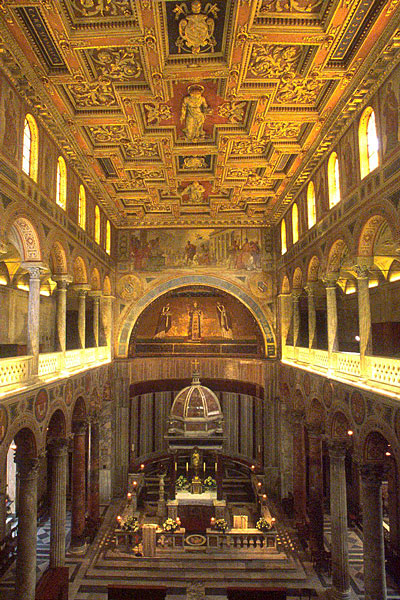
Interior of the nave of the Basilica of San Giovanni in Laterano
Rome


Over the passage of the 1,700 years since the Lateran became the mother church of Christianity the building has passed through much wear and tear. It was nearly 100 years old when Alaric brought his Goths to sack Rome in 410. It was plundered by the Vandals in 455. It has suffered damage from earthquakes (896) and fires (1307 and 1361) and been reconstructed many times, but still retains its original form as a Roman basilica. Some of the most "recent" reconstructions were the work of famous architects of the late Renaissance, Baroque and Rococo: Domenico Fontana, Francesco Borromini and Alessandro Galilei respectively. The last architectural interference was the extension of the apse in 1880.


Apse Mosaic, 4th, 9th and 13th Centuries
Rome, Basilica of Saint John Lateran


Little of its original interior has survived, although there are notable exceptions. When the apse was extended in the late 19th century the original 4th century mosaics were removed, stored and replaced in the new work, along with some of the later additions, which date from the 9th and the 13th centuries. So, parts of what we see today were seen by those who were present at the dedication, in the 4th Century, exactly 1,700 years ago.


The floor, decorated in what is known as cosmati work (from the name of the Roman family of artisans who did it) dates from the 14th century.

 
Cosmati work floor
Rome, Basilica of Saint John Lateran


The adjoining palace was the home of all the popes from Sylvester I (314-335) to Clement V (1305-1314). Clement V, a Frenchman, found himself in a problematical political position when he was elected as pope. In the early 14th century, political conflict between the Holy Roman Emperor and the King of France and between the King of France and the King of England had serious repercussions for the Church which, while it models the Kingdom of God in this world, is not immune to the troubles of that world. Not long before Clement's election, the French King, Philip IV, had attacked and imprisoned the previous Pope, Boniface VIII.

Clement remained in France, establishing a court at Avignon. He was followed by six other French popes, all of whom remained in Avignon. During this time, the Lateran suffered two devastating fires, and although the church was repaired, the papal palace was not.

When Pope Martin V returned the seat of the papacy to Rome in 1420 the old palace was uninhabitable, so the seat of papal administration was moved to the smaller residence next to Saint Peter’s Basilica and there it has remained ever since. But the cathedral of Rome remains in its original location --- at the Lateran.

You can take a virtual tour of the Lateran basilica and its surroundings here: 


© M. Duffy, 2011.  2024 Updated slightly to commemorate the 1,700 anniversary of the its dedication on November 9, 324.

Sunday, July 8, 2012

Byzantium and Islam – A Belated Review

Mosaic Fragment with Two Goats
Jordan, 535-536
Mount Nebo, Franciscan Archaeological Institute
Custody of the Holy Land
Multiple medical problems delayed my visit to the exhibition called “Byzantium and Islam: Age of Transition”, at the Metropolitan Museum, which, sadly, ends today. This is the latest in a series of exhibitions, dating back nearly 20 years that have traced the course of Byzantine art from its beginnings. This show does not excite the same level of interest from me as did some of the previous shows. There are no great icons, no amazing array of mosaics and jewelry. Still, the show does have some remarkable items of interest.

Bone Plaque with Vine Scroll
Egypt or Syria, 8th Century
Athens, Benaki Museum
The exhibition is organized around the story of how the art of Christian Byzantium developed or changed into the non-figural art of Islam in the areas that were conquered by Arabic armies from the 7th to the 9th centuries. One of the reasons this was accomplished so easily seems to be that, while much of Christian Byzantine art was figural, not all of it was. Frequently, more or less abstract decorative patterns, such as vines, were commonplace prior to the Islamic conquests. It’s relatively easy to see how these patterns from nature developed into the abstract patterns known as arabesques.

The exhibition explores several themes: Orthodox Christianity, Syriac Christianity, Coptic Christianity, Judaism, Pilgrimage, Iconoclasm, Commerce and several kinds of objects: Silks, Dress, Trade Goods, as well as a historical survey of Byzantium’s Southern Provinces, Palaces And Princely Life and Islamic Religious Works to present a fairly comprehensive survey of this transitional period.

For me there are several objects of high interest. Among them were:

Fragment of Tapestry Weave in
Polychrome Wool and Undyed Linen
on Plain Weave Undyed Linen
Possibl Egyptian, 6th - 7th Century
Paris, Louvre

• The remarkable survival of so many textile fragments from this remote time and from this frequently troubled region. There are many surviving pieces in the show, fragments of costume or furnishings that have survived by inclusion in burials or from the lucky circumstance of being chosen to wrap some precious sealed object. Three especially stood out.

The first was an incomplete piece which is encountered in the very first gallery. This is an unfinished fragment of tapestry of wool and linen, dated to the 6th-7th centuries. The pattern is a pomegranate tree with its distinctive red fruit clearly represented in a deep and vibrant red, completely surprising in its detail and in the strength of its color.

Silk Fragment
Possibly Iran, 7th-8th Century
New York, Metropolitan Museum

The second is a piece of patterned silk, possibly from Iran, dating to the 7th-8th centuries. In what we today might call a jacquard weave are stylized urns (or vases), centered in diamond shapes, which are surrounded with stylized ribbons. It’s a surprisingly modern looking pattern, something one might find today on a tablecloth or upholstery or drapery fabric.

The third astonishing textile survival is a truly magnificent piece, presumably woven in an imperial workshop during the 8th or 9th century.
Silk Fragment, Annunciation
Possibly Egypt, Syria or Constantinople, 8th-9th Century
Vatican City, Vatican Museums
It shows a repeating pattern of a highly detailed scene of the Annunciation within a medallion, in which Mary is seated in a throne-like chair, as Gabriel stands in front of her. The scene is repeated twice in the surviving fragment and is presumed to belong to a larger design in which other scenes from the New Testament were also portrayed inside medallions. This fragment survived because it was used as the wrapping for a relic, which at some point in the past, was given to a pope. The quality of this fragment is so high and the production of such a piece is so complex that it is suspected that it comes from the highest level of workshop, presumably from either Alexandria or from Constantinople itself.

Basalt Relief of a Stylite Saint
Syria, 5th-6th Century
Berlin, Stiftung Preussischer Kulturbesitz,
Staatliche Museen zu Berlin--
Skulpturensammlung und Museum fuer Byzantinische Kunst
• A charming survivor that answers a few of the questions that derive from efforts by certain Christians of this period to, in some way, duplicate the experience of martyrdom in am already Christianized setting. One has heard of the existence of Christian holy men and women, who practiced intense forms of asceticism in an attempt to duplicate the martyr experience in an unbloody way. In the West an example can be found in the extreme monastery of Skellig Michael, perched on a tiny spike of rock off the coast of County Kerry in Ireland. In the East it took the form of stylites, solitary men living on top of pillars.

Clearly, such people needed some help from those on the ground and one of the items in the Pilgrimage section demonstrates how communications took place. This is a 5th or 6th century basalt bas-relief showing one of these extreme hermits, atop his pillar. On a ladder placed beside it another monk climbs up with what the catalog describes as a censer (but could be a basket of food), while above his head, a dove holds a wreath. The figures are abstract, but charmingly naive and, in their charm and naïveté, very touching. They have a look that is reminiscent of the monks in the recent animated film, The Secret of Kells.

• A series of chased silver plates, depicting the story of David, including his confrontation with Goliath, made in 7th century Constantinople during the reign of the emperor Heraclius. These plates show the finest workmanship and a very high level of classical relief.

David Anointed by Samuel
Constantinople, 629-630
New York, Metropolitan Museum

Arming of David
Constantinople, 629-630
New York, Metropolitan Museum


• One of the most interesting works on display is not shown as a whole, but is rather a collection of pieces from a magnificent lost work: The Grado Chair.

Raising of Lazarus (from the Grado Chair)
Eastern Mediterranean or Egypt, 6th-7th Century
London, British Museum
St. Mark Preaching (from the Grado Chair)
Eastern Mediterranean or Egypt, 6th-7th Century
Milan, Civiche Raccolte d'Arte Aplicata--Castello Sforzesco
This chair, probably made of a wooden core and dating to the 7th-8th centuries, was covered with finely carved ivory plaques. The plaques are now dispersed through many collections all over the world: London, Milan, New York, Paris, Washington. They tell the stories of the life of Christ and the life of St. Mark, the first bishop of Alexandria.  This was a great opportunity to see them all together in one place.


Rabula Gospels, Canon Table
Syria, Completed 586
Florence, Biblioteca Medicea Laurenziana (Plut.I.56)


• The famous Rabula Gospels, created in Syria in the 6th century. It was interesting to observe that at some time in its life the pages of the Gospel were trimmed along its edges, so that the outer illuminations on each page have been truncated.


Dioscorides Manuscript
Italy, late 6th - early 7th Century
Naples, Biblioteca Nationale "Vittorio Emanuele III"
MS Ex-Vind.Gr.1

• A most interesting illustrated copy of the Dioscorides, which describes the medicinal properties of 287 plants. The illustrations, in addition to being beautiful, have the look of a very modern plant identification book. However, they date from the end of the 6th or beginning of the 7th century.


• A fascinating group of metal liturgical objects, called the Attarouti Treasure. Dating from the 6th-7th centuries the group includes a large number of chalices, plus a wine strainer, a censer and a silver dove which hung above the altar.

Silver and Silver Gilt Chalice
from the Attarouti Treasure
Syria, late 6th - early 7th Century
New York, Metropolitan Museum
Silver Dove from the Attarouti Treasure
Syria, late 6th - early 7th Century
New York, Metropolitan Museum


The objects come from a hoard that belonged to two different churches, St. John and St. Stephen, in the village of Attarouti in Syria. One of the things that make these treasures so memorable is the existence of inscriptions with the names of the faithful who donated them to the churches.

Child's Tunic with Hood
Egypt, 430-620
New York, Metropolitan Museum
• Among the most interesting survivors of the centuries are several items of clothing, including a child’s hooded robe.

• As I mentioned, there is little jewelry in this exhibition, especially compared with previous exhibitions of Byzantine work. But there are a few pieces. Among them is one absolutely stunning item, a necklace. This striking piece, made of lapis and gold stands out for its intense color and strikingly modern design.

Necklace and Pendant of Gold and Lapis
East Mediterannean, 7th Century
Washington, DC, Dumbarton Oaks Byzantine Collection
The necklace is made of alternating gold and lapis bicone beads and gold wire. Suspended from the center, is a pendant of lapis, carved in the shape of a shell edged in gold, with a tiny golden figure of wave-born Aphrodite positioned in front. It demonstrates the fact that, even as late as the 7th century, there were still lively fragments of the older Greco-Roman pantheon.

Luster-painted Glass Bowl
Syria (Damascus), 786-787
Corning, NY, Corning Museum of Glass
Gold Solidus of Heraclius, Heraclius Constantine and Heraclonus
Constantinople, 638-641
New York, Metropolitan Museum
There is much else besides: mosaics, carved capitals, glassware, pottery, metalwork, manuscripts, and a splendid array of copper, silver and gold coins (proving once again that gold is unaffected by the passage of time, so long as it is not melted down).

My one regret is that I wasn’t able to get there soon enough to make many return trips.

© M. Duffy, 2012

Essays on many of these items, and many other topics, can be accessed online at the special blog set up by the Met for this eshibition.

Friday, January 20, 2012

“The Eve of Saint Agnes”: A Poet, Some Painters, a Roman Princess and a Saint

William Holman Hunt, The Escape of Madeline and Porphyro
English, 1848
Liverpool, Walker Art Gallery


“ST. AGNES’ Eve—Ah, bitter chill it was!
The owl, for all his feathers, was a-cold;
The hare limp’d trembling through the frozen grass,
And silent was the flock in woolly fold”


This is the opening stanza of “The Eve of Saint Agnes” by the English Romantic poet, John Keats. The complete poem tells the tale of a young girl who elopes from her home with
 a young man.1 


The poem begins with this evocation of a freezing January night and with references to the old superstition that on the night of January 20/21, if certain rules were fulfilled, a girl would dream of the man she would marry. 


John Everett Millais, The Eve of Saint Agnes
English, 1863
Windsor, Royal Collection Trust


The remainder of the poem tells a story (reminiscent of Romeo and Juliet) of a young man from an “enemy” family, who secretes himself in the girl’s room, spies on her as she prepares for bed and goes to sleep. After a time he wakes her and urges her to elope with him, which she does. Their escape is made easier because everyone in her family home had caroused late into the night and was in no condition to challenge them. 

Arthur Hughes, The Eve of Saint Agnes
English, 1856
London, Tate Britain
 

Keats’ poem was the inspiration for the work of several of the Pre-Raphaelite painters, among them John Everett Millais, Arthur Hughes and William Holman Hunt. The poem’s mélange of sub-textual sexuality, detailed observation of the natural world and romanticized Medievalism exactly matched the guiding philosophy of the Pre-Raphaelites. 2

However, all this is very far from the Catholic view of Saint Agnes. 


So, Who Is Agnes?


Agnes has one of the best known saint’s names in Catholicism. She is one of the early martyrs of the city of Rome, those who are memorialized in the intercession prayer of the traditional “Roman” canon of the Mass (now Eucharistic Prayer #1), along with other female saints like Cecilia, Agatha, Felicity, Perpetua and Anastasia, as well as the early Popes and male martyrs like Saint Lawrence.3   According to the traditional belief, she was a young teenage Christian girl, tortured for her refusal to sacrifice to the Roman gods and for her desire to remain a virgin because of her commitment to Christ. Eventually, she was murdered for her faith and her refusal to capitulate. 

Procession of Female Martyrs
Byzantine, Second Half of 6th Century
Ravenna, Church of Sant' Appolinare Nuovo
Saint Agnes is easily identified on the far left because of the lamb associated with her.


Agnes Has a Lamb

Because of the close relationship between her name, “Agnes”, and the Latin word for lamb; “agnus”, her symbol has traditionally been a lamb. A popular saint in medieval and Renaissance art, she is easily identified by the proximity of the lamb (which, of course, is also a symbol for Christ, the Lamb of God.)


Saints Agnes and Barbara
From the Livre d’images du Christ et les saincts
Flemish (Hainaut), c. 1275-1300
Paris, Bibliotheque nationale de France
MS Nouvelle acquisition francaise 16251, fol. 96r


Saint Agnes, Stained Glass Window
Austrian, c. 1340-1350
New York, Metropolitan Museum of Art, The Cloisters Collection


Master of the Brussels Initials and Workshop, Saint Agnes
From the Hours of Charles the Noble, King of Navarre
French (Paris), c. 1405
Cleveland, Museum of Art
MS 1964.40, fol. 2


Donato de' Bardi, Right Wing From the Triptych of the Madonna and Child with Saints Philip and Agnes
Italian, c. 1425-1430
New York, Metropolitan Museum of Art


Saint Agnes
From a Book of Hours
French (Anjou), 1440
New York, Pierpont Morgan Library
MS M 157, fol. 200v


Saint Agnes from February Calendar Page
From the Hours of Louis of Savoy
French (Savoy), c. 1445-1460
Paris, Bibliotheque nationale de France
MS Latin 9473, fol. 3v 


ean le Tavernier and Follower, Saint Agnes
From the Hours of Philip of Burgundy
Flemish (Oudenaarde), c. 1450-1460
The Hague, Koninklijk Bibliotheek
MS KB 76 F 2, fol. 275v


Anonymous, Geertruy Haeck Kneeling Before Saint Agnes
Dutch, c. 1465
Amsterdam, Rijksmuseum


Adriaen van Wesel, Saint Agnes
Dutch, c. 1470-1480
Amsterdam, Rijksmuseum


Neri di Bicci, Saints Agnes and Clare of Assisi
Italian, c. Mid-1470
Philadelphia, Museum of Art


Hieronymous Bosch, Agneese de Gramme Protected by Saint Agnes
Right Wing of the Triptych of the Adoration of the Magi
Dutch, c. 1494
Madrid, Museo Nacional del Prado


Bernhard Strigel, Saint Agnes, Wing of a Triptych
German, c. 1510
Marburg, Museum für Kunst und Kulturgeschichte der Philipps-Universität Marburg


Master of the Saint Marein Triptych, Saint Agnes
German, c. 1510-1530
Detroit, Institute of Arts


Diego de Tiedra, Saint Agnes
Spanish, c. 1550
New York, Metropolitan Museum of Art


Bowl with Saint Agnes and Her Lamb
French (Limoges), 17th Century
Paris, Musée  du Louvre, Département  des Objets d'art du Moyen Age, de la Renaissance et des temps modernes


Dominichino, Saint Agnes
Italian, c. 1620
London, Royal Collection Trust, Kensington Palace


Vicente Carducho, Saint Agnes
Spanish, 1637
Madrid, Museo Nacional del Prado


More concretely, on her feast day two lambs are presented to the Pope during Mass. For the occasion they are bedded down in a basket each and decorated with red flowers, a reminder that they are symbolic of a martyr saint.  When they are shorn, several months later, their wool is sent to the cloistered convent attached to the church of Santa Cecilia in Trastevere. There it is woven into the strips of woolen cloth from which are made the pallia (symbolic collars) that are presented by the Pope to newly elevated archbishops. 


The presentation of the lambs blessed by Pope Francis on the feast of Saint Agnes, Jan. 21, 2016. 
Credit: L'Osservatore Romano


Saint Agnes -- Buried Outside the Walls, But Never Out of Memory


Following her death at the hands of the executioners, the body of Agnes was buried in a catacomb outside the walls of Rome, on the via Nomentana. 4 

In the 4th century, shortly after the issue of the Edict of Milan and contemporary with the construction of the major basilicas of St. John Lateran and St. Peter’s (the first purpose-built Christian churches), several extremely large basilican-type buildings were constructed in the outskirts of Rome, beyond the walls.*

These basilica-like buildings were not intended as churches, like St. John’s or St. Peter’s, but as covered cemeteries. 5   They were constructed near the graves of martyrs who were remembered by Roman Christians as having been important.  Excavations have found that their floors were literally paved with graves and their walls also bore stacked rows of sarcophagi.  One was built on the via Nomentana, near the grave of Agnes.
Plan showing the layout of the site off via Nomentana.
The Constantinian era cemetery basilica (parts of which still exist) is the largest structure.
The circular structure is Santa Costanza, the still existing mausoleum of Constantine's daughter.
The small basilica at the right (down a flight of steps) is the 7th century church of Sant' Agnese fuori le mura, built over the catacomb in which Agnes was buried, and that still exists.

Above the nearby catacomb a smaller basilican church was also built on top of her grave in the 7th century. Called Sant'Agnese fuori le mura (Saint Agnes outside-the-walls), it still stands.

Interior, Church of Sant' Agnese fuori le mura
Roman, 7th century
Rome


Church of Sant' Agnese fuori le mura, Floor level view
Roman, 7th century
Rome


Saint Agnes with Popes Symmachus and Honorius
Late Antique Apse Mosaic, 7th Century
Rome, Church of Saint'Agnese fuori le Mura


One feature of these large basilican cemeteries was that they were often the locations at which wealthy Christians chose to build their own tombs. Helena, Constantine’s mother, built her tomb adjacent to the cemetery basilica which adjoined the catacomb containing the graves of the martyrs Marcellinus and Peter off the via Labicana.6

Her granddaughter, Constantine’s daughter Constantina, built her mausoleum next to the cemetery basilica of Agnes (coemeterium Agnetis).7   It still stands next to the via Nomentana, although the adjoining cemetery basilica is now in ruins. Now called Santa Constanza (and converted into a church), it preserves some of the earliest mosaic decorations which incorporate Christianized classical images.


Exterior view of Santa Costanza showing remains of the 4th century cemetery basilica walls
Roman, 4th century
Rome, Church of Santa Costanza 


The vaulting famously includes images of classical putti (what today we would call “cherubs”) cavorting amid entwining grape vines during a grape harvest, a possible Eucharistic reference.

Vault Mosaic Showing Putti Harvesting Grapes
Roman, 4th Century
Rome, Church of Santa Costanza


Also decorating the vaults are images of birds, flowers, fruits and serving vessels.  Again these are open to Christian interpretations, or they may simply be a continuation of Roman decorative wall paintings and mosaics.


Vault Decoration
Roman, 4th Century
Rome, Church of Santa Costanza


In the two small apses are mosaics depicting the Tradito Legis and Christ as Pantocrator Giving the Keys to Saint Peter (Traditio Clavum).


Traditio Legis Mosaic
Roman, 4th century
Rome, Church of Santa Costanza


Traditio Clavum Mosaic
Roman, 4th century
Rome, Church of Santa Costanza

The nearby cemetery basilica of Saint Agnes is still partially standing as well.  

All this for a young, but tenacious, teenager who could neither be dissuaded nor bullied into abandoning her faith.

© M. Duffy, 2012, pictures updated and new material added 2023, restructured with updated and new images 2024.
_________________________________________
1. Published in 1819. The full text can be read at http://www.bartleby.com/126/39.html

2. For the Pre-Raphaelites see, http://www.victorianweb.org/painting/prb/1.html

3. The text of Eucharistic Prayer #1 can be accessed at http://old.usccb.org/romanmissal/samples-priest-prayer1.shtml

4. Butler, Rev. Alban. Lives of the Saints, New York, Benziger Brothers, 1894, pp. 43-44.

5. Krautheimer, Richard. “Mensa-Coemeterium-Martyrium” in Studies in Early Christian, Medieval and Renaissance Art, New York, New York University Press, 1969, pages 35-58. and Rome, Profile of a City, 312-1308, Princeton, NJ, Princeton University Press, 2000, p. 24-25.  In ancient Rome (from pagan times onwards) no burials were allowed inside the walls.

6. Krautheimer, op cit.

7. Krautheimer, op cit.

*  The basilica is a type of building we still have with us, though its purpose has been modified.  Originally, basilicas were all-purpose civil buildings (as opposed to temples).  They were basically plain structures on the outside, though they could be elaborate on the inside.  They followed a basic plan, with usually a straight entrance wall, straight side walls and a rounded end, called an apse.  They could serve various functions, often used as law courts, with the judges seated at the apsidal end.  In the German city of Trier the basilica that was used as a throne room by the Roman Emperors when Trier was the second capital of the Empire in the West still survives, converted to a church.  When Christians were able to build churches for the first time, the basilica offered a ready made plan that had no unwelcome associations with the temples of the pagan or even of the Jewish world.  And it had the Imperial backing of Constantine, who ordered the construction of the first two great basilican churches, Saint John Lateran and Saint Peter on Vatican hill.