Showing posts with label Roman Canon. Show all posts

Friday, January 20, 2012

“The Eve of Saint Agnes”: A Poet, Some Painters, a Roman Princess and a Saint

William Holman Hunt, The Escape of Madeline and Porphyro
English, 1848
Liverpool, Walker Art Gallery


“ST. AGNES’ Eve—Ah, bitter chill it was!
The owl, for all his feathers, was a-cold;
The hare limp’d trembling through the frozen grass,
And silent was the flock in woolly fold”


This is the opening stanza of “The Eve of Saint Agnes” by the English Romantic poet, John Keats. The complete poem tells the tale of a young girl who elopes from her home with
 a young man.1 


The poem begins with this evocation of a freezing January night and with references to the old superstition that on the night of January 20/21, if certain rules were fulfilled, a girl would dream of the man she would marry. 


John Everett Millais, The Eve of Saint Agnes
English, 1863
Windsor, Royal Collection Trust


The remainder of the poem tells a story (reminiscent of Romeo and Juliet) of a young man from an “enemy” family, who secretes himself in the girl’s room, spies on her as she prepares for bed and goes to sleep. After a time he wakes her and urges her to elope with him, which she does. Their escape is made easier because everyone in her family home had caroused late into the night and was in no condition to challenge them. 

Arthur Hughes, The Eve of Saint Agnes
English, 1856
London, Tate Britain
 

Keats’ poem was the inspiration for the work of several of the Pre-Raphaelite painters, among them John Everett Millais, Arthur Hughes and William Holman Hunt. The poem’s mélange of sub-textual sexuality, detailed observation of the natural world and romanticized Medievalism exactly matched the guiding philosophy of the Pre-Raphaelites. 2

However, all this is very far from the Catholic view of Saint Agnes. 


So, Who Is Agnes?


Agnes has one of the best known saint’s names in Catholicism. She is one of the early martyrs of the city of Rome, those who are memorialized in the intercession prayer of the traditional “Roman” canon of the Mass (now Eucharistic Prayer #1), along with other female saints like Cecilia, Agatha, Felicity, Perpetua and Anastasia, as well as the early Popes and male martyrs like Saint Lawrence.3   According to the traditional belief, she was a young teenage Christian girl, tortured for her refusal to sacrifice to the Roman gods and for her desire to remain a virgin because of her commitment to Christ. Eventually, she was murdered for her faith and her refusal to capitulate. 

Procession of Female Martyrs
Byzantine, Second Half of 6th Century
Ravenna, Church of Sant' Appolinare Nuovo
Saint Agnes is easily identified on the far left because of the lamb associated with her.


Agnes Has a Lamb

Because of the close relationship between her name, “Agnes”, and the Latin word for lamb; “agnus”, her symbol has traditionally been a lamb. A popular saint in medieval and Renaissance art, she is easily identified by the proximity of the lamb (which, of course, is also a symbol for Christ, the Lamb of God.)


Saints Agnes and Barbara
From the Livre d’images du Christ et les saincts
Flemish (Hainaut), c. 1275-1300
Paris, Bibliotheque nationale de France
MS Nouvelle acquisition francaise 16251, fol. 96r


Saint Agnes, Stained Glass Window
Austrian, c. 1340-1350
New York, Metropolitan Museum of Art, The Cloisters Collection


Master of the Brussels Initials and Workshop, Saint Agnes
From the Hours of Charles the Noble, King of Navarre
French (Paris), c. 1405
Cleveland, Museum of Art
MS 1964.40, fol. 2


Donato de' Bardi, Right Wing From the Triptych of the Madonna and Child with Saints Philip and Agnes
Italian, c. 1425-1430
New York, Metropolitan Museum of Art


Saint Agnes
From a Book of Hours
French (Anjou), 1440
New York, Pierpont Morgan Library
MS M 157, fol. 200v


Saint Agnes from February Calendar Page
From the Hours of Louis of Savoy
French (Savoy), c. 1445-1460
Paris, Bibliotheque nationale de France
MS Latin 9473, fol. 3v 


ean le Tavernier and Follower, Saint Agnes
From the Hours of Philip of Burgundy
Flemish (Oudenaarde), c. 1450-1460
The Hague, Koninklijk Bibliotheek
MS KB 76 F 2, fol. 275v


Anonymous, Geertruy Haeck Kneeling Before Saint Agnes
Dutch, c. 1465
Amsterdam, Rijksmuseum


Adriaen van Wesel, Saint Agnes
Dutch, c. 1470-1480
Amsterdam, Rijksmuseum


Neri di Bicci, Saints Agnes and Clare of Assisi
Italian, c. Mid-1470
Philadelphia, Museum of Art


Hieronymous Bosch, Agneese de Gramme Protected by Saint Agnes
Right Wing of the Triptych of the Adoration of the Magi
Dutch, c. 1494
Madrid, Museo Nacional del Prado


Bernhard Strigel, Saint Agnes, Wing of a Triptych
German, c. 1510
Marburg, Museum für Kunst und Kulturgeschichte der Philipps-Universität Marburg


Master of the Saint Marein Triptych, Saint Agnes
German, c. 1510-1530
Detroit, Institute of Arts


Diego de Tiedra, Saint Agnes
Spanish, c. 1550
New York, Metropolitan Museum of Art


Bowl with Saint Agnes and Her Lamb
French (Limoges), 17th Century
Paris, Musée  du Louvre, Département  des Objets d'art du Moyen Age, de la Renaissance et des temps modernes


Dominichino, Saint Agnes
Italian, c. 1620
London, Royal Collection Trust, Kensington Palace


Vicente Carducho, Saint Agnes
Spanish, 1637
Madrid, Museo Nacional del Prado


More concretely, on her feast day two lambs are presented to the Pope during Mass. For the occasion they are bedded down in a basket each and decorated with red flowers, a reminder that they are symbolic of a martyr saint.  When they are shorn, several months later, their wool is sent to the cloistered convent attached to the church of Santa Cecilia in Trastevere. There it is woven into the strips of woolen cloth from which are made the pallia (symbolic collars) that are presented by the Pope to newly elevated archbishops. 


The presentation of the lambs blessed by Pope Francis on the feast of Saint Agnes, Jan. 21, 2016. 
Credit: L'Osservatore Romano


Saint Agnes -- Buried Outside the Walls, But Never Out of Memory


Following her death at the hands of the executioners, the body of Agnes was buried in a catacomb outside the walls of Rome, on the via Nomentana. 4 

In the 4th century, shortly after the issue of the Edict of Milan and contemporary with the construction of the major basilicas of St. John Lateran and St. Peter’s (the first purpose-built Christian churches), several extremely large basilican-type buildings were constructed in the outskirts of Rome, beyond the walls.*

These basilica-like buildings were not intended as churches, like St. John’s or St. Peter’s, but as covered cemeteries.   They were constructed near the graves of martyrs who were remembered by Roman Christians as having been important.  Excavations have found that their floors were literally paved with graves and their walls also bore stacked rows of sarcophagi.  One was built on the via Nomentana, near the grave of Agnes.
Plan showing the layout of the site off via Nomentana.
The Constantinian era cemetery basilica (parts of which still exist) is the largest structure.
The circular structure is Santa Costanza, the still existing mausoleum of Constantine's daughter.
The small basilica at the right (down a flight of steps) is the 7th century church of Sant' Agnese fuori le mura, built over the catacomb in which Agnes was buried, and that still exists.

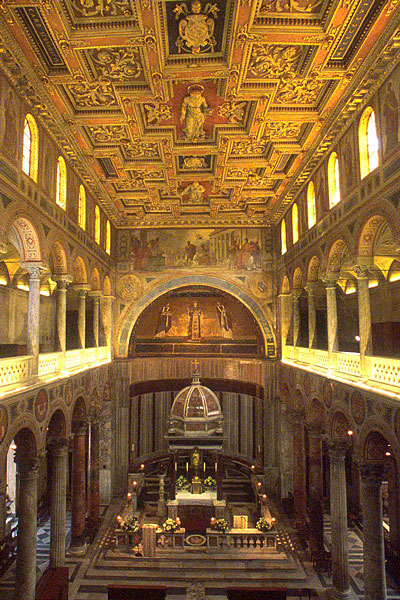
Above the nearby catacomb a smaller basilican church was also built on top of her grave in the 7th century. Called Sant'Agnese fuori le mura (Saint Agnes outside-the-walls), it still stands.

Interior, Church of Sant' Agnese fuori le mura
Roman, 7th century
Rome


Church of Sant' Agnese fuori le mura, Floor level view
Roman, 7th century
Rome


Saint Agnes with Popes Symmachus and Honorius
Late Antique Apse Mosaic, 7th Century
Rome, Church of Saint'Agnese fuori le Mura


One feature of these large basilican cemeteries was that they were often the locations at which wealthy Christians chose to build their own tombs. Helena, Constantine’s mother, built her tomb adjacent to the cemetery basilica which adjoined the catacomb containing the graves of the martyrs Marcellinus and Peter off the via Labicana.6

Her granddaughter, Constantine’s daughter Constantina, built her mausoleum next to the cemetery basilica of Agnes (coemeterium Agnetis).7   It still stands next to the via Nomentana, although the adjoining cemetery basilica is now in ruins. Now called Santa Constanza (and converted into a church), it preserves some of the earliest mosaic decorations which incorporate Christianized classical images.


Exterior view of Santa Costanza showing remains of the 4th century cemetery basilica walls
Roman, 4th century
Rome, Church of Santa Costanza 


The vaulting famously includes images of classical putti (what today we would call “cherubs”) cavorting amid entwining grape vines during a grape harvest, a possible Eucharistic reference.

Vault Mosaic Showing Putti Harvesting Grapes
Roman, 4th Century
Rome, Church of Santa Costanza


Also decorating the vaults are images of birds, flowers, fruits and serving vessels.  Again these are open to Christian interpretations, or they may simply be a continuation of Roman decorative wall paintings and mosaics.


Vault Decoration
Roman, 4th Century
Rome, Church of Santa Costanza


In the two small apses are mosaics depicting the Tradito Legis and Christ as Pantocrator Giving the Keys to Saint Peter (Traditio Clavum).


Traditio Legis Mosaic
Roman, 4th century
Rome, Church of Santa Costanza


Traditio Clavum Mosaic
Roman, 4th century
Rome, Church of Santa Costanza

The nearby cemetery basilica of Saint Agnes is still partially standing as well.  

All this for a young, but tenacious, teenager who could neither be dissuaded nor bullied into abandoning her faith.

© M. Duffy, 2012, pictures updated and new material added 2023, restructured with updated and new images 2024.
_________________________________________
1. Published in 1819. The full text can be read at http://www.bartleby.com/126/39.html

2. For the Pre-Raphaelites see, http://www.victorianweb.org/painting/prb/1.html

3. The text of Eucharistic Prayer #1 can be accessed at http://old.usccb.org/romanmissal/samples-priest-prayer1.shtml

4. Butler, Rev. Alban. Lives of the Saints, New York, Benziger Brothers, 1894, pp. 43-44.

5. Krautheimer, Richard. “Mensa-Coemeterium-Martyrium” in Studies in Early Christian, Medieval and Renaissance Art, New York, New York University Press, 1969, pages 35-58. and Rome, Profile of a City, 312-1308, Princeton, NJ, Princeton University Press, 2000, p. 24-25.  In ancient Rome (from pagan times onwards) no burials were allowed inside the walls.

6. Krautheimer, op cit.

7. Krautheimer, op cit.

*  The basilica is a type of building we still have with us, though its purpose has been modified.  Originally, basilicas were all-purpose civil buildings (as opposed to temples).  They were basically plain structures on the outside, though they could be elaborate on the inside.  They followed a basic plan, with usually a straight entrance wall, straight side walls and a rounded end, called an apse.  They could serve various functions, often used as law courts, with the judges seated at the apsidal end.  In the German city of Trier the basilica that was used as a throne room by the Roman Emperors when Trier was the second capital of the Empire in the West still survives, converted to a church.  When Christians were able to build churches for the first time, the basilica offered a ready made plan that had no unwelcome associations with the temples of the pagan or even of the Jewish world.  And it had the Imperial backing of Constantine, who ordered the construction of the first two great basilican churches, Saint John Lateran and Saint Peter on Vatican hill.


Monday, November 21, 2011

"Hail Bright Cecilia!" -- Great Patroness of Harmony

Carlo Saraceni, Saint Cecilia and the Angel
Italian, ca. 1610
Rome, Galleria Nazionale d'Arte Antica

"Saint Cecilia kept the Gospel of Christ ever near her heart; day and night she never ceased praying and speaking with God."

Antiphon for Evening Prayer on the Feast of Saint Cecilia


Although we have few concrete details about her life and martyrdom, Cecilia of Rome has been one of the most popular saints of the Church in all the centuries since the 4th.


The date of her martyrdom is uncertain. It may be as early as the time of Marcus Aurelius in the mid-2nd century or as late as the time of Diocletian in the early 4th, only about 10 years before the Edict of Milan gave recognition to the Christian Church.


What we do know is that, as early as the years immediately after the Edict of Milan, she was one of the most respected of the Roman martyrs. What was probably her home was one of the early Roman “house churches”, called tituli. And, by the 5th century her name is among the list of martyrs cited in the Roman Canon, the principal Eucharistic Prayer of the Mass, along with other male and female saints, such as Lawrence, Clement, Sixtus, Cornelius, Agnes, Anastasia, Felicity and Perpetua. 1


Carlo Saraceni, Execution of Saint Cecilia
Italian, ca. 1610
Los Angeles, Los Angeles County Museum of Art


Her name, Cecilia, derives (as the names of Roman women always did) from her family name, in this case the Caecilii (for a male family member the form would be Caecilius, which survives in the English given name, Cecil). Presumably, Saint Cecilia was a member of this prominent, noble, old Roman family. She undoubtedly also had another, personal name, which is now lost.


Legends

Legends surround her life and death, although it is entirely possible that some of them may, in fact, be true. We simply don’t have the documentation to know for sure. The best-known tale is that as a young bride, vowed to perpetual virginity, she converted both her husband, Valerian, and her brother-in-law, Tiburtius, themselves prominent Romans, to the Christian faith and that, for this reason, both they and she suffered martyrdom.


Master of the Pesaro Crucifix, Saint Cecilia of Rome and Her Husband, Valerian, Being Crowned by an Angel
Italian, c. 1375-1380
Philadelphia, Museum of Art


*Guillaume Vrelant and Workshop, Saints Valerian and Cecilia Confront the Old Man
From a Speculum historiale by Vincent of BEauvais
Flemish (Bruges), c. 1455
Paris, Bibliotheque nationale de France
MS Francais 309, fol. 117v
The Legneda aurea by Jacobus de Voragine tells the story of Saints Cecilia, her husband and brother-in-law in typically medieval style.  Upon her marriage to Valerian Cecilia converted him.  In his search for someone to baptism him he encountered a mysterious old man who appeared with "a book written with letters of gold".  The book read:  "One God, one faith, one baptism, one God and father of all, above all, and in us all, everywhere".  Valerian was asked for his assent, the old man then disappeared and Valerian was accepted as a candidate for baptism.  I presume that this is the inspiration for this image.1


*Master Francois and Workshop, Saints Cecilia, Valerian and Tibertius
From a Speculum hiustoiriale by Vincent of Beauvais
French (Paris), 1463
Paris, Bibliotheque nationale de France
MS Francias 51, fol. 8r
This stylish image presents a more usual marriage situation. 


*Saints Cecilia and Valerian Crowned for Martyrdom While Saints Tiburtius and Urban Look On
_From a Legenda aurea by Jacobus de Voragine
French (Paris), c. 1480-1490
Paris, Bibliotheque nationale de France
MS Francais 245, fol. 179v
This is another reference to the mysterious old man with the scroll of gold letters.  Here the scroll clearly reads "One God, one faith, one baptism".


Martyrdom


*The Master of the Roman de Fauvel Workshop,  The Martyrdom of Saint Cecilia
From  a Vies des saints
French (Paris), c. 1300-1350
Paris, Bibliotheque nationale de France
MS Francais 183, fol. 96v

By tradition the first attempt at killing her was to suffocate her in a hot bath. I had always thought this was a weird way to kill someone until I learned that the Empress Fausta, Constantine’s second wife, was reported to have been killed by this technique. Perhaps it was a Roman way to execute high born women. However, while it may have succeeded with Fausta, in Cecilia’s case it failed. Instead, she was killed by a more conventional manner, beheading.

The chosen executioner must have been incompetent because, according to tradition, he hacked at her neck three times, wounding her, but leaving her still alive. Such an incomplete beheading might well have left her alive and conscious, though probably at least partly paralyzed, for some time.

According to the story, she lived for three days, giving her enough time to make gifts to the poor of Rome and to donate her residence to the Church. It is certainly possible that this event may actually have happened, although the three days may be more a reference to the Passion and Resurrection of Christ than to a real time span. However, a slow death lasting from several hours to one or two days could be reasonable. Legend has it that she also sang hymns during this time, which, while remotely possible, is unlikely. 2


Luc Olivier Merson, The Dying Saint Cecilia Distributing Her Wealth to the Poor of Rome
Design for a Window
French, 1886
Paris, Musée d'Orsay


Her body was buried in a place of honor in the catacomb of Saint Callistus.


Luis de Madrazo y Kuntz, Burial of Saint Cecilia in the Catacomb of Saint Callistus
Spanish, 1852
Madrid, Museo Nacional del Prado


In the 4th century a church was constructed above what probably had been her home, the titulus Caeciliae, now known as Santa Cecilia in Trastevere. Remains of the original Roman buildings have been found under the church foundations and can be visited. 


Facade, Santa Cecilia in Trastevere
Italian, 5th through 19th centuries
Rome, Piazza Santa Cecilia


 Discovery

In the 9th century, coinciding with the renovation of the church, her body was removed from the catacomb and placed in the church.

The church has been renovated several times, most recently in the 19th century.

In connection with one of these renovations, in 1599, her remains were examined and found to be intact. The sculptor Stefano Maderno was commissioned to carve a statue recording how it looked. He engraved a marble plaque testifying that he had reproduced exactly what he had seen. In translation it reads:
"Behold the body of the most holy virgin Cecilia, whom I myself saw lying incorrupt in the tomb. I have in this marble expressed for you the same saint in the very same posture".

Stefano Maderno, Tomb of Saint Cecilia
Italian, 1600
Rome, Santa Cecilia in Trastevere


Maderno’s white marble figure lies in front of the main altar of the church (which is crowned with a beautiful baldachino by Arnolfo da Cambio, which dates to around 1290). It gives dramatic testimony to Cecilia’s death. She lies, face down, on her right side. Her hair is thrown forward, revealing the deep cuts in her neck. Her fingers have been arranged to deliver a message. Three fingers of her right hand are extended, as is one finger of her left. She is signaling belief in the mystery of the Trinity, of the Three in One.


Stefano Maderno, Saint Cecilia (detail)


This elegant and moving white sculpture is strikingly set into a stone framework of brilliant blue lapis lazuli, with gilded decorations of angels and the figures of other, related, saints. It stands at the beginning of the Baroque period, with its emphasis on presenting the reality of the suffering of the martyrs. 3


Stefano Maderno, St. Cecilia
Rome, Santa Cecilia in Trastevere


Cecilia the Patron of Music

However, it is her association with singing and, by extension with all music, for which she is chiefly remembered. It has made her the patron saint of music and musicians and one of the best known subjects in the history of art.

Her connection to music is very old.  However, many early pictures depicted the scenes of her life, without any reference to music.


Master of Saint Cecilia, Saint Cecilia Altarpiece
Italian, c. 1304
Florence, Galleria degli Uffizi
The smaller pictures on the sides depict the life of Saint Cecilia and her first martyrdom (execution by hot bath).  There are no references to music.


A series of pictures in the fifteenth century depict her with a bird, probably reflecting that by this time she was associated with singing.


Masters of  Zweder van Culenborg, Saint Cecilia with a Bird
From a Book of Hours
Dutch (Utrecht), c. 1430-1435
The Hague, Koninklijk Bibliotheek
MS KB 79 K 2, fol. 264v


Master of Catherine of Cleves, Saints Agnes of Rome and Cecilia of Rome
From a Prayer Book
Dutch (Utrecht), 1438
The Hague, Museum Meermano
MS RMMW 10 E 1, fol. 89v


Attributed to the Painter of the Brunswick Diptych, Saint Cecilia
Dutch, c. 1490-1500
Amsterdam, Rijksmuseum


Saints Agnes of Rome and Cecilia of Rome
From a Prayer Book
Flemish (Malines), c. 1500-1510
The Hague, Koninklijk Bibliotheek
MS KB 71 G 53, fol. 96v


Cornelis Engebrechtszoon, Saint Cecilia and Her Fiance
Dutch, c. 1518-1520
Budapest, Szépmûvészeti Múzeum


However, by the sixteenth century, the principle attribute of Saint Cecilia is a musical instrument.  Organs have prime place, first as small portative organs and later, as the organ developed, case instruments.  But, unlike Maderno’s simply clad figure, or the simple image of the early pictures, most of these turn her into a fantasy figure. She appears in various headgear and dress, often very elaborate and exotic.


Master of the Saint Bartholemew Altar, Saints Agnes, Bartholomew and Cecilia
German, c. 1500-1505
Munich, Alte Pinakothek


Raphael. Saint Cecilia Altarpiece
Italian, 1514
Bologna, Pinacoteca Nazionale


Saint Cecilia
Flemish, c. 1550-1560
Antwerp, Museum Mayer van den Bergh


Jacopo Vignali, Saint Cecilia
Italian, 1562
Dublin, National Gallery of Ireland
Here what appear to be two ladies of Cecilia's own class, turn out, on second look, to be two angels.


Michiel Coxie, Saint Cecilia
Flemish,  1569
Madrid, Museo Nacional del Prado


Antiveduto della Grammatica, Saint Cecilia
Italian, After 1611
Madrid, Museo Nacional del Prado


Orazio Gentileschi and Giovanni Lanfranco, Saint Cecilia and an Angel
Italian, c. 1617-1618 and c. 1621-1627
Washington, National Gallery of Art


Guercino, Saint Cecilia
Italian, c. 1620-1640
Paris, Musée du Louvre


Guillaume Perrier, Saint Cecilia with an Angel
French, c. 1630-1640
Lyon, Musée des Beaux-Arts


Pietro da Cortona, Saint Cecilia
Italian, c. 1620-1626
London, National Gallery


Simon Vouet, Saint Cecilia
French, 1626
Austin, TX, Blanton Museum of Art


Jacques Stella, Saint Cecilia
French, 1626
Rennes, Musée des Beaux-Arts


Nicolas Poussin, Saint Cecilia
French, c. 1635
Madrid, Museo Nacional del Prado

Peter Paul Rubens, Saint Cecilia
Flemish, c. 1639-1640
Berlin, Gemäldegalerie der Staatliche Museen zu Berlin

Jacques Blanchard, Saint Cecilia
French, 1630s
St. Petersburg, Hermitage Museum

Jacques Stella, Saint Cecilia Playing the Organ
French, c. 1640
Paris, Musédu Louvre


Arnould de Vuez, Saint Cecilia
Flemish, c. 1700-1720
Lille, Palais des Beaux-Arts

Paul Delaroche, Saint Cecilia and the Angels
French, 1836
London, Victoria and Albert Museum

Edward Burne-Jones, Saint Cecilia
English, 1890s
Private Collection


John Melhuish Strudwick, Saint Cecilia
English, 1896
Liverpool (UK), Sudley House

Numerous other paintings also honor her, depicting her with a variety of instruments.  .Here too she appears as an exotic. An angel or angels may be in attendance as well.

Guido Reni, Saint Cecilia
Italian, 1606
Pasadena, Norton Simon Museum

Artemisia Gentileschi, Saint Cecilia
Italian, ca. 1616
Rome, Galleria Spada


Domenichino, Saint Cecilia with an Angel Holding a Musical Score
Italian, c. 1617-1618
Paris, Musée de Louvre


Bernardo Cavallino, Saint Cecilia
Italian, c. 1645
Boston, Musseum of Fine Arts

Francesco Solimena, Saint Cecilia
Italian, c. 1740
Pommersfelden (DE), Schloss Weissenstein

Luigi Vanvitelli, Saint Cecilia
Italian, c. 1750
Bradford (UK), Cartwright Hall Art Gallery

Occasionally scenes from her life, especially of her martyrdom were depicted.  Sometimes her husband and fellow martyr, Valerianus, and his brother, Tiburtius, also martyred, appear with her.
Domenichino, Saint Cecilia Before the Judge Refuses to Sacrifice to Idols
Italian, c. 1612-1615
Rome, San Luigi dei Francesi, Cappella Polet

The Martyrdom of Saint Cecilia
From a Book of Hours
Spanish, 17th Century
Paris, Bibliotheque nationale de France
MS Latin 10565, fol. 92v

Orazio Gentileschi, Saints Cecilia, Valerianus and Tiburtius
Italian, ca. 1620
Milan, Brera Gallery


Claude Michel, known as Clodion, Death of Saint Cecilia
French, c. 1776-1777
Rouen, Cathedral of Notre-Dame, Chapel of Saint Nicolas


Johann Evangelist Scheffer von Leonharshoff, Death of Saint Cecilia
Austrian, 1820-1822
Vienna, Belvedere Museum


Etienne Gautier, Dead Saint Cecilia
French, c. 1878
Paris, Musée d'Orsay


Francesco Francia, Burial of Saint Cecilia
Italian, c. 1504-1506
Bologna, Church of San Giacomo Maggiore, Oratory of Saint Cecilia,

In addition, she has been honored in many musical compositions, such as the 1692 “Ode to Saint Cecilia” by Henry Purcell (closing chorus below). Her name appears in the names of not only churches, but in the Academia di Santa Cecilia in Rome, organized in 1585 as a musicians guild, as well as in numerous contemporary choral groups, orchestras, concert series. She is commemorated on November 22nd.


Hail! Bright Cecilia, Hail to thee!
Great Patroness of Us and Harmony!
Who, whilst among the Choir above
Thou dost thy former Skill improve,
With Rapture of Delight dost see
Thy Favourite Art
Make up a Part
Of infinite Felicity.
Hail! Bright Cecilia, Hail to thee!
Great Patroness of Us and Harmony!
_______________________________________
1. Kirsch, Johann Peter. "St. Cecilia." The Catholic Encyclopedia. Vol. 3. New York: Robert Appleton Company, 1908. http://www.newadvent.org/cathen/03471b.htm

2. The Golden Legend or Lives of the Saints. Compiled by Jacobus de Voragine, Archbishop of Genoa, 1275. First Edition Published 1470. Englished by William Caxton, First Edition 1483, Edited by F.S. Ellis, Temple Classics, 1900 (Reprinted 1922, 1931.) http://www.fordham.edu/Halsall/basis/goldenlegend/GoldenLegend-Volume6.asp#Cecilia

3. Wittkower, Rudolf. Art and Architecture in Italy, 1600 to 1750, Pelican History of Art, Baltimore, Penguin Books, 1965, p. 84.

© M. Duffy, 2011, updated 2017
2024 Selected images updated and new image added. 2025 new images added.
+ Indicates an updated image
* Indicates a new image added