Showing posts with label Pre-Raphaelites. Show all posts

Friday, January 20, 2012

“The Eve of Saint Agnes”: A Poet, Some Painters, a Roman Princess and a Saint

William Holman Hunt, The Escape of Madeline and Porphyro
English, 1848
Liverpool, Walker Art Gallery


“ST. AGNES’ Eve—Ah, bitter chill it was!
The owl, for all his feathers, was a-cold;
The hare limp’d trembling through the frozen grass,
And silent was the flock in woolly fold”


This is the opening stanza of “The Eve of Saint Agnes” by the English Romantic poet, John Keats. The complete poem tells the tale of a young girl who elopes from her home with
 a young man.1 


The poem begins with this evocation of a freezing January night and with references to the old superstition that on the night of January 20/21, if certain rules were fulfilled, a girl would dream of the man she would marry. 


John Everett Millais, The Eve of Saint Agnes
English, 1863
Windsor, Royal Collection Trust


The remainder of the poem tells a story (reminiscent of Romeo and Juliet) of a young man from an “enemy” family, who secretes himself in the girl’s room, spies on her as she prepares for bed and goes to sleep. After a time he wakes her and urges her to elope with him, which she does. Their escape is made easier because everyone in her family home had caroused late into the night and was in no condition to challenge them. 

Arthur Hughes, The Eve of Saint Agnes
English, 1856
London, Tate Britain
 

Keats’ poem was the inspiration for the work of several of the Pre-Raphaelite painters, among them John Everett Millais, Arthur Hughes and William Holman Hunt. The poem’s mélange of sub-textual sexuality, detailed observation of the natural world and romanticized Medievalism exactly matched the guiding philosophy of the Pre-Raphaelites. 2

However, all this is very far from the Catholic view of Saint Agnes. 


So, Who Is Agnes?


Agnes has one of the best known saint’s names in Catholicism. She is one of the early martyrs of the city of Rome, those who are memorialized in the intercession prayer of the traditional “Roman” canon of the Mass (now Eucharistic Prayer #1), along with other female saints like Cecilia, Agatha, Felicity, Perpetua and Anastasia, as well as the early Popes and male martyrs like Saint Lawrence.3   According to the traditional belief, she was a young teenage Christian girl, tortured for her refusal to sacrifice to the Roman gods and for her desire to remain a virgin because of her commitment to Christ. Eventually, she was murdered for her faith and her refusal to capitulate. 

Procession of Female Martyrs
Byzantine, Second Half of 6th Century
Ravenna, Church of Sant' Appolinare Nuovo
Saint Agnes is easily identified on the far left because of the lamb associated with her.


Agnes Has a Lamb

Because of the close relationship between her name, “Agnes”, and the Latin word for lamb; “agnus”, her symbol has traditionally been a lamb. A popular saint in medieval and Renaissance art, she is easily identified by the proximity of the lamb (which, of course, is also a symbol for Christ, the Lamb of God.)


Saints Agnes and Barbara
From the Livre d’images du Christ et les saincts
Flemish (Hainaut), c. 1275-1300
Paris, Bibliotheque nationale de France
MS Nouvelle acquisition francaise 16251, fol. 96r


Saint Agnes, Stained Glass Window
Austrian, c. 1340-1350
New York, Metropolitan Museum of Art, The Cloisters Collection


Master of the Brussels Initials and Workshop, Saint Agnes
From the Hours of Charles the Noble, King of Navarre
French (Paris), c. 1405
Cleveland, Museum of Art
MS 1964.40, fol. 2


Donato de' Bardi, Right Wing From the Triptych of the Madonna and Child with Saints Philip and Agnes
Italian, c. 1425-1430
New York, Metropolitan Museum of Art


Saint Agnes
From a Book of Hours
French (Anjou), 1440
New York, Pierpont Morgan Library
MS M 157, fol. 200v


Saint Agnes from February Calendar Page
From the Hours of Louis of Savoy
French (Savoy), c. 1445-1460
Paris, Bibliotheque nationale de France
MS Latin 9473, fol. 3v 


ean le Tavernier and Follower, Saint Agnes
From the Hours of Philip of Burgundy
Flemish (Oudenaarde), c. 1450-1460
The Hague, Koninklijk Bibliotheek
MS KB 76 F 2, fol. 275v


Anonymous, Geertruy Haeck Kneeling Before Saint Agnes
Dutch, c. 1465
Amsterdam, Rijksmuseum


Adriaen van Wesel, Saint Agnes
Dutch, c. 1470-1480
Amsterdam, Rijksmuseum


Neri di Bicci, Saints Agnes and Clare of Assisi
Italian, c. Mid-1470
Philadelphia, Museum of Art


Hieronymous Bosch, Agneese de Gramme Protected by Saint Agnes
Right Wing of the Triptych of the Adoration of the Magi
Dutch, c. 1494
Madrid, Museo Nacional del Prado


Bernhard Strigel, Saint Agnes, Wing of a Triptych
German, c. 1510
Marburg, Museum für Kunst und Kulturgeschichte der Philipps-Universität Marburg


Master of the Saint Marein Triptych, Saint Agnes
German, c. 1510-1530
Detroit, Institute of Arts


Diego de Tiedra, Saint Agnes
Spanish, c. 1550
New York, Metropolitan Museum of Art


Bowl with Saint Agnes and Her Lamb
French (Limoges), 17th Century
Paris, Musée  du Louvre, Département  des Objets d'art du Moyen Age, de la Renaissance et des temps modernes


Dominichino, Saint Agnes
Italian, c. 1620
London, Royal Collection Trust, Kensington Palace


Vicente Carducho, Saint Agnes
Spanish, 1637
Madrid, Museo Nacional del Prado


More concretely, on her feast day two lambs are presented to the Pope during Mass. For the occasion they are bedded down in a basket each and decorated with red flowers, a reminder that they are symbolic of a martyr saint.  When they are shorn, several months later, their wool is sent to the cloistered convent attached to the church of Santa Cecilia in Trastevere. There it is woven into the strips of woolen cloth from which are made the pallia (symbolic collars) that are presented by the Pope to newly elevated archbishops. 


The presentation of the lambs blessed by Pope Francis on the feast of Saint Agnes, Jan. 21, 2016. 
Credit: L'Osservatore Romano


Saint Agnes -- Buried Outside the Walls, But Never Out of Memory


Following her death at the hands of the executioners, the body of Agnes was buried in a catacomb outside the walls of Rome, on the via Nomentana. 4 

In the 4th century, shortly after the issue of the Edict of Milan and contemporary with the construction of the major basilicas of St. John Lateran and St. Peter’s (the first purpose-built Christian churches), several extremely large basilican-type buildings were constructed in the outskirts of Rome, beyond the walls.*

These basilica-like buildings were not intended as churches, like St. John’s or St. Peter’s, but as covered cemeteries.   They were constructed near the graves of martyrs who were remembered by Roman Christians as having been important.  Excavations have found that their floors were literally paved with graves and their walls also bore stacked rows of sarcophagi.  One was built on the via Nomentana, near the grave of Agnes.
Plan showing the layout of the site off via Nomentana.
The Constantinian era cemetery basilica (parts of which still exist) is the largest structure.
The circular structure is Santa Costanza, the still existing mausoleum of Constantine's daughter.
The small basilica at the right (down a flight of steps) is the 7th century church of Sant' Agnese fuori le mura, built over the catacomb in which Agnes was buried, and that still exists.

Above the nearby catacomb a smaller basilican church was also built on top of her grave in the 7th century. Called Sant'Agnese fuori le mura (Saint Agnes outside-the-walls), it still stands.

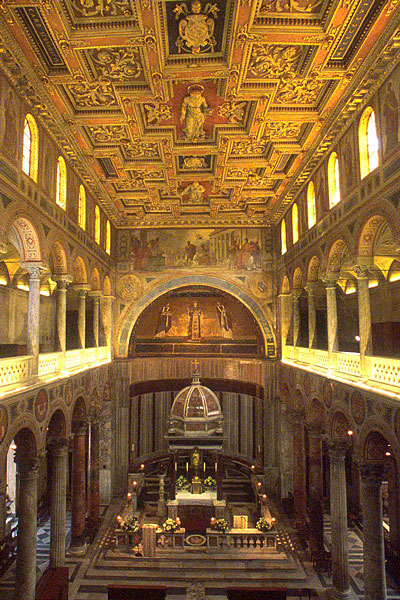
Interior, Church of Sant' Agnese fuori le mura
Roman, 7th century
Rome


Church of Sant' Agnese fuori le mura, Floor level view
Roman, 7th century
Rome


Saint Agnes with Popes Symmachus and Honorius
Late Antique Apse Mosaic, 7th Century
Rome, Church of Saint'Agnese fuori le Mura


One feature of these large basilican cemeteries was that they were often the locations at which wealthy Christians chose to build their own tombs. Helena, Constantine’s mother, built her tomb adjacent to the cemetery basilica which adjoined the catacomb containing the graves of the martyrs Marcellinus and Peter off the via Labicana.6

Her granddaughter, Constantine’s daughter Constantina, built her mausoleum next to the cemetery basilica of Agnes (coemeterium Agnetis).7   It still stands next to the via Nomentana, although the adjoining cemetery basilica is now in ruins. Now called Santa Constanza (and converted into a church), it preserves some of the earliest mosaic decorations which incorporate Christianized classical images.


Exterior view of Santa Costanza showing remains of the 4th century cemetery basilica walls
Roman, 4th century
Rome, Church of Santa Costanza 


The vaulting famously includes images of classical putti (what today we would call “cherubs”) cavorting amid entwining grape vines during a grape harvest, a possible Eucharistic reference.

Vault Mosaic Showing Putti Harvesting Grapes
Roman, 4th Century
Rome, Church of Santa Costanza


Also decorating the vaults are images of birds, flowers, fruits and serving vessels.  Again these are open to Christian interpretations, or they may simply be a continuation of Roman decorative wall paintings and mosaics.


Vault Decoration
Roman, 4th Century
Rome, Church of Santa Costanza


In the two small apses are mosaics depicting the Tradito Legis and Christ as Pantocrator Giving the Keys to Saint Peter (Traditio Clavum).


Traditio Legis Mosaic
Roman, 4th century
Rome, Church of Santa Costanza


Traditio Clavum Mosaic
Roman, 4th century
Rome, Church of Santa Costanza

The nearby cemetery basilica of Saint Agnes is still partially standing as well.  

All this for a young, but tenacious, teenager who could neither be dissuaded nor bullied into abandoning her faith.

© M. Duffy, 2012, pictures updated and new material added 2023, restructured with updated and new images 2024.
_________________________________________
1. Published in 1819. The full text can be read at http://www.bartleby.com/126/39.html

2. For the Pre-Raphaelites see, http://www.victorianweb.org/painting/prb/1.html

3. The text of Eucharistic Prayer #1 can be accessed at http://old.usccb.org/romanmissal/samples-priest-prayer1.shtml

4. Butler, Rev. Alban. Lives of the Saints, New York, Benziger Brothers, 1894, pp. 43-44.

5. Krautheimer, Richard. “Mensa-Coemeterium-Martyrium” in Studies in Early Christian, Medieval and Renaissance Art, New York, New York University Press, 1969, pages 35-58. and Rome, Profile of a City, 312-1308, Princeton, NJ, Princeton University Press, 2000, p. 24-25.  In ancient Rome (from pagan times onwards) no burials were allowed inside the walls.

6. Krautheimer, op cit.

7. Krautheimer, op cit.

*  The basilica is a type of building we still have with us, though its purpose has been modified.  Originally, basilicas were all-purpose civil buildings (as opposed to temples).  They were basically plain structures on the outside, though they could be elaborate on the inside.  They followed a basic plan, with usually a straight entrance wall, straight side walls and a rounded end, called an apse.  They could serve various functions, often used as law courts, with the judges seated at the apsidal end.  In the German city of Trier the basilica that was used as a throne room by the Roman Emperors when Trier was the second capital of the Empire in the West still survives, converted to a church.  When Christians were able to build churches for the first time, the basilica offered a ready made plan that had no unwelcome associations with the temples of the pagan or even of the Jewish world.  And it had the Imperial backing of Constantine, who ordered the construction of the first two great basilican churches, Saint John Lateran and Saint Peter on Vatican hill.


Sunday, June 5, 2011

Why Contemporary Christian Art Is Lame and/or Dreadful

Oliviero Rainaldi, Pope John Paul II
Italian, 2011
Rome, Piazza Giovanni Paolo II


Within the last few weeks I have picked up on a series of news items and of blog entries by Steven Greydanus and the discussions they have provoked.


 The news stories were about a newly unveiled statue by Oliviero Rainaldi of Blessed Pope John Paul II recently placed in the square named for the Pope near the Termini train station in Rome,


Robert Graham, Our Lady of the Angels
American, 2002
Los Angeles, Our Lady of the Angels Cathedral
while the blog postings were in regard to a statue of the Blessed Virgin Mary by Robert Graham in Los Angeles’ Our Lady of the Angels cathedral.

Generally, the reactions to both of these statues were deeply negative.


In 2008, when I began blogging, this kind of subject matter was much on my mind and was among the first subjects I wrote about. This was in a series of three essays, titled “Why Christian Art is Lame #1, 2 and 3”. I’ve summarized these below and added some additional points, as well.


1. The idiom of art no longer speaks the idiom of human form. Since the second century Christian art has been a figural art, rather than a symbolic one. As the introduction to my blog (over on the right) points out, this is unique among the monotheistic religions. Both Judaism and Islam forbid the making of images of God. Christianity, because of its incarnational basis, is friendly to images, although there have been periods and places where iconoclasm has done much damage. Indeed, Christian art, for most of its history has been primarily based on images of God the Father, Jesus, Mary and the saints and angels. Furthermore, as the Gospels make clear, the people and events they describe occurred in a particular place and at a particular time, not in some misty mythological realm.  For example, the familiar narrative of the birth of Jesus places it firmly in a historical and geographic context:  "In those days a decree went out from Caesar Augustus that the whole world should be enrolled. This was the first enrollment, when Quirinius was governor of Syria. So all went to be enrolled, each to his own town. And Joseph too went up from Galilee from the town of Nazareth to Judea, to the city of David that is called Bethlehem, because he was of the house and family of David, to be enrolled with Mary, his betrothed, who was with child." (Luke 2:1-5)

But it isn’t iconoclasm that has caused the current problems for Christian art. The problem lies instead in the way in which contemporary art deals, or better, doesn’t deal with human form.

Gustav Klimt, Adele Bloch-Bauer
Austrian, 1907
New York, Neue Galerie
 
 
Since the middle of the 19th century, beginning with the early Impressionists, artists have flattened, decomposed, fractured and abstracted the human shape until it has virtually disappeared. It has become more and more difficult for artists to tell the Christian story, using a visual vocabulary that does not support a visual story.


2. Much “Christian” art is often nothing better than sentimental eye candy. Alongside the problem of bodily distortions and eventual disappearance, is the problem of images that, while readable, have become trivialized and pedestrian. In other words, much of the “Christian art” of the last 150 years or so has been diluted by a spirit of sentimentality and wish not to give offense.

This trend can begin to be seen in some of the art of the first half of the 19th century, especially in the work of the German Nazarenes and the English Pre-Raphaelites. A popular image from the very beginning of this strain is William Holman Hunt’s “Light of the World” (Manchester, City Galleries). Painted in 1851-52, this work illustrates the passage from Revelation that reads:  Behold, I stand at the door and knock. If anyone hears my voice and opens the door, I will enter his house and dine with him, and he with me. (Revelation, 3:20)


William Holman Hunt, The Light of the World
English, 1852
Oxford, Keble College


Warner Sallman, Christ at the Heart's Door
American, 1940s
Anderson University, Indiana


While Holman Hunt’s image still retains some of the mystery and awe that had attended images of Christ from the earliest times, it also stands at the beginning of a series of images that progressively sentimentalized, trivialized and domesticated Christ and His presence. We all know the results of this process. We have lived with it all our lives, from the “gentle Jesus, meek and mild” image of countless Good Shepherd pictures, to the works of Warner Sallman to innumerable devotional images of the Sacred Heart. In contrast to the portrayals of Christ in earlier art, where Christ is presented as a solid personality, in this strain of art Jesus is presented, as almost hollow, somehow lacking in personality and uniformly pretty.

Add to this abstraction of personality the visual abstraction that has taken place since the 19th century and one finds that recent Christian art no longer has much contact with a concrete reality, with the Incarnation in fact. It can be difficult to see in the late-19th and earlier-20th-century mild mannered Jesus or in the late-20th/early-21st-century abstract Christ any relation to a living person, who is also God. The balance between the man and the Godhead has vanished into a dreamlike state of unreality. This Jesus is shown as already living in eternity, where no human emotion exists and, therefore, lacking in anything that might engage our own emotions.


3. There has been a disconnect between patron and artist. Art is and has always been an expensive proposition. It is not one of the necessities of life. On the contrary, it is a product of leisure and thought. Even the cave dwellers needed to have gained enough food to provide them with the leisure to take the time to grind up their colors, plan their designs, practice making them and, finally, place the final designs on the walls of their caves. 

Ahkenaten and His Family Offering to the Aten
Egyptian, 18th Dynasty
Cairo, Egyptian Museum


From the beginning of art history the work of the artist has been intimately linked with the requirements of the patron. This is as true for the art of Amarna, where the pharaoh, Ahkenaten, requested from his artists an entirely new iconography to serve his new, single God, the Aten, as it is for the art of Michelangelo, as he struggled with both the demands of his own muse and the demands of Pope Julius II in creating the ceiling of the Sistine Chapel .

Up to the time of the Enlightenment and the French Revolution the Church was one of the primary sources of patronage for artists. The other primary source of patronage was European royalty and nobility. Frequently, the two sources of patronage were in agreement. The Church commissioned works for itself and royal and noble patrons also commissioned works for the Church. In both cases the religious works of artists were as important to their survival as their secular works.

This symbiotic relationship came to an end under the triple pressures of the Enlightenment, French Revolution and Industrial Revolution. As a secular art market developed, with sales and commissions more and more frequently being handled by specialist art dealers, the importance of both the religious and noble art commission diminished. The style and subjects of art changed, with domestic scenes, landscapes, portraits taking a greater and greater share of artistic production. As the inheritance of the Revolution spread throughout the 19th and 20th centuries, fewer and fewer artists turned their thought to religious themes, while the forms of art went farther and farther from readable human forms suitable for the depiction of Christian themes.

At the same time, Church patronage became more and more conservative. New churches, whether Catholic or Protestant, were usually constructed to reflect historic styles: Neo-Gothic, Neo-Classical, Neo-Byzantine, Neo-Renaissance. This often resulted in beautiful spaces, but it also meant that, by the first quarter of the 20th century, religious art and high art flowed in entirely different and often antagonistic channels.

Those artists who chose to pursue a career in high art frequently held beliefs quite opposed to Christian, or indeed any, religious belief. There are a few who seem to have been able to bridge the gap, but they stand out in art history by this very uniqueness. In addition, the art establishment tends to reward those who do not express religious content in their work. “Spiritual” content may be acceptable, but not religious content that references Christian belief.

Consequently, it is now very difficult for patrons of religious art to find persons who have both high contemporary style and who can imbue their productions with an inner core of belief. One can easily see why contemporary religious commissions appear somewhat awkward and self-conscious in a way the work of earlier periods never did. 


4. The rise of individualism and the exaltation of personal style. Prior to the Renaissance visual artists were considered to be artisans, what we would call crafts persons, albeit on a higher level than a carpenter, for example. The basic understanding was that an artist was a manual worker, not a person who dealt with abstract ideas, therefore, not on a par with a learned person such as a philosopher, theologian or doctor. The understanding was also that the “program” for a work of art, at least beyond the level of the most basic images, would be set up by a learned person, often the patron or a scholar in the service of the patron. However, as the Renaissance progressed, it became increasingly common to view the artist more and more as a learned person in his or her own right, as someone who gave visual form to abstract or internally set ideas and, therefore, equal to those same scholarly professionals.1 By the time Giorgio Vasari wrote his Lives of the Most Eminent Painters, Sculptors and Architects in the second half of the 16th century, the idea of the artist as hero and genius had been well established. As the centuries passed, the position of artists rose and fell somewhat, but generally the trend was always upward. By the beginning of the 20th century artists were in the forefront of the rising tide of modernism. We need only think of such artists as Picasso, Matisse, Pollack and Rothko, sculptors such as Giocometti and Calder and architects such as Mies van der Rohe and Le Corbusier to see the impact they have had on our visual surroundings.  An excellent comparison may be made between two buildings, built 40 years apart, that stand within two blocks of each other on Manhattan's Park Avenue:

Bertram Goodhue, The Church of Saint Bartholemew
American, 1918
New York, NY

Saint Bartholemew's Episcopal Church of 1918, built in Romanesque style by Bertram Goodhue (with portico from the previous church by Stanford White) and the Seagram Building, built in 1958 by Ludwig Mies van der Rohe.


Mies van der Rohe, Seagram Building
German, 1958
New York, NY


All this contributes to reason #5.


5. A reversal of roles between the artist and the patron. In past eras the position of artist and patron was, at least to a degree, one of servant and master. The artist wished to please the patron by carrying out his or her wishes and instructions. And the patron understood that he or she held “the power of the purse strings” and could accept or reject the final work to the degree that it fulfilled his or her intent. Because of the change in the status of artists there has been something of a reversal in position. The patron now may be less inclined to set specific conditions for a work and more inclined to accept the work produced as an expression of the artist’s personal genius than might have been true in the past. Further, the change in how artists earn a living, i.e., the existence of a secular art market, means that commissions, while sought after and welcome, are not the sole way in which artists can sell their work. This makes the artist less dependent on pleasing the patron.

Consequently, roles have reversed, at least to some extent. The would-be patron, once having chosen an artist for a commission, may relinquish control over the final product. Modern contracts may also be less favorable to the patron than to the artist. In addition, as many commissions are for major, expensive works, decisions are likely to be made by a committee, always a difficult method of reaching a successful outcome.

6. Lack of visual literacy on the part of decision makers. Probably the majority of patrons, whether clerical or lay, for contemporary ecclesiastical art have little background in the visual arts. Decisions, even those open to competition, may be based on sketches or even written descriptions of the work to be carried out. The decision makers may have done little or no research into the prior work of the artist being commissioned or may be basing the decision on having seen a small group of works. This can result in problems of scale (too big or too small for a space) as well as in confusion or difficulty in the visual reading of the finished work. Finally, lack of literacy can make the patron(s) more deferential to the artist and, therefore, less willing to challenge him or her than might otherwise be the case.

7. The uncritical embrace of the new. Finally, some church decision makers have been largely uncritical in their embrace of the “new” and too eager to “throw the baby out with the bathwater”. This was particularly true in the period immediately after Vatican II when some churches were “updated” for the liturgical changes. Some unfortunate church buildings were subjected to what amounted to a new iconoclasm and were virtually stripped of their furnishings. Some of the worst examples of this that I have seen were perpetrated in Ireland. 

One particularly egregious example was Saint Mel’s Cathedral in Longford where the interior of a beautiful Neo-Classical building was almost entirely ripped out and inappropriate modern interior furnishings were substituted.


Joseph B. Keane, Saint Mel's Cathedral
Irish, 1840-1853
Longford, Co. Longford
(A picture of the nave taken in the late 19th century)


Joseph B. Keane, Saint Mel's Cathedral
Irish, 1840-1853, remodeled 1970-1975
Longford, Co. Longford
(Picture taken before the fire on December 25, 2009)


The effect was as if a human being had been eviscerated, vacant and sad. The interior of the building was subsequently destroyed by a fire in the early hours of Christmas Day 2009. It is now being restored and one hopes that it will be restored in a more appropriate manner.

New church buildings were also built in severely modern style, often on a non-human scale and without ornamentation or with minimalist, abstract ornament. Whatever the intent, the result has often been bleak and unwelcoming.

These comments may raise the question of whether it is possible for there to be works of modern art that are both beautiful and respectful of Christian tradition and history. The answer is that, happily, it is. While I have been rather severe in criticism of the situation in Ireland I have seen many accomplishments there since the very bleak days of the 1970s. One of the most astoundingly beautiful sets of modern stained glass I have ever seen was installed during the late 1980s in my mother’s home church, Saint Kentigern in Eyeries, Co. Cork. While definitely modern, they are full of human warmth and have iconography that is very easy to read. (Photo is mine.)

George William Walsh, Annunciation and Nativity Window
Irish, 1980s
Eyeries, Co. Cork, Ireland Church of Saint Kentigern

 
Similarly, in many older churches, poor quality modern work, installed during the late 1960s and 1970s, has been removed and replaced by furnishings more in keeping with the dignity of the space and of the liturgy that takes place within it.

For instance, in my home parish in New York, Saint Jean Baptiste, several beautiful elements were removed from the upper church in the 1960s and replaced by poor quality modern. However, starting in the late 1980s, some of the older elements have been replaced or reimagined and new work commissioned in the same style as the church, which opened in 1913.

Altar of Sacrifice, Church of Saint Jean Baptiste
American, c. 1910-1913
New York, NY
This altar, now in use as the principal altar for the celebration of Mass in the main church, was originally the altar of the secondary, lower church (no longer in use).  It was moved to the main church during a restoration in the late 1990s to replace an incongruously modern altar that was placed in the church during remodeling in 1968.  Its classic style is in harmony with the elaborately decorated Beaux-Arts Baroque design of the church and its decoration.

_________________________________________
1. Martindale, Andrew. The Rise of the Artist in the Middle Ages and Early Renaissance, New York, McGraw-Hill, 1972.

© M. Duffy, 2011