,%20c.%201385-1390_Paris,%20BNF_MS%20Latin%2018014,%20fol.%2073r.jpg) |
| *Jacquemart de Hesdin, Saints Peter and Paul Baptizing From the Petites Heures of Jean de Berry French (Bourges), c. 1385-1390 Paris, Bibliotheque nationale de France MS Latin 18014, fol. 73r |
June 29th is the combined feast of the two patrons of Christian Rome, Saint Peter and Saint Paul. These two men, the outspoken Galilean fisherman and the Jerusalem-educated sailmaker from Tarsus, the apostle who walked with (and denied and loved) Jesus and the persecutor-turned-apostle, both died in the city that was the capital of the Roman Empire within a short space of each other and the sites of their burials are among the earliest of Christian churches. Peter is particularly honored today as the bedrock of the Roman diocese and, by extension, of the universal Church. The Gospel for today recounts the scene from the Gospel of Matthew, sometimes called “The Giving of the Keys” that includes the statement:
“I say to you, you are Peter,
and upon this rock I will build my Church,
and the gates of the netherworld shall not prevail against it.
I will give you the keys to the Kingdom of heaven.
Whatever you bind on earth shall be bound in heaven;
Excerpt from the Gospel for June 29, 2012and upon this rock I will build my Church,
and the gates of the netherworld shall not prevail against it.
I will give you the keys to the Kingdom of heaven.
Whatever you bind on earth shall be bound in heaven;
and whatever you loose on earth shall be loosed in heaven.” (Matthew 16:18-19)
However, today I am going to concentrate on the First Reading for the Mass of today. This reading from the Acts of the Apostles recounts the miraculous liberation of St. Peter from imprisonment in Jerusalem by Herod.
"On the very night before Herod was to bring him to trial,
Peter, secured by double chains,
was sleeping between two soldiers,
while outside the door guards kept watch on the prison.
Suddenly the angel of the Lord stood by him
and a light shone in the cell.
He tapped Peter on the side and awakened him, saying,
"Get up quickly."
The chains fell from his wrists.
The angel said to him, "Put on your belt and your sandals."
He did so.
Then he said to him, "Put on your cloak and follow me."
So he followed him out,
not realizing that what was happening through the angel was real;
he thought he was seeing a vision.
They passed the first guard, then the second,
and came to the iron gate leading out to the city,
which opened for them by itself.
They emerged and made their way down an alley,
and suddenly the angel left him.” (Acts 12:6-10)
Excerpt from First Reading for June 29, 2012
Peter, secured by double chains,
was sleeping between two soldiers,
while outside the door guards kept watch on the prison.
Suddenly the angel of the Lord stood by him
and a light shone in the cell.
He tapped Peter on the side and awakened him, saying,
"Get up quickly."
The chains fell from his wrists.
The angel said to him, "Put on your belt and your sandals."
He did so.
Then he said to him, "Put on your cloak and follow me."
So he followed him out,
not realizing that what was happening through the angel was real;
he thought he was seeing a vision.
They passed the first guard, then the second,
and came to the iron gate leading out to the city,
which opened for them by itself.
They emerged and made their way down an alley,
and suddenly the angel left him.” (Acts 12:6-10)
Excerpt from First Reading for June 29, 2012
The illustrations for this passage from Acts range from barebones representations in the early medieval period to complex works of the late Baroque. At the beginning representations are almost schematic. They feature the bare minimum needed to tell the story: Saint Peter, the angel and a suggestion of prison walls.
_11th-12th%20c_Nouvelle%20acquisition%20latine%202246,%20fol%20113v_2.jpg) | |
|
_ca.%201225-1250_Morgan_M.711,%20fo.%2025r.jpg) |
| Initial N, The Liberation of Saint Peter From a Gradual, Sequentiary, Sacramentary German (Weingarten), c. 1225-1250 New York, Pierpont Morgan Library MS M.711, fol. 25r |
Later on, there is a fairytale quality to the representation: St. Peter and the angel appear much larger than the tiny symbolic prison.
_14th%20c_BNF_Francais%20152,%20fol%20457v_2.jpg) | |
|
 |
| The Liberation of Saint Peter, West Facade Tympanum German (Regensburg), c. 1411-1421 Regensburg, Cathedral of Saint Peter |
 |
Claes Brouwer and the Alexander Master, The Liberation of Saint Peter From a Historiated Bible Dutch (Utrecht), c. 1430 The Hague, Koninklijk Bibliothek MS KB 78 D 3811, fol. 213v |
_commissioned%20for%20Beauvais,%20part%20of%20set,%201460_Paris,%20Cluny.jpg) |
| Tapestry, The Liberation of Saint Peter Flanders (Tournai), 1460 Part of a set commissioned for the Cathedral of Beauvais Paris, Musée de Cluny, musée national du Moyen Âge |
It remained for the Ranaissance to bring the picture into focus, as it were. The prison is now in scale (mostly) with the figures.
 |
| +Filippino Lippi, Saint Paul Visiting Saint Peter in Prison Italian, c. 1481-1482 Florence, Church of Santa Maria del Carmine, Brancacci Chapel |
 |
| +Filippino Lippi, The Liberation of Saint Peter Italian, c. 1481-1482 Florence, Church of Santa Maria del Carmine, Brancacci Chapel |
But it is Raphael, in his design for the depiction of the scene surrounding one of the doors in the Stanza d’Eliodoro at the Vatican Palace in 1514 that finally “set the scene” firmly in time and space.
Raphael tells the story in three sections: a scene of the guards outside the prison on the left, the scene of the sleeping Peter being roused by the angel in the center and the scene of the angel leading Peter out of the prison on the right.
 | |
|
Raphael tells the story in three sections: a scene of the guards outside the prison on the left, the scene of the sleeping Peter being roused by the angel in the center and the scene of the angel leading Peter out of the prison on the right.
 |
| +Raphael and Assistants, The Liberation of Saint Peter Left Section |
 |
| +Raphael and Assistants, The Liberation of Saint Peter Central Section |
 | |
|
Leading the way to the future is Raphael’s exploration of the effects of light. We see the effect of moonlight as well as the mysterious light that emanates from the angel.
This is quite different from the flat lighting that was seen in earlier images and leads to the development, which gathered strength during the century after Raphael and leads to the Baroque experiments with light and darkness that sprang from the work of Caravaggio and his followers.
We can see this in later representations of the Liberation of Peter by Steenwyck, Carraciolo, and others.
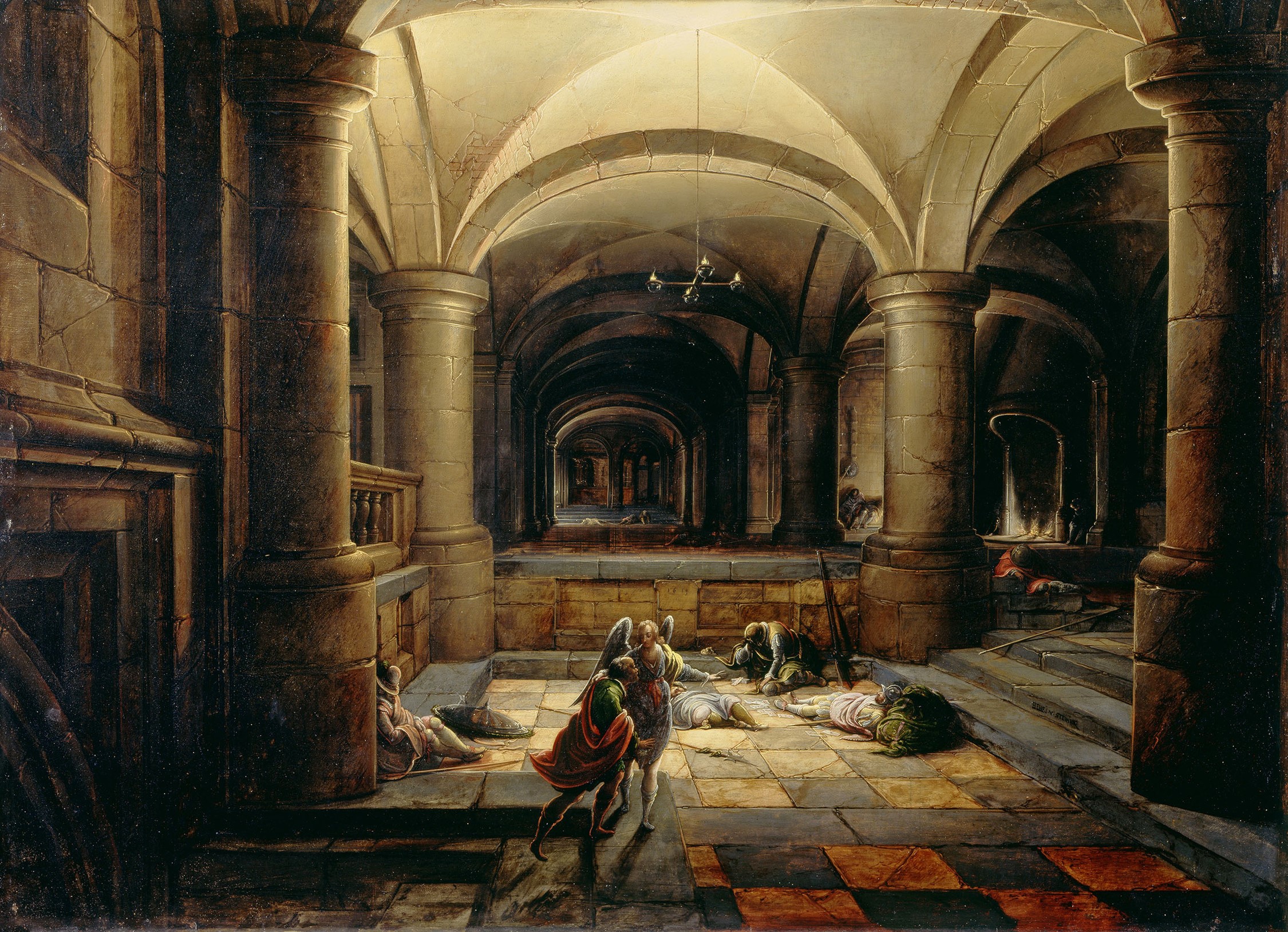 |
| +Hendrick van Steenwyck the Younger, The Liberation of Saint Peter Dutch, Oil on copper, 1619 Hampton Court Palace, Royal Collections Trust |
_LIberation%20of%20Peter_Naple,%20Museo%20Nazionale%20di%20Capodimonte_1615.jpg) |
| Giovanni Batista Carrociolo, The Liberation of Saint Peter Italian, 1615 Naples, Museo Nazionale di Capodimonte |
 |
| Antonio de Pereda, The Liberation of Saint Peter Spanish, c. 1643 Madrid, Museo Nacional del Prado |
 |
| Mattia Preti, The Liberation of St. Peter Italian, c. 1650-1660 Vienna, Akademie der bildenden Künste |
 |
| Bartolome Murillo, The Liberation of Saint Peter Spanish, 1667 St. Petersburg, State Hermitage Museum |
 |
| Gerrit van Honthorst, The Liberation of Saint Peter Dutch, c. 1616-1618 Berlin, Gemäldegalerie der Staatliche Museen zu Berlin |
 |
| Guercino, The Liberation of Saint Peter Italian, c. 1620-1623 Madrid, Museo Nacional del Prado |
 |
| Sebastiano Ricci, The Liberation of Saint Peter Italian, 1722 Venice, Church of San Stae |
Peter was led out of prison in Jerusalem to spread the Gospel and lead the Church in its formative years. Eventually, he came to Rome where he was again imprisoned and, finally, executed in the circus of Nero at the base of the Vatican hill, across the Tiber from Imperial Rome. Afterwards he was buried in the cemetery across the road from his place of death and, in the year 319 Constantine began construction of a large basilican church above his grave. Today, Pope Benedict XVI, the 265th successor of Peter, and Metropolitan Emmanuel Adamakis, leader of the Greek Orthodox in France, representing Patriarch Batholemew I of Constantinople, the successor of Peter's brother, Andrew, prayed together above Peter's tomb, while the combined choirs of the Sistine Chapel and Westminster Abbey (Anglican) sang the moving anthem "Tu es Petrus" ("You are Peter", quoted from the Gospel reading of the day) by Lorenzo Perosi (1872-1956). It was quite a moment!
© M. Duffy, 2012. Selected images updated and new material added 2024.
* Indicates new material
+ Indicates updated image


