Showing posts with label St. Paul. Show all posts

Saturday, June 30, 2012

Peter and Paul and Jerusalem


*Jacquemart de Hesdin, Saints Peter and Paul Baptizing
From the Petites Heures of Jean de Berry
French (Bourges), c. 1385-1390
Paris, Bibliotheque nationale de France
MS Latin 18014, fol. 73r
June 29th is the combined feast of the two patrons of Christian Rome, Saint Peter and Saint Paul. These two men, the outspoken Galilean fisherman and the Jerusalem-educated sailmaker from Tarsus, the apostle who walked with (and denied and loved) Jesus and the persecutor-turned-apostle, both died in the city that was the capital of the Roman Empire within a short space of each other and the sites of their burials are among the earliest of Christian churches.  Peter is particularly honored today as the bedrock of the Roman diocese and, by extension, of the universal Church. The Gospel for today recounts the scene from the Gospel of Matthew, sometimes called “The Giving of the Keys” that includes the statement: 
“I say to you, you are Peter,
and upon this rock I will build my Church,
and the gates of the netherworld shall not prevail against it.
I will give you the keys to the Kingdom of heaven.
Whatever you bind on earth shall be bound in heaven;
and whatever you loose on earth shall be loosed in heaven.” (Matthew 16:18-19)
Excerpt from the Gospel for June 29, 2012

However, today I am going to concentrate on the First Reading for the Mass of today. This reading from the Acts of the Apostles recounts the miraculous liberation of St. Peter from imprisonment in Jerusalem by Herod.
"On the very night before Herod was to bring him to trial,
Peter, secured by double chains,
was sleeping between two soldiers,
while outside the door guards kept watch on the prison.
Suddenly the angel of the Lord stood by him
and a light shone in the cell.
He tapped Peter on the side and awakened him, saying,
"Get up quickly."
The chains fell from his wrists.
The angel said to him, "Put on your belt and your sandals."
He did so.
Then he said to him, "Put on your cloak and follow me."
So he followed him out,
not realizing that what was happening through the angel was real;
he thought he was seeing a vision.
They passed the first guard, then the second,
and came to the iron gate leading out to the city,
which opened for them by itself.
They emerged and made their way down an alley,
and suddenly the angel left him.” (Acts 12:6-10)
Excerpt from First Reading for June 29, 2012


The illustrations for this passage from Acts range from barebones representations in the early medieval period to complex works of the late Baroque. At the beginning representations are almost schematic. They feature the bare minimum needed to tell the story: Saint Peter, the angel and a suggestion of prison walls.


+The Liberation of Saint Peter
From Lectionarium officii s. petri cluniacensis, 
France (Cluny), c. 11th-12th Century
Paris, Bibliotheque nationale de France
MS NAL 2246, fol. 113v


Initial N, The Liberation of Saint Peter
From a Gradual, Sequentiary, Sacramentary
German (Weingarten), c. 1225-1250
New York, Pierpont Morgan Library
MS M.711, fol. 25r


Later on, there is a fairytale quality to the representation: St. Peter and the angel appear much larger than the tiny symbolic prison.


+The Liberation of Saint Peter
From a Bible historiale by Guiard des Moulins,
France (St. Omer), 14th Century
Paris, Bibliotheque nationale de France
MS Francais 152, fol. 457v


The Liberation of Saint Peter, West Facade Tympanum
German (Regensburg), c. 1411-1421
Regensburg, Cathedral of Saint Peter


Claes Brouwer and the Alexander Master, The Liberation of Saint Peter
From a Historiated Bible
Dutch (Utrecht), c. 1430
The Hague, Koninklijk Bibliothek
MS KB 78 D 3811, fol. 213v


Tapestry, The Liberation of Saint Peter
Flanders (Tournai), 1460
Part of a set commissioned for the Cathedral of Beauvais
Paris, Musée de Cluny, musée national du Moyen Âge


It remained for the Ranaissance to bring the picture into focus, as it were. The prison is now in scale (mostly) with the figures.


+Filippino Lippi, Saint Paul Visiting Saint Peter in Prison
Italian, c. 1481-1482
Florence, Church of Santa Maria del Carmine, Brancacci Chapel


+Filippino Lippi, The Liberation of Saint Peter 
Italian, c. 1481-1482
Florence, Church of Santa Maria del Carmine, Brancacci Chapel


But it is Raphael, in his design for the depiction of the scene surrounding one of the doors in the Stanza d’Eliodoro at the Vatican Palace in 1514 that finally “set the scene” firmly in time and space.


+Raphael and Assistants, The Liberation of Saint Peter
Italian, 1514
Vatican City, Vatican Museums, Stana d'Eliodoro


Raphael tells the story in three sections: a scene of the guards outside the prison on the left, the scene of the sleeping Peter being roused by the angel in the center and the scene of the angel leading Peter out of the prison on the right.


+Raphael and Assistants, The Liberation of Saint Peter
Left Section


+Raphael and Assistants, The Liberation of Saint Peter
Central Section


+Raphael and Assistants, The Liberation of Saint Peter
Right Section


Leading the way to the future is Raphael’s exploration of the effects of light. We see the effect of moonlight as well as the mysterious light that emanates from the angel.

This is quite different from the flat lighting that was seen in earlier images and leads to the development, which gathered strength during the century after Raphael and leads to the Baroque experiments with light and darkness that sprang from the work of Caravaggio and his followers.

We can see this in later representations of the Liberation of Peter by Steenwyck, Carraciolo, and others.
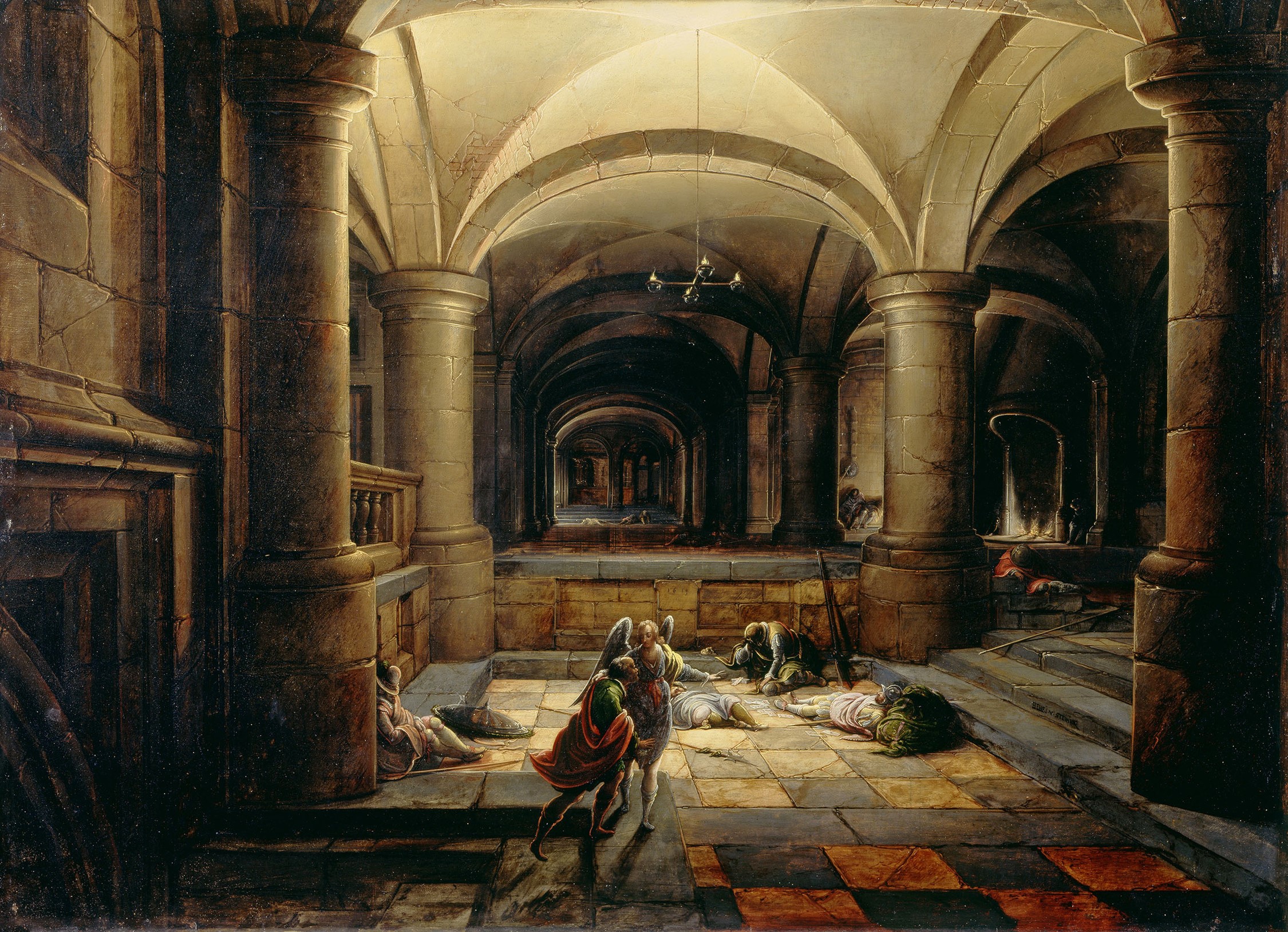


+Hendrick van Steenwyck the Younger, The Liberation of Saint Peter
Dutch, Oil on copper, 1619
Hampton Court Palace, Royal Collections Trust


Giovanni Batista Carrociolo, The Liberation of Saint Peter
Italian, 1615
Naples, Museo Nazionale di Capodimonte


Antonio de Pereda, The Liberation of Saint Peter
Spanish, c. 1643
Madrid, Museo Nacional del Prado


Mattia Preti, The Liberation of St. Peter
Italian, c. 1650-1660
Vienna, Akademie der bildenden Künste


Bartolome Murillo, The Liberation of Saint Peter
Spanish, 1667
St. Petersburg, State Hermitage Museum


And, along with the the movement introduced by the play of light, comes movement in the composition.   The angel no longer approaches sedately, instead he bursts into the picture, full of energy, to arouse Peter from sleep, to extract him from his chains and to lead him out. 


Gerrit van Honthorst, The Liberation of Saint Peter
Dutch, c. 1616-1618
Berlin, Gemäldegalerie der Staatliche Museen zu Berlin


Guercino, The Liberation of Saint Peter
Italian, c. 1620-1623
Madrid, Museo Nacional del Prado


Sebastiano Ricci, The Liberation of Saint Peter
Italian, 1722
Venice, Church of San Stae


Peter was led out of prison in Jerusalem to spread the Gospel and lead the Church in its formative years.  Eventually, he came to Rome where he was again imprisoned and, finally, executed in the circus of Nero at the base of the Vatican hill, across the Tiber from Imperial Rome.  Afterwards he was buried in the cemetery across the road from his place of death and, in the year 319 Constantine began construction of a large basilican church above his grave.  Today, Pope Benedict XVI, the 265th successor of Peter, and Metropolitan Emmanuel Adamakis, leader of the Greek Orthodox in France, representing Patriarch Batholemew I of Constantinople, the successor of Peter's brother, Andrew, prayed together above Peter's tomb, while the combined choirs of the Sistine Chapel and Westminster Abbey (Anglican) sang the moving anthem "Tu es Petrus" ("You are Peter", quoted from the Gospel reading of the day) by Lorenzo Perosi (1872-1956).  It was quite a moment!


©  M. Duffy, 2012.  Selected images updated and new material added 2024.
* Indicates new material
+ Indicates updated image


Sunday, January 25, 2009

The Conversion of Saint Paul and the Two Michelangelos

 Michelangelo Buonarroti, The Conversion of Saint Paul
Italian, c. 1542-1545
Vatican City, Apostolic Palace, Pauline Chapel


"On that journey as I drew near to Damascus,
about noon a great light from the sky suddenly shone around me.
I fell to the ground and heard a voice saying to me,
'Saul, Saul, why are you persecuting me?'
I replied, 'Who are you, sir?'
And he said to me, 'I am Jesus the Nazorean whom you are persecuting.'
My companions saw the light but did not hear the voice of the one who spoke to me.
I asked, 'What shall I do, sir?'
Acts 22: 6-10


With these words Saint Paul described the powerful experience that befell him on the road to Damascus, an experience that completely reshaped his life. From that point on, the persecutor of the Way in Jerusalem became the great apostle of the Way to the entire world, to Jew and Gentile alike. From this point on the man who had held the cloaks of those who had stoned Saint Stephen to death for proclaiming Jesus the Nazorean as Lord, was himself persecuted, imprisoned and martyred for the sake of that same Jesus. From that time on Saul of Tarsis became Paul, the preacher and teacher.

There are few more dramatic moments in the history of the early church than this event on the road between Jerusalem and Damascus. It is a drama that has received considerable attention from some of the world’s greatest artists. Among the greatest to have tackled it are two Michelangelos: Michelangelo Buonarotti (known as “Michelangelo”) and Michelangelo Merisi da Caravaggio (known as “Caravaggio”).

Both men initially imagined the scene as one of high drama and activity. Indeed, Michelangelo imagined it, in his great late painting in the Vatican’s Pauline Chapel (painted 1542-1545), as an event involving large, active groups of figures in both heaven and earth. From heaven, Christ, surrounded by many other figures (angels, saints) plunges dramatically downward, a bolt of lightening springing from his hand, almost in the manner of the classical deity, Jupiter. The bolt hits the earthly group, which centers on the figure of Saul, lying on the ground, with his arm shielding his face, as a companion supports him. Other companions react by trying to shield themselves, or trying to flee, or simply by cowering, while one person tries to recapture Saul’s startled horse. Michelangelo’s Saul appears curiously older than he is usually depicted, being white bearded. He appears to bear a slight resemblance to Michelangelo himself. One wonders if there was some biographical content in his image. Or is it simply that he wanted to balance the older Saint Peter, whose martyrdom is depicted on the opposite wall of the Pauline Chapel?

Michelangelo Buonarroti, The Conversion of Saint Paul (detail)
Italian, c. 1542-1545
Vatican City, Pauline Chapel


In the composition, Michelangelo recapitulates some of his work in the Sistine Chapel, especially the “Last Judgment”, while harking back as well to such early Florentine works as the long-vanished “Battle of Cascina”.

 
Caravaggio painted two very different representations of the event on the road to Damascus relatively early in his career (both are dated as being circa 1600). The first version is usually called “The Conversion of Saul” and resides in the Odescalchi Balbi Collection in Rome. It is typical of many of Caravaggio’s compositions from around this time. (One thinks, for example, of the “Martyrdom of St. Matthew” in the Contarelli Chapel of San Luigi dei Francesi in Rome). There is a great rush of movement from the upper right where Christ and a supporting angel appear to plummet down, toward the lower left, where Saul lies, his hands covering his face. Caravaggio, of course, was the master of dramatic lighting effects, his great legacy to almost all later painters. And there is plenty of drama in the way in which the light from heaven illumines the face of the angel, the hands of Christ, the face of Saul’s startled companion and finally swells to a crescendo on Saul’s body and protective hands. This painting, commissioned by Cardinal Tiberio Cerasi for his chapel in the church of Santa Maria del Popolo in Rome, was never installed there. It was recently cleaned and exhibited in Milan during Advent 2008.


Michelangelo Merisi called Caravaggio, The Conversion of Saint Paul
Italian, c. 1600
Rome, Odescalchi Balbi Collection


The second version, which did get installed in the Cerasi Chapel, where it remains today, is often called “The Road to Damascus”. It is an extraordinary painting. Instead of a narrative full of frantic movement we are faced with the experience itself. With our vision blocked by the body of Saul's horse, we are, as it were, inside the silent center of the experience at the moment it happens. We are one of Saul’s companions. We see him in his weakness, his shock, his blindness. 


Michelangelo Merisi called Caravaggio, The Conversion of Saint Paul
Italian, c. 1600-1601
Rome, Santa Maria del Popolo, Cerisi Chapel


We see him sprawled on his back, in a tangle of arms and legs: his own and those of his horse and other companion. We do not see the cause of his fall, we see, as his companions did, only the light. But, although we cannot even see much of his face, we see the intensity of his reaction. We know he is listening to a voice we cannot hear. And we are struck with wonder.


Michelangelo Merisi called Caravaggio, The Conversion of Saint Paul (detail)
Italian, c. 1600-1601
Rome, Santa Maria del Popolo, Cerisi Chapel


When you stand in the Cerasi Chapel, which is very, very tiny, the effect of this monumental picture and its equally monumental pendent, “The Crucifixion of St. Peter” is truly overwhelming. One of the aims of Counter-Reformation art and of Baroque art in general is to engage the spectator, to make the events of salvation history present to the viewer. It is hard to imagine a more truly involving work of art.


© M. Duffy, 2009, pictures updated 2024.


Sunday, June 29, 2008

Peter, Paul and Raphael

Raphael, Miraculous Draught of Fishes
Italian, 1515-1516
London, Victoria and Albert Museum
Today is an unusual day. It is both a Sunday and the feast of St. Peter and St. Paul, the two pillars of the early church. What makes today so special is that for this Sunday the liturgy for the feast of the day, St. Peter and St. Paul, takes precedence over the Sunday liturgy. This illustrates how important these two apostles are for the church. It is also the day on which the special “Year of St. Paul” begins, a year set aside by the Holy Father as a year of special reflection and honor for St. Paul. It promises to be an interesting year.

Paul, as is well known, was initially an opponent of the fledgling Christian movement. He participated in the stoning of St. Stephen, the first to die because of belief in Jesus, and it was while he was traveling to Damascus, to stamp out the followers of the Way in that city, that he was struck down by the light that revealed to him the Person he had been opposing. He went on to spread the Gospel up and down the cities of Roman Palestine, Asia Minor, Greece and the Balkans and, eventually, Rome, where he was beheaded as part of the persecutions under Nero. His burial place lies beneath the basilica of St. Paul’s Outside the Walls.

St. Peter, after his denial of Jesus, went on to become the generally recognized leader of the apostles, charged by the Risen Christ to “feed my sheep”. He played a large role in encouraging the acceptance of the non-Jewish converts that Paul made during his travels. He also undertook missionary journeys, eventually also reaching Rome and dying in the same Neronian persecutions. Above his tomb grew the great basilica of St. Peter’s.

Both men arrived in Rome, both died there and both are remembered in great Roman churches. In the early years of the sixteenth century both were remembered in the decorative tapestries, commissioned by Pope Leo X from Raphael, for display in the Sistine Chapel of the Vatican Palace. The tapestries were planned to cover the painted draperies that covered the lower walls of the chapel, to complement the cycle of frescoes by Perugino and others that covered the mid-level walls  and to complete (and probably to vie with) the great fresco cycle of Michelangelo’s Sistine Ceiling. The commission was given to Raphael in 1515 and the cartoons were completed between 1516 and 1520. The cartoons are full-scale, detailed and colored sketches which the tapestry weavers could follow to prepare the final, woven cloth.


Raphael, Feed My Sheep
Italian, 1515-1516
London, Victoria and Albert Museum
Fortunately, seven out of the ten cartoons in the cycle were preserved, in spite of the tremendous upheaval caused by the Protestant Reformation, which began in 1517, the year in which the cartoons were sent north to Brussels to be woven. Eventually they came into the hands of King Charles I of England, a great collector of art. They were also preserved during the English Civil War, in which Charles lost both his crown and his head, and the subsequent Commonwealth period. At the Restoration of Charles’ son, Charles II, they were returned to the English Crown. Though still the property of the Crown, they are on permanent display at the Victoria and Albert Museum in London.

Of the seven surviving cartoons, four depict scenes from the lives of St. Peter and three from the life of St. Paul.

Probably the most well-known image is that of the Risen Christ telling St. Peter to “feed my sheep”. This image and that of the “Miraculous Draught of Fishes”, shown at the top left, are unusual in the cycle for being set in open landscape. The majority of the other surviving scenes are set in townscapes. Typical is the image of “St. Paul Preaching in Athens”, shown above. In a claustrophobic, closed urban space, Paul is seen from the side, gesturing to the multitude assembled to hear him. Because of the point of view, our attention is drawn more to the listeners and their reactions than to Paul himself. Most listen intently, some respond with enthusiasm. What Paul is telling them is:  "You Athenians, I see that in every respect you are very religious.
Raphael, St. Paul Preaching in Athens
Italian, 1515-1516
London, Victoria and Albert Museum
For as I walked around looking carefully at your shrines, I even discovered an altar inscribed, 'To an Unknown God.' What therefore you unknowingly worship, I proclaim to you. . . . . . God has overlooked the times of ignorance, but now he demands that all people everywhere repent because he has established a day on which he will 'judge the world with justice' through a man he has appointed, and he has provided confirmation for all by raising him from the dead."

When they heard about resurrection of the dead, some began to scoff, but others said, "We should like to hear you on this some other time." And so Paul left them. But some did join him, and became believers.” (Acts 17:22-23, 31-34)


© M. Duffy, 2008